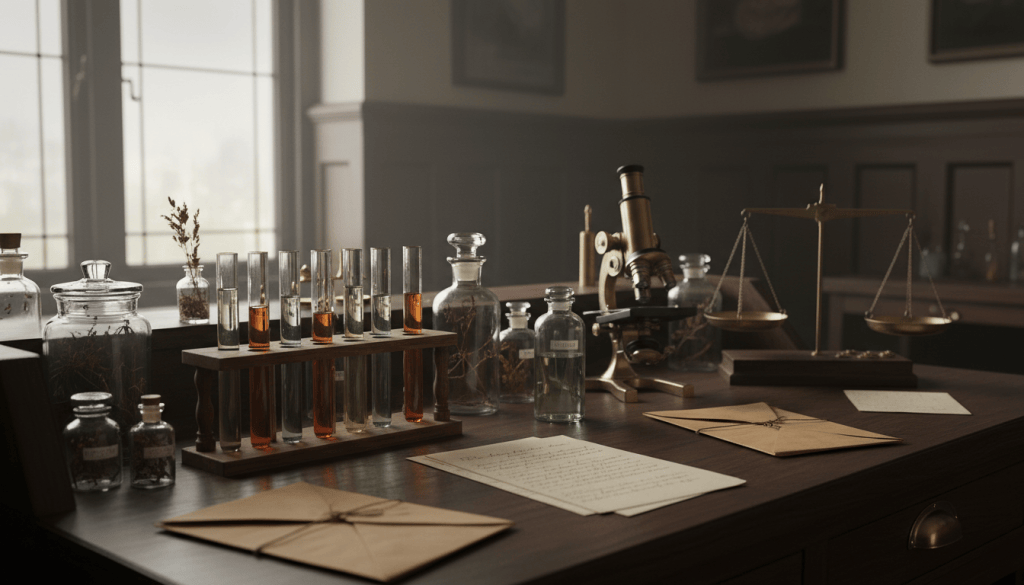
In 1922, a sudden death after a communal meal could provoke an immediate and frightening question: had someone been poisoned? The suspicion might spread long before a doctor, coroner or analyst could establish what had actually happened. The science of detecting poisons was already sophisticated in some respects, but an investigation in England did not resemble a modern television crime laboratory.
Investigators needed to distinguish illness from deliberate poisoning, identify any substance involved, establish when and where exposure might have occurred, and then decide whether the evidence connected that exposure to a particular person. Those were separate questions—and a convincing answer to one did not necessarily settle the others.
Why a suspicious death was not automatically a poisoning
Symptoms such as nausea, pain, weakness or collapse could have several possible explanations. Their timing might provide important clues, but neither a frightened witness nor a doctor could safely identify a poison merely because someone became ill after eating. Medical history, the course of the illness and the findings after death all mattered.
Suspected poisonings were particularly troubling because the harmful substance might leave few immediately visible signs. Historically, commentators worried about poisons that could be administered without an obvious struggle or wound. Historian Katherine D. Watson’s review of poisoning crimes and forensic toxicology traces how that anxiety helped establish chemical experts as important witnesses in court.
What did the coroner do?
A sudden, unexplained or suspicious death in England could involve a coroner’s inquiry. The coroner’s role was to investigate the circumstances of the death, while police inquiries could address possible criminal responsibility. A medical examination and an inquest were not identical to a murder trial, and the procedures surrounding each did not always follow the same timetable.
The National Archives guide to coroners’ inquests explains why surviving material often appears in county collections and local newspapers rather than in one national set of files. That is especially relevant to anyone researching an actual early-twentieth-century case: the place and date of death are often the best starting points.
For a 1922 case, it is also important not to project later arrangements backward. Legal provisions and the organisation of scientific services changed over subsequent decades.
What evidence might investigators examine?
A careful inquiry would not need to start with a spectacular laboratory discovery. It could begin with observations: who saw the deceased last, when symptoms began, what food or drink was consumed, whether others at the table had fallen ill, and whether there was access to medicines or other potentially hazardous materials. Witnesses could be sincere yet mistaken about times or quantities.
Suspected food, drink, containers and bodily material might offer opportunities for examination. But a sample could be spoiled, mixed with other substances or handled in a way that complicated later interpretation. Notes about where an item came from, who recovered it and what happened next therefore mattered. A missing or uncertain detail in that history might undermine a claim that otherwise sounded persuasive.
Investigators also had to resist the temptation to treat the most visible object as the source. A shared supper could dominate local conversation even if the crucial exposure occurred elsewhere.
Was laboratory testing available in 1922?
Yes. Chemical analysis in criminal poisoning cases was well established before the 1920s. Doctors and chemists had spent the nineteenth century devising methods to identify substances in food, medicines and human remains. Skilled analysts associated with medical schools, hospitals and laboratories had become significant figures in British criminal trials.
But the organisation of that expertise was different from today’s. Britain did not yet have the later network of Home Office forensic laboratories. Parliamentary evidence on the history of the Forensic Science Service notes that local analytical facilities grew into a more organised national framework during the 1930s. In 1922, a police inquiry could therefore depend on particular doctors and analysts rather than an immediately available modern forensic service.
Geography and workload also mattered. Sending samples away and receiving a professional report involved practical steps, not an instant result delivered while officers waited beside a table.
What could an arsenic test prove?
Arsenic was an important subject in the history of toxicology because it was used in a variety of legitimate products as well as criminal poisonings. The chemist James Marsh devised an influential test in 1836. Another method associated with Hugo Reinsch appeared in 1841. These were not discoveries made in the 1920s; they were part of an existing tradition of forensic chemistry.
The medical-history study of English poisoning trials describes the significance of both tests and the demands they made on analysts. The US National Library of Medicine’s history of the Marsh test also shows why producing convincing evidence for a court was not as simple as obtaining a suggestive chemical reaction.
The central distinction was between detecting a substance and proving the story of how it arrived. An analytical finding might support a conclusion about exposure, but it could not independently identify who handled the material, why it was present or whether the death was criminal.
Why contamination and interpretation were serious problems
Even apparently impressive laboratory results required caution. Samples might contain trace contamination, be affected by earlier handling or yield results that demanded skilled interpretation. In a trial, the reliability of the method and the analyst’s expertise could be questioned. The presence of a substance did not always explain the timing or circumstances of a death.
Historical toxicology is therefore a story of both progress and limitation. New tests gave investigators evidence that ordinary observation could not produce, but the tests did not replace the need for sound medical reasoning, careful collection and an honest account of uncertainty.
Witnesses, accounts and ordinary objects still mattered
A poisoning investigation could have a strong documentary side. Shop accounts, purchase orders, deliveries and appointment records might help establish who had access to particular materials. Timetables could test claims about someone’s movements. A locked door or altered fitting might raise a question about access, but the physical detail needed to be compared with testimony and other records.
This kind of evidence was particularly valuable in a close-knit community. People could know a great deal about one another while still misunderstanding a private arrangement, a disputed payment or an innocent visit. Rumour was a poor substitute for a verified sequence of events.
Poison investigations and the appeal of a historical village mystery
In Poison After Harvest, Book 3 of The Brackenfell Mysteries by Miriam Perevell, a merchant’s death after a harvest supper places fictional Brackenfell, Yorkshire, under suspicion. The book’s civilian investigator, blacksmith Nell Harwood, brings practical knowledge of mechanisms and records to questions being examined by Inspector Wardle. The scene is fictional, but the contrast between local speculation and slower medical evidence reflects a genuine historical difficulty.
For readers, the satisfying question is not only what substance was involved? It is what can each kind of evidence actually establish? That distinction is essential to understanding the history of poisoning investigations—and the logic of a fair-play mystery.
Where to explore the history further
For detailed research, consult Katherine D. Watson’s history of poisoning crimes and forensic toxicology, the National Archives guide to inquest records and the National Library of Medicine’s exhibit on early chemical tests. For another look at evidence outside the laboratory, see How Blacksmithing Becomes a Fair-Play Clue System in Historical Mystery Fiction.

