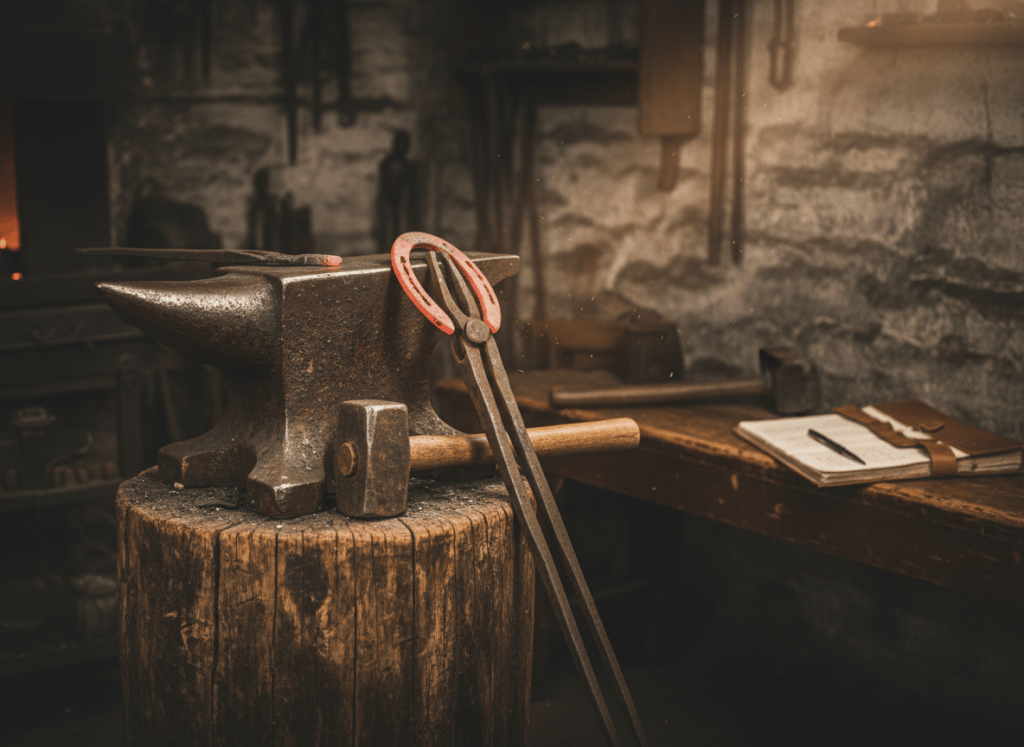
A good fair-play mystery depends on evidence the reader can understand after the fact. Blacksmithing offers an unusually rich way to build that evidence because metal records use. A worn horseshoe, a misplaced hammer mark, an unfamiliar weld, or a tool used in the wrong way can all become clues without turning the story into a laboratory procedural.
That is why a working forge can be more than atmospheric scenery in historical mystery fiction. It can become part of the logic of the investigation.
Why craft knowledge works so well in a fair-play mystery
Fair-play mysteries ask the writer to place meaningful evidence in front of the reader before the solution is revealed. The challenge is to make that evidence visible without making its significance obvious too early.
Specialist craft knowledge solves that problem elegantly. An ordinary observer may notice an object. A practitioner notices how it was made, how it has been used, whether the wear is natural, and whether a claimed history matches the physical material.
Blacksmithing is particularly useful because forged iron is shaped by heat, force, tools, and repeated wear. Those processes leave traces. The clues can therefore emerge from practical observation rather than sudden intuition.
Metal can preserve a history of use
A forged object is not simply “old iron.” Its shape may reflect the tools used to make it. Its surface may show repeated contact. Edges may be polished by handling, distorted by strain, or altered by later repair.
In mystery fiction, this gives the investigator several questions to ask. Does the object look as old as someone claims? Does its wear fit its supposed purpose? Was it made by the same hand or in the same workshop as another piece? Has it been modified after the fact?
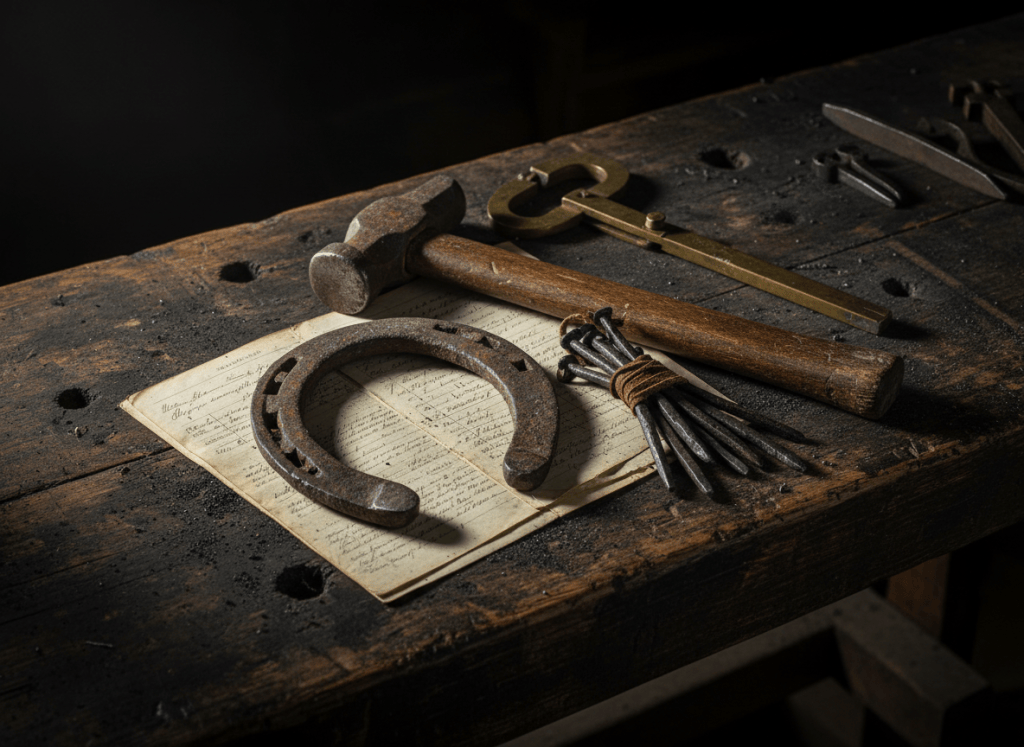
The important point is not that readers must already know blacksmithing. A well-built mystery teaches them what they need at the moment it matters. The specialist knowledge creates a second layer of meaning, but the clue still remains accessible.
Tool marks make workmanship part of the evidence
Tools do not merely create objects; they create patterns. Hammer blows, punches, chisels, tongs, files, and anvils all leave characteristic effects. In fiction, that allows a writer to connect an object to a method of manufacture, a workshop habit, or a later alteration.
This works best when the clue is specific but not magical. The investigator should not be able to identify any object instantly from a single scratch. Instead, the evidence becomes persuasive through several small observations that agree with one another.
That accumulation is what makes craft-based clues feel fair. The reader has seen the object, heard the relevant explanation, and watched the protagonist test possibilities. The eventual deduction feels earned.
Horseshoes connect the forge to the wider village
In an early twentieth-century rural setting, a forge sits at the intersection of many lives. Farmers, carters, tradespeople, veterinary practitioners, and anyone dependent on horses may have reasons to visit. That makes the workplace socially useful as well as technically useful.
A horseshoe can carry information about fit, wear, repair, timing, and the condition of an animal. A farrier’s work also creates natural reasons for characters to discuss journeys, lameness, schedules, deliveries, and who was where at a particular time.
That is valuable in a village mystery because it integrates practical evidence with community knowledge. The clue is not isolated from character relationships; it grows out of them.
Ledgers turn practical work into documentary evidence
A traditional workshop also produces paper trails: account books, receipts, orders, barter arrangements, outstanding debts, and informal notes. These records offer a useful contrast with physical evidence.
People can misremember. They can lie. A ledger can be incomplete or misleading. An iron object can also be altered. The strongest mystery arises when different kinds of evidence are compared rather than trusted automatically.
This is central to The Ledger Beneath the Anvil, Book 1 of The Brackenfell Mysteries by Miriam Peverell. Its protagonist, Eleanor “Nell” Harwood, runs her late father’s forge in fictional Brackenfell, Yorkshire, in 1921. Her knowledge of blacksmithing, metalwork, horses, accounts, and wartime aircraft riveting shapes the way she evaluates evidence surrounding a murder.
The book’s investigative appeal comes from the tension between what villagers remember and what work materials can actually support. A questioned iron tally, old business records, worn metal, and practical trade knowledge all belong to the same evidence system.
Why this kind of clue system feels satisfying
Craft-based clues work because they give the protagonist a reason to notice what others miss. The skill is not an arbitrary superpower. It is part of a life already being lived.
They also make the setting productive. A forge is not only picturesque. Its routines, tools, customers, records, and materials can all affect the mystery. This is one reason occupational mysteries often feel more immersive than stories in which a protagonist’s profession disappears once the crime begins.
For readers, the pleasure is twofold: following the puzzle and learning enough about a real craft to understand why a detail matters.
The best specialist clue is understandable in retrospect
A mystery should never require the reader to possess the protagonist’s full technical knowledge. The satisfying version gives readers the raw material, then lets expertise reorganize it.
When that happens, an anvil, a ledger, or a horseshoe becomes more than period decoration. It becomes testimony.
Readers interested in how setting itself can carry a mystery may also enjoy Why 1920s Luxor Is Such a Powerful Setting for Historical Mysteries, which looks at a very different historical environment where place, profession, and documentary evidence shape the investigation.
Related reading: Women, Skilled Trades, and Working Life in Britain After the First World War.

