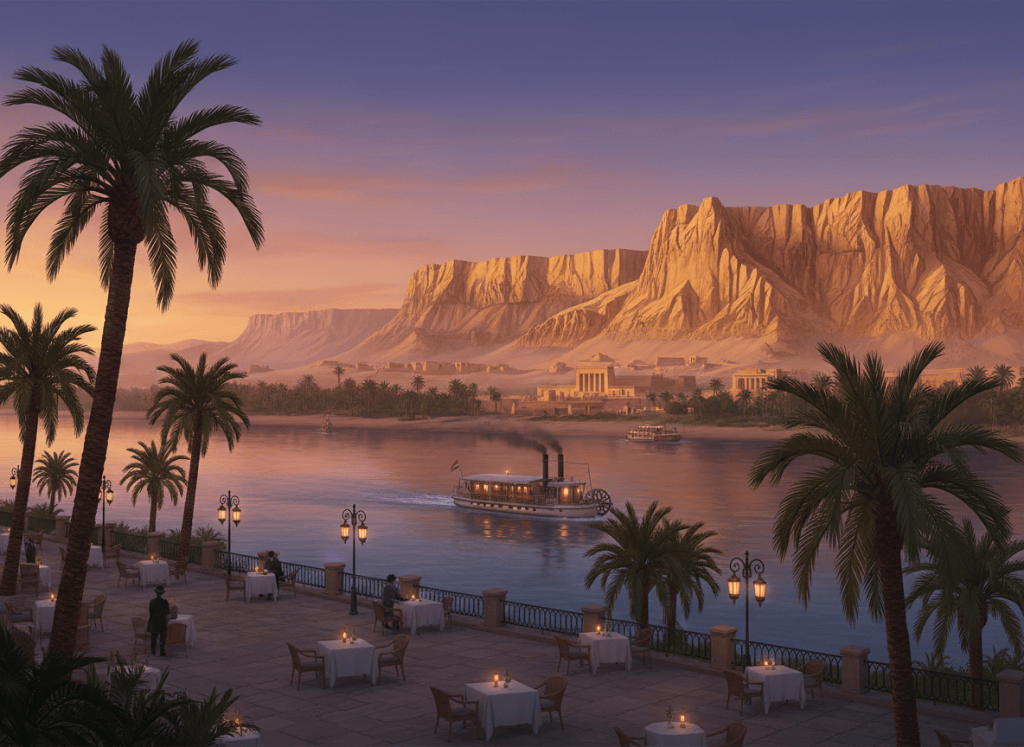
Luxor in the 1920s offers a historical mystery writer an unusual combination: an active modern Egyptian city, monumental remains of ancient Thebes, international archaeology, Nile travel, private collectors, official antiquities work, and a social world in which scholars, tourists, hotel guests, servants, officials, and wealthy patrons could cross paths.
For a mystery set in 1927, that mixture matters. The past is not simply scenery. It is being excavated, catalogued, photographed, debated, transported, and sometimes privately collected while the story unfolds. Records can be clues. Professional rivalries can have practical consequences. A villa collection or hotel conversation can lead back to an excavation register, an accession mark, or a disputed account of where an object came from.
Luxor sits between a living city and ancient Thebes
Modern Luxor occupies part of the landscape of ancient Thebes. The Nile divides the area into the East Bank, with major temple sites including Luxor and Karnak, and the West Bank, where the Theban necropolis and the Valley of the Kings lie against the desert cliffs. That geography creates a naturally dramatic mystery setting: river crossings, gardens, cultivated land, hotels, temples, excavation areas, and desert tombs can exist within the same narrative world without feeling artificially assembled.
The contrast is also atmospheric. A character can move from a shaded hotel terrace or palm garden to a dusty work site, from a crowded social room to the visual openness of the river, or from the green Nile valley toward the stark western desert. Historical mystery benefits from settings that change the emotional pressure of a scene, and Luxor provides those transitions organically.
In 1927, archaeology was not finished history
The discovery of Tutankhamun’s tomb in the Valley of the Kings in November 1922 had transformed international attention toward Egyptian archaeology. The British Museum’s account of the discovery notes both Howard Carter and the Egyptian team involved in the work, while the surviving excavation records show how methodical the documentation became.
Crucially for fiction set later in the decade, work connected with the tomb continued for years. The Tutankhamun Spatial Archive at Oxford’s Griffith Institute records a 1927–1928 season beginning in October 1927, including work on the Treasury and Annexe and the production of object cards, correspondence, scientific notes, maps, plans, conservation notes, images, journals, and diaries.
That detail explains why the period works so well for a clue-driven mystery. Archaeology generates paperwork. Finds have numbers. Objects are photographed. Materials are examined. Decisions are recorded in letters and notebooks. The administrative life surrounding a dig can become as narratively important as the excavation itself.
The archaeological world creates a ready-made cast of suspects and witnesses
An archaeological setting naturally brings together people with different forms of access. Excavators know the trenches. Cataloguers know the records. Conservators know an object’s physical condition. Photographers may preserve details others overlook. Antiquities officials understand permits and collections. Local workers possess site knowledge. Patrons and collectors may control money or property. Journalists and travelers can circulate information beyond professional circles.
For a mystery novelist, this creates useful asymmetry: no single person necessarily knows everything. One witness may understand where an object was found but not where it later went. Another may know the collector’s story but never have seen the excavation record. A third may recognize that a catalogue number has been altered without knowing why.
That is more interesting than simply hiding a clue in a tomb. It allows the mystery to emerge from competing records, expertise, status, and memory.
Hotels, villas, gardens, and the Nile add a second social world
Archaeological work is only one part of the setting. Luxor also supports the enclosed social spaces that historical cozy mysteries use especially well: hotels, private houses, garden gatherings, river journeys, dining rooms, terraces, and invitation-only collections. These spaces put people who might otherwise remain professionally separated into close proximity.
A hotel can function almost like a village in miniature. Guests notice who arrives late, who receives a letter, who changes tables, and who suddenly leaves. A private villa can hold family tensions alongside collections and household records. A river crossing can delay an interview or isolate a character from the person they need to reach. None of these requires graphic violence or constant pursuit to create suspense.
The result is a setting that can remain elegant and socially observant while still supporting serious questions about evidence, ownership, and historical truth.
Why provenance becomes especially powerful in this period
When ancient objects move through excavations, private collections, institutions, or inheritances, their documentation becomes part of their history. That makes provenance a natural source of mystery. A label may be genuine while the story attached to it is incomplete. A collector may repeat an acquisition history that cannot be verified. A photograph can reveal that an object was somewhere earlier than a catalogue claims.
If you want the real-world background to that kind of clue, our companion article explains what archaeological provenance is and how a missing record can change an artifact’s story.
How Death Beneath the Date Palms uses 1927 Luxor
In Theo Penrose’s Archaeological Digs Mysteries, the historical setting is tied directly to the way the investigation works. Book 2, Death Beneath the Date Palms, follows widowed archaeological cataloguer Cressida “Cress” Vale in 1927 Luxor. A note left by her late husband draws her toward a private antiquities collection, where suspicious catalogue histories begin to overlap with the concerns of a young heiress.
The fictional mystery moves through a Nile-side villa, the fictional Lotus Crown Hotel, private collections, household routines, and the wider antiquities world. Its clues include labels, ledgers, letters, accession marks, photographs, typewriter traces, and conflicting testimony. The location therefore does more than provide date palms and desert views; it determines what kinds of evidence Cress can find and why her professional skills matter.
The romance remains restrained as Cress works alongside Inspector Julian Harcourt, keeping the investigative and historical elements in the foreground. Readers who prefer non-graphic crime, capable female sleuths, professional clues, dry wit, and atmospheric travel settings can also explore our earlier guide to historical mysteries with travel, wit, and ancient secrets.
What makes Luxor different from a generic “Egyptian” backdrop?
Specificity is the answer. Luxor is not interchangeable with Cairo, Alexandria, or a fictional desert outpost. Its East Bank and West Bank geography, concentration of ancient monuments, proximity to the Theban necropolis, long archaeological history, and dependence on river movement all shape how characters meet and how information travels.
Even a real archaeological residence can illustrate that working world. Egypt’s Ministry of Tourism and Antiquities notes that Howard Carter’s house near the Theban necropolis, built in 1910, included work spaces and a photographic darkroom and remained his Luxor base for decades. It is a reminder that archaeology in this period involved not only dramatic discoveries but also ordinary rooms filled with notes, equipment, photographs, samples, and unfinished work.
A setting where the past can become evidence
Historical mysteries are strongest when the location changes the investigation rather than merely decorating it. In 1920s Luxor, ancient objects, modern paperwork, private wealth, official oversight, local knowledge, international attention, and the geography of the Nile can all influence who knows what and when.
That gives the setting a distinctive form of tension: the past is physically present, but its meaning depends on records made by living people. For more about the author and the wider fictional world, visit the Theo Penrose page and the Archaeological Digs Mysteries series page.
 Wonder Shelf Books