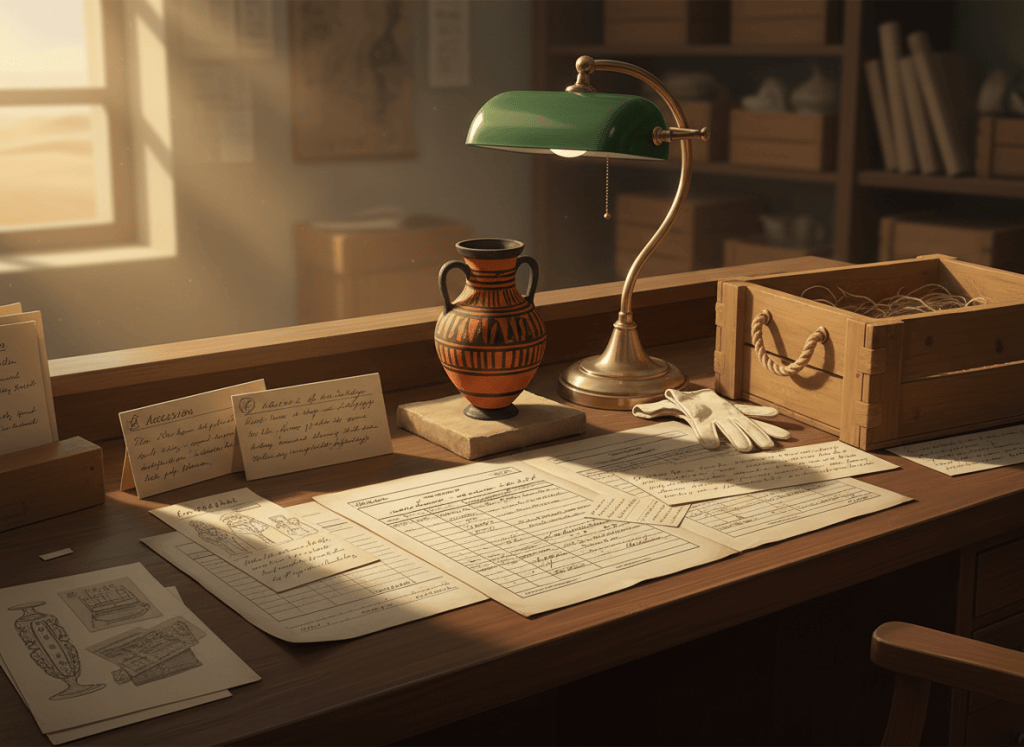
Archaeological provenance is the documented history that connects an object to the people, places, collections, and records through which it has passed. A beautiful artifact can be impressive on its own, but without reliable documentation, some of the most important questions about it become harder to answer: Where did it come from? Who owned it? When did it enter a collection? Was it excavated legally and recorded at the time? Has its identification changed?
That paper trail is one reason archaeology can feel surprisingly close to detective work. The object matters, but so do the labels tied to it, the notebook in which it was first described, the photograph showing where it once stood, the accession number written on a crate, and the letter explaining how it changed hands.
What does “provenance” actually mean?
In museum and collecting contexts, the Smithsonian describes provenance as the history of ownership of an object from its creation to the present. For archaeological material, another closely related term matters: provenience. The Archaeological Institute of America distinguishes provenance—the origin or history of ownership—from provenience, the three-dimensional context in which an archaeological object was found.
The distinction is useful even though usage varies between countries and disciplines. Provenience asks where an object was found. Provenance follows what happened to it afterward. Archaeological context goes wider still: it includes the object’s relationship to the surrounding soil, structures, features, and other finds. The U.S. National Park Service emphasizes that context is what gives an archaeological resource much of its meaning.
An artifact is only one part of the evidence
Imagine a small ceramic vessel in a private collection. Its shape and decoration may suggest a particular date or region, but the documentation can add layers the object itself cannot supply. An excavation register may record the trench where it was found. A field photograph may show its position beside other material. A shipping list may document its transfer. A museum ledger may record its accession. A collector’s letter may explain when and from whom it was acquired.
Useful provenance evidence can include accession cards, excavation notebooks, dealer or auction records, customs documents, collection inventories, photographs, correspondence, published catalogues, labels, inscriptions, crate numbers, conservation notes, and even old pencil annotations. None of these is automatically decisive on its own. Their value comes from how well they agree with one another.
What changes when a record goes missing?
A missing record does not automatically mean an object has a sinister history. Paper disappears for ordinary reasons: collections move, heirs reorganize estates, institutions change cataloguing systems, labels become detached, correspondence is discarded, or old inventories use descriptions that no longer match modern terminology.
But a gap can still change what researchers are able to say with confidence. If the original findspot is unknown, an artifact may lose archaeological context. If ownership history is incomplete, the route by which it entered a collection may be uncertain. If two labels give different acquisition dates, researchers have to determine whether one is an error, a later correction, or evidence that the object has been confused with another item.
This is why provenance research rarely consists of finding one perfect document. It is more often a process of comparison. Handwriting, dates, catalogue numbering systems, photographs, institutional records, and related objects can all help reconstruct a sequence. Sometimes the result is a clearer history. Sometimes the most accurate conclusion is that part of the history remains unknown.
Why older private collections can be especially complicated
Private collections assembled in the nineteenth and early twentieth centuries can present particular challenges. Objects might have passed through households, dealers, excavators, travelers, institutions, and heirs before modern documentation standards were established. Descriptions could be brief. Names could be inconsistent. A single collection might combine excavated material, gifts, purchases, and inherited objects.
The legal and administrative framework also changed over time. In Egypt, excavation permits and antiquities regulation evolved during the early twentieth century. By the 1920s, the Egyptian Antiquities Service played a central role in excavation permissions and the disposition of finds. That makes dates, permits, excavation records, and acquisition histories especially important when reconstructing how an object moved from the ground into a collection.
Why provenance works so well as a mystery mechanism
For a mystery writer, provenance creates a natural form of investigation because it turns records into clues without requiring the story to become action-heavy. A changed accession number can matter. A label written in the wrong hand can matter. A photograph can contradict a catalogue entry. An object supposedly acquired in one year can appear in an earlier inventory.
That is the kind of evidence at the heart of Theo Penrose’s Archaeological Digs Mysteries. In Book 2, Death Beneath the Date Palms, widowed archaeological cataloguer Cressida “Cress” Vale encounters suspicious catalogue histories connected to antiquities in a proposed marriage settlement. The fictional investigation uses altered labels, accession marks, ledgers, photographs, typewriter evidence, and other documentary traces rather than treating archaeology as mere exotic scenery.
The professional setting also changes the role of the sleuth. Cress does not need to be the strongest person in the room. Her advantage is knowing how records should behave, what a catalogue entry ought to contain, and when two apparently minor details fail to line up. Readers who enjoy that style of clue can also explore historical mysteries built around travel, wit, and ancient secrets elsewhere on Wonder Shelf Books.
Five questions that reveal an artifact’s paper trail
- Where was it found? A precise archaeological context can be more informative than a broad place name.
- Who recorded it first? Field notebooks, excavation registers, photographs, and find cards can establish an early documentary anchor.
- How did it move? Transfers between excavators, dealers, collectors, institutions, or heirs should ideally leave evidence.
- Do the records agree? Dates, labels, descriptions, numbers, photographs, and handwriting can confirm—or contradict—one another.
- What remains uncertain? Good provenance research identifies gaps instead of disguising them.
The mystery is often in the record, not the object
Provenance changes the way we look at artifacts because it shifts attention from appearance to history. The most important clue may not be carved into stone or painted onto pottery. It may be a crossed-out catalogue line, a misplaced photograph, or a name that disappears between one inventory and the next.
That documentary tension is especially effective in historical fiction because records can preserve truth, distort it, or leave it incomplete. For a companion look at the period surrounding Cress Vale’s investigations, see why 1920s Luxor makes such a powerful setting for historical mysteries. More about the fictional world and its author is available on the Theo Penrose page.
 Wonder Shelf Books