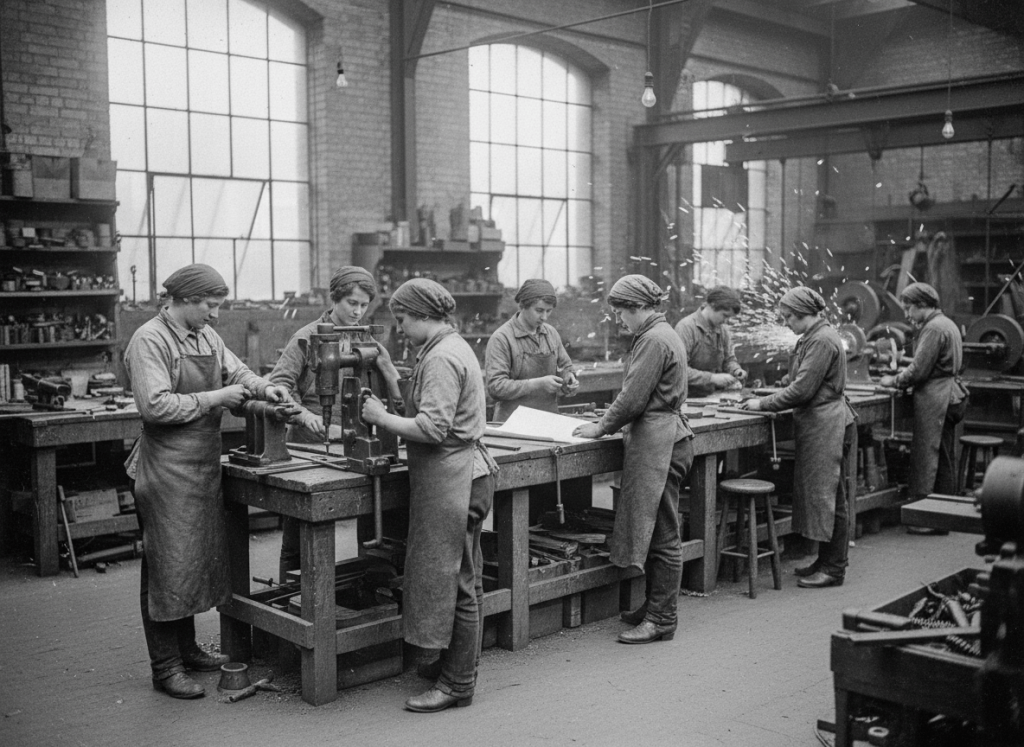
Women’s wartime work changed what many people in Britain had seen women do in public, industrial, and technical life. But the end of the First World War did not produce a simple story of permanent occupational freedom. By 1921, women who had entered engineering, munitions, transport, agriculture, and other forms of work during the conflict were living in a complicated postwar moment: their skills had been demonstrated, while many of the opportunities created by wartime necessity were being withdrawn.
That tension makes the early 1920s especially interesting for historical fiction. A woman could be highly competent at skilled work and still find her right to continue doing it questioned.
Women moved into new kinds of work during the First World War
The First World War altered the British labour market because millions of men were serving in the armed forces and wartime production expanded dramatically. Women entered areas of employment that had previously been more difficult for them to access.
The National Archives notes that women undertook physically demanding work ranging from engineering to agriculture, and that women worked in factories and military services where engineering skills were important to wartime production.
These jobs were not all identical and should not be collapsed into a single image of “munitionettes.” Women worked in many settings, with different levels of training, responsibility, pay, danger, and permanence.
Technical competence did not guarantee postwar job security
One of the most important facts about the postwar transition is that wartime employment was often treated as temporary substitution rather than a permanent reordering of skilled trades.
The Restoration of Pre-War Practices Act 1919 required certain establishments to restore prewar trade practices where wartime conditions had led to changes. In a 1920 parliamentary answer, the government explained that where men had been replaced by women during the war and that substitution departed from established trade practice, the relevant prewar practice was to be restored.
The National Archives’ overview of the 1920s describes the practical consequence plainly: many working women lost jobs in the early postwar years, while some returned to occupations such as domestic service.
The numbers show the scale of wartime change
UK Parliament’s history of wartime labour records that the proportion of women in total employment rose from 24 percent in July 1914 to 37 percent by November 1918. That increase does not mean all women entered skilled industrial work, but it does show how significantly women’s participation in paid employment changed during the war.
After the Armistice, employment levels fell back. The postwar question was therefore not simply whether women could perform work previously associated with men. Wartime experience had already provided abundant evidence that many could. The conflict was over whether those opportunities would remain available in peacetime.
Skill, status, and social acceptance were different things
A woman could possess genuine technical ability and still face barriers created by custom, workplace rules, unions, employers, family expectations, or the political priority given to returning servicemen. That distinction matters in historical fiction.
Competence does not automatically erase prejudice. Nor does discrimination mean that every woman working in a nontraditional occupation must constantly deliver speeches about it. The more convincing historical tension often appears in ordinary interactions: who is trusted with a task, who is assumed to be temporary, who is paid, who signs an account, who is expected to step aside, and whose authority must be proved repeatedly.
Why 1921 is a powerful year for a working-woman protagonist
By 1921, Britain was no longer in wartime emergency, but the consequences of the war remained everywhere. Demobilisation, economic strain, grief, altered family structures, changing political rights, and contested employment practices all shaped daily life.
Women over 30 who met qualifying conditions had gained the parliamentary vote under the Representation of the People Act 1918, while equal voting rights with men would not arrive until 1928. That places a woman working in a traditionally male trade inside a society that was changing, but unevenly.
For fiction, this creates tension without requiring anachronism. A woman may have wartime training, confidence, and professional habits that are entirely plausible, while still encountering a peacetime culture trying to reassert older boundaries.
Nell Harwood as a fictional example
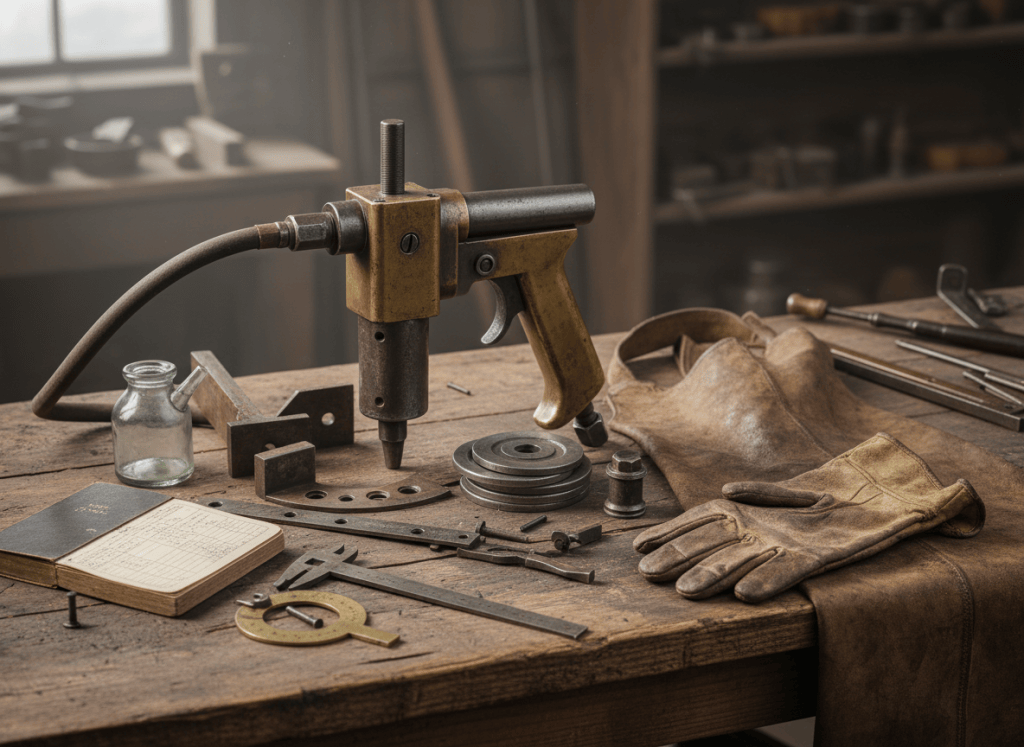
That historical tension informs Eleanor “Nell” Harwood, the fictional protagonist of The Ledger Beneath the Anvil by Miriam Peverell. The novel is set in fictional Brackenfell, Yorkshire, in March 1921. Nell runs her late father’s forge and brings to the work both inherited blacksmithing knowledge and two years of wartime aeroplane riveting experience.
Her background matters because it makes her practical authority believable. She is not given expertise only when the mystery needs it. Her work shapes how she reads iron, tools, horses, ledgers, and physical evidence.
The novel is the first book in The Brackenfell Mysteries, a series built around a rural Yorkshire community in the years after the First World War.
Why work history matters in historical mysteries
Occupation affects far more than a character’s income. It determines daily routines, physical knowledge, social contacts, access to places, and the kinds of details a person notices.
For a historical mystery, that makes working life especially valuable. A believable trade can produce clues, suspects, schedules, conflicts, and relationships at the same time. It can also reveal how large social changes were experienced at ground level.
The early 1920s are compelling precisely because the story is not one of straightforward progress. Women had performed difficult and technical work on an unprecedented wartime scale, yet many were pushed out of those roles afterward. Fiction set in this period can explore the gap between demonstrated ability and permitted opportunity without turning history into a simple victory narrative.
For further historical context, see the National Archives guide to women and the First World War and UK Parliament’s historical overview of wartime labour.
Related reading: How Blacksmithing Becomes a Fair-Play Clue System in Historical Mystery Fiction.

