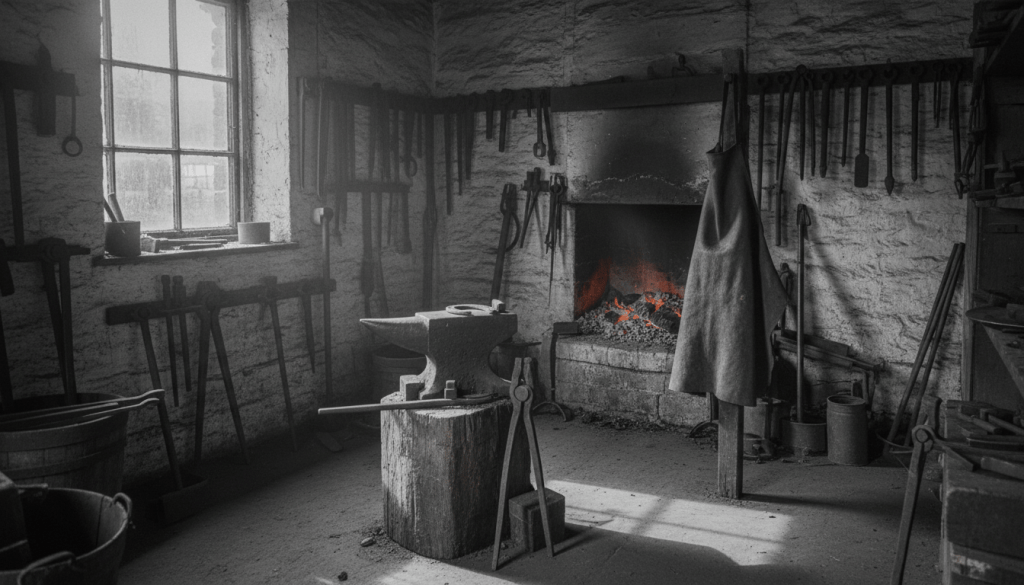
A village blacksmith’s shop in 1920s Britain was more than a place where someone struck hot iron. It was a repair workshop, a meeting point for customers, and a small business connected to the daily rhythms of farms, transport and households. But what happened when the person in charge was a woman? Could she learn the trade, run the forge and persuade neighbours to trust her work?
The short answer is that skilled women certainly existed in Britain’s industrial world, yet a woman blacksmith was not the ordinary or universally accepted figure in a rural community. Understanding her position means looking at the work itself, how skills were passed on and why the end of the First World War did not remove older expectations.
What did a rural blacksmith actually make and repair?
Blacksmithing meant shaping and joining iron or steel, often with heat, hammering and other hand tools. In a village workshop, customers might need a damaged gate fitting straightened, a hinge repaired, a chain adjusted, a latch made, or an agricultural tool returned to service. Some shops undertook wheel or cart repairs; some also worked with horses. The exact combination depended on the smith’s skills and local demand.
As Heritage Crafts explains, blacksmithing encompasses practical and decorative metalwork, including tools and agricultural implements. It is important to distinguish a general blacksmith from a farrier, whose specialist work concerns horses’ feet and shoeing. The trades could overlap in a village setting, but they are not interchangeable terms.
How might a woman learn forge skills?
A blacksmith’s competence came from practice, not simply from strength. A beginner had to learn how iron behaved at different temperatures, which hammer blows would move the metal, how to grip awkward pieces with tongs and when a repair would fail. A badly judged bend or a poor fitting could cost a customer time and money.
Formal apprenticeship was one route into such skills. Another plausible route was growing up around a family workshop, observing jobs, helping with routine tasks and gradually taking responsibility. Family training would not automatically confer the public standing that an established male tradesman might enjoy. Moreover, what is plausible for one household should not be mistaken for proof that women commonly owned and operated forges.
The working day was practical, varied and commercial
A smith could spend part of the day at the hearth and the rest measuring, fitting, delivering or discussing a job. Coal, iron stock, tool upkeep and premises costs mattered. So did the weather: wet conditions might interrupt outdoor work but also make urgent repairs to gates, harness fittings or equipment more pressing. Work had to be finished to a usable standard, not merely made to look convincing.
In a small enterprise, bookkeeping was another skill. A repair might be paid for promptly, carried on account or folded into a longer relationship with a farm. The smith needed to keep track of orders, materials, creditors and customers who returned month after month. A person skilled with a hammer but unable to price work or collect debts might still struggle to keep the doors open.
How the First World War changed the argument about women’s skills
During the First World War, women took on forms of industrial and engineering work that had often been reserved for men. The National Archives’ records show women doing physically demanding tasks, including work associated with aircraft engines, munitions and other engineering activities. Their experience challenged the assumption that technical employment was automatically beyond women’s abilities.
The aftermath was more complicated. Jobs opened by wartime necessity did not necessarily remain available once soldiers returned. The National Archives’ account of the 1920s explains how postwar employment policy, including the Restoration of Pre-War Practices Act 1919, contributed to women being displaced from positions they had held during the conflict.
A documented example of the wider change is engineer Verena Holmes. According to the Science Museum, she continued building her technical qualifications after wartime employment and graduated in engineering in 1922. Holmes was an engineer rather than a village blacksmith, but her career shows that women’s technical ambitions continued beyond the Armistice, even when institutions and employers remained difficult to navigate.
What social barriers could a woman blacksmith face?
The challenge was not one single rule that applied to every forge. It was a network of expectations and practical obstacles. A family might doubt that daughters should inherit workshop responsibilities. Customers might ask for a male worker before accepting the same repair from a woman. Training contacts could be harder to secure, and access to capital, premises, tools or reliable suppliers could determine whether a workshop survived.
There was also the issue of authority. A woman who knew precisely how to correct a piece of metal might still have to explain her judgment more often than a man. Some neighbours could welcome her skill while others treated her business as an exception. It would be inaccurate, however, to assume that every customer disapproved or that every woman encountered identical conditions.
The important historical distinction is between being capable of the work and being readily accepted as the person entitled to do it. In the early 1920s those two things could be very different.
Why village customers and reputation mattered
A rural workshop’s reputation was built through ordinary transactions. If a hinge failed a week after repair, the news could travel quickly. If a smith completed a difficult job honestly, that too could become known. Customers from farming, transport and household trades supplied both business and informal testimony about the craftsperson’s reliability.
That environment could make a woman proprietor unusually visible. The forge was a public-facing workplace, not an isolated hobby. Price disputes, credit, repairs and delivery dates put its owner in direct contact with people whose views shaped her standing in the village. A good repair had practical value; public trust determined whether new jobs followed.
An example from historical fiction: Nell Harwood
Eleanor “Nell” Harwood, the fictional blacksmith in Poison After Harvest by Miriam Perevell, runs her late father’s forge in fictional Brackenfell, Yorkshire, in October 1922. Her daily work gives her a particular eye for mechanisms, repairs and the paper trail surrounding an order. Those skills become relevant when a local merchant dies and rumours begin to outrun evidence.
The novel is Book 3 of The Brackenfell Mysteries. It uses a fictional character to explore a historically credible tension: competence can be demonstrable at a workbench long before it wins universal respect outside it.
Reading the history without romanticising it
The story of women in skilled trades is neither a neat tale of prohibition nor a straight line of progress. War opened opportunities; peacetime removed some of them. Individual women built working lives, but broader acceptance could lag behind. For a useful companion perspective, read Women, Skilled Trades, and Working Life in Britain After the First World War, or explore how blacksmithing produces physical clues in historical mysteries.
For primary historical context, begin with The National Archives’ First World War records, then compare them with the Heritage Crafts overview of the blacksmith’s trade. The distinction between general industrial employment and the daily reality of an independent rural forge helps keep the history precise.

