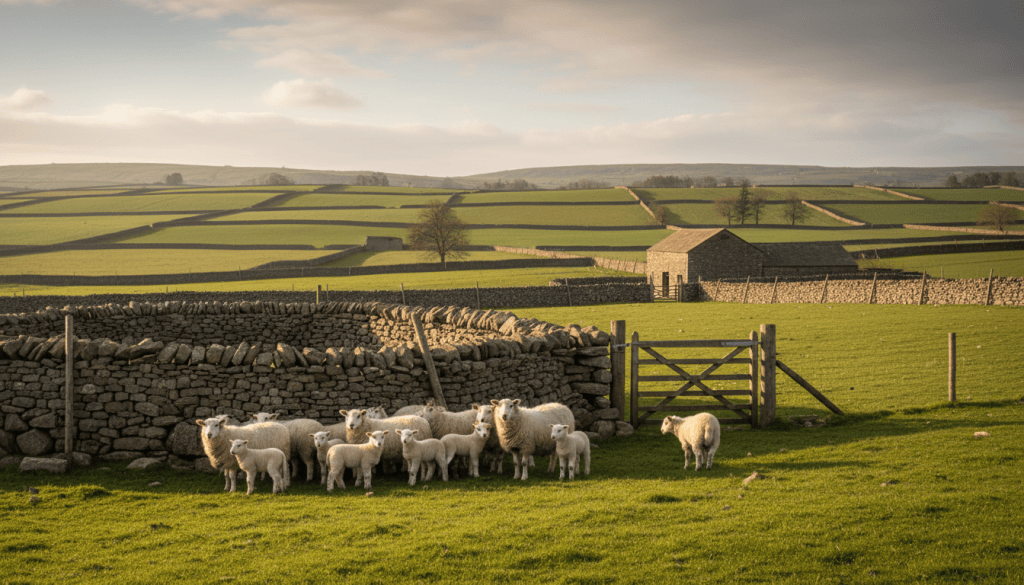
Lambing season could turn a quiet Yorkshire hillside into one of the busiest places on a farm. Ewes needed watching, newborn lambs needed shelter, and a gate left unsecured could cause serious trouble. On a Yorkshire farm in the 1920s, much of this work depended on shepherds’ judgment, local knowledge, and long hours rather than modern monitoring equipment.
There was no single method used on every holding. A sheltered valley smallholding, a large estate, and a flock kept on exposed upland grazing could operate very differently. Yet all had to deal with weather, feed, the movements of sheep, and the short period when new lambs were most vulnerable.
Why the Yorkshire landscape mattered
The Dales were a working landscape long before they became a familiar image of English countryside. Farmers divided pastures with dry-stone walls, stored winter fodder in field barns, and managed a mixture of sheltered meadow and higher grazing. The Yorkshire Dales National Park Authority explains how farming helped create the region’s walls, hay meadows, and outlying barns.
The location of a flock shaped a farmer’s choices. A field protected from the wind might be useful during lambing. Higher ground offered grazing, but could be harsh in bad weather. Access to water, food, and a passable track mattered just as much as the view.
It is tempting to picture all sheep permanently scattered across open hills. In practice, farmers organized movements according to season, land, and the needs of their animals. Different breeds and holdings required different arrangements.
When did lambing happen?
Spring was an important lambing period for many upland flocks, although the timing varied with management and local conditions. Lambing was not one event on one day. Births could occur across a series of days or weeks, while routine farm work continued.
A shepherd watched for ewes approaching birth, checked that newborn lambs were getting up and feeding, and assessed whether either animal needed help. Many births progressed naturally, but problems required experience and prompt decisions. Cold rain or strong wind could make an already difficult situation worse.
Even a good pasture could be unsuitable after a sudden change in weather. The need for nearby pens, sheltered places, reliable gates, and practical routes therefore became particularly urgent at this time of year.
What exactly was a lambing fold?
A fold was an enclosure for holding or managing sheep. Some folds were made from dry-stone walls; others made use of timber gates, simple pens, or existing field boundaries. A shepherd might use one to gather animals, examine a ewe, or manage a small group more safely.
There is direct historical evidence of specialized lambing buildings in Yorkshire. Historic England records lambing pens and an attached shepherd’s hut at Settrington, probably built around 1840. That survival helps show what was possible before the 1920s, but it would be misleading to suggest every farm owned structures of that kind.
A fold was not simply picturesque scenery. A poorly secured entrance could allow animals to escape or interrupt work at exactly the wrong moment. A sound wall, workable latch, and sensible layout reduced strain for both livestock and those handling them.
The shepherd’s day during lambing
A shepherd had to observe animals carefully, often returning to the same places repeatedly. Counting sheep, noticing a ewe separated from the flock, checking an unwell lamb, and deciding whether intervention was necessary were all parts of the job.
Lambing did not remove other responsibilities. Fences needed inspection, feed and water had to be managed, equipment still wore out, and a farmer might also keep cattle or work hay meadows. On some holdings family members or hired workers helped; on others a small number of people carried a heavy workload.
Veterinary help existed, but distance and cost could affect how quickly it was available in an isolated place. Knowing when to seek assistance mattered. The point is not that shepherds worked without expertise, but that their own practiced observation formed the first line of care.
Why field gates and ironwork mattered
Dry-stone walls restricted livestock movement and divided land; the North York Moors National Park explains the long history of these boundaries in northern England. A gate completed the boundary while allowing people, carts, and animals to move through it.
Iron hinges, catches, chains, and fasteners were small objects with large consequences. Wear could make a latch unreliable. A badly aligned gate might swing open. A rushed repair might hold during ordinary use but fail when livestock crowded against it.
Village blacksmiths and other tradespeople helped keep farms operational by repairing fittings, tools, and agricultural hardware. Their work rarely appears in picturesque accounts of country life, yet it connected the farm to the wider village economy. Someone familiar with the original ironwork could also recognize whether damage was old, recent, accidental, or mechanically unusual.
How had the First World War affected farm life?
By 1921, rural Britain was still adjusting to the aftermath of the First World War. Wartime demands had affected labour, production, and family life. Women had taken on agricultural roles during the conflict, including through the Women’s Land Army, while many men had served away from home.
The return to peacetime was not a simple reset. Farms also faced older challenges involving distance, seasonal work, uncertain income, and the maintenance of land and equipment. The degree of change varied widely among households and districts.
On a holding with limited spare money, losing livestock, replacing a broken gate, or employing additional help could be serious concerns. That practical context helps modern readers understand why apparently minor disagreements over work or property could cause lasting tension.
How does historical fiction use these details?
A credible rural setting involves choices and consequences, not just hills and stone cottages. When did a shepherd last check a pen? Could a person reach the next farm by the route they described? Was an iron fitting repaired that morning, or had it been damaged for months? Those questions depend on working knowledge.
In Death in the Lambing Fold, Book 2 of The Brackenfell Mysteries, Miriam Perevell imagines a death beside a lambing fold in the fictional village of Brackenfell, Yorkshire, in May 1921. The accusation against a young shepherd draws attention to what villagers think they know about familiar routines. Blacksmith Nell Harwood’s understanding of practical materials offers a different way to look at the evidence.
For more about the craft behind such clues, see How Blacksmithing Becomes a Fair-Play Clue System in Historical Mystery Fiction. The author’s other work is collected on the Miriam Perevell page.
A landscape shaped by work
Lambing season was a period when animals, weather, labour, and infrastructure depended closely on one another. A fold could provide control, a wall could define safe grazing, and a working latch could prevent a small problem from becoming a major one.
Looking beyond the scenery reveals the everyday expertise behind the Yorkshire countryside. Those details are useful not only for understanding agricultural history, but also for appreciating why a modest rural object can carry so much meaning in a carefully constructed historical mystery.

