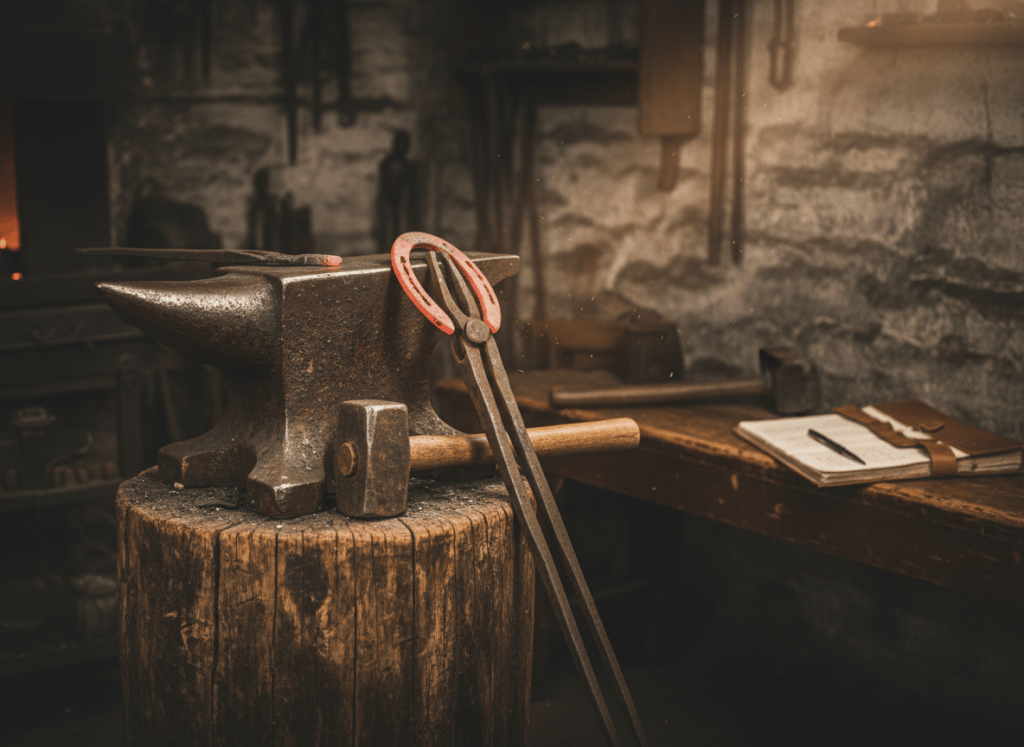
Book: The Ledger Beneath the Anvil
Author: Miriam Perevell
Series: The Brackenfell Mysteries, Book 1
Inside: Two original short mysteries and a guide to fictional Brackenfell
BONUS STORY 1 — The Gate That Opened Itself
By half past eight, Nell Harwood had repaired a broken trace hook, reset one loose shoe, refused an argument about the price of nails, and decided that the morning had achieved a respectable level of irritation.
Then Thomas Bellamy came through the forge doors without a horse.
Nell looked at his empty hands. “That is becoming a habit.”
“Good morning to you too.”
“No case. No halter. No animal bleeding on my floor. I assume you have come to admire the chimney.”
Thomas took off his hat. “I have come because a stable gate has opened itself twice.”
Nell set down the rasp.
Outside, Bracken Beck ran brown and quick beneath the stone bridge after two nights of rain. A milk cart clattered uphill. Somewhere beyond the green Ned Lister’s motor lorry coughed once, failed to catch, and coughed again with the wounded dignity of a machine that considered starting optional.
“Gates,” Nell said, “do not open themselves.”
“That was my first conclusion.”
“Your second?”
“That someone is opening it.”
“That is not an improvement.”
He leaned one shoulder against the bench, carefully avoiding the tray of hot nails. He had learned that much.
“The pony belongs to Mr Avery at Low Bank,” he said. “Dun, twelve hands, more appetite than judgment. He strained a foreleg yesterday. Avery asked me to keep him overnight because the lane down to his place is deep enough to swallow a cartwheel.”
“And the pony escaped.”
“At midnight, he was standing in my yard eating the broom.”
“Perhaps the broom offended him.”
“At six this morning, he was halfway to the bridge.”
Nell considered that.
“Same gate?”
“Same gate.”
“Latched?”
“Both times.”
“You saw it latched?”
Thomas paused.
Nell folded her arms.
“I heard it latch.”
“Ah.”
“That sound means something different to a blacksmith?”
“It means you heard iron strike iron.”
“And not necessarily stay there.”
“You may yet earn your breakfast.”
Thomas smiled. “Would you look at it?”
Nell glanced toward the line of work pinned beneath the office window. Two hinges. One cracked shovel socket. Samuel Bell’s gate hooks, which had already moved through three negotiated delivery dates without becoming less urgent in Samuel’s mind.
“After ten.”
“I can live with that.”
“The pony may not.”
“The pony has eaten half my broom. He is in excellent spirits.”
Thomas put on his hat and crossed the bridge.
Nell reached for the shovel socket.
Ada Pritchard appeared in the doorway before Thomas reached the green.
“What gate?” Ada asked.
Nell closed her eyes.
“Good morning, Ada.”
“Mr Bellamy said something about a gate.”
“You were listening from the post office?”
“I was crossing the bridge.”
“Slowly.”
“The stones are damp.”
“Ada.”
“A pony got out twice.”
“You appear fully informed.”
Ada brightened. “So it is true.”
“Go and deliver something.”
“I have.”
“Then invent a second round.”
Ada left with the expression of a woman temporarily separated from useful information but confident of reunion.
By the time Nell walked south of the green at ten past ten, Brackenfell had improved the story. According to Harker, who intercepted her outside the Black Bull, the veterinary surgeon’s stable had been broken into. According to a farm lad near the dairy, someone had released three horses. According to Ned Lister, who had finally persuaded his lorry to start, the pony had nearly boarded the carrier to Leyburn.
“There is one pony,” Nell said.
Ned leaned out of the cab. “One confirmed pony.”
“Go away.”
“I am transporting civilisation.”
“It is leaking oil.”
Ned looked down.
Nell kept walking.
Thomas’s premises stood behind a low stone wall, with a narrow yard, two loose boxes, a small treatment room and a roof that had clearly been repaired by three different men who had not spoken to one another. The dun pony occupied the nearest box.
He had the round, mild face of an animal innocent of all charges.
“That,” Nell said, “is a criminal expression.”
Thomas stood beside the gate. “He has witnesses.”
The gate itself was older than the yard. Oak boards, iron straps, a simple lift latch dropping into a keeper on the stone post. Nothing clever. Nothing that ought to open twice in one night.
Nell lifted the latch.
It moved cleanly.
She closed the gate.
Clack.
Thomas raised an eyebrow.
“Latched,” he said.
Nell put two fingers beneath the strap and pulled.
The gate opened.
Thomas stared.
“It sounded latched.”
“Sound is vain.”
“You have been waiting all morning to say that.”
“Only since breakfast.”
She shut the gate again and crouched beside the stone post.
The keeper was not broken. The screws were sound. The latch dropped into place. But the iron entered only the outer edge of the slot.
“Your post has moved,” she said.
Thomas looked at the stone.
“The post is stone.”
“The gate has moved, then.”
She stood and lifted the far end. There was play at the upper hinge.
“Rain swelled the timber. Upper hinge has loosened in the wood. The gate is hanging low and outward. The latch is reaching the keeper, but not enough.”
Thomas pushed the gate gently.
Clack.
He pulled.
It opened.
“So no one released him.”
“Probably not.”
“Probably?”
Nell pointed at the dun pony.
“He still had to push.”
The pony lowered his head and rubbed his cheek against the top rail.
The gate shifted.
Clack.
Then, under the pony’s weight, the latch lifted clear of the shallow keeper.
The gate swung six inches.
The pony stopped rubbing and looked at them.
Thomas said, “He appears pleased.”
“He has solved your gate.”
“That is unsettling.”
The pony pushed again.
Nell caught the gate before it opened fully.
“And you have been blaming burglars.”
“I had not reached burglars.”
“Brackenfell has. Harker is already selecting suspects.”
Thomas sighed. “I should have told no one.”
“You told me.”
“That was the first mistake.”
Nell examined the hinge again.
“I can reset the strap, but the wood around the screws is tired. Better to move the upper fastening and deepen the keeper. I’d add a drop pin as well.”
“One-handed release?”
She looked at him.
“You do listen.”
“Professionally.”
“Naturally.”
They carried the gate off its hinges.
The dun pony watched with interest until Thomas moved him to the second box. Nell took the loosened strap back to the forge, where Ada had already arrived ahead of her.
“Well?” Ada asked.
“The gate opened.”
“I know that.”
“Then you are finished.”
“Who opened it?”
“Gravity, damp timber and a pony with an itchy cheek.”
Ada considered this with visible disappointment.
“No person?”
“Not unless you wish to arrest the weather.”
“I did not suggest arresting anyone.”
“You had a list.”
Ada left.
Thomas arrived ten minutes later carrying the gate strap and, for reasons known only to Edie Fawcett, two wrapped slices of seed cake.
“She said one was for you,” he explained.
“Which one?”
“She did not specify.”
“Then she has created a moral problem.”
“I ate breakfast.”
“A tactical error.”
Nell heated the strap while Thomas stood clear of the sparks. She flattened the old screw holes, punched two new ones, and drew out the end enough to give the gate more purchase against the post. The work was simple, but simple work could still be done badly.
Thomas watched the colour in the iron.
“When do you know it is ready?”
“When it is.”
“Excellent teaching.”
“You charge people to say their horses are lame.”
“I generally add detail.”
“So do I. Eventually.”
The iron reached a bright orange. Nell moved it to the anvil.
Hammer. Turn. Hammer. Check.
The forge settled around the rhythm.
Thomas did not fill the silence. Nell had begun to notice that about him. He could stand beside work without treating quiet as a failure.
When the new strap was cooling, she made a simple drop pin with a broad ring at the top and a rounded end. No sharp projection. No cleverness for its own sake.
“That will stop him?” Thomas asked.
“That will stop the gate. I make no guarantees regarding the pony.”
They returned to the veterinary yard after midday.
By then Samuel Bell had heard the story.
He was standing outside Thomas’s wall with his arms folded.
“Pony opened it,” he said.
Nell stopped.
“Who told you?”
“Nobody.”
“Ada.”
Samuel looked offended. “I could work that out.”
“From your farm?”
“Ponies open things.”
Thomas said, “You might have mentioned that before we removed the gate.”
Samuel shrugged. “You didn’t ask.”
Before Nell could put the brace to the hinge, Samuel looked toward the lane.
“There was a boy here yesterday,” he said.
Thomas straightened. “What boy?”
Samuel shrugged. “From Low Bank, I think. Thin lad. Cap too large. Came past with a sack over his shoulder.”
Nell stared at him. “You have waited until now to mention this?”
“Mention what? A boy walked down a lane.”
Thomas said, “Was he near the gate?”
“Everyone is near a gate eventually.”
“Sam.”
Samuel rubbed his chin. “He stopped here. Maybe a minute.”
Thomas looked at Nell.
She did not like the look. It contained the beginning of a story, and Brackenfell already produced stories faster than it produced facts.
“What did he do?” she asked.
Samuel thought.
“Bent down.”
“At the latch?”
“Could have been.”
“Could have been tying his boot.”
“Could have been.”
Nell put down the brace.
“Wonderful. We now have a gate that does not latch properly and a boy who may have possessed feet.”
A voice from beyond the wall said, “Tommy Wren.”
Ada Pritchard appeared through the opening carrying a parcel under one arm.
Nell turned slowly.
“No.”
“I have not said anything.”
“You said a name.”
“Because Samuel described Tommy Wren. He works two fields over from Low Bank.”
Samuel nodded. “That’s him.”
Ada looked satisfied.
Nell said, “Why are you here?”
“Delivery for Mr Bellamy.”
Thomas accepted the parcel. “Thank you.”
Ada did not leave.
Nell said, “Delivery complete.”
“I am aware.”
“Then practise departure.”
Ada ignored her. “Tommy Wren came into the shop yesterday for bootlaces.”
“There. He did possess feet.”
Thomas tried not to smile.
Ada said, “He also asked whether Mr Bellamy was in.”
Nell’s expression changed despite herself.
“Why?”
“I did not ask.”
Three people looked at Ada.
She drew herself upright.
“Contrary to popular belief, I do not interrogate every customer.”
Samuel coughed.
“Often,” Ada amended.
Thomas set the parcel inside his doorway.
“Tommy brought me a message from Avery yesterday. The pony had gone sore after slipping in the lane. He was the reason I collected him.”
Nell looked toward the gate.
“And he stopped here after delivering the message?”
“Possibly.”
“Then ask him what he did before half the village decides he released a horse.”
Samuel said, “He’s at Bell Fold today.”
Nell pointed at him. “That information would also have been useful earlier.”
They found Tommy Wren twenty minutes later carrying a forkful of straw across Samuel’s yard.
He stopped when he saw the four of them approaching and immediately acquired the expression of a boy who believed adulthood was an organised conspiracy.
“I never touched the pony,” he said.
Nell looked at Ada.
Ada looked offended. “I said nothing to him.”
Tommy said, “Mr Harker did.”
Of course he had.
Nell stepped closer. “Nobody is accusing you. We want to know why you stopped by Mr Bellamy’s gate yesterday.”
Tommy shifted the fork.
“Dropped his brush.”
Thomas frowned. “My brush?”
“Curry brush. Lying by the wall. I put it inside.”
“Inside where?” Nell asked.
“Over the gate.”
“Did you open it?”
“No. Reached through.”
“Did you touch the latch?”
“No.”
“Did the gate move?”
Tommy thought.
“Pony shoved it while I was there. Made a noise.”
Nell glanced at Thomas.
“What sort of noise?”
Tommy imitated the wooden knock of a gate shifting against stone.
“Then it opened a bit. I pushed it back.”
Thomas said, “And it latched?”
Tommy nodded. “Sounded like it.”
Nell folded her arms.
“There is our witness.”
Tommy looked alarmed. “To what?”
“Bad ironwork.”
His relief was immediate.
Samuel said, “Not your ironwork.”
“Which is why I am able to criticise it freely.”
They returned to the veterinary yard with the useful parts of the story intact: the gate had already shifted under the pony’s weight before either escape, Tommy had pushed it shut, and the sound of the latch had misled him just as it had misled Thomas.
Ada, denied a culprit, appeared nevertheless satisfied to possess an accurate sequence.
“I shall correct Harker,” she said.
Nell stopped walking.
“Correct only Harker.”
“Naturally.”
“Not the shop.”
“Of course not.”
“Not anyone who comes into the shop while you are correcting Harker.”
Ada considered the terms.
“That is excessively restrictive.”
Nell reset the upper strap into sound wood and deepened the keeper. Thomas held the weight of the gate while she worked. Samuel offered advice until Nell handed him the brace and told him to use it or leave.
He used it.
When they rehung the gate, Nell closed it.
Clack.
The latch sat fully inside the keeper.
She dropped the pin.
The dun pony returned to his preferred spot, rubbed his cheek against the rail and leaned.
The gate held.
The pony leaned harder.
The gate held.
The pony stepped back and regarded Nell with deep personal disappointment.
Samuel laughed.
Thomas scratched the pony between the ears.
“You have been defeated by iron.”
Nell wiped her hands on her apron.
“Most of Brackenfell has.”
Samuel left before anyone could ask him to pay for the entertainment.
Thomas walked Nell back toward the bridge. At the green, Ada emerged from the post office with a parcel.
“Fixed?” she asked.
“Yes,” Thomas said.
“So it was the pony.”
“It was the gate,” Nell said.
“But the pony opened it.”
“Because the gate was wrong.”
Ada looked from one to the other.
“That distinction will not survive luncheon.”
She went inside.
Thomas said, “She is probably right.”
“Usually. It encourages her.”
At the bridge he took out his wallet.
Nell named the price.
He paid it without bargaining.
She looked at the coins in her palm.
“You continue to misunderstand village commerce.”
“I thought I was purchasing memory.”
Nell looked up.
He was smiling.
“Careful, Bellamy.”
“Professionally.”
“Naturally.”
He turned toward his yard.
Nell crossed the bridge to the forge.
Behind her, somewhere south of the green, a pony tested a gate and discovered that Brackenfell had become less accommodating.
BONUS STORY 2 — The Basket with the Red String
Edie Fawcett’s message reached Harwood Forge shortly after two on Saturday afternoon.
It arrived by way of a boy Nell did not know, who stood in the doorway holding a folded scrap of paper and looking disappointed that the forge contained no visible murder.
“Mrs Fawcett says you’re to come to the Kettle.”
Nell took the paper.
On it, in Edie’s firm hand, were four words.
Bring no hammer. Please.
Nell read it twice.
“Did she say why?”
“No.”
“Was Ada there?”
The boy nodded.
That explained urgency, though not danger.
Nell banked the forge fire, hung her apron on its peg and crossed the bridge.
The Copper Kettle was full.
Saturday had collected half the village into one room: farmers waiting for the carrier, two women from the estate, Harker with his tea, Ada near the counter, Ned Lister occupying a chair as though he had invented sitting, and three wicker baskets on the floor beneath the coat pegs.
Edie saw Nell and pointed to the back table.
“There.”
A fourth basket sat on the table.
It was ordinary willow, oval, with a lid and a handle repaired near one end with red string.
Nell looked at it.
“You summoned a blacksmith for a basket.”
“I summoned Nell.”
“More expensive.”
Edie lowered her voice.
“Mrs Metcalfe’s sewing basket has gone missing.”
“That is not it?”
“That is what she took home.”
Nell waited.
Edie lifted the lid.
Inside lay a man’s wool scarf, a small tin of screws, two oily rags and a motor-lorry catalogue folded into quarters.
Nell looked across the room.
Ned Lister stopped drinking tea.
“No,” he said.
“I have not asked anything.”
“That is not my basket.”
“It contains your scarf.”
“Many men own scarves.”
Nell lifted the catalogue.
Ned sighed.
“Many men consider modern transport.”
Harker laughed into his cup.
Edie said, “Mrs Metcalfe had her basket here for the sewing table. She left at one. When she reached home, she found that.”
“What was in hers?”
“Needles. Wool. A half-finished baby jacket. And a small packet wrapped in blue tissue.”
Nell looked at Edie.
“Important?”
“A silver thimble. It belonged to her sister. She means to give it to her granddaughter.”
Nell’s irritation disappeared.
“Who had baskets here?”
Ada answered from behind her.
“Mrs Metcalfe, Mrs Alderson, Ned, and the rector’s housekeeper.”
Nell turned.
“Have you begun an inventory?”
“Only mentally.”
“That is worse.”
Edie put a hand on the table.
“Nobody is accusing anyone.”
Harker said, “Nobody except the basket.”
Ned pointed at him.
“You’ve been sitting beside those baskets since noon.”
“Because Edie put my chair here.”
“That sounds arranged.”
“Enough,” Edie said.
The room obeyed.
Nell understood again why Inspector Wardle had once looked as though he believed Edie outranked the county.
She examined the red-string basket.
The repair was old. One strand had frayed pale where it rubbed the handle. The base carried a black crescent of grease.
“Ned.”
“I said it isn’t mine.”
“Then why is the bottom marked with axle grease?”
“Because the world contains axle grease.”
“Mostly near you.”
Ned came over reluctantly.
He turned the basket upside down.
“Ah.”
“A confession already?” Ada asked.
“No.”
Ned rubbed the grease with his thumb.
“It was on my lorry.”
Edie stared at him.
“You told me you had no basket.”
“I did not bring a basket.”
“That sentence has become suspiciously narrow.”
Ned looked around the room.
“Mrs Alderson asked me to take one down to her daughter near Mill Lane.”
Ada made a small sound of satisfaction.
“When?” Nell asked.
“Half past twelve, perhaps.”
“Which basket?”
“One of those.”
“Useful.”
“It was by the coat pegs.”
“So was Mrs Metcalfe’s.”
Ned looked genuinely troubled now.
“I might have taken the wrong one.”
“And what did you do with it?”
“Put it in the lorry.”
“Then?”
“Drove to Mill Lane.”
“Then?”
“Discovered Mrs Alderson’s daughter wasn’t home. Brought it back.”
“And put it where?”
Ned looked toward the coat pegs.
Edie closed her eyes.
“Ned.”
“I was helping.”
“You were circulating luggage.”
Nell checked the three baskets still on the floor.
One contained folded linen and a jar of marmalade. One held knitting. The third was empty except for crumbs.
“Whose is the empty one?” she asked.
Harker said, “Rector’s housekeeper took pies in it.”
Edie turned.
“How do you know?”
“I saw you put them in.”
“And the basket came back?”
“Ten minutes ago.”
Nell lifted it.
No red-string repair. No sewing things.
“Mrs Alderson?”
Ada said, “Left with a basket at twelve forty.”
“Of course you know the minute.”
“The carrier passed.”
“And Mrs Metcalfe?”
“One o’clock.”
Nell pictured the row beneath the pegs.
Mrs Metcalfe arrives with sewing basket. Mrs Alderson arrives with basket for her daughter. Rector’s housekeeper has another. Ned borrows one. Returns one. Mrs Alderson leaves with one. Mrs Metcalfe leaves with Ned’s things.
“Where is Mrs Alderson now?”
“Home,” Ada said.
“Did anyone send to her?”
Edie nodded. “The boy who fetched you went there first. She says her basket is at home and contains exactly what it ought to contain.”
Nell frowned.
“Then the sewing basket came back from Mill Lane.”
Ned said, “If I took it.”
“You took something that gained axle grease.”
“Fair.”
“And Mrs Metcalfe took something with your scarf in it.”
“Also fair.”
“So your things moved from somewhere into that red-string basket after you returned.”
Ned stared.
“I moved them.”
“Why?”
“My scarf and catalogue were on the bench. I put them into an empty basket so I wouldn’t forget them.”
There was a silence.
Edie said, very carefully, “You put your belongings into a basket that was not yours.”
“I believed it was empty.”
“Did you look beneath the cloth lining?” Nell asked.
Ned’s expression changed.
“There was a cloth lining?”
Nell lifted the red-string basket again.
There was no lining now.
“Mrs Metcalfe’s basket had one?”
Edie nodded. “Blue cotton. She made it herself.”
“Then this still is not hers.”
Ada said, “But she took it home.”
“Because the baskets have moved more than once.”
Harker put down his cup.
“I told you sitting by them was dangerous.”
Nell ignored him.
“Ned. Show me the lorry.”
“Why?”
“Because you carried at least one basket in it, and we have run out of room to lose things indoors.”
The lorry stood beyond the bridge.
Ned opened the passenger side with an apologetic flourish.
The cab smelled of petrol, damp wool and old tobacco. A spanner lay on the floor. So did three receipts, a length of twine, one glove and half a biscuit.
“Efficient,” Nell said.
“Mobile.”
She looked under the seat.
Nothing silver.
Then she saw a thread of blue cotton caught on the rough edge of the wooden passenger bench.
Nell pulled it free.
“Lining.”
Ned bent down.
“So I did take hers.”
“At least once.”
She ran her fingers along the gap between the seat and the side panel.
Paper crackled.
Before Nell put her hand under the seat, she stopped.
“No. Start again.”
Ned blinked. “With what?”
“Your journey.”
“I drove to Mill Lane.”
“That is the middle. Start when you picked up the basket.”
Ned sighed with the patience of a man being asked to account for an event he had not considered important enough to remember.
“Mrs Alderson was by the counter. She said her daughter had left a shawl here and asked if I was passing Mill Lane. I said I was. Edie said there was a basket for her.”
Edie, who had followed them outside, shook her head.
“I said there was a basket under the pegs.”
“Same thing.”
“Demonstrably not.”
Ada made an approving sound.
Nell said, “What did the basket look like?”
Ned considered.
“Basket-shaped.”
Edie covered her face with one hand.
“Lid?” Nell asked.
“Yes.”
“Cloth lining?”
“Didn’t look.”
“Red string?”
“Might have.”
“Weight?”
Ned paused.
“Light.”
That mattered.
Mrs Metcalfe’s sewing basket, with wool, needles and a baby jacket, would not have been very heavy either. The difference between one light basket and another was not the sort of thing a man thinking about a motor engine was likely to notice.
“Where did you put it?”
“Passenger seat.”
“Not the floor?”
“Seat was dry.”
“And at Mill Lane?”
“Knocked. No answer. Waited. Knocked again. Then the engine stalled.”
Nell looked at him.
“Relevant?”
“Everything involving that engine feels relevant at the time.”
“What did you do with the basket while starting the lorry?”
Ned frowned.
“Moved it.”
“Where?”
He opened the door wider and pointed behind the passenger seat.
There was a narrow space between the wooden bench and the cab wall.
“I put it there so it wouldn’t tip while I cranked the engine.”
Edie said, “You put someone else’s sewing basket behind a motor seat beside your tools.”
“Only briefly.”
“Duration is not the principal objection.”
Nell crouched beside the open door but still did not reach into the gap.
“When you came back to the Kettle, did you carry the same basket inside?”
“I carried a basket inside.”
“Ned.”
“I had my own in the back.”
There was a silence.
Ada said, “You had two baskets in the lorry.”
Ned looked as though he had discovered this fact only under interrogation.
“For part of the journey.”
Nell stood.
“Show me the back.”
The rear of the lorry held two empty milk crates, a rolled tarpaulin, a wooden toolbox and enough loose hardware to repair a small bridge or injure a careless foot.
In the corner lay a short length of red string.
Edie picked it up.
“Same colour.”
Nell took it.
“Colour proves little.”
She compared the frayed end with the repair on the basket they had brought outside.
“But this was torn recently.”
Ned looked from the string to the basket.
“My mother tied that handle.”
“Then your basket was in the back, as you said.”
“Good.”
“Do not sound relieved. We still have Mrs Metcalfe’s basket moving through your cab.”
They returned to the Kettle and spread the remaining contents of the baskets across the back table under Edie’s supervision.
Mrs Alderson’s basket was easy to identify once opened properly. Beneath the marmalade jar lay the folded shawl that had caused the entire transport arrangement. The rector’s housekeeper’s basket smelled faintly of warm pastry and contained a tea cloth marked with the church laundry stamp. Ned’s red-string basket contained the items Mrs Metcalfe had found, but nothing that belonged to her.
“So where is Mrs Metcalfe’s actual basket?” Ada asked.
Nell looked toward the door.
“At her house.”
Edie frowned. “She said she brought the wrong basket back.”
“She brought Ned’s basket back because that was the one she carried home. But that does not mean her own basket is missing now.”
“Then where—”
Nell looked at Ned.
“You returned from Mill Lane with Mrs Metcalfe’s basket. You already had your own basket in the back. At some point you brought one inside and left the other in the lorry.”
Ned’s face changed.
“I took my basket in first.”
“Then later moved your scarf and catalogue into it.”
“Yes.”
“Which means Mrs Metcalfe’s basket stayed in the lorry.”
He looked toward the bridge.
They went outside again.
This time Ned lifted the rolled tarpaulin.
Beneath it sat a wicker basket lined in blue cotton.
Edie made a noise that contained relief and a considerable desire to strike him with it.
“You covered it.”
“It started raining.”
“You protected it from rain and forgot it existed.”
“Those are separate skills.”
Nell opened the lid.
Wool. Needles. A half-finished baby jacket.
No blue packet.
For the first time, Ned stopped joking.
“It was in there?”
Edie nodded.
Nell examined the lining.
One corner had pulled loose from the wicker. The tear was fresh. A thread of blue cotton was missing.
She looked back at the passenger cab.
Now there was somewhere specific to search.
Nell reached farther.
Her fingertips closed around tissue.
She drew out a small blue packet, flattened at one corner and marked with a crescent of grease.
Ned stared.
“I never opened it.”
“I know.”
“How?”
“Because if you had, the paper would be torn.”
“That is kinder than your usual methods.”
They carried the packet back to the Kettle.
Edie opened it only after Ada had been sent three feet away from the table.
Inside lay a silver thimble, worn smooth around the rim and engraved with two small initials.
Edie exhaled.
“Thank God.”
“So it fell out in the lorry?” Harker asked.
“Most likely when Ned put the basket on the passenger seat,” Nell said. “The lining caught on the splinter. Packet slipped through the gap.”
Ned looked offended on behalf of his vehicle.
“There is no gap.”
“There is a thimble-sized gap.”
“That proves nothing about engineering.”
“It proves something about housekeeping.”
Edie wrapped the thimble again.
“I’ll take it to Mrs Metcalfe myself.”
“Take the basket too,” Ada said.
Everyone looked at the red-string basket.
“Not that basket,” Nell said.
“Whose is it?”
Ned raised a hand.
“Mine, apparently.”
Edie stared.
“You began by saying you had no basket.”
“I said I did not bring one.”
Nell looked at him.
“Where did it come from?”
Ned rubbed the back of his neck.
“My mother gave it to me last week. I left it in the lorry.”
“And today?”
“I brought it inside because it had my scarf in it.”
“After taking Mrs Metcalfe’s out.”
“Possibly.”
Harker laughed so hard Edie removed his cup for safety.
By four o’clock every basket had returned to its owner.
Mrs Metcalfe came to the Kettle herself for the thimble. She held the packet in both hands, said very little, and then kissed Edie on the cheek.
She looked at Nell.
“Thank you.”
“Thank Ned’s passenger seat.”
Ned, from the corner, said, “I would rather you didn’t.”
Mrs Metcalfe laughed.
The tension went out of the room.
Edie brought Nell a cup of tea and a slice of seed cake without asking.
“I can pay for that,” Nell said.
“You can try.”
Nell took the tea.
Ada sat opposite.
“I had the times correct.”
“You did.”
“They were useful.”
“Moderately.”
Ada smiled into her cup.
Outside, Ned started the lorry.
It coughed, rattled and finally caught.
Edie glanced toward the window.
“Do you think his mother knows he stores family baskets beside axle grease?”
Nell drank her tea.
“Not yet.”
Ada’s head came up.
Nell pointed at her.
“No.”
Ada looked wounded.
Edie began to laugh.
Within seconds Nell joined her.
Nothing had been stolen. Nobody had lied for any reason more serious than embarrassment. A silver thimble was going home. Four baskets had recovered their identities.
For Brackenfell, it was an unusually successful Saturday.
COMPANION BONUS — A Reader’s Guide to Brackenfell, 1921
Brackenfell is a fictional Yorkshire village. The locations below belong to the story world of The Brackenfell Mysteries. The guide is designed as a spoiler-light companion to the setting rather than a map of the main mystery.
Harwood Forge
The working center of Nell Harwood’s life. The forge stands near the stone bridge over Bracken Beck and includes the main forge space, shoeing area, office and cart shed. Horses, farmers, broken tools, gate fittings, account questions and uninvited opinions all pass through its doors. Nell runs it after the death of her father, Josiah Harwood, bringing together inherited blacksmithing knowledge and the disciplined technical habits she gained doing wartime aircraft work.
The Stone Bridge and Bracken Beck
The bridge is one of the village’s natural crossing points. Carts, horses, bicycles and pedestrians pass within sight of the forge, which makes the bridge part road, part noticeboard and part informal observation post. Bracken Beck changes with the weather, running hard after rain and shaping the physical rhythm of the lower village.
The Copper Kettle
Edie Fawcett’s warm, busy tea room is where food, practical kindness and village intelligence frequently meet. Its tables gather farmers, visitors, tradespeople and local regulars. Broth, tea, toasted cake and the movement of people through the room make it one of Brackenfell’s most useful social crossroads. Edie notices more than she announces and has little patience for anyone who tries to replace luncheon with stubbornness.
Pritchard’s Shop and Post Office
Ada Pritchard’s domain links Brackenfell to the wider world through letters, parcels, telegrams and postal business. It also guarantees that information rarely travels in a straight line. In a village where a telegram can matter enormously and a missed delivery can change a day’s plans, the post office is more than background scenery.
Thomas Bellamy’s Veterinary Premises
South of the green, the new veterinary surgeon keeps a practical yard and treatment space for the animals that shape local work. His professional world naturally overlaps with Nell’s: horses need both veterinary care and sound shoeing, while stable fittings, gates and farm equipment bring ironwork into the same conversations.
The Black Bull
The village inn supplies drink, conversation and the particular kind of certainty that develops when several people have heard different versions of the same event. It is one of the places where Brackenfell’s oral history is produced in real time.
Farms, Lanes and the Wider Dale
Brackenfell is not isolated from work beyond the green. Farms, cattle, horses, field repairs, lambing, deliveries and market journeys connect households across the surrounding countryside. Mud, distance, weather and the condition of a road can matter as much as a timetable.
A Village Between Horse and Motor
The series opens at a moment when older and newer forms of transport share the road. Horses remain essential to rural work, while Ned Lister’s temperamental motor lorry represents a noisier version of the future. Carts, bicycles, carriers and early motor transport create different speeds of movement and different assumptions about what can be delivered, repaired or reached in a day.
How Brackenfell Works as a Mystery Setting
The village is close-knit without being simple. People know one another’s routines, debts, habits and family histories, but knowledge is uneven. A person may know exactly when a cart crossed the bridge and know nothing about why it did. That gap between observation and understanding is central to the atmosphere of the series.
For Nell, the most reliable starting point is usually practical: what was made, what was moved, what was written down, what an animal can do, what a tool can show, and what ordinary work leaves behind. Brackenfell’s mysteries grow from that everyday world rather than sitting outside it.
\n\n\nExplore more from this series on the series page and discover other companion resources in the Wonder Shelf Reader Extras library.
\n
