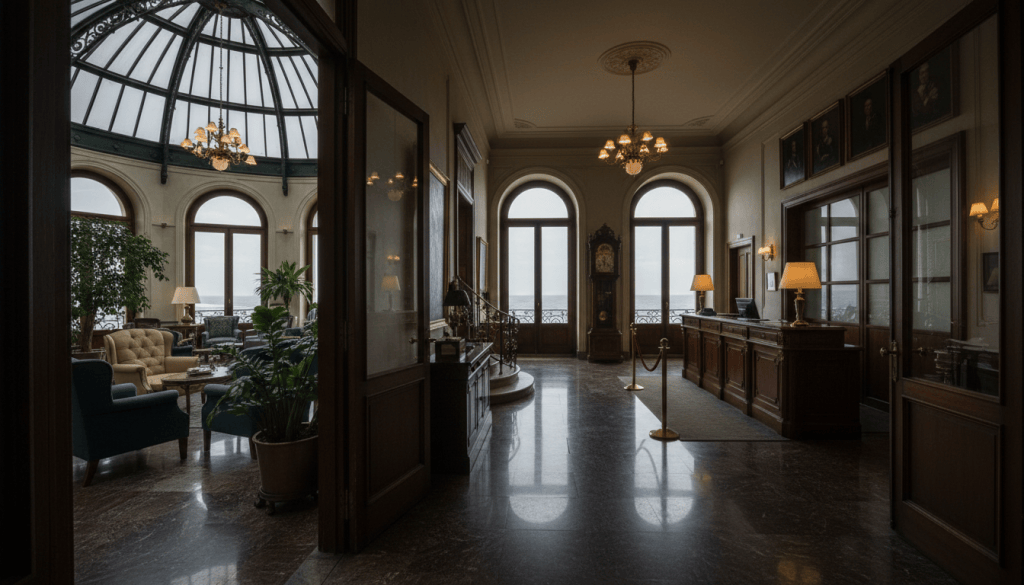
Grand hotels are unusually rich settings for cozy mysteries because they combine glamour with machinery. Guests see polished public rooms, careful service, restaurant rituals, flowers, luggage, and a sense of order. Behind that surface is a working system of kitchens, receiving areas, staff corridors, offices, storerooms, housekeeping routes, archives, keys, schedules, and event spaces.
For a mystery, that hidden structure matters. It gives characters believable reasons to cross paths, creates natural limits on access, and produces records that can challenge what people say. The building becomes more than scenery. It becomes part of the puzzle.
A hotel creates a temporary closed community
Cozy mysteries often work best when suspects and witnesses remain close enough for repeated encounters. A grand hotel provides that containment without requiring an isolated island or snowbound house. Guests may arrive for a festival, conference, wedding, press event, holiday, or business meeting, while the permanent staff continue their normal routines around them.
This creates two overlapping communities. One is temporary: the visitors who may barely know one another. The other is institutional: chefs, concierges, managers, housekeepers, porters, suppliers, and maintenance staff who understand how the hotel works. A mystery can move between those worlds and exploit the fact that each group sees different things.
Public luxury hides private infrastructure
A grand hotel is designed to make effort disappear. The dining room opens on time, luggage reaches rooms, flowers are replaced, breakfast appears, linens are changed, events are reset, and special requests are handled without forcing guests to think about the process.
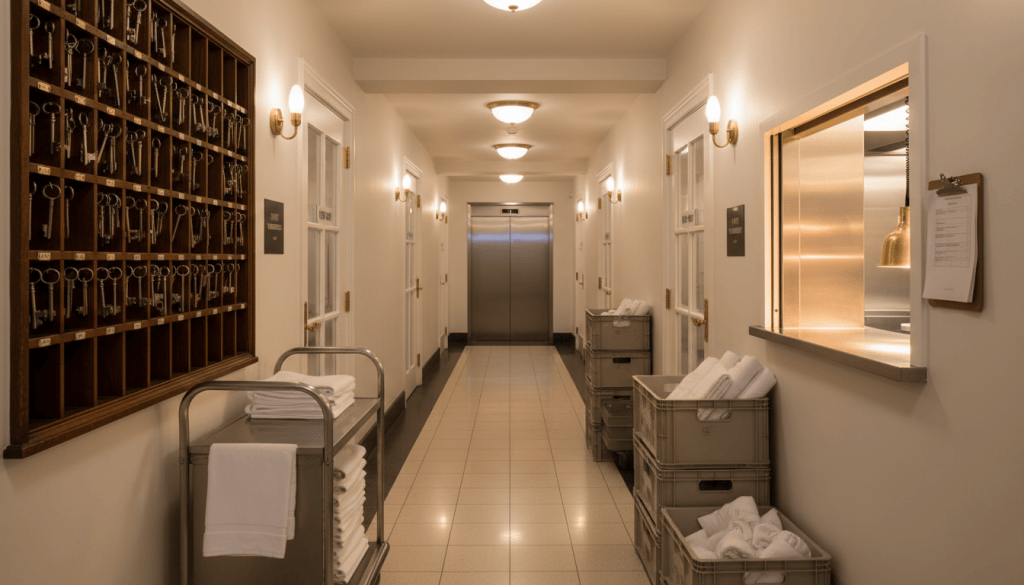
That invisible work is excellent mystery material. A service door that guests ignore may be important to staff. A corridor that looks peripheral may connect two key areas. A delivery entrance can establish who entered the building. A preparation room may have a self-latching door whose behavior changes the apparent possibilities of a crime. The mystery grows out of the architecture and routine rather than being laid on top of them.
Access becomes a fair-play clue
Hotels are full of thresholds. Guest rooms, kitchens, private dining rooms, archives, offices, storerooms, terraces, function rooms, staff corridors, and service lifts all have different access rules. The question is not only who wanted to enter a space, but who could do so naturally without attracting attention.
This makes access useful for fair-play plotting. A person who seems suspicious may not have had a plausible route. Someone who appears unimportant may have had routine permission to move through staff-only areas. Keys, door mechanisms, shift patterns, and ordinary job responsibilities can all narrow a timeline without requiring sensational technology.
Events intensify the hotel’s social pressure
Festivals and special events make the setting even more useful. They bring outsiders into a system that normally runs on routine. Additional rooms may be opened, temporary preparation areas may be used, deliveries increase, schedules shift, and staff members have to coordinate with organizers who do not know the building as well as they do.
That produces plausible confusion without making the plot arbitrary. A changed timetable, misplaced folder, altered room assignment, late delivery, or unexpected guest can matter because the hotel already has to absorb constant movement. The mystery can hide inside ordinary operational noise.
Archives and institutional memory add another layer
Older grand hotels also carry history. Menus, ledgers, guest books, supplier files, photographs, recipes, event records, renovation notes, and staff traditions can preserve one version of the past while leaving gaps in another. That makes the hotel useful not only for a present-day investigation but also for mysteries about credit, reputation, and whose work was remembered.
A historical document can therefore do double duty. It can illuminate the hotel’s identity and create a present conflict. The archive becomes a place where institutional storytelling meets evidence, particularly when a cherished tradition turns out to be more complicated than the polished public version suggests.
The kitchen gives the hotel its own evidence system
When the protagonist works in food, the hotel’s restaurant and kitchen add another practical layer. Receiving records, batch notes, supplier invoices, preparation schedules, tasting events, storage routines, and recipe files can all become part of the investigation. Professional competence becomes a method for checking stories.
This is closely related to the way culinary evidence works in food-science clues in culinary cozy mysteries. A hotel setting strengthens that approach because the kitchen is connected to other departments: concierge, events, purchasing, security, housekeeping, and management. One discrepancy can therefore cross several systems.
A spoiler-free example from the fictional Grand Marivelle
In Pippa Marlowe’s The Marmalade Ledger at Marivelle, Book 2 of Secrets on the Marivelle Pass, the fictional Grand Marivelle is preparing for Merehaven’s Citrus and Conserves Festival. Executive Chef Sophie Delacourt is helping reconstruct a 1904 bitter-orange savarin when gaps in the hotel’s culinary records become difficult to ignore.
Festival treasurer Gareth Morrow claims an old ledger may show that local producers contributed more to the hotel’s celebrated food history than the official account acknowledges. Before he can show Sophie what he found, he is discovered dead in a self-latching festival preparation room. His folder and the ledger are missing.
The hotel matters because the investigation depends on its working systems: access, preparation spaces, receiving documentation, archives, suppliers, event logistics, and kitchen timelines. Sophie does not investigate in spite of being an executive chef. Her job is the reason she can recognize when hotel practice, food evidence, and someone’s account do not agree.
Community and slow-burn relationships feel natural here
A recurring hotel also supports relationships beyond the central puzzle. Staff members work together under pressure, remember previous incidents, and develop trust through practical cooperation. Local producers and organizers return for events. Guests come and go, but the core community remains.
That continuity is useful for a slow-burn romantic subplot as well. In the Marivelle series, Sophie’s developing connection with concierge Julian grows inside a shared professional world. Their roles place them near the same problems from different angles, allowing trust and attraction to develop alongside the mysteries rather than replacing them.
Why cozy mystery readers respond to hotel settings
For readers who prefer non-graphic mysteries, capable sleuths, professional detail, ensemble casts, atmospheric interiors, community relationships, and clue systems built from routine rather than violence, a grand hotel offers an unusually flexible stage. It can feel luxurious without losing practical credibility and contained without becoming claustrophobic.
The strongest hotel mysteries let every part of the building carry narrative weight. A kitchen is a workplace, an archive is a memory system, a lobby is a social crossroads, and a service corridor is a route with rules. Once those systems begin to contradict one another, the hotel itself starts asking questions.
Readers can explore more of the fictional Grand Marivelle on the Secrets on the Marivelle Pass series page and find more books by Pippa Marlowe.

