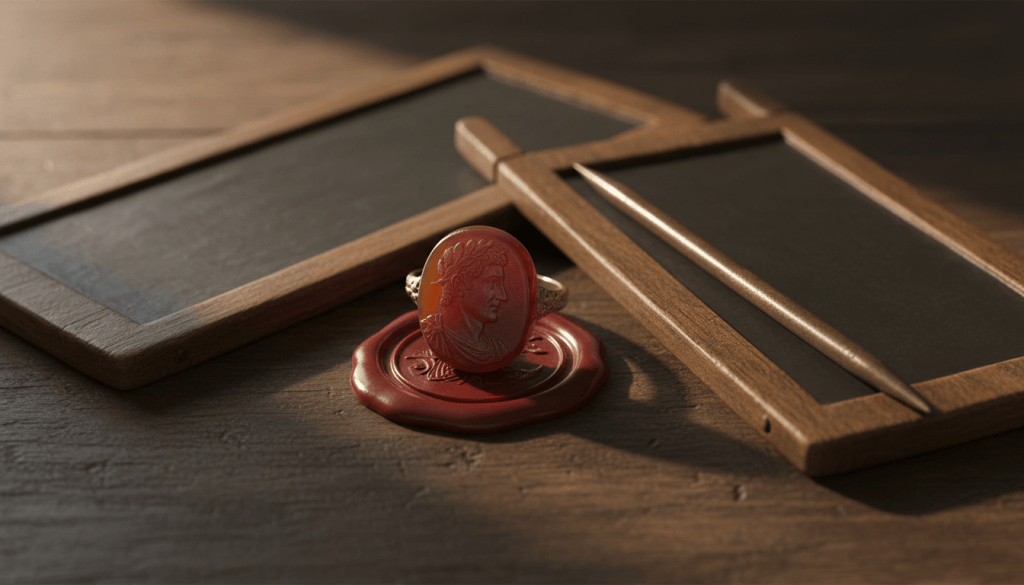
Why a tiny engraved ring mattered
Imagine receiving a folded message in Roman Britain or the capital itself. Before reading a word, you might notice a lump of wax bearing a miniature figure: a bird, an animal, a portrait, or an emblem associated with its sender. That mark was more than ornament. A seal could identify the person who closed a document and offer visible evidence that its contents had not been disturbed.
Roman signet rings made personal identity portable. Their designs were cut into metal or gemstones and pressed into a soft substance, generally wax or clay, leaving a recognizable impression. The resulting mark worked differently from a modern signature, password, or identity card. It depended on social recognition, physical custody, and trust in the person who possessed the ring.
So how did Romans authenticate documents with signet rings—and how secure was the system?
What was a Roman signet ring?
A signet ring was a ring whose bezel or inset stone bore an engraved design capable of making an impression. The recessed technique used for carved gems is called intaglio. Artists worked at a remarkably small scale, creating recognisable figures that appeared in relief once impressed into wax.
Surviving rings demonstrate the wide variety of stones, motifs, and owners. Carnelian is one familiar material, but engraved stones and metal bezels were not limited to one precious substance or one social class. Some rings doubled as jewelry or personal amulets. What made a signet useful for securing correspondence was not merely its cost but its distinctive mark and recognizable association with a person.
The Metropolitan Museum of Art’s discussion of engraved gems describes their use for identification, documents, containers, and private spaces. A ring could therefore serve in everyday administration as well as display wealth or taste.
How a wax seal worked
The principle was straightforward. Someone prepared a letter, tablet, or closed container; secured it with an appropriate fastening; and applied soft wax that received the ring’s impression. The mark gave an observer something to compare with a familiar or expected device. Depending on how a letter or object was closed, breaking the seal could also leave visible signs of access.
The impression was not a written statement of every legal fact in the document. It could instead establish that a specific person or participant had sealed it, or indicate that a package had not been opened since sealing. Context mattered enormously: a seal on a private letter, a witness’s seal, and a mark securing goods could serve overlapping but different purposes.
Archaeological finds help explain the technology. In some Roman provinces, small metal sealing capsules protected wax impressions on tied writing tablets. The Deutsche Digitale Bibliothek describes these Roman sealing capsules, including how the wax could be examined for evidence that a document had been opened.
Why engravers carved images in reverse
One of the most interesting details is easy to miss: the ring’s carved picture and its impression do not look identical. Letters and directional motifs have to be engraved in reverse so that the impression appears the intended way around. A cutter making an intaglio must plan not only what the gem looks like in the hand but what it will leave in wax.
This has consequences for studying surviving artifacts. A tiny difference in the shape of a branch, an animal’s foot, or the outline of a figure can distinguish two matrices that at first seem alike. A skilled imitation might reproduce the broad design while preserving different minute details. Scholars cannot simply conclude that two similar impressions came from the same original without examining the physical evidence.
The Corinium Museum’s introduction to Roman intaglios explains both the reverse-carving process and the broad range of items the rings could help seal.
Was a sealed Roman document automatically trustworthy?
No. A seal helped people establish identity or detect interference, but it did not guarantee that every statement inside was true. A genuine owner’s mark could appear on a document whose interpretation was contested. Someone might acquire a ring without permission, use an authorized ring improperly, or commission an imitation. Even without deliberate fraud, damaged wax or careless storage could make a mark difficult to read.
It is helpful to separate three questions. Identity: whose device appears in the wax? Integrity: has the sealed object been opened or altered since it was secured? Truth: are the claims recorded in the document accurate? A seal might illuminate the first two questions while leaving the third unresolved.
Roman transactions also relied on social procedures and witnesses, not a magical stamp of authenticity. The significance of a particular sealing practice depends on document type, place, date, and applicable legal conventions. No single procedure describes every Roman legal instrument across centuries of imperial history.
Why custody and witnesses mattered
Evidence becomes stronger when observers can reconstruct where an object came from and who handled it. That is true for modern archives and was relevant to Roman disputes as well. If a tablet moved between a household, a clerk, a messenger, and a recipient, each transfer created opportunities for accidental damage, mistaken attribution, or misconduct.
Witnesses could corroborate a transaction or the circumstances of sealing. Multiple impressions on a legal instrument might make it harder to substitute a document without attracting notice. Equally, disagreement among witnesses might turn a physically intact seal into only one part of a larger inquiry.
The difference between the surviving object and the story told about it is central to historical research. Readers interested in this connection can explore our article Why Paper Trails Make Such Powerful Clues in Historical Mysteries.
How can historians identify an ancient seal?
Researchers look at material, carving style, iconography, and archaeological context. An isolated stone can tell us about craftsmanship, while a seal found with a tablet or in a well-documented excavation may reveal considerably more about use. Images on a ring are not necessarily portraits or names of its owner: motifs also communicate fashion, religious associations, and personal preferences.
Dating is often approximate. A ring may be older than the event in which it was used, and objects can remain in circulation or pass between owners. Claims that a particular impression proves a named individual signed a specific document require stronger evidence than visual resemblance alone.
The broader category of ancient seals and sealstones includes multiple techniques and societies. Roman signets are one historically rich example, not the whole story of document authentication.
Why seals make compelling clues in historical fiction
A seal is a compact physical clue with several possible interpretations. It invites questions: who owned the ring, who had access to it, who saw the document before it was closed, and whether two apparently matching marks truly came from the same tool.
That appeal informs The Saturnalia Seal, Book Three of Theo Penrose’s The Vestal Mysteries. Set in Trajan-era Rome, the novel follows Vestal priestess Junia Secunda as the death of an engraver leads toward suspicious impressions and guarded records. The fictional case uses a historical practice to create a puzzle, rather than treating a wax mark as infallible proof.
For more of the author’s historically grounded fiction, visit Theo Penrose’s author page.
The enduring lesson of Roman document security
Ancient Roman sealing was an ingenious combination of craftsmanship, recognizable identity, and visible tamper evidence. Its limitations are equally revealing. A beautiful device could be copied; a document could be handled dishonestly; and a seal could tell us who apparently secured something without proving that the words beneath it were accurate.
Understanding those distinctions makes Roman objects more interesting—and offers a useful reminder that the history of authentication is also the history of trust.

