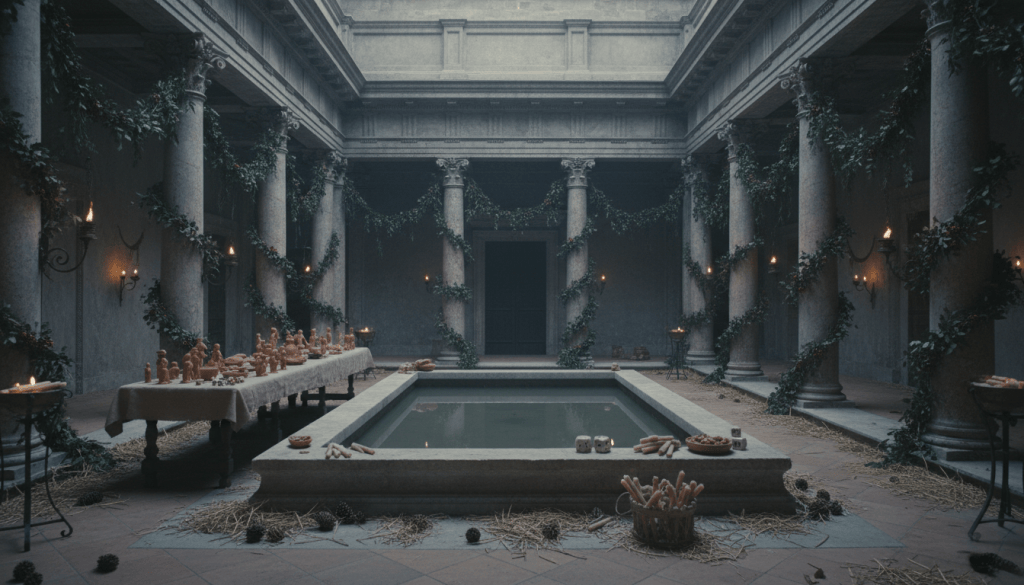
What happened during Saturnalia?
For a few December days, ancient Rome looked and sounded different. Ordinary routines relaxed, households prepared festive meals, friends exchanged presents, and dice games became a conspicuous part of public and private celebration. Saturnalia was among the most anticipated occasions on the Roman calendar.
Yet it was not simply a Roman version of a modern winter holiday. Saturnalia honored the god Saturn, reflected Roman ideas about an earlier age of abundance, and temporarily played with distinctions that shaped ordinary life. Ancient writers describe both the pleasure of the celebrations and the inconvenience felt by people who wanted quiet.
Its distinctive customs tell us about religion, household relationships, gift culture, and the limits of social change in imperial Rome.
When was Saturnalia celebrated?
Saturnalia began on December 17 in the Roman calendar. Its official duration shifted at different times, while popular festivities could extend over several days. Ancient sources and later descriptions do not always present one tidy, unchanging schedule: state calendars, household customs, and related gift-giving festivities overlapped.
The celebrations fell close to the winter solstice, when shorter days made candlelight and communal activity especially noticeable. But historians should resist describing every familiar modern winter custom as directly inherited from Saturnalia. Similarities do not establish a straight line of descent.
The festival was associated with Saturn and the temple dedicated to him in the Roman Forum. Its public religious observances sat alongside a broad range of activities in homes and streets.
Why did Romans celebrate Saturn?
Saturn was connected with agriculture and sowing. Roman accounts also linked him with a legendary Golden Age—a time imagined as less burdened by hierarchy and hardship. Festival customs could evoke that imagined freedom through special clothing, relaxed behavior, and playful changes to rank.
These ideas help explain why people remembered Saturnalia for more than food. The holiday gave Roman society a brief occasion to picture its everyday order turned upside down, without permanently abolishing that order.
Exactly how any individual experienced the festivities would depend on wealth, status, location, and household circumstances. Literary descriptions often reflect the views of educated male authors, so they should not be mistaken for direct testimony from every social group.
What did Romans give one another as Saturnalia gifts?
Gifts were a hallmark of the season. Ancient accounts mention candles and small figurines, including the little clay or wax objects known as sigillaria. Some gifts were deliberately modest or playful. A present could acknowledge friendship or social obligation without the formality of a costly transaction.
Roman poet Martial’s collections Xenia and Apophoreta are particularly useful for understanding a world of guest gifts and small offerings. They refer to an enormous range of possible objects: practical household items, foods, writing materials, and humorous surprises. Poetry, of course, is not a warehouse inventory. It reveals cultural expectations and jokes as much as what an average Roman bought.
Gift exchanges also had a social dimension. A person giving a present to a patron, client, friend, or relative was participating in an existing relationship. The holiday could soften expectations of rank for a moment, but gifts could still express status or obligation.
Were dice games and gambling really part of the festival?
Yes. Dice and other games are closely associated with accounts of Saturnalia. Ancient writers describe ordinary restrictions on gambling being relaxed for the celebrations. The playful atmosphere also encouraged riddles, verbal games, and collective entertainment.
Roman dice did not require a grand casino. A small set of pieces and a surface to throw them on could create a lively household diversion. The games made the social reversal visible: activities normally criticized or controlled could become acceptable holiday recreation.
That did not mean the streets were free of all rules, or that everyone gambled. Descriptions of universal abandon are literary generalizations. Individual households and personalities varied.
Did masters and enslaved people really change places?
The most frequently repeated Saturnalia custom is a reversal of roles between masters and enslaved people. Ancient texts mention relaxed behavior, freer speech, shared dining, and situations in which masters served the people they normally commanded. They also describe a temporary festive ruler sometimes called a king of the Saturnalia.
These accounts need careful interpretation. The festival did not abolish enslavement or give enslaved people permanent legal equality. The special freedom was limited, conditional, and ultimately controlled within a society built on profound inequalities.
Nor should we assume that every household observed a formal reversal dinner in exactly the same way. The practice is important partly because Roman authors considered it remarkable enough to record. Their fascination with reversal itself reveals the rigidity of the usual system.
What did Saturnalia look and feel like?
Picture a city whose daily rhythm has changed: crowded visits, festive meals, shops supplying presents, people wearing relaxed dinner garments rather than formal togas, and the sound of conversation and gaming spilling from houses. Candles were common gifts and helped give December gatherings their visual atmosphere.
Roman sources mention the pilleus, a felt cap associated with freedom, as part of Saturnalian imagery. The garment matters because it offered a visible reference to the idea of temporary liberty. Yet we should not imagine a uniform costume parade: material circumstances varied between households and regions.
Food, hospitality, and social calls were central pleasures. Still, the festival could also be noisy or exhausting. Seneca complains about December revelry, while Pliny the Younger describes withdrawing to work away from household celebration. Not every Roman embraced the excitement in the same way.
Was Saturnalia the same as Christmas?
No. Saturnalia was a Roman religious festival with its own deity, calendar, traditions, and social meaning. Christmas developed in a different religious context. Both have winter associations and may share superficial similarities such as gatherings, gifts, and light, but straightforward claims that one simply became the other conceal a more complicated history.
The question historians ask is not merely whether two customs resemble each other, but whether evidence demonstrates transmission, continuity, adaptation, or independent practice. A candle given in December is not by itself proof of direct descent from one religious festival to another.
How reliable are our accounts of Saturnalia?
Much of our understanding comes from Roman literature written for particular audiences. Martial, Seneca, Pliny, and later Macrobius offer different perspectives, with different priorities. They describe real customs, but they also joke, exaggerate, moralize, or look nostalgically backward.
A useful approach is to combine literary evidence with material culture and the broader history of Roman households. Be especially cautious about accounts that imply one festival experience applied equally to a senator, a merchant, an enslaved domestic worker, and a child in a rural household.
For a compact collection of ancient references and their contexts, see the Encyclopaedia Romana’s Saturnalia overview.
Saturnalia as a setting for historical mystery
A festival that changes routine creates fascinating possibilities for fiction. Someone may be away from their ordinary duties. A servant might enter a room normally reserved for someone else. Visitors and gifts pass between households, while noise and celebration complicate memory. None of these possibilities proves a historical crime occurred; they simply show why everyday festival practices can produce persuasive fictional misdirection.
In Theo Penrose’s The Saturnalia Seal, Book Three of The Vestal Mysteries, the celebrations form a backdrop to Vestal priestess Junia Secunda’s inquiry into an engraver’s death. Sacred obligations, Roman family interests, and records of identity matter as much as festival atmosphere.
Those intrigued by the physical evidence in such stories can also explore how paper trails become clues in historical mysteries, or browse Theo Penrose’s historical fiction.
What Saturnalia reveals about Roman life
Saturnalia offers a vivid glimpse of a society that could temporarily celebrate freedom while retaining powerful divisions. Its meals, gifts, games, and playful reversals show how religious tradition, social connection, and everyday pleasures overlapped.
Above all, the festival reminds us that the most revealing historical questions often concern ordinary behavior: who exchanged gifts, who had leisure to play, who prepared the meals, and whose freedom lasted only until the festivities ended.

