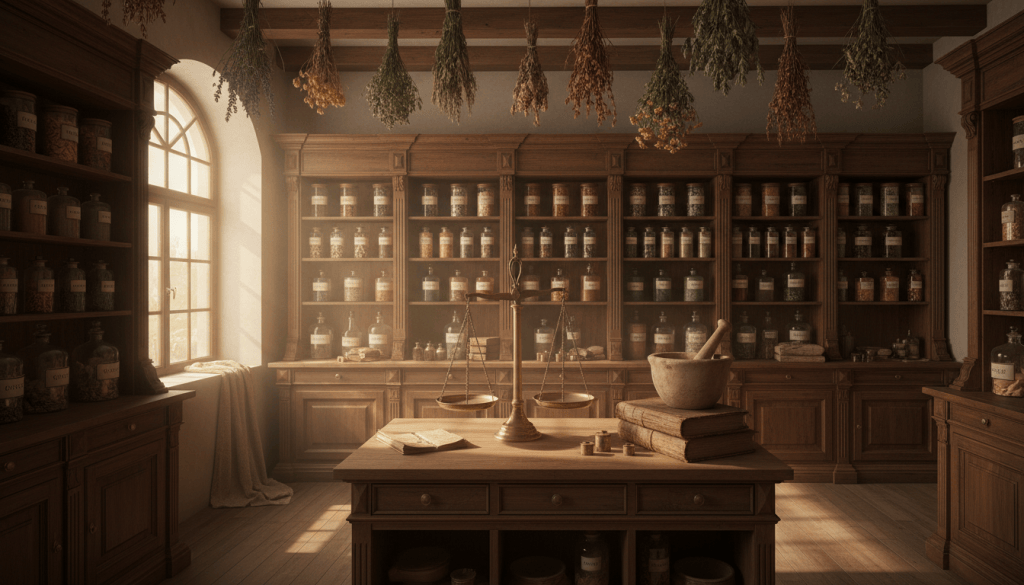
Picture a narrow shop lined with wooden drawers, ceramic jars, dried leaves, and the smell of lavender or rosemary. The apothecary behind the counter measures ingredients on a balance and consults a book of preparations. This familiar image contains some historical truth—but it also conceals a profession that changed substantially across centuries and countries.
Apothecaries were suppliers and preparers of medicinal substances, often working within regulated trades and local networks of physicians, merchants, patients, and other healers. Their story is not simply one of mystical herbs. It is also a history of measurement, commerce, training, risk, and changing ideas about health.
What was an apothecary?
In many European settings, an apothecary was a specialist who stocked, compounded, and sold medicinal preparations. Depending on the location and period, the work could include obtaining ingredients, preparing remedies according to established recipes, and advising customers. The boundary between apothecaries, physicians, surgeons, and other practitioners was neither universal nor fixed.
A modern pharmacist is not exactly the same as an early modern apothecary. Pharmacy eventually developed stronger professional education, manufacturing standards, laboratory science, and legal controls. Describing every historical apothecary as a modern pharmacist in old-fashioned clothes overlooks important changes.
What did an apothecary actually sell?
The stock could include dried herbs, roots, seeds, resins, oils, spices, minerals, and prepared mixtures. Some ingredients were locally grown; others arrived through long-distance trade. Apothecaries could make powders, ointments, syrups, tinctures, pills, and other formulations depending on contemporary knowledge and local practice. A historical example is John Pechey’s 1697 medical compendium, catalogued by Wellcome Collection, which documents period categories of medicinal materials and shop compositions. Such books are evidence of what people prepared and believed, not proof that the preparations were effective or safe.
Containers and drawers were functional, not only decorative. Ingredients needed organization, protection from damage, and identification. Inconsistent naming, contamination, and adulteration could create serious problems. The careful management of stock therefore mattered as much as a picturesque display.
Not everything in a historical shop was effective or safe. Some widely used preparations had limited benefit, while others involved toxic substances or unreliable doses. The existence of an old recipe should not be mistaken for evidence that it works or is appropriate for present-day use.
How were herbal preparations made?
Preparation depended on the ingredient and intended form. Plant material might be dried, ground, soaked, heated, filtered, or mixed with a carrier such as oil or syrup. Mortars and pestles, sieves, presses, balances, and measuring vessels were important practical tools.
An infusion generally involves steeping plant material in a liquid; a decoction generally involves simmering tougher materials, although historical usage and procedures varied. Tinctures and other extracts use solvents to draw out constituents. These terms describe preparation methods, not evidence that the resulting product is safe or effective.
Consistency could be difficult. Growing conditions, harvesting, storage, species identification, and preparation all influence plant constituents. A plant gathered from one site might differ from another sold under the same common name. The challenge of reliable identification remains important in botanical science and modern product quality control.
What made an ingredient trustworthy?
Provenance mattered long before modern laboratory testing. Merchants and practitioners relied on established suppliers, examination of appearance and smell, trade knowledge, and written descriptions. These methods had limits: related plants can look similar, adulterants can be subtle, and an attractive appearance does not verify composition.
Modern quality systems can draw on botanical identification, chemical analysis, standards, traceability, and contamination testing. Regulation differs by country and product classification. Such safeguards are important precisely because natural origin does not guarantee harmlessness.
For readers of mysteries, labeling and provenance offer an especially rich puzzle structure. A jar’s name, supplier, batch, or missing ingredient can create a trail of questions: what was ordered, what was delivered, and who had reason to change the record?
The apothecary’s shop as a social place
A medicinal shop could be a place for purchasing necessities, exchanging information, and seeking advice. The apothecary needed practical knowledge and commercial judgment. Customers might arrive with a prescription, a household request, or questions about symptoms, though the appropriate professional response depended heavily on local rules and period.
These businesses also depended on inventory management and credit. Account books, receipts, supplier correspondence, and price records can reveal everyday relationships and economic conditions. A shop was part of a broader community rather than an isolated room of mysterious bottles.
Women, households, and the wider world of remedies
The history of healing was never confined to licensed male shopkeepers. Women managed household medical knowledge, prepared remedies, worked within family businesses, and practiced forms of caregiving, although their opportunities for formal trade membership differed considerably across places and times.
Monastic gardens, household recipe books, botanical collectors, and local healers contributed to knowledge about plants. It is important not to collapse all these traditions into one timeless image of the wise herbalist. Distinct communities had different practices, authorities, beliefs, and levels of access to training.
How did apothecaries become modern pharmacies?
Over time, advances in chemistry, pharmacology, industrial manufacturing, public-health regulation, and professional training transformed medicine supply. The pace varied geographically. In some places historic trade boundaries survived for long periods, while elsewhere pharmacy increasingly became a distinct and standardized profession.
Today’s pharmacies depend on quality-controlled medicines and trained professionals, not merely the individual judgment of a person compounding a jar at a counter. Some compounding remains part of modern practice, but it operates within contemporary regulatory and clinical frameworks.
Why do apothecary shops work so well in fiction?
An apothecary offers tangible objects that carry stories: a labeled bottle, a misplaced herb, a damaged ledger, an old receipt, or a preparation nobody remembers ordering. The setting naturally brings customers, suppliers, local gossip, and questions of trust into contact.
It also joins two appealing reading experiences. One is sensory: shelves, herbs, glass, rain against windows, and warm lamplight. The other is investigative: exact quantities, provenance, records, and the gap between what a label says and what a container holds. In a fair-play mystery, these details can serve as understandable evidence.
That combination appears in Hollow Creek Witch Mysteries, a fictional paranormal mystery series by Marnie Blackthorn. Its apothecary, Blackthorn & Sage, belongs to a magical invented community; its restricted infusions are fantasy elements, not historical medicinal products. The storytelling nevertheless draws on real-world questions about ingredients, accurate records, and responsibility.
What to remember about historical apothecaries
Apothecaries were skilled participants in changing systems of medicine and trade. They sourced and prepared substances, maintained stock, served customers, and operated amid imperfect knowledge and evolving rules. Their history is more interesting than a simple contrast between ancient herbs and modern pills: it shows why identity, measurement, transparency, and trust have long mattered whenever one person prepares something another person may consume.
Readers curious about how evidence becomes a story device can also explore How Food Provenance Becomes a Clue in Culinary Cozy Mysteries, which examines a related question of tracking ingredients in fiction.

