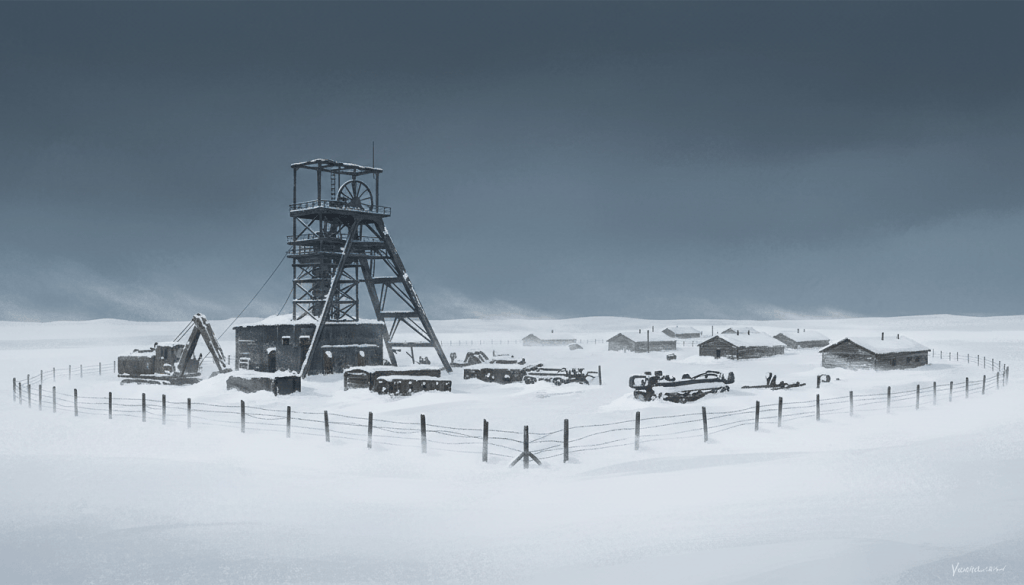
When people refer to the “Vorkuta Gulag,” they often picture a single camp with one gate. The historical record is more complicated. Vorkuta was an Arctic industrial region connected to different camp administrations, mines and settlements. One important institution was Rechlag, also called the River Camp or Special Camp No. 6. Understanding its organization helps explain both the conditions prisoners faced and why the 1953 work stoppages cannot be reduced to one location or one account.
This guide focuses on the institution itself: what “special camp” meant, how the camp divisions related to the mines, and how historians can use administrative documents without confusing an official report with a complete history of the prisoners’ experiences. For a chronological account of the uprising, a separate article can examine the strike day by day.
What was Rechlag?
Rechlag was a Soviet special camp based in the Vorkuta area and designated Special Camp No. 6. The Ukrainian Institute of National Memory’s historical overview identifies 17 divisions in Rechlag in 1953. These divisions were not seventeen identical prisons standing side by side. They formed part of a wider system tied to industrial work, detention, transport and administration.
The name itself matters. “Rechlag” is a transliteration of the Russian abbreviation for River Camp. English-language writing may spell the name Rechlag, Retchlag or Rechlag’s expanded form. A researcher should record the spelling used by a source while establishing whether it refers to the same institution. Even the phrase “Vorkuta camp” is not precise enough when a claim concerns a specific episode in 1953.
Why was it called a special camp?
Following the Second World War, Soviet authorities established special camps to hold prisoners classified as particularly dangerous to the state, including many serving sentences for political offenses. Those official classifications should not be mistaken for independent evidence of guilt. Political categories, national labels and accusations in camp files often reflect the security system’s own language and priorities.
A “special camp” was therefore both an administrative category and a lived regime. The distinction shaped detention and surveillance as well as expectations for release. When writing about an individual prisoner, it is important to distinguish the legal label imposed by the state from what historians can establish about the person’s actions or beliefs.
The geography of work: mines, compounds and transport
Vorkuta’s mines depended on an infrastructure that extended beyond a barbed-wire perimeter. Prisoners could be assigned to mines, construction and related work, while railway lines and industrial facilities connected sites that were administratively distinct. Camp-division numbers, mine names and place names appear in reports, and they must not be used interchangeably.
This geography helps clarify what it meant to withhold labor. A work stoppage did not simply prevent a routine morning roll call. It could interrupt an industrial chain that depended on assigned labor and closely scheduled operations. To understand a particular refusal to work, ask which division was involved, which workplace it served and what supervisors expected the prisoners to do.
What changed after Stalin’s death?
Joseph Stalin died in March 1953. An amnesty issued that month affected some categories of prisoners but largely bypassed people serving long sentences under political provisions. Expectations of change therefore collided with the reality of continuing detention for many in the special camps. This difference mattered to the atmosphere in Rechlag.
Yet prisoner expectations were not uniform. Conditions, sentence histories, access to information and opportunities for communication varied. Explaining the work stoppages as a single emotional reaction to the amnesty would erase the complexity of the demands and the circumstances in different divisions.
Why the distinction between divisions matters
Accounts of the Vorkuta uprising describe refusals to work spreading across parts of the camp system in July 1953. A report from one division may describe who stopped working there, the demands recorded by local officials, and the actions taken by the administration. It does not automatically establish the sequence in every other division.
The same caution applies to numerical claims. A total for prisoners in Rechlag is not a count of people who participated in a particular work stoppage. An official figure for one mine is not necessarily a total for the regional protest. Researchers should identify the date, institution, reporting authority and definition of each number before repeating it.
What do surviving administrative documents show?
The historical-document collection’s record of an operational report dated August 2, 1953 describes conditions in camp divisions on August 1–2. A July 30 plan by an Interior Ministry commission is another example of an official source from the crisis. These materials offer evidence of what authorities recorded, decided and attempted to control.
Their terminology is also revealing. Soviet administrative documents could classify refusals and protests as “mass disturbances.” That is the language of the institution writing the report. It is not a neutral verdict on why prisoners acted or how their experiences should be understood. Official records need to be read alongside testimony, independent research and the dates of later reconstructions.
Why accounts of the violence differ
The violent suppression of the strike at the Yur-Shor site on August 1, 1953, is central to the event’s memory. But an account describing what happened at Yur-Shor should not be silently generalized to all of Rechlag. Differences in casualty figures can reflect varying definitions, access to evidence, and whether a source is counting only those killed immediately or a broader set of deaths.
A responsible history avoids treating a contested figure as exact simply because it appears in an official document or repeated online summary. The Map of Memory entry for Yur-Shor offers a point of departure for the place and its remembrance, while documentary and archival material helps readers test the chronology.
A practical checklist for reading Rechlag sources
- Name the institution: Is the author discussing Rechlag, another Vorkuta camp administration, or the mining town?
- Name the location: Is a camp division, mine, burial place or entire region being described?
- Record the date: Was the source written during the crisis, after the uprising or decades later?
- Identify the voice: Is this a camp official, prisoner, eyewitness, later historian or memorial project?
- Define every total: Does a number mean all detainees, those on strike, casualties at one site or a different group?
- Separate description from judgment: Is a word such as “disturbance” an official label or the historian’s own analysis?
Where can a reader begin further research?
For a concise historical overview of the uprising’s setting, consult the Encyclopedia of Modern Ukraine entry on the Vorkuta uprising. The Bundesstiftung zur Aufarbeitung’s documentary feature offers an additional perspective. Those resources should be approached with awareness of their different purposes and the evidence each presents.
Rechlag is not a synonym for every part of Vorkuta’s history. It is a specific institution whose structure, terminology and surviving paper trail help us reconstruct how political detention and Arctic industry intersected. A careful description of the camp gives the strike a clearer setting without replacing the stories of those who resisted.
For broader nonfiction on Vorkuta, explore Luke Halden’s VORKUTA EXPOSED series or his author page.

