The Vestal Virgins are among the most recognizable women of ancient Rome, yet popular portrayals often reduce them to a single duty: keeping a sacred fire burning. Their actual responsibilities were more varied, combining public religious authority, rigorous ritual obligations, special legal standing, and a highly regulated communal life. Understanding their work reveals how the Romans connected the safety of the state to the daily labor of a small priestly college.
Who were the Vestal Virgins?
The Vestals were priestesses of Vesta, the Roman goddess associated with the hearth. They served at the heart of Rome’s public religion rather than in a private household cult. The Pontifex Maximus oversaw their college, and the number of priestesses was traditionally six. Ancient authors describe girls chosen for the office while still young, commonly between six and ten years old.
A Vestal’s commitment ordinarily lasted thirty years. The period was conventionally divided into ten years of learning, ten years of performing the duties, and ten years of teaching newer members. When service ended, a woman could in principle marry, although many did not. The familiar phrase ‘Vestal Virgin’ therefore describes a specific public religious obligation, not an informal community of devotees.
Why was the sacred flame so important?
The perpetually tended fire in Vesta’s temple embodied Rome’s continuing life. Ancient Romans treated its accidental extinction as a grave public religious failure. The priestesses’ care for that fire was consequently more than symbolic housekeeping: it was a visible assurance of religious continuity.
Contrary to an image of a huge open temple accessible to everyone, Vesta’s round temple contained a sacred interior subject to restrictions. The work of tending fire included attention to fuel, purity, timing, and ritual rules. Particular procedures varied across the long history of the institution, and ancient accounts do not document every ordinary shift of duty.
What did Vestals do besides guard the flame?
They prepared and handled substances required by Roman public rites. One especially important preparation was mola salsa, a mixture of sacred grain and salt used in sacrifices. Ancient descriptions associate the Vestals with gathering or processing grain and with preparing ritual materials at appointed times. Their participation linked carefully performed domestic-looking tasks to ceremonies conducted on behalf of the wider community.
Vestals also took part in public festivals and important state rituals. Their presence was not incidental decoration. Roman religious practice depended on recognized offices, authorized participants, correct materials, and customary procedures. The Vestals occupied a distinctive position within that system.
Another element of their responsibility concerned protected sacred objects and traditions. Ancient sources refer to objects kept under special guardianship associated with the sanctuary of Vesta. Some details are obscure precisely because access and knowledge were restricted. Modern accounts should distinguish a securely recorded practice from a later reconstruction or literary embellishment.
What happened during Vestalia?
Vestalia, celebrated in June, placed Vesta’s cult prominently in Rome’s religious calendar. Ancient testimony associates the festival with a period when matrons could enter areas normally inaccessible to them. Bakers and millers also appear in the festival’s traditions, reflecting the association of the hearth with food preparation and civic sustenance.
These traditions are useful clues to what Roman religious life meant to participants. Vesta was not merely a decorative figure on an altar. Her cult drew connections between grain, household fire, communal survival, and a stable city. Yet ancient testimony spans centuries; not every practice necessarily occurred in identical form in every period.
Where did the Vestals live?
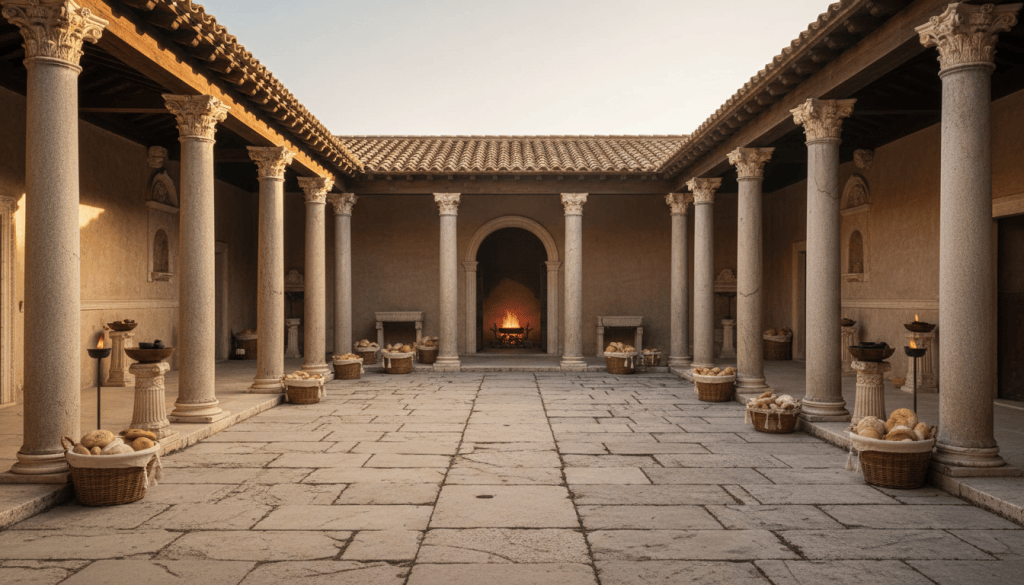
The priestesses lived in the Atrium Vestae, usually called the House of the Vestals, within the Roman Forum’s sacred complex. Archaeological remains preserve the outline of an unusually substantial residence, with a courtyard, pools, and ranges of rooms modified over time. Its architecture offers a glimpse of collective residence and institutional continuity, although assigning one specific daily function to every surviving room is risky.
The religious household was not isolated from Rome’s wider economy. A large urban establishment required provisions, maintenance, storage, and practical oversight. Modern historical fiction can reasonably explore deliveries and inventories as plausible features of such a setting; individual fictional records or office procedures, however, should not automatically be treated as documented ancient practice.
What rights and privileges did Vestals possess?
Vestals held an exceptional legal and social position. Ancient writers emphasize their release from certain ordinary forms of paternal authority, their ability to manage property in ways unusual for Roman women, and the respect accorded to them in public. Traditions also associate them with reserved seating and formal privileges at public events.
These distinctions did not make them unrestricted. Their office imposed demanding standards of ritual purity and sexual abstinence. The penalties ancient authors report for violations could be extreme, including the notorious live burial of a priestess judged to have broken her vow. The severity of those accounts shows the asymmetry of privilege and control surrounding the college.
Could a Vestal participate in civic disputes?
Religious prestige could give a Vestal influence outside ordinary temple routines. Ancient sources recount occasions when priestesses interceded or their persons and status affected public events. That influence should not be confused with holding a magistracy or exercising modern police powers. Their authority belonged to a distinctive religious institution, and its practical reach depended on circumstance.
This distinction makes the Vestal setting particularly fruitful for a historical detective story. A priestess might be unusually well placed to notice wrongdoing within a sacred household, yet still need someone else to investigate outside it or compel testimony. The contrast between access and restriction creates investigative tension without importing modern institutions into ancient Rome.
How historical mysteries use the Vestal world
In Theo Penrose’s Ash Beneath the Atrium: A Vestal Mystery, the opening volume of The Vestal Mysteries, young Vestal Junia Secunda encounters a suspicious death amid records, ritual duties, and the spaces of the Atrium. Its central setting draws attention to the difference between sacred status and practical vulnerability. Junia and the case are fictional; the broader religious institution has a documented Roman history.
Readers interested in this form of historically grounded deduction can explore Theo Penrose’s author page and the related article on paper trails as clues in historical mysteries. These connections are particularly useful when an apparently small document discrepancy matters more than a dramatic confrontation.
What can we reliably know about a Vestal’s ordinary day?
Not everything. Surviving accounts disproportionately describe rituals, privileges, scandals, and moments of public importance. They seldom record a complete schedule of meals, shifts, discussions, training, or domestic chores. Archaeology reveals spaces but cannot always tell us exactly how occupants used them on a particular morning.
A careful reconstruction therefore separates three layers: activities explicitly described by ancient sources, plausible duties implied by an institution’s needs, and imagined personal scenes used by novelists. This approach makes the real Vestals more interesting, not less. They were both extraordinary public religious figures and members of a functioning urban household.
Their story is ultimately about the work required to maintain an institution that Romans believed protected the city itself. The enduring fascination of the Vestals lies in that combination: immense ceremonial significance, a remarkably restricted vocation, and everyday acts that carried public meaning.
Read More from The Vestal Mysteries
Discover Ash Beneath the Atrium by Theo Penrose on Amazon, or enjoy the free reader bonus with two original stories. The fictional mysteries stand apart from the historical background discussed here.
Related reading: How Did Ancient Romans Seal and Protect Important Documents?. Explore more books on the Theo Penrose author page.

