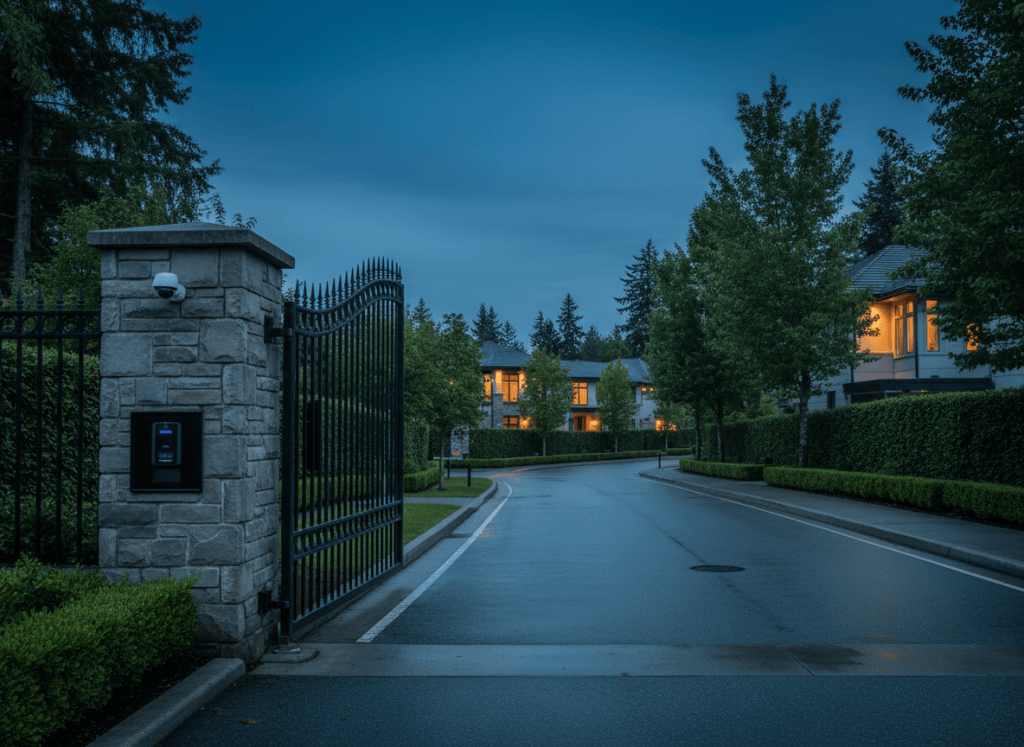
Security systems appear to create certainty. A gate records a vehicle. A camera captures an arrival. A telephone system preserves the time of a call. An electronic lock knows when a credential was used.
In mystery fiction, however, the most useful security record rarely answers the entire question. It answers one narrow question accurately while forcing the investigator to ask a better one.
A gate may prove that a particular transponder entered a property without proving who was driving the vehicle. A camera may establish that somebody crossed a corridor without explaining why. A phone record may verify that two numbers connected without revealing who actually spoke. That gap between recorded fact and human interpretation is what makes security data such a powerful mystery device.
Security Records Create an Apparently Objective Timeline
Witnesses forget. They estimate. They remember events in the wrong order. Automated systems do something different: they record specific events according to programmed rules.
A mystery may therefore use electronic gate entries, key-card activity, alarm events, telephone connections, camera timestamps, motion sensors, automatic lighting records, visitor registers, parking records, or access-control systems. These records can help establish a timeline that appears more reliable than memory.
But the distinction between what the system recorded and what investigators assume the record means is crucial. If a gate records Credential A at 6:53 p.m., the reliable fact may be only that Credential A was detected. It does not automatically prove that its legitimate owner was present. That is where the mystery begins.
A Good Digital Clue Answers One Question and Creates Another
Weak technological clues act like magic: the investigator presses a button and receives the answer. Strong clues narrow uncertainty.
Suppose a residential gate shows that a familiar resident credential was used during the period of a disappearance. That may answer how a vehicle entered without being stopped. But it creates new questions. Who possessed the credential? Was it still supposed to be active? Could it have been copied? Did the vehicle match the one originally assigned to it? Did the system record a person, a vehicle, or merely an electronic code?
The clue becomes valuable because it changes the investigative problem rather than ending it.
Controlled Environments Make These Clues More Important
Security records are especially effective in mysteries set in locations designed to control movement: gated communities, hotels, hospitals, office buildings, private clubs, schools, residential complexes, archives, laboratories, and retirement communities.
These environments establish expectations. There are approved entrances. Visitors may need permission. Staff work defined shifts. Residents or employees become familiar with normal traffic. When something unexplained happens, investigators can compare what people remember with what the system recorded.
A supposedly secure environment therefore creates an immediate contradiction: If movement was controlled, how did the unexplained person get inside?
Why Gated Communities Offer Particularly Rich Evidence
A gated residential community combines private homes with shared administration. The gate may record vehicles. The management office may retain visitor information. Maintenance staff may use service routes ordinary visitors never see. Residents may follow predictable routines. Cameras may cover common facilities while deliberately avoiding private homes.
This creates partial visibility rather than complete surveillance. A system can be functioning normally while still failing to capture the event investigators most need to understand.
Electronic Evidence Is Not the Same as Identity
One of the most important rules for technology-based mystery clues is that credentials and people are different things. A badge is not a person. A phone is not automatically its owner. A transponder is not a driver. A password is not proof of who typed it. A camera image is not always a confirmed identity.
This allows mystery writers to use technically accurate records without making technology omniscient. An access system may be absolutely correct that a credential was used at a particular moment. The human error comes when characters conclude that the credential’s registered owner must therefore have been present.

Security Data Can Contradict Eyewitness Memory
Suppose a neighbor says she saw a resident at home at 7:00. A security record shows a related vehicle leaving at 6:45. Neither fact automatically disproves the other. The witness may have seen someone else. The resident may have remained while another person drove the vehicle. The witness may have misremembered the time. The security system may have recorded a credential rather than the expected car.
A good mystery allows several explanations to remain possible until additional evidence narrows them. This makes the tension more satisfying than simply declaring one source wrong.
Everyday Technology Often Produces Better Clues Than Exotic Forensics
Some of the most convincing investigative details come from systems people barely notice in daily life. A porch light activates automatically. A thermostat changes state. A visitor uses an intercom. A maintenance employee records a task. A telephone extension connects to another residence. A vehicle passes a municipal camera.
Each event can create a time marker. The power of the clue comes from normality. Nobody installed the system to solve the fictional case. The system happened to preserve a fragment of what occurred. That accidental documentation gives evidence-driven mysteries much of their documentary atmosphere.
Records Must Still Be Interpreted by People
Technology may reduce certain kinds of uncertainty, but it introduces others. Investigators must ask what exactly a system records, when it was maintained, whether credentials can be duplicated, who can change the data, whether cameras cover the entire route, and whether a supposed anomaly represents misconduct, malfunction, or normal behavior.
The investigator’s skill lies in interpretation rather than simply accessing data. That makes these clues particularly appropriate for methodical detectives and documentary-style crime fiction.
Security Systems Can Create False Confidence
A controlled environment often produces psychological effects as important as its technical ones. Residents may assume anyone who reaches their street has already been screened. Employees may ignore a familiar vehicle. Neighbors may not challenge a stranger carrying professional-looking materials. Management may trust its own procedures because those procedures usually work.
This produces a useful mystery theme: the security system does not have to fail completely. People merely have to trust it more than they should. That distinction allows suspense to remain plausible without requiring every guard, camera, and electronic system to become conveniently incompetent.
How The Counselor No One Hired Uses Security Evidence
Audrey Valehurst’s The Counselor No One Hired: A Fictional True-Crime Thriller of a Vanished Widow, a Gated Community, and a Visitor Without a Past is a standalone fictional true-crime-style psychological thriller in which routine records become central to the investigation.
Recently widowed Marjorie Hale disappears from Cedar Haven Estates, a fictional gated retirement community near Grayhaven. The setting promises controlled access, which makes ordinary security information immediately relevant. Detective Mara Voss examines details including gate activity, electronic access information, telephone records, lighting data, photographs, maintenance information, and witness statements.
The important point is not simply that technology exists in the story. Different types of evidence establish different kinds of facts. A system may confirm that something happened while leaving the identity or purpose of the person involved unresolved. That approach supports the novel’s documentary style and its broader questions about false assumptions, uncertain identities, and apparently safe environments.
For more on the author’s approach to fictional investigations, visit the Audrey Valehurst author page or read What Is a Fictional True-Crime Thriller?
Why This Works Especially Well in Fictional True-Crime Style
Documentary-style thrillers depend on reconstruction. Readers are invited to compare what people said with what the records show. Neither source is automatically complete.
A record may appear early and acquire a different meaning later when another piece of evidence changes its context. The reader is therefore solving an interpretive puzzle: not simply What happened? but What does this particular piece of evidence actually prove?
What Readers May Enjoy About This Clue Style
Security-record mysteries often suit readers who enjoy precise timelines, documentary narration, procedural investigation without excessive technical detail, contradictions between witnesses and records, controlled settings, missing-person cases, identity questions, clues hidden in ordinary routines, and gradual reinterpretation of earlier evidence.
They can also provide substantial suspense without graphic violence. The tension comes from realizing that the apparently reliable structure around the characters does not mean what everyone assumed it meant.
Frequently Asked Questions
What kinds of security records can be used as mystery clues?
Mystery fiction can use visitor logs, electronic gates, access cards, cameras, alarm records, phones, motion sensors, parking records, automated lighting systems, or maintenance systems. The strongest clue usually preserves one specific fact without explaining the entire event.
Does a digital record automatically prove who was present?
No. A system may record a credential, device, vehicle, or connection rather than a verified human identity. That difference can become an important source of mystery.
Why are gated communities good settings for security-based mysteries?
They create clear expectations about who can enter and how movement should be recorded. When a disappearance or unexplained visit occurs anyway, the security structure itself becomes part of the puzzle.
Can technological clues work in non-graphic psychological thrillers?
Yes. Access records, photographs, timestamps, and communications can create suspense through contradiction and uncertainty without requiring graphic violence.
How does The Counselor No One Hired use this type of clue?
The fictional investigation uses gate activity, electronic access information, telephone records, photographs, lighting data, maintenance information, and witness testimony to reconstruct the disappearance of Marjorie Hale from Cedar Haven Estates.
What makes a technology-based clue feel fair to the reader?
The reader should understand what the system can and cannot establish. The strongest clues follow consistent rules and become meaningful because of interpretation, not because previously unknown technology suddenly produces the solution.

