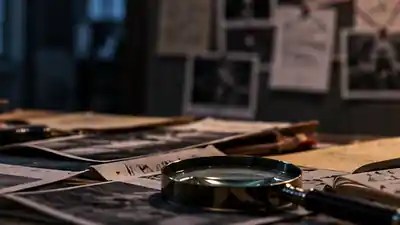
A fictional true-crime thriller borrows the investigative texture of a case file without presenting a real crime. Instead of asking readers simply to follow a protagonist through a conventional suspense plot, it invites them to reconstruct what happened from statements, timelines, messages, overlooked details, and competing versions of the truth.
That distinction matters. True crime is nonfiction: it deals with real people, real victims, real investigations, and the ethical responsibilities that come with writing about them. Fictional true-crime thrillers use some of the narrative tools associated with investigative reporting and documentary storytelling, but the case itself is invented. The result can feel unusually immediate while still giving the author full control over the mystery, evidence, suspects, and resolution.
Key idea: A fictional true-crime thriller is invented fiction presented with the investigative logic of a case reconstruction.
A thriller designed like a reconstruction
In a traditional thriller, the reader often experiences events in sequence: a threat appears, the protagonist reacts, the danger escalates, and the story moves forward. A fictional true-crime thriller can work differently. The central event may have happened before the story begins. Someone disappeared. A journey ended in an unexplained gap. A witness changed a statement. A seemingly ordinary day contains one hour that no one can account for.
The pleasure comes from reconstruction. Readers are shown fragments and asked, implicitly, to compare them. Which account is consistent with the known timeline? Which detail is repeated too carefully? What object seemed meaningless at first but becomes important later? Why does one witness remember a sound, a route, or a conversation differently from everyone else?
This structure creates a distinctive kind of suspense. The tension does not depend only on what might happen next. It also depends on what already happened but has not yet been understood.
The tools of documentary-style suspense
Fictional true-crime thrillers often use details that feel procedural without becoming dry. A route log can establish where someone should have been. A photograph can contradict a remembered time. A voicemail can change the emotional meaning of an earlier scene. A witness statement can be technically accurate while still hiding the most important fact.
- Timelines reveal gaps, overlaps, and impossible sequences.
- Witness statements create tension between memory, self-protection, and truth.
- Messages and calls preserve fragments of intent long after the sender is gone.
- Ordinary objects become evidence when their context changes.
- Official explanations provide a version of events that may be incomplete rather than entirely false.
None of these devices needs to look like a literal police report on the page. The important quality is the feeling that the story has been assembled from evidence. Readers are encouraged to notice discrepancies rather than merely wait for a twist.
Why unreliable testimony is so powerful
One of the strongest engines in this kind of fiction is conflicting testimony. People rarely remember an event in identical ways, and memory is not a recording. Fear, loyalty, embarrassment, guilt, grief, and self-interest all affect what a person notices and what they later choose to say.
A strong fictional investigation does not need every witness to be a deliberate liar. In fact, the story is often more convincing when several people are partly right. One remembers the weather correctly but gets the time wrong. Another remembers the exact words of an argument but conceals why they were nearby. A third tells the truth as they understood it, unaware that one assumption was false.
This gives the reader an active role. The question becomes not simply, “Who is lying?” but “Which parts of these accounts can exist together?” That is closer to solving a puzzle than receiving a sequence of revelations.
The appeal of the missing hour
Many documentary-style mysteries are built around absence: a missing person, a missing document, a missing call, a missing witness, or a missing stretch of time. Absence is powerful because it creates a shape the reader can see without yet knowing what belongs inside it.
A timeline may look complete until one unexplained interval appears. Once that gap matters, every event around it changes. Who had access? Who knew the route? Who had time to act? Why was an ordinary stop omitted from the first account? The mystery becomes concentrated around a blank space, and the reader begins testing every new detail against it.
This is one reason disappearance stories are so well suited to fictional true-crime form. The absence at the center of the story affects every surviving piece of evidence.
How Audrey Valehurst uses the form
Audrey Valehurst’s thrillers are built around the idea that the accepted version of an event may be only the first version. In The Bride Who Never Arrived, a wedding-day disappearance becomes a problem of shifting accounts, messages, and a missing interval. In The Last Delivery on Route Six, an apparently routine route becomes disturbing when its final sequence of stops no longer fits the simple explanation first offered.
The emphasis is on investigative suspense rather than graphic violence. The story asks readers to pay attention to what was said, what was omitted, and what becomes significant only after another fact is uncovered.
Is fictional true crime the same as a crime novel?
It belongs to the broad crime and thriller family, but its reading experience is different enough to deserve a clear label. A police procedural may focus on investigators and official methods. A psychological thriller may center on identity, manipulation, or danger inside a relationship. A fictional true-crime thriller is especially interested in reconstruction: how a case looks when assembled from incomplete evidence and contradictory human accounts.
For readers who enjoy podcasts, documentary series, cold-case discussions, timeline analysis, and mysteries where one small inconsistency changes the meaning of everything, the form offers a natural bridge between investigative storytelling and fully invented suspense.
Explore fictional true-crime at Wonder Shelf Books
Visit our Fictional True-Crime Thrillers section, discover Audrey Valehurst, browse New Releases & Promotions, or join the Wonder Shelf Books newsletter.
 Wonder Shelf Books