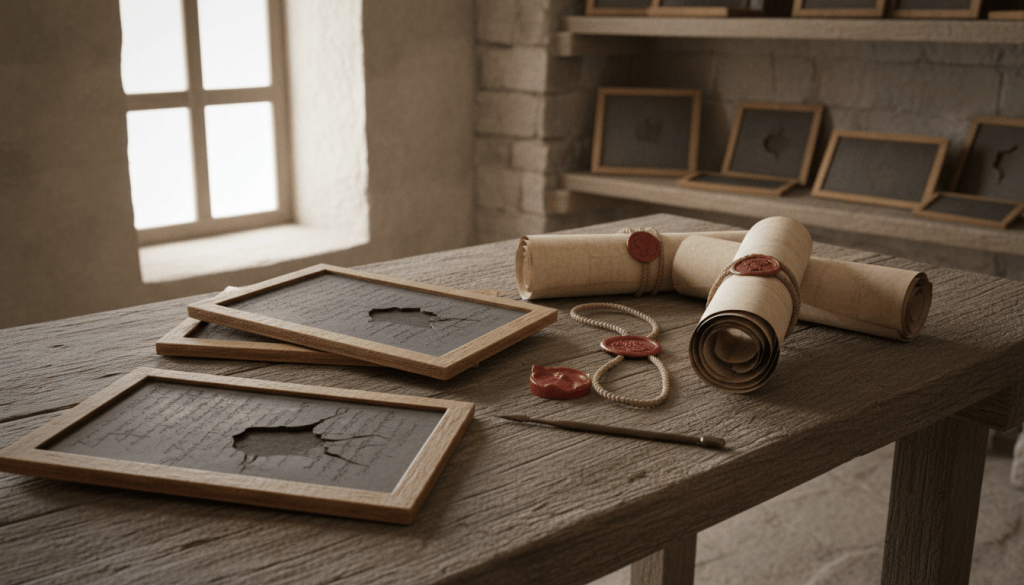
An important document in ancient Rome could affect ownership, inheritance, debt, legal rights, or reputation. Before modern envelopes, printed signatures, and electronic records, people used physical devices to show that a text had been closed and that its contents had not been casually altered. Wax seals, cords, folded tablets, and witnesses all played roles. Their effectiveness depended not on one ingenious object but on an entire practice of authentication and custody.
What kinds of documents did Romans use?
The Romans wrote on several materials, depending on purpose and period. Wooden tablets coated with wax were useful for notes and certain legal acts: a stylus scratched letters into the darkened writing surface, and its flattened end could smooth wax for corrections. Papyrus scrolls and sheets served other writing needs. More durable inscriptions appeared on stone or bronze when public display and permanence were the goal.
An everyday shopping note and a document asserting a legal obligation did not need identical protection. The latter might require identified witnesses, recognized wording, and measures to discourage substitution. Surviving evidence also varies widely across place and time, so there was no single Roman security protocol suitable for every century.
How did wax seals work?
A seal was an impression made in a pliable substance by a signet or seal device, often in connection with ties securing a document. Wax is particularly familiar from later and literary representations; Roman material evidence and practices also include sealing compounds and impressed materials that must be understood in their own context. The significant feature was the personal or identifiable impression.
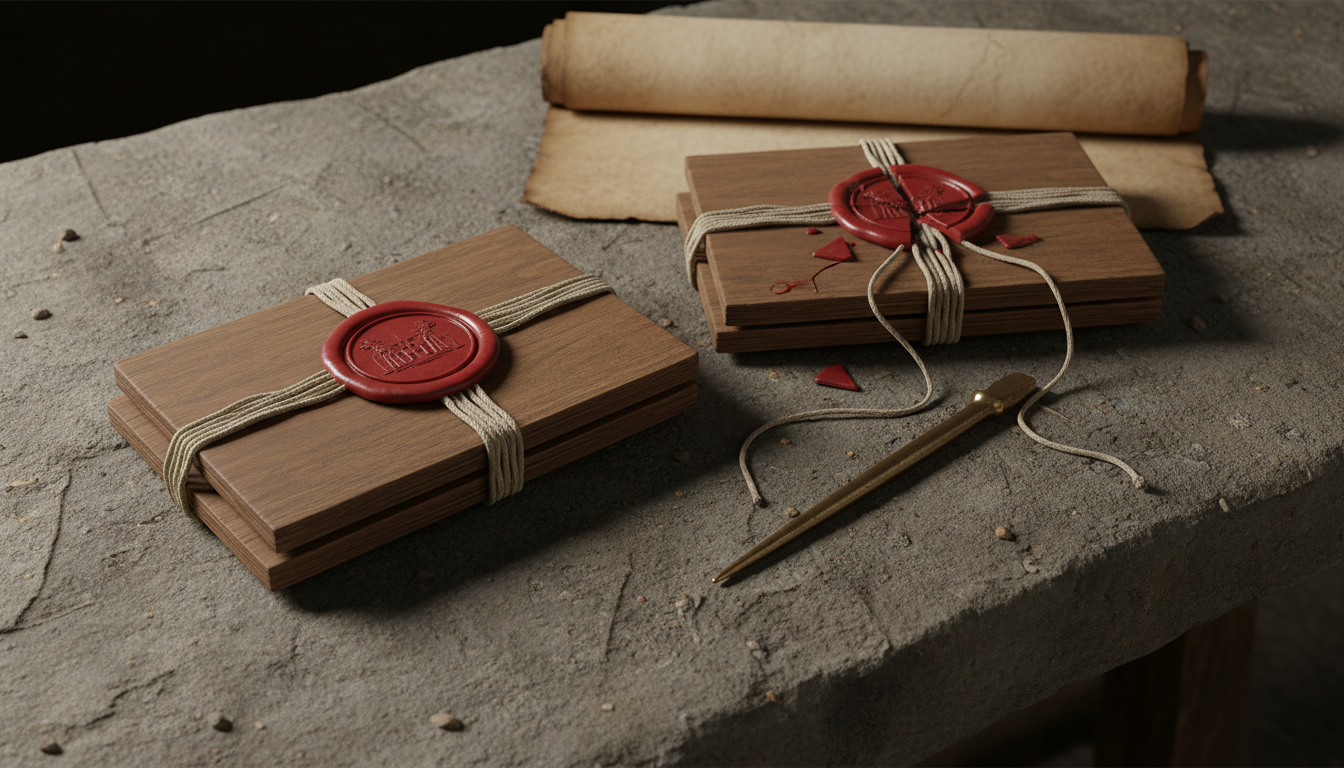
When a folded or bound document was secured with cord and impressed seals, opening it in an unauthorized way could disturb that arrangement. A broken seal might signal access since sealing, while a seal associated with a known witness could help people identify who had participated. But a visual mark alone was not an infallible guarantee: impressions could be imitated, and seals could be damaged accidentally.
Why were witnesses essential?
A seal became more meaningful when combined with people who could attest to an act. Roman documentary procedures, especially in some legal contexts, used groups of witnesses whose names and seals formed part of the evidence. The exact number and arrangement depended on the kind of legal instrument and the governing period.
For some transactions, documentary requirements became particularly formal. A sealed writing tablet could carry both a legally significant interior text and information visible on the outside. If the parties later disagreed, the artifact, the witness identifications, and the surrounding circumstances could all matter. The system sought credibility through corroboration rather than through the mere attractiveness of a signet.
What were triptychs and sealed tablets?
Roman legal documents could be prepared using multiple wooden leaves joined together. In some surviving examples, the inner text was protected while an outer version or summary remained accessible. A three-leaf arrangement is commonly called a triptych. The precise layout mattered: a cord might pass through holes or grooves, with seals guarding the concealed portion.
This arrangement reduced the need to expose a protected text every time someone wished to identify the document. It also created a physical distinction between a document whose bindings remained intact and one that had been opened. Yet historians must inspect the specific archaeological object or legal source before claiming a universal arrangement for all Roman wills and contracts.
How could an ancient document be tampered with?
Possible risks included replacing one copy with another, making changes before final sealing, opening bindings and attempting to restore them, or presenting a genuine-looking document without a dependable chain of custody. Different handwriting, unusual materials, or an inconsistent witness list could raise questions. None of these details automatically proved a crime.
For instance, a damaged cord might indicate deliberate access, ordinary wear, or mishandling after discovery. Variants between two copies might arise from a copyist’s error, a legitimate revision, or dishonest intervention. Careful interpretation requires reconstructing when each version was produced and who had access to it.
How did Romans detect forgery?
Roman law recognized problems associated with false documents and forged seals. The lex Cornelia de falsis, linked to Sulla’s legislation, became a central reference point in later legal discussion of falsification. Its interpretation and application changed across periods. Roman writers and jurists addressed forgery in relation to wills and other legally consequential instruments.
A disputed writing could be challenged through testimony, comparison, and the surrounding legal facts. Modern handwriting expertise did not exist in its current form, so it is misleading to imagine a standardized Roman forensic laboratory. The useful historical question is more modest: what evidence would persuade the people authorized to decide whether a particular instrument could be trusted?
What does a chain of custody mean in an ancient setting?
Today the phrase describes a documented sequence showing who possessed evidence and how it was handled. The Romans did not use this modern forensic label, but the underlying problems were familiar: who deposited a document, where it was stored, who could retrieve it, and when it was opened. Witnesses, repositories, and identifiable seals could each help establish a credible story of custody.
Archives and private collections served different purposes. Public records could be associated with official offices, while families, businesses, and religious establishments kept documents relevant to their affairs. It is important not to project a single modern archive catalog onto all these settings. Security was shaped by local practice, the authority of custodians, and the social standing of those asking to inspect the records.
Why are wax seals useful clues in historical mysteries?
The power of a sealed document as a fictional clue comes from its double nature. It contains a statement written by someone, and it is also an object with a physical history. A mystery can ask not only ‘What does this clause say?’ but also ‘Who tied this cord?’, ‘Why does this impression differ?’, or ‘When was this packet last intact?’
Such clues are fair to readers when their meaning is established through observable details. The same seal should not magically identify a culprit; the investigator needs supporting facts about access, opportunity, chronology, and motive. An apparently altered document may be central to a crime—or it may distract from a different problem.
In Theo Penrose’s fictional ancient-Roman mystery Ash Beneath the Atrium: A Vestal Mystery, a suspicious death and discrepancies in preserved records create exactly this kind of evidence-led investigation. The setting is a sacred household during Vestalia, but the broader idea extends to mysteries in monasteries, manor houses, libraries, and commercial archives.
What can an ancient seal actually prove?
An intact seal can support an argument that a particular fastening has not visibly been disturbed. It cannot, standing alone, prove the text was genuine before sealing, that the correct witness applied it, or that every related copy matches. Likewise, a broken seal demands explanation rather than an immediate verdict.
For further examples of documentary clues in fiction, read Why Paper Trails Make Such Powerful Clues in Historical Mysteries, or discover Theo Penrose and his historical fiction. Understanding the material history of documents makes a seemingly minor discrepancy much easier to appreciate.
The Roman solution to document trust was layered: material signs, identifiable people, established procedures, and contested evidence. That is why a small pressed impression in wax can tell a surprisingly large story—provided we ask the right questions of it.
Read More from The Vestal Mysteries
Discover Ash Beneath the Atrium by Theo Penrose on Amazon, or enjoy the free reader bonus with two original stories. The fictional mysteries stand apart from the historical background discussed here.
Related reading: What Did the Vestal Virgins Actually Do in Ancient Rome?. Explore more books on the Theo Penrose author page.

