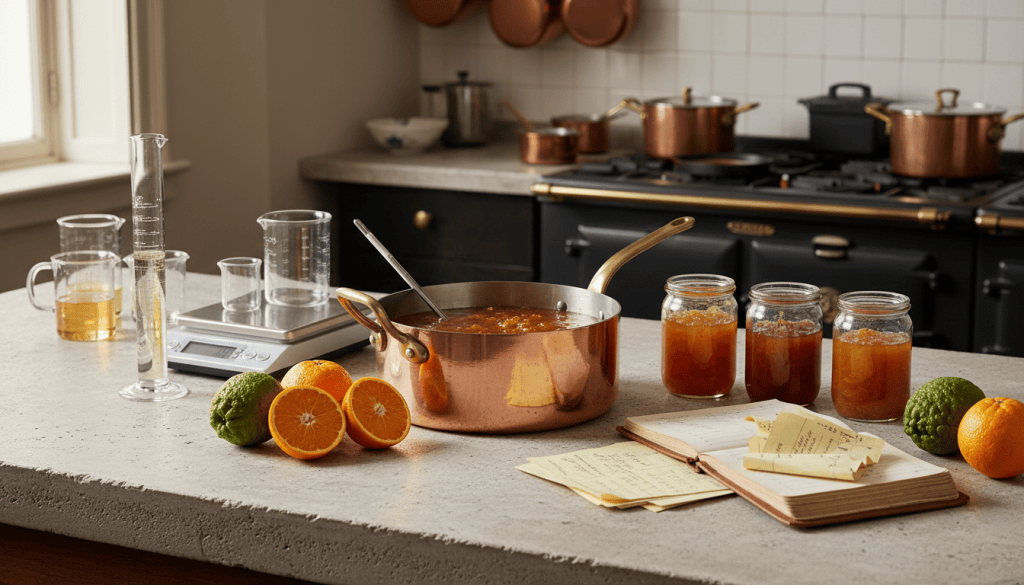
Book: The Marmalade Ledger at Marivelle
Author: Pippa Marlowe
Series: Secrets on the Marivelle Pass, Book 2
Inside: Two original cozy stories and three culinary companion recipes
BONUS STORY 1 — The Vanishing Winter Garden Teapot
The trouble with historic hotel objects, Sophie Delacourt had learned, was that the moment someone described them as priceless, three other people immediately wanted to put flowers beside them.
“No lilies,” she said.
Miriam Cole looked up from the Winter Garden seating plan. “There are no lilies.”
“There will be.”
“There are hellebores.”
“Worse.”
Tansy, arranging miniature lemon cakes on a silver stand, paused. “In what botanical system are hellebores worse than lilies?”
“The system in which florists place damp stems beside pastry.”
“Ah. Culinary taxonomy.”
It was early March, three damp weeks after Merehaven’s winter festival, and the Grand Marivelle had returned to the kind of crisis Sophie preferred: seventy-two afternoon teas, one local chamber-music fundraiser, six vegetarian substitutions, a photographer from the county paper, and an argument about whether a ceramic teapot should sit under glass.
The teapot was the argument.
Blue-and-white porcelain, low-bellied and slightly asymmetrical, it had been used in the Winter Garden sometime between the wars. Jonas Wren had produced it from the hotel archive that morning with cotton gloves, a padded box, a condition sheet, and an expression suggesting the object had survived ninety years solely through his personal vigilance.
It was not to hold tea. It was not to be touched by guests. It was not to be moved without Jonas. It was, Miriam had explained, to appear in one photograph beside the fundraiser’s printed program because the chamber society’s oldest surviving concert notice mentioned “tea at the Marivelle following the performance.”
Sophie had asked why a concert notice required a teapot.
Miriam had said, “Atmosphere.”
Sophie distrusted atmosphere. It tended to stain table linen.
At eleven twenty, Jonas placed the teapot on a felt-covered side table near the windows. At eleven twenty-five, the photographer arrived. At eleven twenty-seven, Miriam discovered that the sponsor cards had been printed with last year’s date. At eleven thirty, Tansy announced that somebody had moved her candied lemon peel. At eleven thirty-two, Sophie found the peel exactly where Tansy had left it.
At eleven thirty-four, Jonas made a sound Sophie had previously heard only from chefs watching sauce split during service.
The teapot was gone.
The felt square remained. So did the condition sheet. So did the small museum card that read WINTER GARDEN TEA SERVICE, c. 1930s.
The teapot did not.
“Nobody moves,” Jonas said.
A porter carrying twelve folded music stands stopped mid-step.
Tansy looked delighted. “I’ve always wanted someone to say that in a hotel.”
“Not helping,” Sophie said.
Julian arrived from the main corridor with the calm expression of a man who had been informed that history was missing and had decided not to let history see him hurry.
“What’s gone?” he asked.
Jonas pointed to the empty felt.
Julian looked at it once. “The blue pot.”
“You knew?” Sophie asked.
“Jonas showed me the movement authorization at eight fourteen.”
Tansy stared. “There is a movement authorization for crockery?”
“There is now.”
Jonas looked almost proud.
Julian turned to the nearest staff door. “Who has been through here since eleven twenty?”
Finn, supervising room movement for the fundraiser, checked his notes. “Photographer. Florist. Two servers. One porter. Me. Chef Vale’s pastry runner. Housekeeping once.”
Tansy raised a finger. “My runner has a name.”
“I know. I’m protecting him from this conversation.”
“Good management.”
Sophie crouched beside the table.
Nothing dramatic. No broken porcelain. No snagged cloth. No footprint, because this was a hotel and the floor had been polished recently enough to make footprints a personal insult to housekeeping.
But on the felt square sat one small dark crescent.
Sophie touched it with one finger.
“Wet?” Julian asked.
“Dry.”
She smelled her fingertip.
Tansy leaned closer. “Please tell me history smells suspicious.”
“Tea.”
Jonas recoiled. “Impossible.”
“The pot had tea in it?” Miriam asked.
“It was empty,” Jonas said. “Completely dry.”
Sophie looked at Julian.
He looked toward the service pantry.
They reached it together.
On the tea shelf sat a second blue-and-white teapot.
At first glance it looked identical.
Jonas made another sound.
“That,” he said, “is the reproduction.”
Sophie picked it up by the handle. Newer glaze. Slightly heavier. A maker’s mark beneath the base. No repaired hairline near the spout.
“Why does the hotel have a reproduction?”
Miriam, who had followed them, looked guilty enough to become useful.
“For photographs.”
Jonas turned slowly. “What?”
“Not today’s photograph. Generally. We had it made last year so the original wouldn’t need to leave the archive every time someone wanted heritage tea service.”
“And where,” Jonas asked with terrifying calm, “was this information recorded?”
Miriam hesitated.
Tansy whispered, “This is better than pastry.”
Sophie ignored her.
The reproduction’s normal place was the service pantry. The original had been placed in the Winter Garden. Someone, seeing a blue teapot where a blue teapot was expected, had apparently used the wrong one.
Julian reached for the internal phone.
“Tea requests since eleven twenty.”
Finn checked the board. “Room 214. Room 307. Private salon B. One staff pot in the committee room.”
“Which used blue service?” Sophie asked.
Finn frowned. “None intentionally.”
“Intentionally is carrying a lot of weight.”
Tansy lifted the reproduction’s lid.
“This one has never been used today.”
Sophie looked inside. Dry. No heat. No leaf residue.
“So the original went into service.”
Jonas went pale.
Julian said, “It has survived eighty or ninety years. It can survive twelve minutes of Earl Grey.”
“That is not the point.”
“No,” Julian said. “But it may help you breathe.”
It did not.
Room 214 had ordered mint tea and returned the pot already. White porcelain.
Room 307 had ordered breakfast tea for two. Silver service.
Private salon B had a coffee service.
That left the committee room.
They found four festival volunteers, three stacks of envelopes, a broken stapler, and no teapot.
“We had tea,” one volunteer said. “It went back ten minutes ago.”
“Which corridor?” Julian asked.
“The young server took it.”
Finn closed his eyes.
“Theo.”
“Find Theo,” Julian said.
They found him in the dish lobby, staring at three teapots as though they had formed a tribunal.
“I was coming to tell someone,” he said immediately.
“Good,” Julian said. “Tell us.”
Theo pointed.
On a folded drying cloth sat the missing blue teapot.
Whole.
Clean.
And, to Jonas’s horror, recently washed.
“I thought it was pantry service,” Theo said. “It was where the blue one normally sits, except not exactly there, but I was carrying two trays and someone asked for another pot and—”
“Stop,” Julian said.
Theo stopped.
“Did you drop it?”
“No.”
“Chip it?”
“No.”
“Scrub it?” Jonas asked.
Theo looked frightened. “No. I rinsed it by hand. Soft cloth. I know old glaze can craze.”
Jonas blinked.
“You know that?”
“My mother restores ceramics.”
Tansy whispered, “Plot twist.”
Sophie elbowed her.
Theo had realized something was wrong when he saw the old repair beneath the spout. He had stopped, dried the pot gently, and been working out whether admitting the mistake would get him dismissed.
Julian looked at the teapot.
Then at the reproduction.
Then at the shelf labels, which said TEA SERVICE but did not distinguish historic from replica because, as Miriam had now admitted, nobody had expected both pots to be in circulation on the same morning.
“You’re not dismissed,” Julian said.
Theo exhaled so hard the spoons beside him rattled.
Jonas opened his mouth.
Julian lifted one hand. “You can be angry with the system first.”
Jonas closed his mouth.
Sophie watched that.
She understood systems better than she wanted to admit. Kitchens trained people to blame the nearest pair of hands because hands were visible. But if two objects looked nearly identical, sat in adjacent work zones, and depended on unwritten knowledge to remain separate, then the mistake had been waiting for a busy morning.
“The reproduction needs a permanent mark,” she said.
Jonas nodded reluctantly.
“And the original doesn’t leave the archive without a dedicated case.”
“Agreed,” Julian said.
Miriam said, “And perhaps no flowers.”
Sophie looked at her.
“Now you understand.”
The photograph was taken at twelve fifteen using the reproduction.
The original went back to the archive under Jonas’s supervision, wrapped in enough acid-free tissue to survive a minor geological event.
The fundraiser opened on time.
Tansy’s lemon cakes disappeared first.
At two forty, Sophie found Julian at the edge of the Winter Garden watching a student quartet tune beneath the glass roof.
“Theo?” she asked.
“Back on service.”
“Jonas?”
“Writing a revised handling protocol.”
“How many fields?”
“Currently nine.”
“Reasonable.”
“That may be the first time anyone has said that about one of his forms.”
They stood for a moment without speaking.
The quartet began testing a slow passage. Rain made small bright tracks down the Winter Garden panes.
Sophie said, “You didn’t make Theo explain himself in front of everyone.”
Julian glanced at her. “He’d already understood the mistake.”
“Some managers like the performance of correction.”
“Some chefs too.”
She looked at him.
His expression remained perfectly neutral.
“Dangerous,” she said.
“What?”
“Accuracy.”
His mouth shifted.
Not quite a smile.
Close enough.
Tansy appeared behind them with two plates.
“I brought peace offerings.”
“For what?” Sophie asked.
“For having enjoyed the teapot crisis too much.”
She handed them lemon cakes.
Sophie took one.
Julian did too.
“Any historic crockery involved?” he asked.
“Only emotionally.”
The quartet began properly.
The Winter Garden filled with music, tea, wet coats, and the small domestic noise of people giving money to a cause while pretending not to care who had eaten the last lemon cake.
The original teapot stayed exactly where it belonged.
Which, Sophie decided, was the closest a hotel ever came to peace.
BONUS STORY 2 — The Two Pies of Merehaven
Sophie had agreed to judge the Merehaven Spring Table because Tansy had lied to her.
“You said tasting.”
“Judging contains tasting.”
“So does poisoning.”
“That feels unnecessarily dark for apple pie.”
The Spring Table occupied the old assembly hall above the harbor: folding tables, paper bunting, mismatched crockery, three hundred daffodils, and enough baked goods to make fire regulations feel theoretical.
It was the first Saturday in April, cold enough outside for coats and bright enough inside for Merehaven to behave as though spring had already signed a contract.
The event raised money for the town’s shared garden plots and tool shed. Nothing about it required the Grand Marivelle. That was part of why Sophie had allowed Tansy to drag her there.
No ballroom.
No guest list.
No historical reconstruction.
Just twelve tables of bread, pies, chutneys, seed cakes, savory tarts, and people who had been arguing about pastry since before Sophie arrived in Merehaven.
“You’ll love it,” Tansy said.
“I already don’t.”
Mae Kersey appeared beside them carrying a paper cup of coffee.
“Good. You came.”
Sophie looked at her. “Were you involved?”
Mae drank.
“That is not a denial.”
“The original third judge has influenza.”
“And somehow this became my problem.”
“You have opinions.”
“So does everyone here.”
Mae looked around the hall. “Yes. But yours come with knife skills.”
The pie class had twenty-two entries.
Entries were anonymous. Each pie sat behind a small card bearing only a number. Judges scored crust, filling, balance, texture, appearance, and what the committee called “overall pleasure,” a category Tansy considered spiritually important.
By pie seventeen, Sophie regretted every life choice that had led her to a room containing this much butter.
By pie twenty, Tansy was still cheerful.
“You’re unnatural,” Sophie said.
“I trained for this.”
“Professionally?”
“Emotionally.”
The final scores were close.
Number fourteen: apple, honey, restrained spice, crisp base, clean edge.
Number forty-one: also apple, also honey, also excellent, with a softer crust and a distinct herbal note Sophie could not immediately place.
“Fourteen,” she said.
Tansy nodded. “By two points.”
The third judge, Mr. Vale from the bakery cooperative, agreed.
Mae carried the result to the registration desk.
Three minutes later, the hall exploded.
Not literally.
There were standards.
But two women reached the judging table at the same time, each accompanied by relatives, and each insisting the winning pie was hers.
“My entry was fourteen,” said the first woman.
“No, mine was fourteen,” said the second.
Sophie looked at Tansy.
Tansy looked delighted again.
“No.”
“I didn’t say anything.”
“Your face did.”
The first baker was Nora Bell, a retired school secretary with silver hair, a severe navy cardigan, and the posture of a woman who had spent thirty years making adolescents explain themselves.
The second was Elsie Fen, who ran a small guesthouse on the north road and wore an apron printed with yellow pears despite having entered an apple pie.
Both produced registration stubs.
Nora’s said 14.
Elsie’s also said 14.
Mae looked at the stubs.
“That seems suboptimal.”
The registration volunteer went pale.
“I wrote them from the sheet.”
“Where’s the sheet?” Sophie asked.
The volunteer pointed to a table where a vase of daffodils had recently fallen over.
The sheet was wet.
Very wet.
The ink across entries thirteen through forty-two had become a blue-grey marsh.
Tansy leaned in. “Flowers again.”
Sophie looked at her.
“I’m developing a position.”
Number forty-one still sat on the judging table.
Number fourteen had been moved to the winner’s display.
“Which one did each of you bake?” Sophie asked.
“Apple and honey,” Nora said.
“Apple and honey,” Elsie said.
Tansy covered her face.
“Of course.”
Nora crossed her arms. “Mine has no cinnamon.”
Elsie said, “Neither does mine.”
“Mine uses honey from my brother’s hives.”
“So does mine.”
Sophie looked from one to the other.
“Are your brothers the same man?”
“Cousins,” Mae said.
Sophie closed her eyes.
Merehaven.
The prize was not valuable. A ribbon, a small silver-colored trophy, and a year’s worth of bragging rights.
The bragging rights were the problem.
“We can identify them,” Tansy said.
“By taste?” Mae asked.
“If they tell us what they did.”
Sophie shook her head. “Separately.”
Nora was sent to the seed-cake table.
Elsie stayed.
“Describe your crust,” Sophie said.
Elsie narrowed her eyes. “Are you trying to steal it?”
“No.”
“She already has pie,” Tansy said.
“Too much pie.”
Elsie thought.
Butter crust. A spoonful of ground oats. Cold water. No egg. Apples cut thick. Honey warmed before mixing. A small amount of fresh thyme rubbed between the fingers and scattered beneath the apples.
There.
The herbal note.
Sophie said nothing.
Nora returned and described hers.
Butter and a little lard. Plain flour. Egg yolk. Apples sliced thinner. Honey brushed over the fruit after baking. Lemon zest. No herbs.
Tansy’s eyes met Sophie’s.
Number forty-one was Elsie’s.
Number fourteen was Nora’s.
Which should have ended the matter.
It did not.
Elsie produced her phone.
On it was a photograph taken at home before she left.
Her pie sat on a white plate.
A paper tag beside it clearly read 14.
Nora produced her own photograph.
Her pie sat on a blue plate.
The tag beside it clearly read 41.
Sophie stared.
“So the stubs were switched after arrival,” Mae said.
“Or the pies were.”
Tansy looked toward the registration table.
“How did entries get from check-in to judging?”
The volunteer explained.
Each pie received a numbered card. The baker received a matching stub. Pies were then carried to the judging tables in groups of six. Numbers stayed with the plates.
“Plates,” Sophie said.
Nora’s home photograph showed blue.
Elsie’s showed white.
On the judging table, number fourteen sat on white.
Number forty-one sat on blue.
Mae looked at Sophie.
“The plates moved.”
“The pies didn’t,” Sophie said.
Tansy frowned. “Who replated twenty-two pies?”
Nobody had.
But between registration and judging, one table had lost a leg brace and begun listing toward the floor. Volunteers had shifted six pies onto a neighboring table while the brace was fixed.
One of those volunteers was found near the bread raffle.
He remembered the emergency clearly.
“I moved the cards first so I’d know where each pie went.”
“Cards first?” Sophie repeated.
“Yes.”
“Then the pies?”
“Yes.”
“In the same order?”
He hesitated.
There it was.
“I thought so.”
Tansy smiled with terrifying sweetness.
“You rotated the tablecloth, didn’t you?”
He stared.
“What?”
She pointed.
The judging tablecloth had a small embroidered rose in one corner. The temporary tablecloth on the repaired table had the same rose, but it now sat at the opposite corner.
“You shifted the numbered cards left to right,” Tansy said, “then came back around the other side with the pies.”
The volunteer closed his eyes.
“I rotated the cloth because tea spilled.”
Sophie looked at Tansy.
“Flowers and linen.”
“I’m building a case.”
They reconstructed the six shifted entries from plate colors, photographs, and two other bakers who remembered where their own pies had been placed.
The switch was simple.
No sabotage.
No cheating.
No bitter feud between apple-pie dynasties.
Just a wobbling table, spilled tea, a rotated cloth, and six numbered cards returned in the wrong direction.
Number fourteen—the winning pie—was Nora’s.
Number forty-one was Elsie’s.
The committee corrected the registration sheet.
Nora received the ribbon.
Elsie received second place by one point after the judges recalculated the correctly identified entries.
She looked at Nora’s ribbon.
Nora looked at Elsie’s certificate.
“Your thyme is too strong,” Nora said.
Elsie sniffed. “Your crust is too serious.”
“It won.”
“By two points.”
“Two points is winning.”
“For now.”
They walked away together toward the coffee table, still arguing.
Sophie watched them go.
“That seems healthy,” she said.
Mae laughed.
Tansy took another piece of pie forty-one.
“You’re eating evidence,” Sophie said.
“Case closed.”
“That is not how evidence works.”
“It is how pastry works.”
By four o’clock, the garden fund had exceeded its target.
The bread raffle was won by a man who had only bought a ticket because his wife told him to.
The daffodils remained upright.
The repaired table was marked for retirement.
Sophie escaped the hall carrying half a slice of Nora’s winning pie wrapped in paper.
Outside, the harbor shone hard and silver beneath a clearing sky.
Julian stood at the bottom of the steps.
She stopped.
“Why are you here?”
“Mae said you might require extraction.”
Sophie looked back through the hall doors.
Tansy was accepting congratulations for solving linen.
“Accurate.”
Julian looked at the paper parcel in her hand.
“Evidence?”
“Pie.”
“I see.”
She held it out.
He looked at her.
“You’re sharing?”
“Don’t make it important.”
“I wouldn’t dare.”
They walked back toward the Marivelle with the harbor on their left and the last of winter loosening from the town.
Halfway up the hill, Julian took one bite of the pie.
“Very serious crust,” he said.
Sophie laughed before she could stop herself.
Behind them, somewhere in the assembly hall, Nora Bell and Elsie Fen were almost certainly still arguing.
Merehaven, Sophie thought, would survive spring.
CULINARY COMPANION — Sophie’s Winter-to-Spring Notebook
The recipes below are original reader-bonus recipes inspired by the fictional Grand Marivelle setting. They are not recipes reproduced from the novel.
1. Orange-Rosemary Shortbread
Makes: about 24 pieces
- 225 g / 1 cup unsalted butter, softened
- 100 g / 1/2 cup fine sugar
- Finely grated zest of 1 orange
- 1 teaspoon very finely chopped fresh rosemary
- 1/4 teaspoon fine salt
- 280 g / about 2 1/4 cups plain/all-purpose flour
- 1–2 teaspoons extra sugar for finishing
Heat the oven to 170°C / 340°F. Beat the butter and sugar just until smooth; do not whip in excessive air. Mix in the orange zest, rosemary, and salt. Add the flour and stir until a soft dough forms. Press into a lined 20 cm / 8-inch square tin, level the surface, and prick lightly with a fork. Chill for 15 minutes. Bake for 28–35 minutes, until pale gold at the edges. Sprinkle lightly with sugar while warm. Cool for 10 minutes, cut into fingers or squares, then cool completely in the tin.
2. Warm Apple-Honey Compote with Cultured Cream
Serves: 4
- 4 firm apples
- 20 g / 1 1/2 tablespoons butter
- 2 tablespoons honey
- 1 tablespoon lemon juice
- 2 tablespoons water
- 1 small strip of lemon peel
- Pinch of salt
- 120 ml / 1/2 cup crème fraîche, sour cream, or thick cultured cream
- Optional: toasted oats or chopped hazelnuts for serving
Peel, core, and cut the apples into thick slices. Melt the butter in a wide pan over medium heat. Add the apples and cook for 3–4 minutes, turning carefully. Add the honey, lemon juice, water, lemon peel, and salt. Cover and cook gently for 5 minutes, then uncover and cook until the apples are tender but still hold their shape and the juices have reduced to a light glaze. Remove the lemon peel. Serve warm with cold cultured cream and, if desired, toasted oats or chopped hazelnuts.
3. Thyme-Roasted Root Vegetable Tartlets
Makes: 6 tartlets
- 1 sheet ready-rolled puff pastry, about 275 g / 10 oz
- 1 small carrot
- 1 small parsnip
- 1/2 small red onion
- 1 tablespoon olive oil
- 1 teaspoon fresh thyme leaves
- 1/2 teaspoon salt
- Black pepper
- 60 g / 2 oz soft goat cheese or cream cheese
- 1 teaspoon Dijon mustard
- 1 egg, beaten, for brushing
Heat the oven to 210°C / 410°F. Cut the carrot and parsnip into thin ribbons or very fine matchsticks and slice the onion thinly. Toss with olive oil, thyme, salt, and pepper. Roast on a tray for 10 minutes, just until beginning to soften; cool slightly. Cut the puff pastry into six rectangles and score a 1 cm / 1/2-inch border around each without cutting through. Mix the cheese with mustard and spread a thin layer inside each border. Top with the vegetables. Brush the pastry edges with beaten egg. Bake for 16–20 minutes, until deeply golden and crisp. Serve warm or at room temperature.
Series note: The Grand Marivelle and Merehaven are fictional. These bonus stories are designed as optional between-books extras and do not replace any part of the published novel.
\n\n\nExplore more from this series on the series page and discover other companion resources in the Wonder Shelf Reader Extras library.
\n
