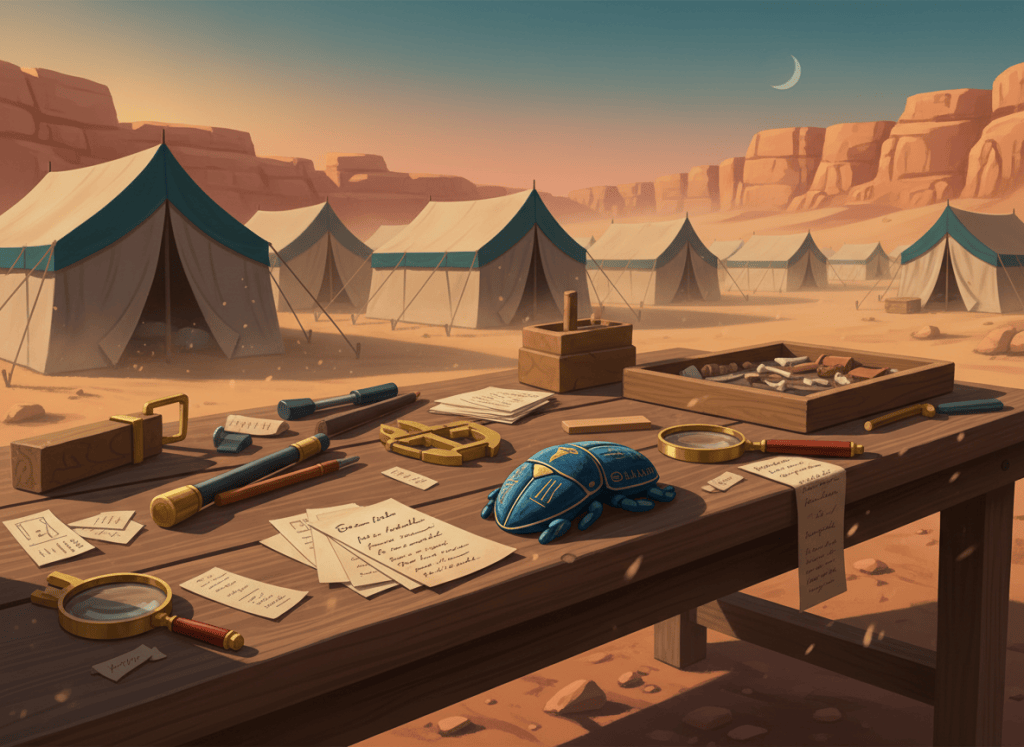
In an archaeological mystery, one of the smallest details on an artifact can become one of the strongest clues: its catalogue number.
A handwritten label, field-register entry, box code, storage number, or accession mark may look purely administrative. But in a clue-driven story, those systems create order—and anything that falls outside that order can become evidence. A duplicated number, an entry written in the wrong sequence, a label using an unfamiliar format, or a box whose contents do not match its register can tell a careful investigator that something has been moved, relabelled, added later, or deliberately made to look routine.
Why catalogue numbers work so well as mystery clues
Cataloguing systems are designed to make objects traceable. The exact method varies between excavations, museums, collections, and periods, but the basic narrative principle is simple: a number connects an object to a record.
That connection gives a mystery writer two pieces of evidence instead of one. There is the physical artifact, and there is the information attached to it. If the object and the record agree, nothing may seem unusual. If they conflict, the discrepancy creates a question.
A ceramic fragment may carry the correct site code but appear in the wrong storage tray. A scarab may have a catalogue number that belongs to another find. A field tag may use a handwriting style associated with a person who was supposedly absent. A sequence may jump unexpectedly from 214 to 216, leaving the reader to wonder what happened to 215.
A numbering system creates expectations
Mystery clues become fair when readers are given enough information to understand what should be normal. A catalogue system is ideal for this because the story can establish its rules early.
- Finds from one area may share a site or trench code.
- Objects may be entered in roughly chronological order.
- Boxes or trays may carry matching inventory references.
- Field notebooks may repeat the same identifying number used on labels.
- Photographs may show an object beside its original tag.
- Later collection records may refer back to an earlier excavation number.
Once those expectations are clear, a tiny inconsistency becomes meaningful. The clue does not need to be dramatic. Its power comes from violating a system the reader has already learned to trust.
Duplicate numbers can create two competing histories
One particularly useful mystery device is the duplicate number. If two objects appear to carry the same identifier, several explanations become possible.
There may have been an innocent clerical mistake. A label could have been copied incorrectly. An object might have been renumbered during later cataloguing. Or someone may have deliberately given one artifact the identity of another.
That last possibility is especially rich for fiction because it allows the physical object and the documentary record to tell different stories. The investigator must determine which is trustworthy, who had access to the records, and whether the duplication benefits anyone.
Sequence errors can expose when a record was created
Numbers also suggest sequence. If a register was normally filled in as discoveries were processed, an entry that appears in an unexpected place may raise questions. Was it added later? Was a page replaced? Was the number copied from an older record? Does the ink, handwriting, or wording match nearby entries?
A mystery can use this without requiring the reader to understand specialist archaeology. The key is comparison. If five entries follow one pattern and the sixth breaks it, the anomaly becomes visible.
Labels can reveal more than the object itself
Physical labels are especially useful because they can preserve small details that official summaries omit. A label may have been folded, rewritten, pinned, tied, pasted, replaced, or written in a different pencil. It may contain an abbreviation that one assistant uses but another never does.
Those details give the sleuth something concrete to compare. An apparently ordinary object may become suspicious not because of its appearance, but because its label does not behave like the others around it.
The strongest clue often comes from cross-checking records
A catalogue number becomes much more powerful when it can be checked against another source. The same identifier might appear in a field notebook, packing list, photograph, storage ledger, telegram, shipping document, or later collection register.
If all of those sources agree, the history of the object becomes stronger. If one contradicts the others, the mystery gains a fault line.
This is why document-driven mysteries reward patient comparison. One record rarely solves everything. Instead, several ordinary records begin to disagree in ways that only become important when placed side by side.
How this differs from archaeological provenance
Catalogue numbers and provenance are related, but they are not the same thing. A catalogue number is an identifying tool inside a recording system. Provenance concerns the broader documented history of an object—where it came from, who held it, and how it moved through collections or institutions.
For a deeper explanation of that broader history, see What Is Archaeological Provenance—and How Can a Missing Record Change an Artifact’s Story?.
Why cataloguers make believable mystery protagonists
A cataloguer has a natural reason to notice anomalies that other characters might ignore. The work encourages attention to sequence, labels, handwriting, storage location, cross-references, and the exact wording of records.
That creates a form of detective work based on professional habit rather than improbable intuition. The sleuth does not need to recognize danger instantly. She only needs to recognize that something does not belong where the record says it belongs.
This is central to Theo Penrose’s The Scarab at Sundown, the first Archaeological Digs Mysteries novel. Widowed archaeological cataloguer Cressida “Cress” Vale works in a world of excavation records, labels, inventories, photographs, telegrams, and disputed artifacts. Her advantage is not physical force. It is knowing how objects and records are supposed to fit together—and noticing when they do not.
Explore the full Archaeological Digs Mysteries or visit the Theo Penrose author page.
Paper trails make the puzzle larger
A catalogue number is rarely interesting in isolation. Its real value appears when it becomes one strand in a wider paper trail. A numbered object can be compared with a railway record, hotel register, letter, photograph, inventory sheet, or shipping document.
That wider documentary method is explored in Why Paper Trails Make Such Powerful Clues in Historical Mysteries.
Small clerical details can carry large consequences
The appeal of a catalogue-number mystery is that the decisive clue can be almost invisible. A transposed digit, missing entry, repeated code, rewritten label, or object in the wrong tray may look trivial until the investigator understands what the system was designed to preserve.
That is exactly what makes these clues satisfying in historical mystery fiction. The evidence is not hidden behind extraordinary technology. It is sitting in plain sight inside the ordinary machinery of record-keeping, waiting for someone attentive enough to notice that the pattern has broken.
 Wonder Shelf Books