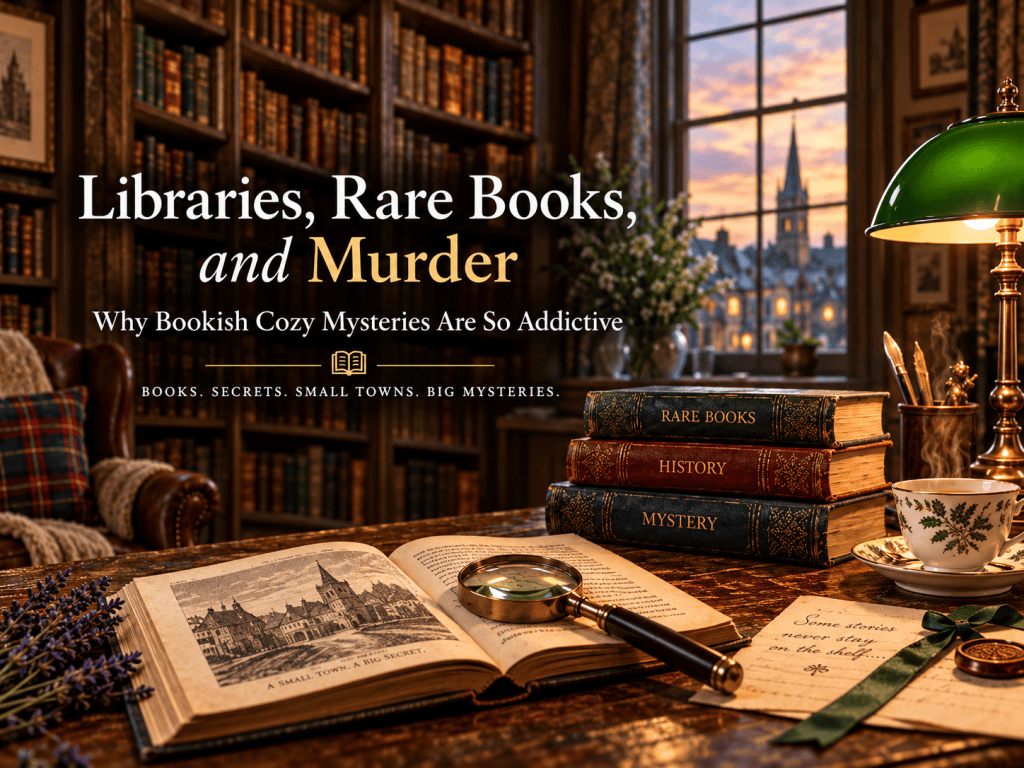
There is something wonderfully dangerous about a library in a mystery novel.
Rows of books create the appearance of order. Every volume has a place. Every title can be catalogued. Every borrower can be recorded.
But books have histories of their own.
A missing page.
A handwritten note in the margin.
A dedication that should not be there.
A rare edition quietly removed from a locked collection.
A book returned by somebody who was never supposed to have borrowed it.
And sometimes, a library contains exactly the piece of evidence someone hoped would never be found.
That combination of comfort and secrecy helps explain why bookish cozy mysteries have become such an appealing corner of the genre.
In Miriam Alderwick’s Ashworth Library Mysteries, books, archives, literary communities, old collections, and the people who protect them become part of the investigation itself.
Libraries Are Naturally Full of Secrets
Libraries seem peaceful because so much of what happens inside them is quiet.
That does not mean nothing is happening.
People research family histories.
Rare books change hands.
Collections are donated.
Private papers are catalogued.
Old correspondence is discovered.
Researchers request materials that have not been opened for decades.
A library is therefore one of the few places where information from completely different periods can exist side by side.
A newspaper clipping from fifty years ago may sit only a few shelves away from a modern local history.
An old diary can contradict the official biography of a respected figure.
A forgotten donation may contain documents nobody expected to survive.
For a mystery writer, that is an extraordinary amount of potential evidence.
The detective does not always need to discover something newly created.
Sometimes the clue has been waiting on a shelf for years.
Rare Books Make Excellent Mystery Objects
Rare books carry several kinds of value at once.
They can be financially valuable.
Historically important.
Emotionally significant.
And sometimes dangerous.
A first edition might reveal ownership through a bookplate.
A handwritten inscription may connect two people who publicly denied knowing each other.
Marginal notes can show what a reader was thinking decades earlier.
A replacement binding may conceal something placed inside the original cover.
Even the absence of a book can become evidence.
Who removed it?
Why?
Was someone trying to steal something valuable—or simply prevent somebody else from reading it?
This makes rare books unusually satisfying mystery objects because they are never merely decorative.
Their physical details can matter.
Paper.
Ink.
Binding.
Provenance.
Annotations.
Library stamps.
Borrowing records.
A cozy mystery can turn all of these into clues without losing the warm, bookish atmosphere readers came for.
Marginalia Turns Reading Into Detective Work
There is something intimate about writing inside a book.
A printed text belongs to everyone who owns a copy.
A handwritten comment belongs to one particular reader.
That is why marginalia is so useful in a mystery.
A sentence underlined twice may reveal what mattered to somebody.
A question mark beside a paragraph can show doubt.
Initials may identify a reader.
A date can place a person somewhere at a particular moment.
An apparently meaningless symbol may turn out to be part of a private code.
And once readers understand that the marks themselves matter, the act of examining the book becomes part of the investigation.
That is particularly appropriate for a bookish cozy mystery.
The sleuth and the reader are doing something very similar.
Both are looking closely.
Both are searching for patterns.
Both are asking why one detail was included while another was omitted.
The Restricted Room Is Almost Too Perfect
Every library mystery deserves at least one place readers are not supposed to enter.
A restricted collection immediately creates questions.
Why is access limited?
What is being protected?
Who has permission?
Who knows where the keys are kept?
And who might have entered without authorization?
The appeal is partly practical. Rare materials require protection.
But in mystery fiction, restricted spaces also represent hidden knowledge.
The locked room becomes a promise.
Something inside matters.
The fun comes from discovering whether the secret is valuable, embarrassing, historically important—or connected to murder.
Miriam Alderwick’s Ashworth setting uses precisely this tension between a respectable institution and the secrets preserved inside it.
Libraries exist to make knowledge accessible.
Mysteries often begin when somebody desperately wants knowledge to remain hidden.
Literary Communities Create Excellent Suspects
Books attract passionate people.
Collectors.
Authors.
Librarians.
Academics.
Booksellers.
Researchers.
Local historians.
Donors.
Readers who have spent decades pursuing one obscure subject.
Most of that passion is harmless.
In a mystery, however, passion creates motive.
A scholar may need a discovery to secure a reputation.
A collector may believe a rare edition belongs in private hands.
A family may want embarrassing papers removed from an archive.
A bookseller may know that a supposedly ordinary volume is worth far more than its owner realizes.
A donor may regret giving away documents once their contents become known.
These motives fit cozy mystery particularly well because they can be serious without depending on organized crime or extreme violence.
The stakes may begin with something as civilized as a disputed manuscript.
That does not mean they remain civilized.
Bookshops Expand the Mystery Beyond the Library
Bookish mysteries become even richer when the investigation moves between libraries and bookshops.
A library preserves.
A bookshop circulates.
Books pass from owner to owner, sometimes leaving only fragmentary records behind.
An antiquarian bookseller may recognize a binding.
A travelling bookseller may remember purchasing a box of books from an estate.
A collector may have been searching for one particular edition for years.
A bookshop owner may know the habits of local readers better than anyone realizes.
This movement creates a fascinating paper trail.
Or, sometimes, the absence of one.
A rare volume appearing in the wrong place can raise exactly the kind of small question that eventually becomes a large mystery.
Banned Books Bring Conflict Into the Open
Books become especially interesting mystery objects when people disagree about whether they should be available at all.
A banned or challenged book raises questions about power.
Who decides what other people may read?
Who benefits from removing a particular story?
What happens when a community disagreement about a book reveals older tensions beneath the surface?
In a cozy mystery, these conflicts can expose relationships long before they expose a murderer.
People who appear polite in ordinary circumstances may become unexpectedly fierce when questions of morality, reputation, history, or censorship arise.
The book itself may not be the real problem.
It may simply be the object that forces everybody to reveal what they already believed.
Libraries Offer the Comfort Cozy Readers Want
For all their mystery potential, libraries remain comforting places.
That matters.
Cozy mystery works through contrast.
A murder is disturbing.
The surrounding world offers continuity.
Readers return to familiar spaces: reading rooms, stacks, desks, book carts, old tables, local archives, cafés, bookshops, and community events.
The environment provides intellectual pleasure without requiring relentless darkness.
The mystery can be serious while the reading experience remains inviting.
That is why bookish cozies are particularly good at creating the feeling many readers want from the genre:
something intriguing enough to solve, inside a world pleasant enough to revisit.
A Library Mystery Rewards the Careful Reader
Bookish mysteries are also naturally suited to fair-play detection.
Small details matter.
A publication date.
A name written on a flyleaf.
A catalogue number.
The order of books on a shelf.
A quotation somebody remembers incorrectly.
A borrowing record.
A missing dust jacket.
A note placed inside the wrong volume.
These are clues readers can understand.
Nothing requires laboratory expertise or highly technical knowledge.
The challenge comes from observation.
Why is this book here?
Who handled it?
Who knew it existed?
What does this annotation mean?
And why did somebody assume nobody would notice?
That creates a satisfying partnership between author and reader.
The answer is hidden.
But it is not hidden unfairly.
Why Readers Return to Ashworth
A recurring library setting can support many different mysteries because books connect naturally to almost every part of community life.
One mystery may revolve around a restricted room.
Another around marginalia.
Another around a travelling bookshop.
Another around banned books, literary societies, old houses, or forgotten collections.
The setting remains familiar while the documentary trail changes.
That is one of the strengths of Miriam Alderwick’s Ashworth Library Mysteries.
Readers return not only to discover who committed the next crime, but to see which apparently harmless book, document, or literary tradition will become important this time.
Discover the Ashworth Library Mysteries
Miriam Alderwick’s Ashworth Library Mysteries combine classic cozy investigation with libraries, rare books, literary clues, archives, community secrets, and the pleasures of discovering that an ordinary page may contain something extraordinary.
For readers who enjoy bookish mysteries, rare editions, marginalia, locked collections, literary communities, old documents, and fair-play clues, Ashworth is a particularly inviting place to investigate.
Start the series with:
The Last Checkout Murder
Because in a library mystery, the most important clue may already have been checked out.
 Wonder Shelf Books