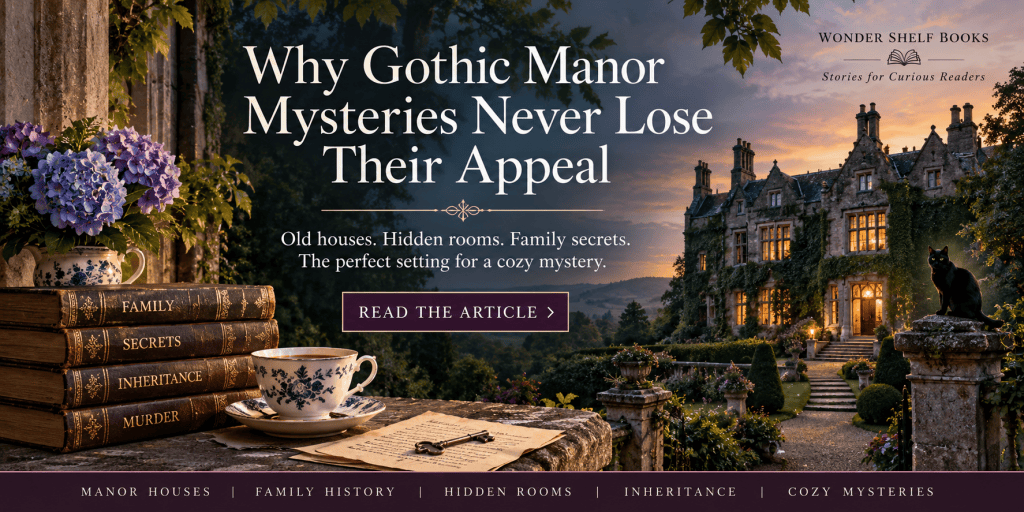
A locked room at the end of a corridor.
A portrait whose subject seems to know more than the living.
A walled garden no one enters anymore.
A family story repeated so often that nobody remembers who first told it.
And somewhere inside the house, a secret that has survived longer than the people who created it.
Gothic manor mysteries have been captivating readers for generations because they combine two irresistible pleasures: the atmosphere of an old house and the intellectual satisfaction of uncovering what happened there.
The manor is never merely a backdrop. It remembers.
Every staircase, portrait, sealed room, family document, abandoned outbuilding, and inherited object has the potential to become evidence.
That is exactly the kind of world readers enter in Nora Ashwell’s Ravensworth Manor Gothic Cozies.
The House Becomes Part of the Mystery
A great manor house gives a mystery writer something an ordinary setting cannot: layers.
A modern apartment can hide a secret.
A centuries-old estate can hide several generations of them.
One family may have occupied the property for decades. Another may have served there. Children grew up in its rooms. Marriages were celebrated there. Arguments happened behind closed doors. Wills were read. Letters were hidden. People disappeared from family photographs.
The building becomes a physical archive.
A locked cabinet may contain papers that contradict the official family history. A portrait may show a person whose existence was quietly removed from later accounts. A sealed room may not be frightening because of anything supernatural, but because someone worked very hard to make sure nobody entered it.
This is where gothic atmosphere and detective fiction fit together so naturally.
The darker corridor is not only atmospheric.
It may lead somewhere important.
Old Families Are Perfect for Mysteries
Family history is one of the richest sources of mystery because families rarely preserve the past objectively.
They preserve versions of it.
A scandal becomes a misunderstanding.
A disinheritance becomes a regrettable disagreement.
A vanished relative becomes somebody who simply “went away.”
An illegitimate child disappears from the official family tree.
A suspicious death is remembered as an unfortunate accident.
Time makes these stories harder to challenge because the people who knew what really happened are gone.
But evidence remains.
Letters.
Legal documents.
Household records.
Photographs.
Jewelry.
Diaries.
Old newspapers.
And, sometimes, the house itself.
Gothic manor mysteries are particularly satisfying because the investigator must often compare the family’s emotional version of history with the documentary one.
The difference between those two stories is where the mystery begins.
The Portrait Gallery Is Never Just Decoration
Few settings are as instantly gothic as a portrait gallery.
Rows of painted ancestors create a strange tension between presence and absence. The people are dead, yet they remain visible. Their faces continue to occupy the house long after their choices have shaped the lives of later generations.
Portraits are also excellent mystery objects.
Who was painted?
Who was not?
Why was one portrait moved?
Why was a name removed from a frame?
Why does someone in an old painting resemble a person living in the house now?
These questions turn visual details into clues.
In a manor mystery, the past often survives because nobody thought an ordinary household object could still testify.
A portrait may do exactly that.
Nora Ashwell’s Ravensworth world draws on this particular pleasure of gothic mysteries: the realization that familiar objects become unsettling once their history changes.
Walled Gardens, Ice Houses, and Forgotten Rooms
Old estates contain spaces that seem almost designed for mysteries.
A walled garden suggests privacy.
An ice house suggests isolation.
A mausoleum suggests family history made physical.
A music room may preserve an old instrument, sheet music, or correspondence.
A governess’s room may contain letters no member of the family was ever meant to see.
These settings work because they are both ordinary and strange.
They once had practical purposes. The garden grew food or flowers. The ice house stored provisions. The attic held trunks. The servants’ rooms were simply workplaces.
But once those functions disappear, the spaces become historical fragments.
A mystery can ask a wonderful question:
What did this place mean when it was still being used?
The answer may explain why something was hidden there.
This is one of the reasons manor-house mysteries feel so rich. The investigation moves through architecture as much as testimony.
Gothic Does Not Have to Mean Horror
The word gothic often brings to mind ghosts, supernatural events, and frightening houses.
But gothic mystery does not need to become horror.
Atmosphere can come from uncertainty instead.
A sound in the night may have a perfectly rational explanation.
A family legend may turn out to conceal a crime rather than a haunting.
A room may be avoided not because it is cursed, but because somebody knows what was hidden there.
That distinction is especially appealing in a gothic cozy mystery.
Readers can enjoy shadows, old corridors, storms, portraits, abandoned rooms, and family legends while still knowing that the mystery will ultimately depend on clues, motives, human behavior, and a solvable crime.
The mood says:
Something is wrong here.
The detective story asks:
What exactly is it?
Inheritance Makes Everything More Dangerous
Few things generate motives as efficiently as inheritance.
A house can represent money, but it can also represent identity.
Who owns the estate?
Who was promised it?
Who expected to inherit?
Who discovered that an old document might change everything?
Who has spent years protecting a version of the family tree that determines who belongs?
An inheritance mystery is powerful because the stakes are rarely only financial.
People may be defending legitimacy, reputation, memory, status, or a place they believe defines them.
A newly discovered letter can therefore be more dangerous than a missing jewel.
A revised will can destabilize an entire family.
A forgotten marriage can alter ownership.
A secret child can turn history into a legal problem.
This gives manor mysteries an elegant way to connect old secrets with present danger.
The crime may happen today because somebody is terrified of what happened fifty years ago becoming known.
The Best Manor Mysteries Reward Careful Readers
Gothic atmosphere works best when it does not replace the puzzle.
The strongest manor mysteries allow readers to enjoy the setting while also paying attention.
A slightly altered date matters.
A key is found where it should not be.
Someone describes a room incorrectly.
A photograph reveals that an object was moved.
A family member claims never to have entered a part of the house but knows something they should not know.
These small inconsistencies are the foundation of fair-play mystery.
The old estate gives the author hundreds of possible distractions, but the solution should still feel earned.
When the final explanation arrives, the reader should be able to look backward and realize that the truth was present all along.
That is one of the deepest pleasures of cozy mystery fiction.
Why Readers Want to Return to the Same Manor
A recurring manor setting creates a special relationship between reader and place.
At first, the estate is unfamiliar.
Then its geography becomes recognizable.
Readers learn which corridor leads to the library, where the old garden lies, which part of the house has been modernized, and which rooms still seem to belong to another century.
The setting gains continuity.
But every book can reveal another layer.
One story may revolve around a portrait gallery.
Another around a governess’s letters.
Another around an ice house, a mausoleum, a garden, or a music box.
The house feels finite, yet its history keeps expanding.
That makes the series addictive.
Readers are not simply asking who committed the next murder.
They are asking what Ravensworth Manor is going to reveal next.
Discover the Ravensworth Manor Gothic Cozies
Nora Ashwell’s Ravensworth Manor Gothic Cozies bring together old houses, family secrets, inherited mysteries, forgotten rooms, historical evidence, and classic-style investigation.
Across the series, the past repeatedly intrudes on the present through objects and places that once seemed harmless.
A walled garden.
A portrait.
A governess’s letters.
An ice house.
A music box.
A family mausoleum.
Each can become the beginning of a mystery.
For readers who enjoy gothic atmosphere without graphic horror, manor houses, inheritance secrets, old documents, hidden rooms, family history, and carefully planted clues, Ravensworth Manor offers a world designed to be explored one secret at a time.
Start with:
The House That Remembers
Because in an old manor, the most dangerous secret is often the one everyone has agreed not to mention.
Explore Nora Ashwell and the Ravensworth Manor Gothic Cozies
 Wonder Shelf Books