The Oil Jar with Two Marks & Figs for the Wrong Household
Between Books 1 and 2 · Two Original Stories
Two quiet Roman household mysteries: an amphora bearing two ownership marks and a basket of figs delivered to the wrong address.
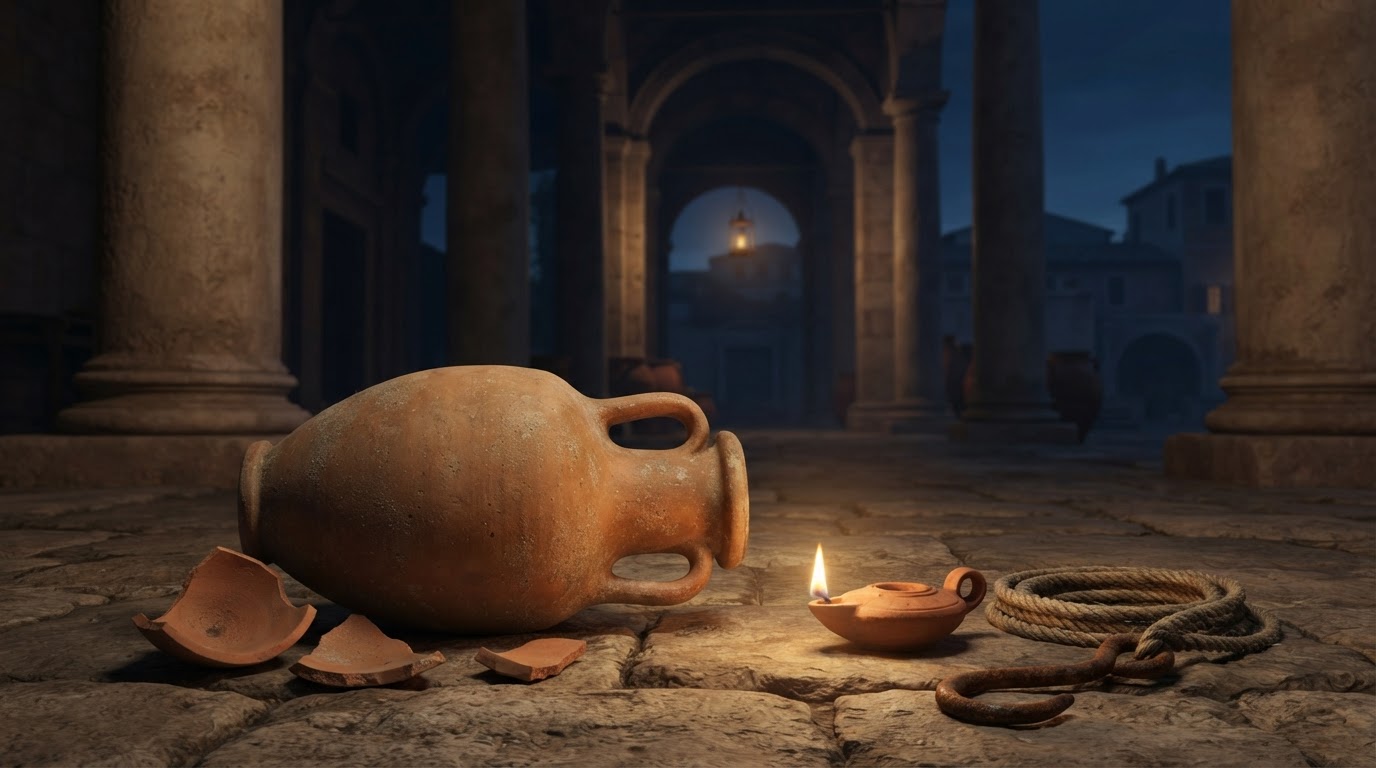
Two self-contained stories featuring Junia Secunda, set between the published Books 1 and 2 of Theo Penrose’s The Vestal Mysteries. The novels can be enjoyed without these companion stories.
Browse the published Vestal mysteries in reading order, or explore more of Theo Penrose’s books.
Bonus Story 1 — The Oil Jar with Two Marks
July 113 CE — after Ash Beneath the Atrium
The amphora arrived before the heat became unreasonable, which in July meant shortly after breakfast.
Tertia Calliste regarded it with suspicion.
“It has two owners.”
Junia Secunda looked down from the household inventory tablet.
“It has one jar.”
“Two marks.”
“That is different.”
“Then one of the marks is lying.”
Helvia Glyke, who had brought the oil herself, put both hands on her hips.
“Clay does not lie.”
Tertia pointed at the scratched merchant symbol on the shoulder.
“That one says Helvia.”
Then at the faded painted mark underneath.
“That one does not.”
Helvia sighed.
“Reused amphora.”
“Convenient.”
“Economical.”
“Suspiciously economical.”
Junia crouched beside the vessel.
The older mark had been painted in red and nearly scrubbed away. Helvia’s newer symbol had been scratched shallowly into the clay below the handle.
The stopper was intact.
The oil smelled clean—green, grassy, faintly bitter.
Junia dipped a narrow spoon and tasted only enough to confirm what Helvia had already said.
Fresh oil.
Nothing wrong with it.
The problem was the record.
Sabina’s delivery tablet named Helvia.
The jar appeared to name someone else.
After the wrong oil had mattered so much in Aulus Numisius’s death, nobody in the House was inclined to be careless about oil jars.
Quintus Fabius Celer arrived while Junia was still inspecting the painted mark.
He stopped at the permitted edge of the work area.
“You have found another murder weapon?”
Tertia answered, “Worse. Recycling.”
Junia pointed.
“Old merchant mark. New delivery mark.”
Quintus examined the amphora without touching it.
“Was the old paint beneath the abrasion?”
“Yes.”
“And the new scratch?”
“Through the abrasion.”
“Then the scratch is later.”
Helvia stared at him.
“I had hoped several years of administrative training might produce something less obvious.”
“It occasionally does.”
Junia said, “Where did you get the jar?”
“From a wine merchant near the Aventine who sells empties.”
“Can he confirm it?”
“He can confirm he sells empties to everyone with two asses to rub together.”
Tertia said, “A broad suspect pool.”
Junia looked at the stopper.
“What did you use to seal it?”
“New cork. Pitch around the edge.”
“Not reused?”
“No.”
“Why scratch your mark instead of painting it?”
Helvia’s expression changed.
“Because paint can be washed.”
There.
Junia looked again at the jar.
Helvia added, “After what happened here during Vestalia, I decided my deliveries should remain identifiable after rain, washing, or a servant with an energetic cloth.”
Quintus’s gaze moved to Junia.
Neither mentioned Aulus.
They did not need to.
Junia said, “So the second mark is not concealment.”
“No.”
“It is a response.”
“Yes.”
Tertia folded her arms.
“I dislike sensible explanations. They reduce the quality of gossip.”
Helvia took the amphora by its handles.
“Shall I remove it?”
Junia shook her head.
“No. Sabina should add that the container was reused and that the scratched mark was applied by the current supplier.”
Quintus said, “Correction without pretending the older mark never existed.”
Junia glanced at him.
He had begun doing that recently—taking her observations seriously without making a performance of agreement.
It remained irritating.
Less irritating than before.
Tertia looked between them.
“This is becoming unpleasant.”
“What?” Junia asked.
“You agree too efficiently.”
Quintus said, “I can object if it restores order.”
Junia stood.
“You usually manage.”
Helvia laughed.
The amphora was accepted.
Sabina added one line to the inventory.
No theft.
No substitution.
No hidden culprit.
Only an old jar carrying evidence of two different lives.
Junia found she liked that better.
Not every mark left on something meant violence.
Sometimes it merely meant the object had survived long enough to be useful again.
Bonus Story 2 — Figs for the Wrong Household
August 113 CE — before the Ludi Romani
The figs were excellent.
This made their disappearance more serious.
“There were three baskets,” Licinia Fausta said.
“There are two,” Junia replied.
“I had noticed.”
Tertia arrived eating a fig.
Junia stared at her.
Tertia stopped chewing.
“This is unrelated.”
Licinia held out her hand.
Tertia surrendered the half-eaten fruit.
“That proves nothing,” she said.
“It proves appetite,” Junia answered.
The missing basket had been promised to an elderly freedwoman household that supplied woven lamp wicks to the Atrium. The other two baskets were intended for temple workers preparing for the coming September games.
All three had been tagged.
All three had been left near the outer service court.
Only two remained.
Junia examined the clay tags.
The surviving baskets bore shallow scratched marks: one vertical line and two.
“The missing one had three?”
Licinia nodded.
Tertia looked toward the doorway.
“There was a baker’s boy here.”
“For figs?”
“No. For bread.”
“That is normally how baker’s boys work.”
“He left carrying something.”
Junia turned.
“Something?”
“A basket.”
“Did you see which?”
“No.”
“Then you saw a boy with a basket.”
“Yes.”
“That is not yet theft.”
Tertia looked offended.
“I never said theft.”
“You thought it loudly.”
They found the baker’s stall before midday.
The boy recognized Junia immediately and turned pale.
“I did not steal anything.”
Tertia murmured, “An encouraging opening.”
Junia said, “What did you carry from the House?”
“A basket they told me to take.”
“Who?”
“The old porter.”
“Where were you told to take it?”
“To the household near the Subura.”
The correct destination for the freedwoman.
Junia frowned.
“Then why was it given to you?”
The boy pointed to the clay tag tied to the basket at his feet.
Three lines.
The missing figs.
Still intact.
The baker said, “He thought it was part of our delivery exchange. We carry bread toward the Forum. Sometimes we take small things back.”
Not theft.
Transport.
Poorly recorded.
Junia said, “Why did nobody tell the House?”
The boy’s expression became deeply Roman.
“I thought they had.”
Tertia sighed.
“Rome would collapse if everyone who thought somebody else had spoken were required to speak.”
The figs reached their intended household by afternoon.
The old freedwoman sent back six lamp wicks and a message informing Tertia that only a barbarian ate August figs before cooling them in water.
Tertia read it twice.
“This is slander.”
Licinia said, “Will you change your habits?”
“No.”
Junia ate one of the replacement figs in the courtyard that evening.
Quintus happened to arrive with an administrative tablet concerning moved records.
Tertia offered him a fig.
He accepted.
Junia watched.
“You did not ask where it came from.”
He looked at the fruit.
“Should I?”
“There was an investigation.”
“Was the fig acquitted?”
“Barely.”
He ate it.
“A reckless man,” Tertia said.
Quintus glanced at Junia.
“I have learned that not every suspicious object in this House is fatal.”
Junia thought of wrong wax, wrong oil, Aulus’s body in the rebuilt Atrium.
Then of a basket carried by the wrong person for an entirely ordinary reason.
“That is useful,” she said.
His expression softened.
“Yes.”
The Ludi would begin soon.
Rome would become louder, more crowded, more difficult.
For the moment there were figs.
That seemed enough.
Reading position: after Book 1, Ash Beneath the Atrium, and before Book 2, The Veil at the Games.
The Vestal Mysteries · Free Reader Extras
Continue Exploring Junia Secunda’s Rome
Optional companion stories for the first three published novels. Choose an extra in reading order; no unpublished book is required.

