The Fountain’s Second Voice & The Window That Borrowed the Sun
More Stories After Book 1 · Two Original Stories & Historical Guide
A mysterious second sound from a courtyard fountain and a moving reflection on a painted wall become two independent mysteries for Junia Secunda.
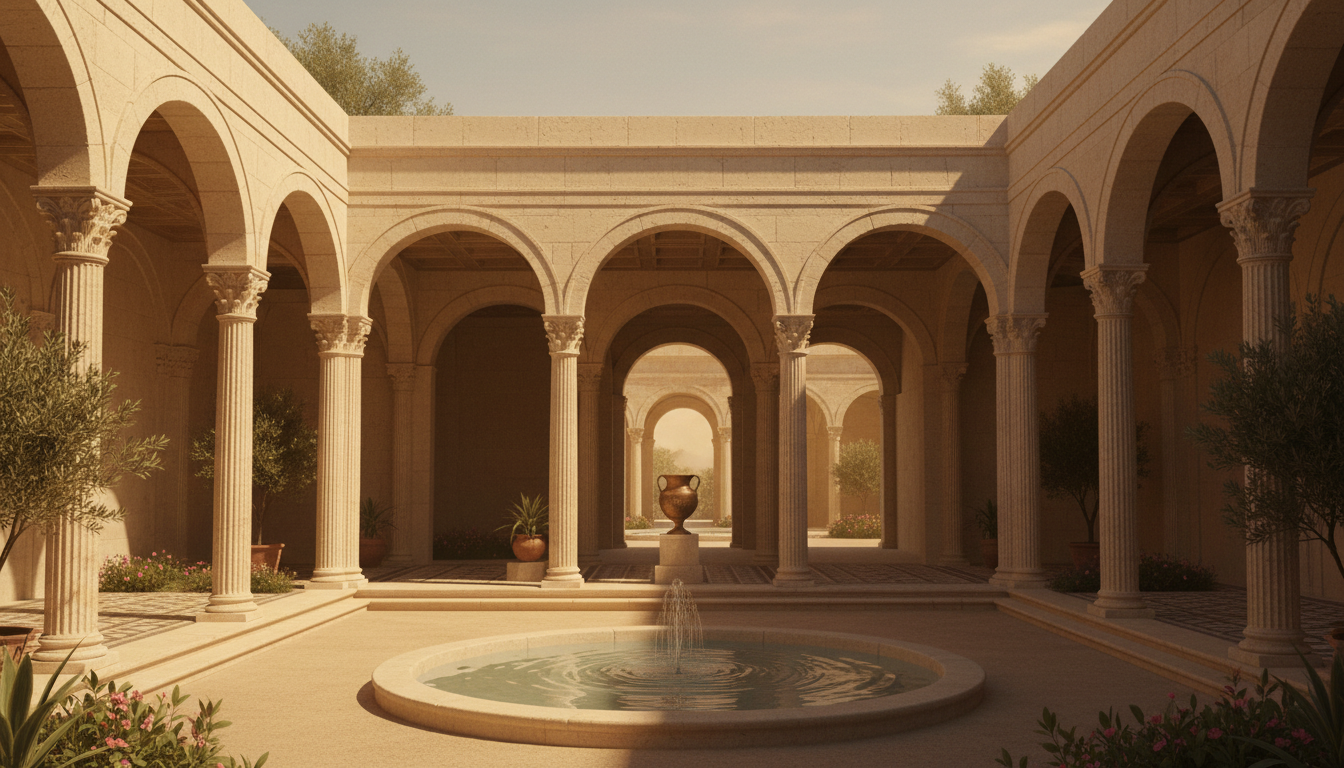
Two original, non-spoiler historical mystery side stories and a reader’s period guide inspired by Ash Beneath the Atrium: A Vestal Mystery, Book 1 of The Vestal Mysteries by Theo Penrose. These fictional incidents stand independently of the novel’s central case and do not change the novels’ reading order.
Explore The Vestal Mysteries and Theo Penrose’s author page for the published reading order.
Bonus Story 1 — The Fountain’s Second Voice
The first note was so thin that Junia thought a bird had been caught somewhere beneath the roof.
The second was lower and considerably less musical. It came from the newly finished courtyard fountain, crossed the paving in a long trembling complaint, and caused Tertia Calliste to put down a bundle of cleaning brushes with the expression of a woman discovering that the building had developed opinions.
“Not another repair,” Tertia said.
Licinia Fausta, who had been tying back her hair before helping at the visitor entrance, listened with her head tilted. “It sounds almost deliberate.”
“Most expensive faults do.”
The water ran quietly again. Morning heat lay against the pale columns of the Atrium, and a damp line beneath the fountain’s carved rim darkened the stone. The household had survived the festival and the disruption of rebuilding. Junia had been looking forward to the ordinary, unremarkable kind of morning in which no one asked her to explain a piece of evidence. She ought to have known that the gods might consider this an extravagant request.
A young attendant named Daphnis emerged from the passage with two brooms. At the sight of Tertia, he stopped so sharply that one broom struck the wall. His cheeks colored. Tertia, noticing both the sound and his face, looked from the fountain to the boy.
“Were you instructed to do something to the watercourse?”
“No, mistress.”
“Were you instructed not to?”
He hesitated. It was a small hesitation. In an office full of men who believed confidence constituted innocence, it might have gone unnoticed. Tertia had spent too many years keeping a large household functioning to miss it.
“I told him to clear the leaves,” said Menedemus, the mason charged with finishing the fountain’s channels. He came through the outer doorway carrying a length of chalk. “He has not yet mastered the distinction between cleaning a structure and attempting to improve it.”
Daphnis looked down at the brooms. Junia watched Menedemus instead. The man was troubled, but not astonished. He seemed to have expected trouble before the first note sounded.
The fountain sang again. Licinia smiled despite herself. Tertia did not.
“Whatever it is,” the steward said, “you will settle it before Terentia Prisca crosses this court. I shall not explain to the chief Vestal that we have added a musical instrument to the plumbing.”
A Noise with Consequences
By the next morning, the sound had acquired three explanations and a reputation. One kitchen worker believed a trapped bird was struggling beneath the basin. Another insisted there was air in the channel, which would have been comforting if he had known where the air had entered. An elderly cleaner, whose memory of older buildings was sharper than her hearing, declared that water sometimes complained when stone was laid badly. Nobody offered to repeat that last opinion in Menedemus’s presence.
Junia found Daphnis sweeping an already clean stretch of paving. She had asked Terentia for permission to examine the public courtyard fittings, and received it on the strict understanding that she would not dismantle sacred property, command artisans, or turn a maintenance matter into an inquiry of state. Terentia had paused after the third restriction.
“I mention them separately,” she said, “because you have a talent for treating one prohibition as permission to attempt the other two.”
Now Junia stood beside the boy and waited until he stopped pretending not to see her. He was about fifteen, thin and earnest, with the hands of someone who worked around grit and wet clay. A pale scratch crossed one wrist. She did not ask about it. Everyone in the rebuilding had scratches.
“Does the noise frighten you?” she asked.
“No, priestess.”
“Then why do you look as if it will?”
“Because when something goes wrong, the person nearest it becomes the person who did it.”
Junia thought that answer deserved more attention than a denial. “Is that what Menedemus says?”
Daphnis kept his gaze on the paving. “He says I should have come to him before touching a thing.”
“Did you touch something?”
“I cleared leaves.”
“That is not what I asked.”
He bent to move a twig that did not need moving. “I know.”
Junia left him there. A frightened person did not become truthful merely because someone with authority repeated a question. She had learned that much without requiring another lesson from Quintus Fabius Celer.
At the fountain, Licinia was kneeling beside the water with the apparent concentration of a scholar consulting a famous text. She dipped two fingers into the basin, watched the ripples, then stood when Junia approached.
“It sings only after Tertia has the far paving washed,” Licinia said. “Yesterday it waited until the attendants emptied the second bucket into the side channel. Today there was a delay because the first bucket was smaller.”
“Did you count the buckets?”
“Of course. It was either that or listen to Menedemus explain stone to three people who live among it.”
That was their first useful distinction. The fountain’s ordinary flow was quiet. Something happened when extra water ran across the courtyard and reached the side drain. It was a humble observation, made without a legal tablet or the assistance of a distinguished official. Junia was pleased enough to keep that pleasure to herself.
The Line Beneath the Stone
The new fountain stood near the open courtyard, where a shallow overflow trough received water and directed it toward a covered channel. Its carved basin was handsome enough to make defects feel almost insulting. At one end of the trough, under the outer lip, a narrow opening disappeared into darkness. A line of fine pale grit had gathered around it.
Menedemus arrived carrying the impatient certainty of a tradesman who expected amateurs to get in the way. “There is no need for priestesses to put their hands into drains,” he told Junia. “If the sound comes again, I shall remove the covering slab.”
“Have you heard it yourself?”
“Twice.”
“Where were you standing?”
“Here.”
“Were the attendants washing the paving?”
His expression tightened. “People are forever washing paving in this house.”
“They are,” Licinia agreed. “It remains surprisingly dirty.”
Junia asked for a small amount of water to be poured into the side gutter while Menedemus watched. Tertia agreed to authorize the test, but only after ordering an attendant to clear the lower passage and another to stand ready with a broom. Junia could have suggested that a bucket was unlikely to threaten Roman civilization. Tertia would have considered that remark a prediction requiring immediate contradiction.
The first pour brought no sound. The water ran along the slope in a shallow silver ribbon, vanished beneath the lip, and left a dark trail. A second pour followed before the first had completely drained. For a moment the ribbon thickened. Then the narrow opening gave a faint chirr, like a cricket briefly shut inside a jar.
Licinia moved toward the sound. Menedemus did not. He was staring at the little hollow beneath the stone.
“Again,” Junia said.
“Not until the channel empties,” Tertia told her. “Otherwise you will test how rapidly we can flood a workroom.”
They waited. The water fell to its ordinary level. When they repeated the double pour, the chirr rose into the thin, long note that had filled the courtyard. Junia heard a tremble at its end, as though a finger were being drawn along the rim of a drinking cup.
Something in that opening vibrated when the water reached a particular depth. The higher flow made the noise; the fountain alone did not. That explained when the sound appeared, but not why a channel completed only weeks before had developed a voice.
“You need not tell us the water is speaking,” Tertia said to Menedemus. “It may be doing so. What I want to know is whether you intend to charge us for the conversation.”
The Apprentice’s Silence
The mason went to fetch his tools. Licinia remained beside the fountain, studying the dark line along the joint in the stone.
“That line is not from today,” she said.
Junia bent closer. It was a thin stain running away from the channel toward the wall of the lower passage. The upper stones were new and clean. The joint below held a slightly greenish shadow where moisture had lingered. No single afternoon’s washing had made it.
At the lower end of the passage, a worker called Varo was lifting a wooden board away from the floor to let it dry. Beneath it, the paving was rough and darker than the stone nearby. He looked displeased when the two Vestals appeared. Not because they had come, Junia thought, but because he expected them to ask the wrong question.
“Has this floor been wet before?” she asked.
“Whenever the courtyard gets too much water.”
“Did someone report it?”
Varo looked toward the fountain. “Daphnis did.”
“To Menedemus?”
“And to me. I put the board down so no one would stumble when the paving was slippery. It worked well enough. Nobody fell.”
“Did you see where the water entered?”
“Not until he showed me.” Varo drew one finger along a low seam in the wall. “It seeps through there when the top drain backs up. The channel is narrow at the bend. A mason ought to know such things.”
Junia understood why Daphnis had watched the fountain as though the stone itself might accuse him. He had noticed a hazard and failed to persuade the person who could repair it. That did not prove he had caused the sound. It gave the sound a history.
They found him at the far side of the court with the same two brooms. Licinia asked him to help measure the damp patch in the passage; his shoulders relaxed when he discovered they wanted to understand the floor rather than accuse him of damaging it.
“How did you know the water was backing up?” she asked.
“I heard it under the stone. Not the singing. A different noise. A rushing sound. Then Varo came out saying the floor was wet again.”
“And Menedemus?”
“He said water always makes noise.”
Junia looked at the boy. “He was correct in a very unhelpful way.”
Daphnis gave a brief, involuntary smile. Then he looked down again, and the smile vanished.
“I was told to keep quiet about the channel,” he said.
“By whom?”
“Menedemus said we should finish the other work first.”
Junia took care not to supply a conclusion for him. A man could put off a repair out of bad judgment without intending harm. A boy could feel silenced without having told every part of his story. She asked him where the noise had begun. He pointed toward the covered opening.
“Before the new sound?”
“Yes.”
“Then perhaps,” Licinia said, “we have two noises and one piece of poor workmanship.”
The Reed at the Mouth
The covering slab was lifted after Terentia had formally permitted Menedemus to work on the channel. Junia and Licinia watched from the dry paving while Tertia supervised the attendants. Beneath the stone lay a small clay-lined runnel curving toward the outer drainage passage. Nothing glittered or moved mysteriously there. It smelled of wet dust and new mortar.
Menedemus inserted a slender wooden probe. When he brought it out, a piece of reed came with it. It was no longer than Junia’s little finger. One end had been cut on a slant, and a neat slit opened along its side. A second, shallower notch had been made just below it.
“That did not grow in the channel,” Licinia observed.
Menedemus held the reed between thumb and forefinger. His face settled into the expression Junia had noticed when the noise first began: not surprise, but a man’s weary recognition of a problem he had chosen not to see.
“A boy’s toy,” he said.
“An oddly placed one,” Junia replied.
Daphnis had come close enough to hear. He stood very still. Tertia saw him and motioned for everyone to leave the work area clear.
It would have been easy to end the matter there. The apprentice had inserted a reed, the reed sang, and the apprentice could be told to remove it and apologize. But the narrow channel had backed up before anyone put a reed into it. Removing the little instrument would not dry the slippery passage. Junia wanted the full explanation, not a convenient culprit for the noise.
She asked Daphnis whether he wished to speak in front of Menedemus. The boy shook his head. Menedemus opened his mouth to object. Tertia, without raising her voice, told him he could examine the cracked joint while Junia and Licinia heard the apprentice at the other end of the courtyard.
“I made it,” Daphnis said as soon as the mason was out of earshot. “I saw how water made the reeds in the waste basket whistle when it ran across them. I thought if one were cut properly and set where the channel rose, the sound would tell someone before the lower floor got wet.”
“You made an alarm,” said Licinia.
He nodded. “I did not think it would sound so loudly. I tried it in a bowl, and it was quieter. I meant to take it out after Menedemus repaired the bend. He said he would repair it next week. Then he said the week after.”
“Did anyone authorize you to put it there?” Junia asked.
“No.”
“Did you know it might obstruct the channel?”
“No. I made the opening large enough for water to pass. At least, I thought I did.”
“Did you explain it to anyone?”
“Varo. He said it was clever.” Daphnis’s voice faltered. “He also said I ought to tell Tertia. But I was afraid Menedemus would say I had been complaining again, and I thought the sound would bring someone to look. When everyone began talking about omens, I could not tell them what I had done.”
Junia sat with that answer. The boy had hidden his part in the disturbance, and he had altered a household fitting without permission. His reasons were neither foolish nor sufficient. They were, uncomfortably, reasons she understood.
“You did not make the drain fail,” she said. “But you made it harder for someone to identify the fault promptly. Those are different things, and both matter.”
He looked relieved enough to make her wish she had spoken more gently. She did not retract the point. Kindness did not require pretending an unauthorized alteration was safe.
What the Sound Was For
Terentia heard the explanation at the boundary of the work court, her hands folded, her face unreadable. Menedemus had identified an uneven seam at the bend. Mortar had been spread too heavily where the runnel turned, reducing the space for water. In ordinary flow the channel emptied. After a heavy washing, the narrowed section slowed the runoff and forced water toward the old joint in the lower wall.
That discovery accounted for all the observed facts. The damp mark in the passage had preceded the reed. The reed sounded when water accumulated above the narrowed bend. A single bucket did not fill the channel enough; two poured close together did. There had been no hidden spirit, dishonest visitor, or mysterious interference with the sacred household. There had been a defect that an apprentice noticed before his superior chose to correct it.
Menedemus protested that repair of the joint had been placed on his list. Tertia asked whether it was above or below the entries for polishing a decorative rim that already looked adequately polished. He did not answer. Junia realized that Tertia knew exactly how the work had been prioritized. Her anger was not theatrical. A subordinate had raised a concern, and a pleasant-looking piece of stone had received attention before a dangerous, unseen floor.
Terentia ordered the obstruction removed and the channel repaired. She also directed that Daphnis should not be punished simply for speaking about the original fault. The apprentice would, however, be required to explain the unauthorized alteration to Menedemus and to learn how to test a drainage fitting safely. He was told plainly that a clever device installed in secret could become a danger of its own.
Menedemus looked as if he hoped the chief Vestal had finished. She had not.
“You are responsible for the workmanship,” she told him. “If a person working under you reports an obstruction, investigate it. Do not mistake his lack of rank for lack of eyes.”
No one spoke for a moment. Even Tertia allowed the silence to hold.
When Terentia withdrew, Menedemus examined the reed again. He was a proud craftsman, but not an incurious one. He admitted that the cut was unusually precise for a beginner. He asked Daphnis whether he had made several attempts. The boy said six. Menedemus raised an eyebrow.
“Then you have wasted six reeds and taught yourself a little about water,” he said. “Next time you will do the experiment where it cannot damage my work.”
“Your work did require damage,” Tertia remarked.
“That,” Menedemus said with an effort, “I have been told.”
A Courtyard That Listened
The repair took the better part of two days. The bend was opened and reset; the lower joint was dried and patched. Varo lifted his board and swept the passage, which could at last be walked without stepping around a wet place. Tertia insisted on a test more severe than the ordinary washing, and the mason agreed to it under her unforgiving eye.
Junia watched Daphnis pour the water. He did so carefully, waiting for the first rush to clear before adding the next. The channel carried it away without backing up. There was no wavering note. The fountain made only the small steady sound of water entering stone.
Licinia appeared disappointed. “I may miss it.”
“You may ask the boy to make you a flute,” Tertia said. “You may not ask him to hide one in the courtyard.”
Menedemus gave Daphnis a narrow piece of clean reed before they left. It was not approval for what he had done, but permission to learn the proper way to do something else. The boy held it as though it were worth a great deal more than its price.
In the evening Quintus Fabius Celer arrived to discuss an unrelated administrative boundary with Terentia. He paused by the fountain when he saw the disturbed stone had been set back into place.
“I was told the water had begun issuing warnings,” he said.
“It did,” Junia replied. “They were practical warnings. A man had failed to heed them until a boy made them too loud to ignore.”
“An uncommon method of petition.”
“Not one I recommend.”
He regarded the silent channel. “Was the boy right?”
“About the danger, yes. About the method, no.”
Quintus inclined his head, apparently satisfied that she had not confused those two conclusions. The small recognition between them was no more than that. Junia was thankful for it, and annoyed that she was thankful.
At supper Licinia said the greatest disappointment was that nobody had heard the voice of a water spirit. Tertia observed that if spirits wished to manage the drains, the household had enough work to occupy several of them permanently. Terentia did not comment, but Junia saw her glance toward the courtyard as if reassured by its quiet.
Later Junia walked once beneath the portico. The stone had cooled. Water moved unseen where it belonged. She thought about Daphnis listening to a fault that older men dismissed, and about the trouble he had made by trying to force them to hear it. The true work had begun only when everyone agreed to listen without deciding beforehand whose voice counted.
From the fountain came a faint splash, ordinary and entirely sufficient. Junia went back inside before anyone could ask her to investigate it.
Bonus Story 2 — The Window That Borrowed the Sun
The light appeared on the painted wall a little before midday, pale as fresh honey and much too neat to be an accident.
It made a bright shape at the corner of a green vine, moved the width of a hand, trembled, and vanished. A moment later it came back. From the shaded doorway opposite, a seller of pottery watched it with the expression of someone whose ordinary morning had acquired a public accusation.
“There,” she said. “You have seen it.”
Licinia Fausta had indeed seen it. She had expected the woman’s complaint to concern a chipped dish, a disputed price, or a quarrel between people who had all become too hot to think fairly. It was a surprise to be asked whether sunshine had criminal intentions.
Junia Secunda stood beside her, safely within the public portion of the narrow street. Their errand was legitimate: Tertia had brought them to meet a carpenter about repairing two worn stools used by women waiting near the Atrium’s permitted entrance. Tertia was inside the workshop negotiating a price with the owner, who appeared convinced that priests and senators would soon bid for every piece of wood in Rome.
The pottery seller had introduced herself as Appia Neria. She was broad-shouldered, brisk, and unwilling to accept that a Vestal could witness an extraordinary occurrence without offering some improvement to the situation.
“The light comes on clear days,” Neria said. “Always from the same side. Twice yesterday. Once the day before. It began after the upper room across the lane was rented. Nobody is willing to say what it means, which is making the talk worse.”
“What sort of talk?” Junia asked.
Neria glanced toward two customers who had stopped at the far corner. They were not buying anything. They were, however, listening with the open concentration of people who had come to a market intending to take home news.
“Signals,” Neria said quietly. “To people waiting at the crossroads. There was a theft of sandals from a stall near the fountain last week. Now someone says the light warns thieves when the watchman passes.”
“Does it?” asked Licinia.
“Of course not. How should I know when the watchman passes? I sell pots. But customers look at my wall and decide my shop must have something to do with it. No one wants to buy a cooking pot from an establishment allegedly directing criminals.”
The bright patch reappeared, slid across the painted vine, and disappeared almost as quickly. Junia looked not at the wall but at the rows of upper windows on the opposite side. A woman shook out a cloth from one. Another had an awning extended against the heat. On the third balcony a small shutter stood half open.
“Does anyone hear a voice or see someone at the window when the light appears?” she asked.
“No. That is why they call it secret.”
Junia was beginning to understand how a rumor could become more impressive with every absence of evidence.
What the Street Thought It Knew
Tertia emerged from the carpenter’s shop with the satisfaction of someone who had made a man lower a price without allowing him to say she had done so. When Neria explained the matter, the steward looked at the painted wall, then at the sky.
“Sunlight is free,” she said. “That alone makes it suspicious to half the merchants in Rome.”
Neria did not laugh. She had heard too many jokes about the strange mark and too few assurances that her business would recover. “They say I have agreed to let someone use my wall.”
“Have you?” Tertia asked.
“No.”
“Then the first thing we know is that the rumor began without your permission.”
Tertia could make such statements sound like formal rulings. Junia knew she was more concerned than she admitted. A tradeswoman’s reputation might be damaged by the same people who would indignantly deny spreading an accusation. The seller did not need a priestess to solve a grand crime; she needed the neighbors to stop treating her shop as evidence of one.
At the corner, an older fruit vendor named Salvius had heard the conversation and volunteered his testimony without invitation. The light, he declared, was bright on market days and absent whenever there was rain. A young sandal mender disagreed about the market days but confirmed that rain stopped it. Someone farther along said that the patch once resembled a letter. That last witness could not remember which letter.
Junia asked each person precisely what they had seen. Salvius had watched the patch near midday but had never seen a thief respond. The sandal mender had once seen the light cross the wall while the watchman was at the opposite end of the street. The man who thought it resembled a letter admitted he had been told this by his sister.
Licinia listened patiently, then asked the question Junia had forgotten. “What happened on the mornings it did not appear?”
“Clouds,” said Salvius.
“The shutters opposite were closed one day,” Neria added. “The upstairs tenant had visitors.”
That was useful. An organized warning could have been given in cloud or rain by a lamp, a hand, or a cloth. The bright mark depended on a clear sky. Its reappearance in almost the same place also suggested a fixed surface directing sunlight, rather than a person flashing a polished object at will from the street.
“Nobody has described a receiver,” Junia said after they had moved away from the gathering.
“Perhaps the thieves are very ungrateful,” Licinia replied.
Tertia turned toward the opposite building. “I will ask the owner who lives upstairs. We cannot enter rooms simply because a man at a fruit stall is excited, but we can ask whether something is being polished near the window.”
“Why polished?” said Licinia.
“Because,” Tertia said, “if the gods intend to write warnings on shop walls, they would probably choose a language easier to read.”
The Window with the Broken Corner
The building across the lane belonged to a retired dyer called Hostilius Varro. He rented two upper rooms to lodgers and occupied a ground-floor space behind a modest courtyard. Tertia knew him from an earlier argument about a basin he had placed where a delivery cart needed to turn. They greeted each other with the politeness of people who had not forgotten the argument but were willing to discuss something new.
Varro confirmed that a young woman named Polla rented the sunny upper room. She worked helping an elderly neighbor with meals and small errands. She paid on time. He had no reason to think she was engaged in an enterprise involving thieves. The metal in her room, he said, was her own affair unless she dropped it on someone.
“May we speak with her?” Junia asked.
“She will be back shortly. She walks to the public fountain for water in the mornings.”
They waited in the narrow shade beneath the stairs. Licinia observed that the shutter on the upper room was not square. A chip had been cut from one upper corner of its opening, leaving an uneven little angle in the line of light that reached the wall inside.
“I saw that corner in the bright patch,” she said.
Junia looked across the lane. The light had appeared as a rectangle with a notch at its top, as if a tiny piece had been bitten away. She could not prove the resemblance from memory, but it was a feature worth checking. She asked Varro whether he had repaired the shutter recently.
“Not since spring. It is an old piece of wood. Why?”
“Because its shape may explain something that people have mistaken for a sign.”
Varro gave a low whistle. “My shutter is accused now? That is progress. At least it cannot defend itself.”
Polla arrived carrying a water vessel and stopped when she found the visitors waiting. She was in her twenties, dressed plainly, with a sunburned nose and a practical way of balancing the vessel on her hip. She listened without interrupting while Tertia explained that a reflection from her window had caused distress across the lane.
“A reflection,” Polla repeated.
“Perhaps,” Junia said. “We have not established it yet.”
Polla looked toward Neria’s shop. Then, almost too swiftly to notice, she glanced past them toward the low window behind Varro’s courtyard. Her expression became guarded.
“I have a polished bronze mirror,” she said. “It belonged to my mother. I keep it near the window sometimes.”
“Would it be possible,” Junia asked, “to look at the place where it stands? You may refuse. We do not have a warrant, and a bright wall does not give us authority over your belongings.”
Polla considered. “You may look from the doorway. I would rather not have a crowd upstairs.”
It was not an unreasonable request. Junia agreed at once.
Light in Two Directions
The upper room was small but orderly. A narrow bed stood against one wall; beside it were a water jug, a stool, and a shelf holding simple dishes. A polished bronze mirror rested upright in a wooden support near the open shutter. Its surface was not perfectly smooth. It reflected the room in a soft, warped glimmer.
Polla had not arranged it as a woman preparing to inspect her hair. The reflective side faced outward and downward. A stone at the base steadied the support, and a narrow strip of wood marked the place where its lower edge usually stood.
Junia noticed the mark and said nothing.
Licinia went to the window and looked down the lane. Neria’s painted wall lay almost directly across from them. Farther below, beyond a short roofline, was the dim interior window of a room at the back of Varro’s courtyard.
When Polla adjusted the mirror slightly, the sunlight moved. It crossed the far wall as a sharp patch, its upper corner cut off by the chipped shutter. There was their public signal: not a secret letter, only light shaped by old carpentry.
Polla immediately lowered the mirror.
“I should have been more careful,” she said.
“Were you trying to put light on Neria’s wall?” Junia asked.
“No.”
“Then where?”
Polla kept her hand on the stand. “It is a private arrangement.”
“Private arrangements do not usually alarm an entire street,” Licinia said, without accusation. “But many harmless things alarm a street if people are encouraged.”
The young woman looked at her. Junia saw that she was weighing whether she would be mocked, reprimanded, or simply misunderstood.
The mirror was old and a little heavy. Polla explained that she had discovered, by moving it from one position to another, that she could send a brief interval of sunlight into the rear room below. She tried to do so after the meal she carried there each day. If she placed it too high, the light struck the wall of Neria’s shop instead. If she placed it a little lower, it reached the other window, but only while the sun stood above the neighboring roof.
“Why did you keep changing it?” asked Junia.
“Because the sun changes. The window does not. I could not afford to pay someone to fix the shutter properly, and I thought the reflection was so brief no one would notice.”
“You were wrong about that,” Tertia said from the doorway.
“Yes.”
Tertia’s voice softened. “You were not wrong to ask that the rest remain private until we understand it.”
They followed Polla to the lower courtyard, with Varro’s permission and without inviting the people from the market to accompany them. The rear room was cooler than the street and shaded by the upper floors. Its occupant sat close to an open window, working a small piece of clay between her palms.
The Woman Behind the Courtyard
Her name was Aelia Rufa. She was old, with swollen fingers and knees that made stairs difficult. She shaped small clay animals for neighborhood children, a craft that gave her satisfaction rather than great income. A wooden board at her side held three unfinished birds, their bodies no larger than walnuts.
When Polla entered, Rufa looked up. “Have you brought the morning?”
“Not yet,” Polla said.
Rufa smiled. It was clearly a familiar exchange.
She had been living in that rear room for many years. A new upper structure on the adjacent property had narrowed the period in which daylight reached her table. By the time she could settle to work, the room was often too dim for her to see the smallest marks she wished to add with a wooden point. She could have moved her board into the courtyard, but the rough path there was awkward for her knees, and she disliked being carried or watched.
“I was not trying to be mysterious,” she told Junia. “I am merely old enough to know that a large number of people can make a simple kindness exhausting.”
Polla had learned to guide light from the upper window onto Rufa’s workboard for a short stretch each day. It was a small gift, not a cure for age or loneliness. A bright patch moved across the clay long enough for her to shape the delicate feathers on a bird’s wings. Some days it failed because of cloud. On others Polla missed the angle and sent the sunlight across the street. She had thought the stray glimmer an inconvenience without consequence.
“I asked her not to tell the neighbors,” Rufa said. “If they hear I cannot see well in this room, they will come to tell me what I ought to do. I know what I ought to do. I would like, occasionally, to choose what I actually do.”
Licinia knelt near the little birds without reaching for them. One held a wing out unevenly, as though caught between landing and flight. The workmanship was delicate, the expression surprisingly proud.
“They are lovely,” Licinia said.
“They are imperfect,” Rufa replied.
“They look alive.”
“Then perhaps I shall allow them to be imperfect.”
Junia understood why Polla had hidden the arrangement. Not because any rule forbade helping an older woman see her work, but because public explanation could turn a generous act into an invitation for unwanted pity. She also understood Neria’s anger. Every day the stray reflection appeared on the wall of a shop whose owner had neither caused nor consented to the disturbance. A private kindness had accidentally made a public problem.
Rufa looked from one visitor to the next. “Will you tell the whole street why Polla has been moving that mirror?”
“That depends,” Junia said. “Is the reason necessary to settle the complaint?”
Polla looked surprised. Tertia looked quietly approving.
A Solution in the Shade
They returned to the upper room and tested several positions of the mirror with the landlord standing below. The problem was not difficult once they named it accurately. Polla had aimed the light through the shutter opening without shielding the portion that escaped toward the market wall. When the mirror was raised, the light struck Neria’s vine. When lowered too much, it fell short of Rufa’s window. The narrow interval between was small enough that tiny changes in the sun’s position defeated her aim.
Varro possessed a strip of thin wood left from a repaired door. Tertia asked whether he would fit it along the inner side of the shutter, not touching the mirror itself. It would block the outward angle that sent the brightest reflection toward Neria while allowing the lower beam to pass toward the courtyard window. They did not alter the structure until Polla agreed and Varro, as owner, consented.
A carpenter could have charged handsomely for this solution. Varro, perhaps ashamed that his broken shutter had become famous, made the adjustment himself. It took a little time and a great deal of criticism from Tertia, who declared that he was not to use one crooked fastening to correct another.
They tested the arrangement twice. From the street, no bright rectangle appeared on Neria’s wall. From below, Rufa called that she could see the edge of her workboard clearly. The beam did not remain steady for long. Polla would still have to adjust the mirror as the days shortened. The difference was that its accidental excursion across the lane could now be checked.
Neria came to the courtyard entrance at Tertia’s invitation. She did not ask to see Rufa, and nobody offered an explanation of the clay birds. Tertia described what they had found: a polished household object had reflected the sun through an old shutter at an awkward angle. No one had been signalling a thief, and Neria had not been involved.
“Then the mark will stop?” Neria asked.
“Yes,” said Varro. “If my repair holds.”
Tertia looked at it. “It will hold if you do not pull the shutter by the loose hinge.”
“There is another loose hinge?”
“Now there is a useful reason to examine the whole window.”
Neria went back to her shop with the information she needed. In the market, she repeated the explanation plainly. Some neighbors were disappointed that the mysterious sign was neither a warning nor an omen. Salvius, the fruit seller, maintained that he had always suspected a mirror. Nobody reminded him that he had also suspected a letter.
The accusation against Neria lost its shape as quickly as it had gained one. Customers returned to examine pots; children resumed arguing about whose turn it was to carry water; the watchman crossed the lane without glancing up at every window. Public curiosity moved elsewhere, as it invariably did.
What May Be Told
Junia and Licinia returned toward the Atrium by the shaded street. Tertia had gone ahead to make sure the carpenter did not arrive with two stools and a demand for additional payment. For the first time that afternoon, Junia was free to think about the part of the investigation that could not be written down as a simple answer.
“You knew the mirror was meant to help someone,” she said to Licinia.
“I suspected it when Polla looked toward the lower room. I did not know whom.”
“Yet you never asked her in front of the landlord.”
“She looked frightened of losing the choice to tell us herself.”
Junia walked a few steps before replying. She had once imagined that truth was a thing to be pulled into full daylight, every piece displayed where all could see it. That was a satisfying image for a mystery, but people were not objects placed on a table. Some facts belonged to a public accusation. Others belonged to a private life that had done no harm.
“Would you have kept the secret if the light continued to hurt Neria’s business?” she asked.
“No,” Licinia said. “But it did not have to. We could protect the shop without putting Rufa in the street for everyone to discuss.”
Junia looked at her. “You have a talent for making a difficult answer sound obvious.”
“It was not obvious before we went upstairs.”
They stopped at the entrance to the House as a little breeze found its way between the stone buildings. Heat still rose from the street, but the shadows had begun to lengthen. Junia imagined the sun sliding down the wall of Rufa’s room and coming to rest for a moment on a clay bird waiting for its second wing.
Later, Polla sent a small gift by a trusted messenger. It was a clay swallow with one imperfect feather and a surprisingly determined face. Rufa had made it to thank the two Vestals, though she had refused to say which of them it most resembled. Licinia claimed it was Junia because it looked as if it were preparing to argue with the wind. Junia claimed it was Licinia because it had chosen an excellent place from which to observe everything.
Tertia inspected the little bird and decreed that it could stand beside the household’s ordinary flower vessel, provided nobody began treating it as an object requiring formal care.
“No one will,” Licinia promised.
“That is what people say before they invent a duty,” Tertia replied.
The bird remained. The next afternoon, when sunlight crossed the portico, it cast the smallest possible shadow on the stone. Junia noticed and smiled. Nothing had been stolen. No one had committed a crime. A woman could see her work, and another woman could sell her pots without being treated as a conspirator.
Some mysteries, she decided, were solved most completely when the answer restored ordinary life and left a little room for privacy.
Pocket Guide: Spaces, Status, and Everyday Objects in Junia’s Rome
This pocket guide is a companion to the two original stories above and to the setting of Ash Beneath the Atrium. It explains places, roles, materials, and social customs that shape everyday life in the fiction. Roman practices changed over time and were not identical in every household. The guide distinguishes broad historical background from invented incidents; it does not identify any suspect or explain the novel’s central case.
1. Atrium Vestae — the House of the Vestals
The Atrium Vestae was the communal residence of the Vestal priestesses within Rome’s Forum complex. Its remains show a substantial establishment with courtyards and rooms altered repeatedly in antiquity. In the fiction, visitors, workers, and residents move through areas with different levels of permission. The exact placement of individual workrooms in a novel is a narrative reconstruction, not a claim that archaeologists can assign each surviving room a certain daily purpose.
2. A Vestal and her vows
Vestal priestesses served Vesta, the deity of the hearth. Their religious office involved demanding obligations as well as unusual public standing. Ancient accounts describe selection at a young age and a conventional thirty-year period of service. Junia Secunda is a fictional young member of this institution. Her intelligence does not exempt her from the restrictions that come with her role.
3. Vestalis Maxima — the senior priestess
The Vestalis Maxima was the leading Vestal. In the novel, Terentia Prisca exercises household and religious authority that the younger priestesses must respect. Her decisions help establish an important boundary for mystery fiction: observing a problem does not mean that an eighteen-year-old has unlimited power to investigate it. Terentia is a fictional character occupying a historically attested type of office.
4. Vestalia — a festival, not an ordinary working week
Vestalia was a festival in June honoring Vesta. Surviving Roman testimony connects its observances with the sacred hearth and, during the festival, particular access for women. A festival could make an already active religious establishment busier, but it would be misleading to assume its special arrangements continued all year. The two bonus stories instead concern everyday work and relationships outside the central festival investigation.
5. The Forum Romanum
The Forum was a dense civic and religious center, not a quiet ornamental square. Temples, administrative activity, commercial business, movement between buildings, and crowds existed close together. The world just outside the Vestals’ walls was therefore essential to the household’s functioning. The stories’ lanes and working courtyards are fictionalized locations within that kind of Roman urban setting, not plotted archaeological addresses.
6. A portico
A portico is a roofed walk or passage supported by columns or a wall. It gives shelter from sun or rain and can provide a place to pause, converse, or wait. Porticoes are useful settings because people can be close together while occupying different spaces of permission and visibility. A person standing at a permitted entrance need not be authorized to walk farther into a religious residence.
7. A vicus
A vicus could mean a street or neighborhood unit within a Roman city. The word helps explain why an ancient urban community might be socially intimate even when surrounded by a very large population. Shopkeepers, artisans, renters, servants, and long-established households could notice small changes in one another’s routines—and could turn those observations into unreliable gossip.
8. Houses and rented upper rooms
Not every Roman lived in a grand house with a courtyard. Urban housing ranged from substantial residences to modest rooms and multi-storey rental buildings, with considerable variation in comfort and safety. The upper room and shaded ground-floor space in the second story reflect that variety. Their exact tenants and layout are inventions, although upper-floor urban accommodation is historically plausible.
9. A freedwoman and a steward
A freedwoman was a woman released from slavery. Manumission could change her legal position while leaving social obligations and inequalities in place. Tertia Calliste, the household’s fictional steward, exercises considerable practical competence; her work illustrates the difference between knowing how an institution functions and possessing the highest formal rank within it. Roman freedom, status, wealth, and influence were not interchangeable.
10. Patrician and official authority
Patrician referred to membership in an old hereditary status group. It was not simply another word for every rich person or every magistrate. Quintus Fabius Celer is presented as a young patrician commissioner, but his authority depends on his assigned work and the rules around it. An official may have status in the Forum and still be unable to enter a restricted part of the Vestals’ home.
11. Apprentices, craft knowledge, and rank
Roman building and repair work relied on practical skill, experienced craftspeople, and people learning by working alongside them. The apprentice Daphnis and the mason Menedemus in the first bonus story are invented. Their disagreement is not offered as a documented Roman anecdote. It dramatizes a timeless but plausible problem in a hierarchical workplace: a less powerful person can notice a material fault before the person authorized to correct it.
12. Water in a Roman courtyard
Water supply, drainage, basins, channels, and maintenance mattered in a crowded ancient city. A beautiful fountain depended on less beautiful channels carrying excess water away. The singing reed and the precise fault in the first story are fictional devices, not a recovered piece of Roman engineering. The distinction is important: an invented small mystery can still make a reader notice the work needed to keep a real historical environment usable.
13. Bronze mirrors and borrowed light
Polished metal mirrors were known in the Roman world, although materials, shape, and quality varied. Bronze could reflect an image or throw a bright patch of sunlight when oriented toward a window. The arrangement Polla makes in the second story is imagined, not attested as a standard Roman lighting system. Its physics is ordinary reflection; its human importance comes from an older woman wishing to work without becoming an object of neighborhood pity.
14. The difference between an observation and an accusation
Roman status could determine whose account received attention, especially when an official or wealthy person disagreed with an artisan, a servant, or a freed person. In both bonus stories, the characters must decide whether a surprising sound or light is evidence of wrongdoing at all. An observation describes what happened; an accusation claims why a person made it happen. Good historical mysteries leave room between those claims until the facts support an answer.
15. What is fictional here?
Junia Secunda, Terentia Prisca, Licinia Fausta, Tertia Calliste, Quintus Fabius Celer, and the supporting people in these stories are fictional characters in Theo Penrose’s narrative world. The sounding reed, the neighborhood rumor about reflected light, Polla’s arrangement, and Rufa’s clay birds are invented side incidents. None is a hidden explanation of the murder in Ash Beneath the Atrium, and none is intended to resolve any future novel.
If you are returning to the series, the essential reading rule is simple: enjoy these episodes as self-contained glimpses of a functioning ancient household. They expand the atmosphere and community without replacing or changing the main novel.
For more historical mysteries, visit Theo Penrose’s verified author page. Browse the available Vestal mysteries and reading companions below.
The Vestal Mysteries · Free Reader Extras
Continue Exploring Junia Secunda’s Rome
Optional companion stories for the first three published novels. Choose an extra in reading order; no unpublished book is required.

