The Basin at the Turning Sun & The Missing Sixth Note
More Stories After Book 2 · Two Original Stories & Historical Guide
A service basin that will not hold water and a tune missing its final note draw Junia Secunda into two further household puzzles.
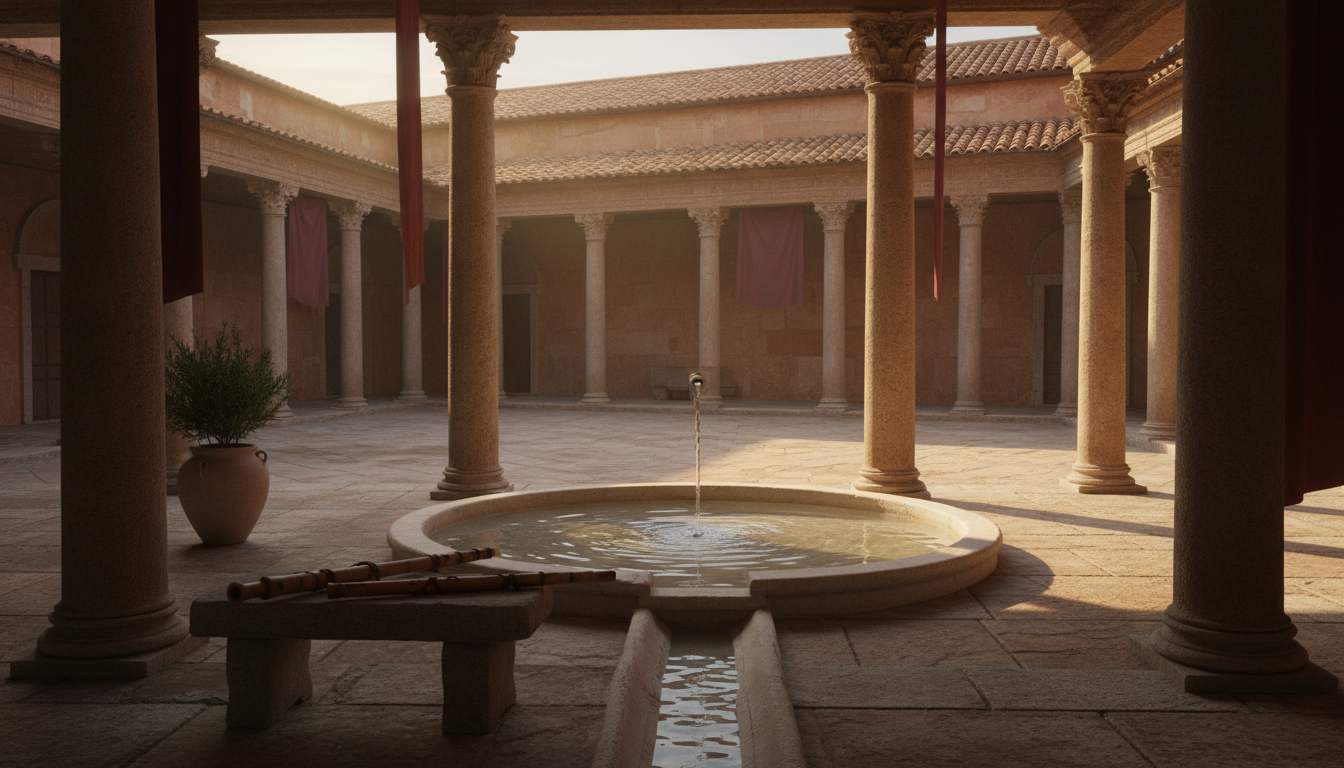
Theo Penrose · The Vestal Mysteries · Book Two
Two Original Stories & a Historical Companion
These independent, spoiler-safe episodes take place during Junia Secunda’s service in ancient Rome. They are neither missing chapters nor necessary to understand the novel. They do not reveal the main investigation’s solution.
Bonus Story One: The Basin at the Turning Sun
The basin had been full when Sabina went for water at dawn. By noon it held enough to wet a sparrow’s feet and not much more.
Tertia Calliste stood at the outer service gate with a pitcher in one hand and an expression suggesting that the basin had personally failed Rome.
“I dislike water that makes appointments it does not keep,” she said.
Licinia Fausta peered into the shallow stone bowl. “Has it promised an appointment?”
“Every morning. It arrives. Every afternoon. It abandons its responsibilities.”
Junia Secunda looked past the rim toward the strip of lane between the House’s service wall and a cluster of small shops. A vendor was trying to persuade two customers that the herbs on her tray had been cut that morning. They had. The leaves still wore droplets of water. Junia wondered where it had come from.
The basin was ordinary, a convenience supplied by a small household cistern, not part of the sacred water maintained for ritual use. Servants filled pitchers there, workmen rinsed dust from their hands, and people waiting at the permitted outer entrance sometimes asked for a cup. Its unreliability was irritating rather than dangerous.
The irritation had already grown teeth.
“It is the boy,” said a man carrying a cage of empty pottery jars. “He comes before the heat and goes away with water. Then the basin dries.”
The herb seller turned on him. “My grandson fills two small cups. There are half a dozen men on this street who take entire pitchers.”
“They pay.”
“Water has begun accepting coins?”
Tertia made an approving sound. Junia wished she would not.
“Which boy?” Licinia asked.
“Naso,” the woman said. “He helps me in the mornings. His mother is ill, and he needs somewhere useful to be.”
The man with the jars shrugged. “I know what I see.”
“That is an impressive claim,” Tertia said. “What do you see?”
“A boy beside an empty basin.”
“And did you see him empty it?”
“I saw his cups.”
“So we have arrived at the arithmetic of two cups against a whole basin.”
Before the man could reply, an attendant came from the inner passage with a reminder that Junia was expected at her assigned duties. She should have gone at once. Instead she looked at Licinia.
“You were due to oversee the storeroom airing, were you not?”
“In another hour.”
“Then perhaps you can find out who is responsible for this basin without letting the entire lane conduct a trial.”
Licinia blinked. In the House, Junia was normally the one who could not leave a question alone. She did not appear to know what to do when the question was handed to her.
“You want me to inquire?”
“Only with permission,” Junia said. “And you must be finished before your duties.”
Tertia looked from one young Vestal to the other. “I was hoping for a shorter route to the answer.”
“Then perhaps,” Licinia replied, “you should have chosen a shorter question.”
Junia smiled despite herself. There were occasions when Licinia deserved encouragement. This was one.
Terentia Prisca was less impressed by their enthusiasm than by the possibility that the outer service arrangements had become an excuse for accusing a child.
“The water is not sacred,” she said, when Licinia put the matter before her. “The basin is maintained for practical use. Speak to the steward, and call the mason who tends the service wall. Do not interfere with the street’s affairs or offer opinions about anyone’s honesty until you have something better than talk.”
“Would you prefer that we leave the boy to the talk?” Licinia asked.
Terentia studied her. “I would prefer that you remember why there are limits to our authority.”
“I do remember.”
“Then you may use the hour you have.”
Licinia emerged looking both relieved and annoyed.
“She agreed,” she told Junia.
“She frequently does, after explaining why agreement is exhausting.”
“She also told me to seek the mason.”
“That sounds useful.”
“And not to accuse anyone.”
“That sounds like Terentia.”
“You could come.”
“I have other duties.”
Licinia hesitated. “But you would notice more.”
“Perhaps. Or perhaps you would notice different things.”
Licinia considered that possibility with an expression of great suspicion. Junia returned to her duties before her friend could argue.
When Licinia reached the gate again, Naso was there. He was smaller than she had expected, a narrow-shouldered boy with dust on his knees and a chipped pottery cup clutched so tightly that his fingers whitened at the joints.
His grandmother stood at the herb tray.
“If you intend to question him,” she told Licinia, “I would rather you ask in front of me.”
“That is fair,” Licinia said.
Naso swallowed.
“How much water do you take?”
“Two cups.”
“For whom?”
“One for my grandmother’s plants. One for the old dog that comes from the baker’s yard.”
The potter who had spoken earlier appeared in his doorway. “A dog. There is your explanation.”
Licinia turned toward him. “How large is the dog?”
“What?”
“How large? If he can drink an entire stone basin, perhaps we should warn the city.”
The herb seller pressed her lips together. Naso made a startled choking sound. Even the potter looked briefly as though he might laugh.
Licinia knelt beside the basin. Water covered the bottom to the depth of a finger, and the stone above it felt rough with heat. The small inlet at the back gave an occasional trickle from the cistern, followed by a long pause.
“Did you ever see water run out over the rim?” she asked Naso.
“Only after a storm.”
“What happens before the water disappears?”
He looked at her, surprised that she wanted an answer rather than an excuse. “It makes a noise.”
“A splash?”
“No. Underneath. Like somebody swallowing when they think no one is listening.”
The potter gave a contemptuous grunt. “Boys invent noises.”
“I hear noises when they are there,” Naso said, with sudden heat.
Licinia held up a hand. “Show me where you hear it.”
He led her around the end of the service wall to a narrow gap where a low row of planted pots occupied the shade. The stone was warm under her palm, except for a patch near the ground that felt unexpectedly cool. A small dark stain spread across the lower masonry.
The sound was gone.
“It does not do it all the time,” Naso explained. “Only when the basin is going down.”
Licinia crouched, careful to keep the edge of her robe away from a puddle of muddy dust.
The dampness was on the outside of the basin’s wall. That was a fact. The boy’s cups were also a fact. They were not the same fact.
“Has the wall been repaired recently?”
Naso nodded toward the gate. “They changed one of the paving stones before the games. Men came with levers, and my grandmother said the whole lane shook.”
A different kind of answer began forming in Licinia’s mind.
She left the boy with his grandmother and asked Sabina whether she had noticed any dampness inside the service court. Sabina had not. She had been looking at the water level and worrying about the pitchers, which seemed an entirely sensible use of her time.
“Has anyone asked the mason?” Sabina said.
“I am going to.”
“Good. There are tasks for which a person ought not to improvise with a hairpin and optimism.”
Licinia decided to repeat that sentence to Tertia at a suitable opportunity.
The mason was named Menander, a compact elderly man with squared fingernails and a habit of inspecting walls before looking at the people who had summoned him. He arrived carrying two small wooden wedges, a plumb line, and a face on which disbelief had settled comfortably long ago.
“Another complaint about the basin?” he asked.
“How many have there been?”
“Four. One said the stone was thirsty. One said the cistern was cursed. One accused a washerwoman from a different street. The fourth wanted me to explain why water refuses to rise uphill.”
“Did you?”
“I explained that it was stubborn by nature.”
Licinia walked him to the basin. By then Tertia had joined them, having decided that missing water fell within the steward’s sphere of annoyance.
Menander examined the inlet, the rim, and the damp patch beyond the wall. He did not touch anything immediately.
“How long has it behaved this way?”
“Since the road work, perhaps,” Tertia said. “I did not connect the two.”
“Most people do not connect stones with water until the water reaches their sandals.”
“Can you repair it?”
“Probably.”
“That is a dangerously indefinite answer.”
“I have not seen the damaged part.”
Licinia told him about the sound Naso had heard. Menander looked toward the boy, who watched them from the herb tray as though the man’s wedges might somehow decide his fate.
“He noticed the sound?”
“Yes.”
“Good ears.”
“They are being treated as evidence of theft.”
The mason straightened. “Then the rest of the street has poor ears.”
Tertia approved this more openly than she had approved Licinia’s earlier remark.
Menander asked the household’s permission to inspect the basin carefully. Terentia sent back approval for work on the ordinary service fixture but no alteration to the sacred supply or its arrangements. Menander seemed grateful for the distinction. A stone did not care whom it served, he explained, but the people who kept accounts for stonework cared very much.
For an hour the basin refused to demonstrate its failure. The inlet trickled, and the water rose by slow degrees. Menander tested the outlet, inspected the mortar, and asked when the larger household cistern was drawn upon.
“Breakfast preparations, washing, and midday cooking,” Tertia said.
“So the flow into this basin is greater at some hours and smaller at others.”
“Yes.”
“That may be enough to make an old fault visible. We will wait.”
Tertia spread her hands. “You are charging for waiting?”
“I am charging for knowing what to wait for.”
Junia returned at the end of her duty to find Licinia standing with the mason, Naso, his grandmother, the potter, two kitchen servants, and an impatient Tertia. She remained beneath the permitted outer portico instead of stepping into the lane.
“Have we found a thief?” she asked lightly.
“No,” Licinia said. “We have found several people eager for one.”
“That sounds familiar to Rome.”
Menander raised a finger. “Watch the water.”
The surface had climbed above a pale line near the basin’s back wall. They stood quietly. A breeze carried hot bread from the neighboring oven and the stronger smell of crushed rosemary from the vendor’s tray.
Nothing happened.
Tertia began to say that stonework was the least dramatic occupation in the city. Then a soft trickle sounded somewhere below the basin. It stopped. Began again.
“There,” said Naso.
Menander nodded. “There.”
He touched the low outside wall. A little bead of water appeared at a dark mortar seam, fell into the soil beside the pots, and was immediately swallowed. A second bead followed. The old pointing had cracked where two courses met; the paving work had shaken a narrow joint loose. When the basin rose above the flaw, water began to escape into the ground beyond the wall.
“But why does it seem full in the morning?” Sabina asked.
“The flow into it is enough to restore the level when fewer people use the cistern,” Menander said. “At busy hours there is less coming in. There is still water going out through that joint. It falls until the leak lies above the surface again.”
“And then stops,” Licinia said.
“The leak stops. The basin is left low.”
Naso leaned forward. “That is why the noise goes away.”
“Yes,” Menander said. “You heard the water where we could not see it.”
Junia looked at the boy’s face. The relief there was immediate, but fragile. He was still waiting for someone to explain why it had taken a mason to believe him.
The potter cleared his throat. “You might have mentioned the sound earlier.”
“I did,” Naso said.
The lane went quiet.
Tertia looked at the potter with an interest that made him wish for another doorway.
Licinia spoke before anyone else could. “He mentioned it to me. The explanation came from Menander. Neither of us would have known where to look without Naso.”
The potter’s embarrassment deepened. “I may have spoken too quickly.”
“You did,” said the herb seller.
Junia watched Licinia. This was the point at which an apology might become merely an unpleasant phrase that everyone hurried past. Her friend did not hurry.
“What did you say about Naso’s cups?” Licinia asked.
The potter looked at her. “I thought he had emptied the basin.”
“Was that true?”
“No.”
Naso studied the stone at his feet.
The potter turned toward him, awkwardly but directly. “Then I was wrong. I should not have said you stole water.”
The boy nodded without looking up.
Menander returned to his work. He advised a temporary restriction on use of the basin while he opened the damaged joint and repaired it. Tertia asked how much the repair would cost. He gave a figure. She gave him a look suggesting he had offered to purchase the Forum.
“You wish a dry wall,” he said, “but a wet bill.”
“I wish a cheap wall and no bill.”
“Then the wall will remain wet.”
After some argument, Tertia agreed to the necessary work and insisted on seeing the finished repair. She could be unreasonable about prices without being unreasonable about safety.
Junia stood beside Licinia as the others dispersed.
“You managed that well,” she said.
“I was not sure I was managing anything. For a long time we watched water.”
“There are worse ways to spend an hour.”
“I almost asked you to speak to the potter.”
“Why did you not?”
“Because Naso was looking at me.”
Junia said nothing.
Licinia rubbed dust from one thumb. “I thought if I called you over, he might believe nobody had listened until somebody more important arrived.”
“That would have been an unfortunate lesson.”
“Yes.”
“I am glad you did not teach it.”
Licinia’s smile came slowly. “You are not offended?”
“That you did something well without me?”
“You might be.”
“I am considering it. Give me time.”
The two women returned to their duties while the mason worked, and Junia thought the matter finished.
It was not.
Before supper, Naso came to the outer entrance asking for Licinia. He carried two very small earthen cups, one intact and one chipped. The attendant fetched Tertia, who fetched Licinia, who looked astonished to find the boy standing there again.
“My grandmother wanted me to say thank you,” he said. “She could not leave the stall.”
“You already thanked me.”
“She said I had thanked you with my face. She wanted words.”
Licinia accepted this distinction. “Then tell her the words are received.”
Naso shifted from foot to foot. “And Menander said the water will be back tomorrow.”
“Yes.”
“And the potter gave us a broken jar with a good bottom. It can hold the rosemary cuttings.”
“That was generous.”
“He said it was because he had too many broken jars.”
“Perhaps he does.”
“He also said I could keep fetching water for the dog.”
Licinia noticed the chipped cup. “Will that hold enough?”
“For a little dog.”
“Is it a little dog?”
“Not now. It was when it started coming.”
For the first time that day, Licinia laughed without looking over her shoulder to see who else was listening.
Naso held out the intact cup. “My grandmother said you might need one.”
“For water?”
“For anything. She says the House has many important cups, but this one belongs to no one important, so you needn’t worry about breaking it.”
Licinia hesitated. It was not a valuable object, and it had not been offered as a religious gift. Still, she would not accept things at the gate without thought. She looked toward Tertia.
Tertia inspected the cup. “A household courtesy, not a sacred offering. I shall put it with the ordinary service vessels, if Terentia agrees.”
Naso appeared faintly disappointed.
Licinia smiled at him. “Then when you next come, you may see whether it is being used.”
He considered this and nodded. It was enough.
After he left, Tertia placed the cup on the receiving bench and studied it.
“Two cups,” she said. “A street thought two cups had taken all the water.”
“People prefer a person they can blame to a wall they must repair,” Licinia answered.
“That is because walls do not argue.”
“Nor do they pay for the work.”
Tertia made a troubled noise and went away to find the mason’s promised account.
At supper, the basin was spoken of only briefly. Terentia asked whether the service had been restored and the repair authorized. Licinia answered both questions. She did not pretend to have directed the mason or to have settled the lane’s affairs by priestly decree.
“Good,” Terentia said. “That was the proper limit.”
Junia expected Licinia to be disappointed by such measured praise. Instead her friend accepted another piece of bread with evident satisfaction.
Later, when the courtyard quieted, Junia found Licinia at the outer threshold looking toward the lane. The potter had set an empty jar beneath the wall to catch the last harmless drops while the new mortar cured. Naso was carrying his chipped cup toward the baker’s yard. The old dog followed him at a stately distance, already convinced that tomorrow would be much the same.
“Will you miss the mystery?” Junia asked.
“The mystery was tiresome.”
“You were pleased when you found the leak.”
“I was pleased when the boy was not frightened anymore.”
Junia considered the distinction.
Licinia looked at her. “You would have found the fault faster.”
“Possibly.”
“But you would have wanted to solve it before the mason arrived.”
“That is possible too.”
“And then Tertia would have had to pay for two repairs.”
“Now you are becoming cruel.”
Licinia rested her hand on the cool stone of the gate. The evening smelled of bread, watered earth, and a little rosemary. Nothing in the House’s sacred routines had changed. A boy still fetched water. A basin still needed maintenance. A woman at an herb stall still had to persuade customers that her plants were fresh.
Yet the lane had changed in one small way. The next time Naso knelt beside the basin, those who saw him might remember that he had heard what they had ignored.
Junia let the thought rest where it belonged: with Licinia.
Behind them, Tertia was arguing with Menander about whether a repaired joint ought to cost as much as a whole new stone. The mason was defending stone as a profession. Terentia, somewhere in the inner rooms, was surely regretting the number of people who had discovered voices.
The basin filled slowly under the turning light, making no sound at all.
Bonus Story Two: The Missing Sixth Note
The tune had six notes. Everyone agreed about that.
Only five came out of the musician’s pipe.
By the time Junia heard the disagreement, three people had explained the problem, four had contradicted them, and a small girl had begun crying behind a painted door.
“An efficient afternoon,” Sabina said, coming up from the market lane with an empty basket.
Junia had been returning from a permitted errand near the Forum with an attendant. She stopped where the public street opened into a courtyard shaded by two long walls and a wooden balcony. A blue bird had been painted above the door. Below it, on a bench, lay a pair of wooden pipes and a shallow dish of walnuts.
“You appear to know the trouble,” Junia told Sabina.
“I know one side of it.”
“That is more than most people admit.”
Sabina lowered her voice. “Dama says his pupil has forgotten the ending. The pupil says she plays the ending every time. They have been proving each other wrong since morning.”
A thin, impatient man emerged from the door with the manner of someone who considered patience a musical defect.
“I am not proving anything,” he announced. “I am teaching.”
“Ah,” Sabina said. “That explains why no one has been allowed to learn.”
The man stopped. His eyes found Junia’s white garments, and he seemed to remember that public streets could contain people whose approval did not depend on buying lessons.
“Forgive me. I am Dama. My family borrows this courtyard for lessons when the weather is good.”
Junia inclined her head. “Junia Secunda. I have no authority over your lessons.”
“Nor do I ask it. I merely require someone with ears.”
“Those are not always the same qualification,” Sabina said.
Dama gave her a suffering look. “You again.”
Sabina had grown up within sound of market musicians, and on days when the House’s supplies drew her into the streets she still greeted one or two as acquaintances. Junia had never thought much about it. Sabina counted lamp wicks with such stern devotion that she seemed to belong entirely to the world of careful lists and orderly shelves.
The painted door opened. A girl of about thirteen stepped into the courtyard carrying a single small pipe. Her hair had been gathered with a cord that looked as though she had tied it herself and regretted the result.
“This is Neria,” Dama said. “She knows the piece.”
“Then why is it a problem?” Junia asked.
“Because knowledge refuses to pass into sound.”
Neria looked at the stones. “It passes for me.”
“Five notes,” Dama said.
“Six.”
“You see?”
Junia did. She saw an instructor who believed his ears and a student who no longer trusted her own. Neither was likely to be helped by a priestess declaring the answer.
“Where is the sixth note supposed to fall?”
Dama demonstrated by tapping his fingers against the bench: one, two, three, four, five, six. The tune was simple, a little climbing phrase followed by a turn downward. It sounded like something a person could carry while walking with full hands.
“My sister taught it to the children,” said a woman in the doorway. She was broad-shouldered and wore a dark apron dusted with flour. “There will be a family supper tomorrow. We meant to play it there.”
Neria’s face altered.
It was a small change, but Junia caught it. Not embarrassment now. Something closer to pain.
The woman continued, “My sister is gone. The supper is for those of us still here, and we thought hearing the tune would be a good way to remember her.”
“You will hear it,” Neria said.
“Of course, child.”
Dama moved his hands through the six-beat pattern again.
Neria lifted the pipe. She breathed, settled her fingers, and played a bright, thin run of notes. Junia counted five. At the end the girl stood very still, as if listening to something a long way off.
“There,” Dama said. “It ends too soon.”
“It does not,” Neria whispered.
A cart rattled through the lane. The sound bounced against the high stone surfaces and faded. Junia noticed how sharply it returned from the far end, where an old staircase climbed toward a doorway above the shops.
Neria put the pipe down.
“Perhaps we should stop,” said the woman in the apron.
“No,” Dama replied too quickly. “If we stop every time an apprentice is upset, no apprentice will ever play before another living person.”
Junia thought this argument might be better offered to apprentices who were not currently upset. She also had no wish to have an argument with Dama about teaching in the street.
“May I ask,” she said, “why you are practicing here?”
“It is sheltered,” Dama said. “The wind can spoil a phrase.”
“Does the same thing happen elsewhere?”
Dama’s answer came at once. “She plays well in my room. That is why I know she can do it.”
“Then perhaps,” Sabina said, “the room is a better teacher.”
Dama bristled. The aunt in the apron sighed. Neria looked startled enough to forget crying.
Junia’s attendant reminded her that they were due back at the House. She accepted the reminder. She had no claim to remain and test the courtyard, and the girl had already suffered enough from an audience.
As she left, Sabina caught up with her.
“Did you hear something odd?” the servant asked.
“Yes. A note seemed to linger after the girl stopped.”
“I heard it too.”
“Perhaps the walls carry it.”
Sabina looked back over her shoulder. “Dama will not enjoy being told that his courtyard has opinions.”
“He can disagree with a wall more safely than with a child.”
“I hope so.”
They returned to the Atrium, where the day’s work had waited with complete indifference to artistic difficulties.
That evening Sabina counted lamp wicks so quickly that Tertia accused her of omitting three out of impatience.
“I have omitted none.”
“You usually count aloud.”
“I know the number.”
“That is what people say just before I find a shortage.”
Sabina reached the end of the table, made her tally, and began again without being asked.
Junia watched her for a moment.
“What are you thinking about?”
“A sound,” Sabina said.
“That is not an explanation.”
“It is the only one I have.”
Tertia pointed at the wicks. “Then you may think about sounds after you have finished counting objects.”
Once the work was complete, Junia found Sabina sitting beneath the outer portico. She had put six pebbles on the bench and was tapping them in order. The fifth pebble received a second, lighter tap that came as an echo from the inner wall.
“You are practicing the tune?” Junia asked.
“No. I am practicing the mistake.”
Junia sat at the opposite end of the bench.
Sabina tapped the fifth stone again. This time Junia heard the reflected click distinctly. Sabina looked pleased and alarmed at once.
“What if Neria hears that answering sound and thinks she has played her last note?” she asked.
“She might. But we heard only five.”
“We were standing by the street. She was close to the staircase. The answers from the wall might be stronger there.”
Junia looked toward the doorway. “You would need to find out from the girl.”
“I could ask Dama tomorrow.”
“You could. You should also ask Neria.”
Sabina frowned. “Would Dama let me?”
“He has no reason to deny her an answer.”
“He may have several.”
“Then you must decide whether the question is worth the discomfort.”
Sabina gathered her stones. She had spent most of her working life recognizing when a question was not hers to ask. That skill could be useful. It could also grow too large.
“Would you come?” she asked.
“Not to conduct the matter. I can speak with Terentia about whether our errands allow a stop there. You need not make a child’s music lesson into the House’s business.”
Sabina nodded, and Junia left her with the pebbles.
The next afternoon they were back in the lane by a perfectly ordinary route. Tertia had sent Sabina to exchange a damaged lamp stand at a nearby metalworker’s shop. Junia and an attendant had been given permission to accompany her for a separate visit and to return directly. None of this made them judges of musicians.
Dama was surprised to see them.
“Did the tune follow you home?”
“Only the argument,” Sabina said.
“I have rehearsed the ending twenty times.”
“Has Neria?”
“She claims she has.”
Sabina looked toward the painted door. “May I ask her a question before she plays again?”
Dama hesitated. He had not yet worked out whether a household assistant could be allowed to instruct a music teacher.
The aunt settled it. “Of course she may.”
Neria emerged with the pipe tucked beneath her arm. She was plainly reluctant to produce it, but Sabina did not ask her to play.
“When you reach the end,” Sabina asked, “what do you hear?”
“The last note.”
“And what do you hear after it?”
Neria looked confused. “After it?”
“Yes.”
“Nothing. It has finished.”
“Does the last note sound as clear as the others?”
“Not quite.”
“Do you ever turn your head to listen?”
The girl nodded. “I thought I was losing the sound because I was frightened.”
Sabina asked her to stand where she had stood the previous day. Neria did so, beside the lower stairs, under the long overhang of the balcony.
“Play only the first three notes,” Sabina said.
Neria obeyed.
The answer came back thin but unmistakable. A little return of the highest tone lingered among the stone surfaces. Dama’s brow drew together.
“Again.”
Neria played the three notes. Again a faint answering sound followed the last.
Sabina walked to the other end of the courtyard.
“Now play them from here, facing the street.”
Neria crossed with the pipe. The three notes sounded bright and simple. Their ending went straight out into the open lane and vanished.
The girl blinked.
“Again,” Dama ordered.
Neria played them again, then turned and looked toward the staircase as if she expected to see another musician behind it.
“I thought that was part of what I was making,” she whispered.
Dama said nothing.
Sabina returned to the foot of the steps and clapped once. From the far masonry came a small delayed answer.
“It is not a person,” she told Neria. “It is the shape of the place.”
Dama lifted his chin. “The walls have always been there.”
“Have you always practiced with her at that end?” Sabina asked.
“No. I stand here to listen.”
“Where did she learn the tune?”
“In my room.”
“And where will she play tomorrow?”
The aunt answered. “In the open courtyard of my brother’s house. There are no tall walls opposite the steps.”
Sabina nodded. “Then she should try the whole phrase facing the open street.”
Dama did not enjoy having his next instruction supplied by someone who counted household wicks. To his credit, he gave it anyway.
Neria took her place, drew a breath, and played.
One note, two, three. A rising fourth. A short turn on the fifth. Then the sixth, clear and settled, falling like a small stone into still water.
She lowered the pipe slowly.
Dama looked at her. The aunt put one hand over her mouth.
“There,” Neria said. The word held less triumph than exhaustion. “I said there was a sixth.”
Dama cleared his throat. “There was.”
Junia, who had been standing well away from the little assembly, thought it prudent not to improve that answer.
Neria examined the pipe as if she had received a different instrument without noticing.
“Why could I not do it before?”
Sabina pointed to the staircase. “The fifth note was returning to you. When you listened for the ending, you heard a second little answer and stopped. You thought the answer was yours.”
“But Dama did not hear it.”
“He stood out here. Different walls, different sound.”
Dama looked from the steps to the street, then to his pupil. He took the pipe from her, played five notes beside the stairs, and tilted his head. The answering sound came back.
“I hear it,” he said. The admission appeared to cost him more effort than the music.
“Good,” said the aunt.
Dama bristled. “I can hear perfectly well.”
“No one doubted that,” she replied, in a tone suggesting that everyone had doubted several other things.
Neria had not smiled yet.
“Will you still let me play tomorrow?” she asked.
Dama looked surprised. “Naturally.”
“You said I had forgotten.”
“I said you were stopping early.”
“You said I was not listening.”
Dama opened his mouth and closed it. For the first time he seemed to understand that he had given the girl two different problems, one concerning the sound and one concerning her trust in him.
“You were listening,” he said at last. “To something I did not hear. I should have asked.”
Neria studied him for a long moment.
Then she said, “You should have stood where I stood.”
Sabina looked away very quickly. Junia suspected she was suppressing laughter. The aunt did not suppress hers at all.
Dama let out an unwilling breath that became a small smile.
“Yes,” he agreed. “That too.”
For a while they experimented with the courtyard as though it were an instrument in its own right. Neria played from the steps, from the bench, beside the painted door, and once from the center where sunlight warmed the stones. The returning sounds changed. Some places blurred the ending, others let it remain clear. Dama was soon too interested in the acoustics to remember he had been offended.
Junia could not remain indefinitely. She and Sabina had errands, and the attendant was patient but not invisible.
Before leaving, Sabina asked Neria what the tune had meant to her aunt.
“She used to sing it when we carried things home from the market,” Neria said. “If my hands were full, she would keep the beat for me with her sandals. I thought I remembered every part.”
“You did,” Sabina answered.
Neria looked down at her pipe.
“Yesterday I thought I had lost the last sound she taught me.”
Sabina waited. Unlike Dama, she did not rush to answer.
Neria continued. “After she died, everyone kept telling me what she was like. I knew her. Sometimes I did not want them to tell me again. Then I began to think I had forgotten something important.”
Junia felt a quiet sympathy for the girl. People often treated the memory of the dead as a vessel that must never be allowed to leak. They forgot that the living carried it with tired hands.
“You remembered the tune,” Junia said. “The place made it difficult to hear.”
Neria looked at her. “Do you think the supper will sound the way it used to?”
“No,” Junia said.
The aunt started to protest, but Junia continued.
“Your aunt will not be there. That changes the sound, even if you play every note correctly. It does not mean the music is less worth playing.”
Neria considered this. A little of the strain left her shoulders.
Dama stood by the painted door, looking suddenly older than he had before. “I knew her too,” he said. “She told me I always hurried the end.”
“Did you?” Neria asked.
“Certainly not.”
The aunt laughed. “You did.”
“I may have expressed a preference for movement.”
“You hurried.”
He sighed. “Very well. Tomorrow I shall follow the pupil.”
Neria smiled then, not widely, but enough that Sabina relaxed.
On the way back toward the House, Sabina carried the replacement lamp stand with more care than its value required.
“You were right about the echo,” Junia said.
“I thought I might be. I nearly said nothing.”
“Why?”
“Dama teaches musicians. I count wicks.”
“Both of you have ears.”
“He uses his to earn a living.”
“And you use yours to notice when someone is wrong about a child. That is not nothing.”
Sabina was quiet.
Junia expected the matter to end there. Instead Sabina asked, “How do you know when not to speak?”
“I do not always know.”
“That is reassuring.”
“It should not be.”
Junia thought of Terentia’s steady demands that she distinguish a fact from an inference, and an inference from permission to act. In the music courtyard she had no office, only an opportunity to listen. Sabina had supplied the useful question. Dama and Neria had supplied the proof.
“I try,” Junia said, “to ask who must live with the consequence if I am wrong.”
Sabina looked at the lamp stand. “Then I should have spoken yesterday.”
“Perhaps. But you spoke today.”
Back at the Atrium, Tertia inspected the returned metalwork and declared the replacement barely less offensive than the damaged stand.
“You have been gone a long time,” she said.
“The market was crowded,” Sabina replied.
“With merchants?”
“With musicians.”
“Worse. At least merchants usually admit they want payment.”
Sabina did not explain the episode until her duties were finished. Then she told Tertia how the fifth note had been returning from the wall, how Neria had thought it was the sixth, and how Dama had found the courage to apologize.
Tertia listened with her chin in one hand.
“And the girl will play?”
“Yes. Tomorrow.”
“Good.”
“I thought you would make a remark about Dama.”
“I have several. None will improve the music.”
Sabina blinked. Tertia returned to her lamp stand.
The next evening the House received no formal report of the family supper. It was not the House’s occasion. But the aunt sent Sabina a small sprig of bay tied with plain cord, along with the message that the tune had been played in the open courtyard without losing a single note.
Sabina showed it to Junia beneath the portico.
“Was Dama satisfied?” Junia asked.
“He played the beginning, then let Neria play the end. The aunt said he managed to wait.”
“That is a substantial professional achievement.”
Sabina laughed.
The sprig of bay was an ordinary courtesy. Sabina took it home when her duties ended. Junia did not ask to keep it, and no one mistook it for a sacred object.
A few days later she passed the same lane while traveling with an attendant. Dama was giving a lesson beneath the blue bird. This time he stood beside the staircase, where the returning note could be heard.
Neria played the phrase without stopping.
One, two, three, four, five, six.
Dama made her play it once more, then called to a small boy waiting with his own pipe.
“Come here,” he said. “Before you begin, I want you to listen to what the wall does.”
Neria shifted along the bench to give the boy room. She showed him where to stand, then waited until he found the echo for himself. Her instruction was patient. She did not tell him that he was imagining it. She did not count for him before he could hear.
Junia watched only long enough to see that Dama was allowing her to teach.
The musician looked up and recognized the white garments across the lane. He bowed politely, then returned to the boy.
Junia went on.
Behind her, one pipe gave a clear, wavering answer to another. The courtyard echoed again, as courtyards do. This time everyone knew which voice belonged to the instrument, which to the stone, and when to wait for the true last note.
Historical Companion: The Vestal World — Places, Duties, Sounds and Everyday Life
This companion separates documented features of Roman life from the invented episodes in the two stories. It is a reader’s orientation rather than a claim that every fictional detail can be reconstructed from surviving ancient sources. These self-contained episodes focus on everyday incidents within the series’ fictional Roman setting rather than assigning precise dates to each event.
The Sacred Household
Vesta. Roman goddess associated with the hearth and its fire. Her public sanctuary occupied an important place in Rome’s religious landscape. The continuity of the sacred flame was associated with the security of the community.
Vestal priestesses. Women selected in childhood for a long period of religious service. Ancient sources traditionally describe thirty years of obligation. Their position brought unusual honors and legal privileges, but it also imposed serious restrictions. A Vestal was not an ordinary magistrate or an investigator acting with police powers.
The Atrium Vestae. The residential complex associated with the Vestals beside Vesta’s sanctuary in the Roman Forum. Its archaeological remains reflect a substantial institution. Historical fiction may invent particular service rooms, routes, staff exchanges and conversations where the evidence is incomplete.
Terentia Prisca, Junia Secunda, Licinia Fausta, Tertia Calliste and Sabina. These are characters in Theo Penrose’s fictional series, not figures presented here as historical persons. Junia is an eighteen-year-old Vestal; Licinia serves within the same household, Terentia exercises senior authority, Tertia oversees practical household affairs, and Sabina helps with its daily work. Their dialogue, personal relationships and the bonus incidents are inventions of the narrative.
Sacred versus ordinary supplies. A household responsible for rites could also have routine requirements: food, lamps, maintenance work and water for service areas. The first bonus story deliberately concerns a non-sacred service basin. Repairing it does not require Junia to alter a ritual water system or exceed the authority granted to her.
Places Readers Encounter
Roman Forum. A central space where political, legal, commercial and religious life met. Its physical form changed across centuries, so a single image of the Forum should never be taken as a complete reconstruction of all Roman periods.
Via Sacra. The route through the Forum associated with ceremonies and public movement. Its proximity helps explain why the fictional household can be affected by the city’s wider activity without becoming identical to the city government.
Portico. A covered walk or entrance area supported by columns or another roof structure. Porticoes provided shade, shelter and places for permitted exchanges. In the stories, distinctions between public-facing thresholds and inner household space help preserve the limits of Junia’s role.
Vicus Tuscus and the market lanes. A historic street of ancient Rome and the broader commercial environment that inspires the second episode. The painted door, the exact music courtyard and its inhabitants are invented. They are not claims about a known archaeological property.
Argiletum. A street area associated with busy urban work and shops, used in the novel’s setting. Readers should not confuse its real historical name with the invented businesses and incidents of the fiction.
Water, Stone and Small Jobs
Cistern. A storage vessel or chamber for water, commonly dependent on local construction and supply arrangements. Rome used multiple ways of storing, transporting and distributing water, and access was not identical for every household. The auxiliary basin in Story One is a fictional fixture designed to illustrate ordinary maintenance rather than a particular excavated installation.
Mortar joint. The material joining courses of masonry. Cracks and failures can allow water to escape. The story’s explanation of a basin losing water through a damaged joint follows elementary physical reasoning; the individual defect is invented.
Mason and steward. Ordinary repairs required skilled labor, permission, materials and payment. The story’s mason, Menander, is fictional. Tertia’s insistence on accounting for an ordinary repair reflects her role as household steward, not an ancient document listing that specific invoice.
Servants, vendors and apprentices. Urban Rome included workers of many legal conditions and economic backgrounds. A person seen doing humble work was not necessarily enslaved; a shopkeeper was not necessarily wealthy. The stories avoid assigning legal status to every one-off character because the supplied materials do not establish it.
Music, Hearing and Memory
Pipes and local tunes. Romans used wind instruments, including forms known from literary evidence, visual depictions and surviving instruments. Their construction and performance traditions varied. Neria’s six-note family tune and Dama’s teaching courtyard are fictional rather than reconstructions of a surviving Roman melody.
An echo is not a second musician. Sound can reflect from hard surfaces, and what a listener hears can differ by position. The acoustic misunderstanding in Story Two is a fictional local puzzle. It should not be read as proof that a specific Roman street produced a particular six-note echo.
A family remembrance. The modest gathering in Story Two is a fictional social event, not an attempt to reproduce a named Roman public ritual. The story concentrates on the ordinary human act of remembering someone through a familiar song.
A Few Terms from the Main Novel
Ludi Romani. Major games and celebrations held in September, an important atmospheric element of The Veil at the Games. These bonus stories do not retell the novel’s festival investigation.
Liberta. A Roman freedwoman, formerly enslaved and subsequently manumitted. Manumission changed legal status but could leave ongoing obligations toward a former owner, now a patron or patrona. Rights varied according to time and circumstances.
Wax tablet and stylus. Common technologies for working notes and records. Wax could be inscribed with a pointed implement and reused. In the novel they contribute to the investigative environment; in these bonuses, records are not the hidden solution.
A note on evidence. Ancient Roman social and religious life is reconstructed from incomplete evidence: literary accounts, inscriptions, legal writings, buildings and artifacts. Those materials do not always agree, and they rarely preserve the experiences of all participants equally. Historical fiction can make those absences emotionally legible, but its invented conversations must remain fiction.
Continue Exploring
Learn more about this fictional world through the verified Theo Penrose author page. For an independent look at why everyday documentation can matter in this genre, read Why Paper Trails Make Such Powerful Clues in Historical Mysteries. These stories stand apart from the novel’s central case and do not identify its culprit or resolution.

