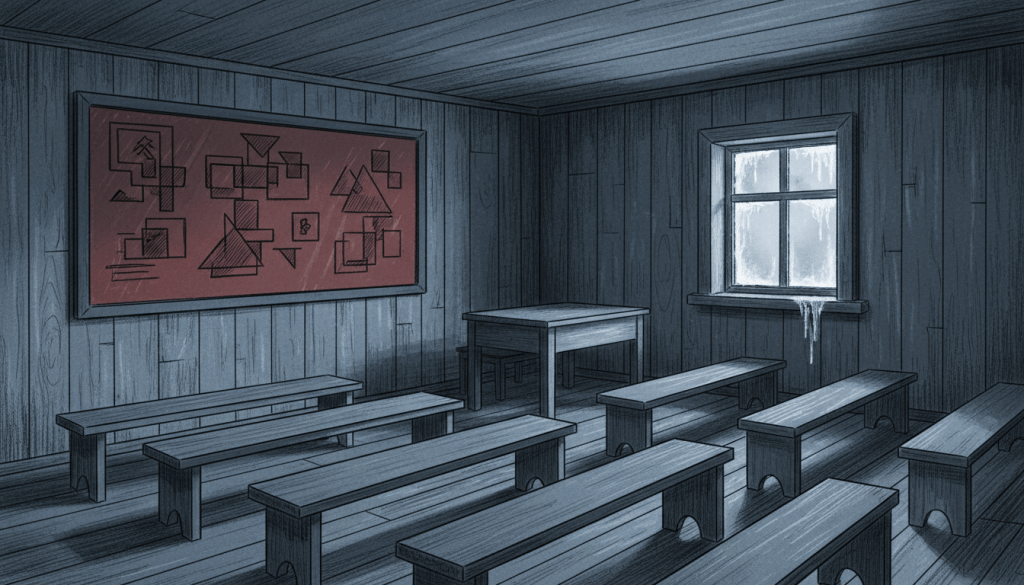
What Was a Soviet Red Corner?
A Soviet “Red Corner” was a designated space for political education and ideological messaging. In many workplaces, institutions, and communal settings, such rooms or corners displayed approved reading material, official portraits, newspapers, and notices. They were intended to bring state messaging into everyday life. In forced-labor camps, however, their function took on a striking contradiction: authorities spoke the language of enlightenment and moral improvement while prisoners were confined, hungry, and required to work.
The term did not describe one standardized room with an identical layout across the entire Soviet Union. Facilities, budgets, camp practices, and periods differed. A Red Corner might be an identifiable room or a modest area of a barracks. Its basic purpose was more consistent than its furnishings: the organized presentation of official political ideas.
Why Did Soviet Authorities Use Political Education?
Bolshevik political culture placed considerable importance on teaching the population how to interpret society through the ruling party’s ideology. Newspapers, organized readings, lectures, and visual displays were ways of reinforcing official accounts of events. The intention went beyond providing information. Political education framed model conduct, acceptable beliefs, and the meaning of loyalty.
In a camp, that language served additional purposes. Authorities classified people as offenders against the state and described labor as part of correction. Ideological sessions could present compliance as evidence of rehabilitation while implying that dissent exposed continuing hostility. These claims belonged to the institution. They should not be mistaken for reliable accounts of what prisoners believed or experienced.
Political education also helped make the camp appear administratively purposeful. A reading room or lecture could be cited as evidence of improvement even though it existed inside a coercive labor system. The presence of educational materials therefore tells historians something about official objectives; it does not automatically tell us whether prisoners accepted the message.
What Might Prisoners Encounter in a Red Corner?
Descriptions of camp cultural and educational work refer to newspapers, wall displays, lectures, reading activities, and political discussion organized under supervision. Officials could highlight production achievements, political anniversaries, or exemplary workers. The Gulag History Museum’s online exhibition explains the system’s cultural-educational sections (K.V.Ch.) and quotes former prisoner Jerzy Gliksman recalling Red Corner clubhouses that were largely empty because inmates were exhausted and preoccupied with survival. This is an individual recollection, not evidence that every camp used such spaces identically.
There was no universal daily experience. Access to materials varied, the practical intensity of political activity changed across camps, and prisoners themselves had different backgrounds and reactions. A prisoner who listened quietly could be exhausted, skeptical, afraid, bored, or simply focused on getting through another day. Silence does not prove agreement.
Visual propaganda matters because it makes institutional priorities visible. When wall notices celebrated production or obedience, they could conceal the conditions under which that output was achieved. A historian reading such material should ask who produced it, who was expected to see it, and what could not safely be said in response.
What Made Political Education Different Inside a Gulag Camp?
The decisive difference was the absence of meaningful freedom. A person could not simply leave the institution, choose another employer, or publicly dispute official statements without risk. The surrounding reality included guard systems, work assignments, rationing, inspections, and disciplinary powers.
Political messaging therefore overlapped with coercion. Labor was described as transforming the prisoner, but the camp also needed labor for economic production. In coal districts such as Vorkuta, the distance between idealized slogans and the extraction of fuel could be especially stark. Miners were required to meet demanding norms in a harsh environment, while the language of correction surrounded their working lives.
This tension also complicates the word “education.” Education ordinarily suggests acquiring knowledge or skills; ideological reeducation in the camp was tied to judgments about acceptable political identity. Some prisoners could participate in educational or cultural activities for reasons entirely unrelated to political conversion. The fact that an institution offered a lecture cannot be separated from who controlled attendance, speech, and punishment.
How Did Propaganda Connect With Labor Quotas?
Camp administrations measured output. Work norms and ration categories could create powerful incentives to meet production targets, even when prisoners lacked adequate rest or food. Political campaigns could reinforce this logic by praising exceptional labor and condemning those accused of lagging behind.
Still, labor arrangements and ration rules changed over time and differed between groups of prisoners and camps. It would be inaccurate to treat a single schedule or formula as universal. The larger historical point is structural: physical survival and official measures of productivity were often entangled.
That entanglement gave propaganda a practical edge. Claims about the dignity of labor could sit next to systems that allocated essential resources according to work classifications. For prisoners, an official lesson praising work could sound very different after a shift underground. Understanding the relationship between rhetoric and incentives is essential to understanding how the camps functioned.
Did Political Education Convince Prisoners?
No single answer represents the experiences of millions of people who passed through the Soviet camp system. Some prisoners may have repeated official formulas or taken part in organized activities. Others quietly rejected the state’s account of their supposed crimes. Outward participation cannot establish private belief.
Memoirs are particularly valuable because they record how individuals remembered the gap between public conduct and private thought. They also require careful interpretation: accounts were written under different circumstances, sometimes years later, and do not describe every camp equally. Official records, meanwhile, can establish what administrators planned or reported, but may reproduce the assumptions and incentives of the authorities.
Read together, these sources show why it is risky to equate an appearance of order with genuine consent. Coercive systems can secure signatures, attendance, and familiar phrases. None of those outcomes, on its own, demonstrates changed conviction.
How Can Historians Evaluate Red Corner Evidence?
A useful approach begins by separating three questions. First, what did the authorities say the educational program was supposed to accomplish? Second, what activities can be documented at a particular place and time? Third, how did people subjected to the program describe its effects?
Posters and newspaper issues reveal official rhetoric. Reports may show the number of lectures scheduled or books distributed, although reported figures need context. Memoirs and oral histories offer accounts of reception and resistance, but must be located in their particular circumstances. Research is strongest when these kinds of evidence are compared rather than treated as interchangeable.
Visitors reading about Vorkuta should also distinguish details specific to its Arctic coal camps from practices documented in other parts of the Gulag. The camp network had shared institutions but was not a uniform experience.
Why the Red Corner Matters Today
Red Corners illustrate how institutions can present coercion in the language of improvement. Their historical importance lies not in dramatic decoration but in the distance between the official message and the lived conditions around it. The same room could embody the state’s claimed mission to educate and a prisoner’s experience of enforced conformity.
For a broader study of Vorkuta’s ideological machinery, see Luke Halden’s Vorkuta Exposed series and the author’s history books. The later Rechlag protests show why it matters to distinguish the state’s official language from the demands and experiences of those imprisoned.

