How to Research Local Craft-Fair History Using Archives and Old Photographs
Who organized the village craft fair thirty years ago? Who won the quilt, knitting, or embroidery prizes? What happened to the makers whose names never appeared in the newspaper? Local craft-fair history often survives in scattered pieces: a photograph tucked inside a family album, an old programme, a church notice, a newspaper cutting, or a handwritten entry in a club ledger. The challenge is not just finding these sources, but interpreting them responsibly.
Begin with a precise research question
A broad search for “village fair history” can produce far too many results. Start with a name, venue, approximate year, craft, or specific event. For example: “Who organized the 1987 needlework exhibition in this parish?” or “Can I identify the maker of the prizewinning quilt pictured in this newspaper clipping?”
Write down what you already know and label each point as confirmed, remembered, or uncertain. Family stories offer valuable leads but are not the same as contemporary records. A date copied onto the back of a photograph could refer to printing, gifting, or the event itself.
Search local newspapers and event notices
Local newspapers often published fair announcements, prize lists, photographs, and short reports. Check the weeks before and after the suspected date. Spelling differences, initials, married names, and changes in venue can complicate a search. Try both the formal event title and everyday alternatives such as “annual show,” “craft exhibition,” or “parish bazaar.”
Search digitized newspaper databases where available, then ask the local library or archives about undigitized issues. Digitization is incomplete, and optical text searches frequently misread old type or poorly reproduced pages. A negative search result does not prove an event never happened.
When you find a reference, preserve the newspaper name, publication date, page number, and archive or web address. A photograph of the clipping alone may omit the information another researcher needs to verify it.
Ask archives what they actually hold
County archives, local history societies, museums, parish collections, and public libraries may preserve records of village organizations. Relevant holdings might include minute books, treasurers’ accounts, festival programmes, entry forms, correspondence, posters, or donated scrapbooks. A school archive may have photographs from an event held in its hall.
Search online catalogs before visiting, but remember that a collection-level description may not name every item inside a box. Ask archivists about access conditions, photography rules, ordering procedures, and any restrictions on fragile material. Give them the event, date range, location, and names you already know: specific questions are easier to investigate.
Not every organization kept records, and many private papers were never deposited. Keep a research log of where you searched, when, and what you did or did not find.
Read old photographs as evidence, not proof
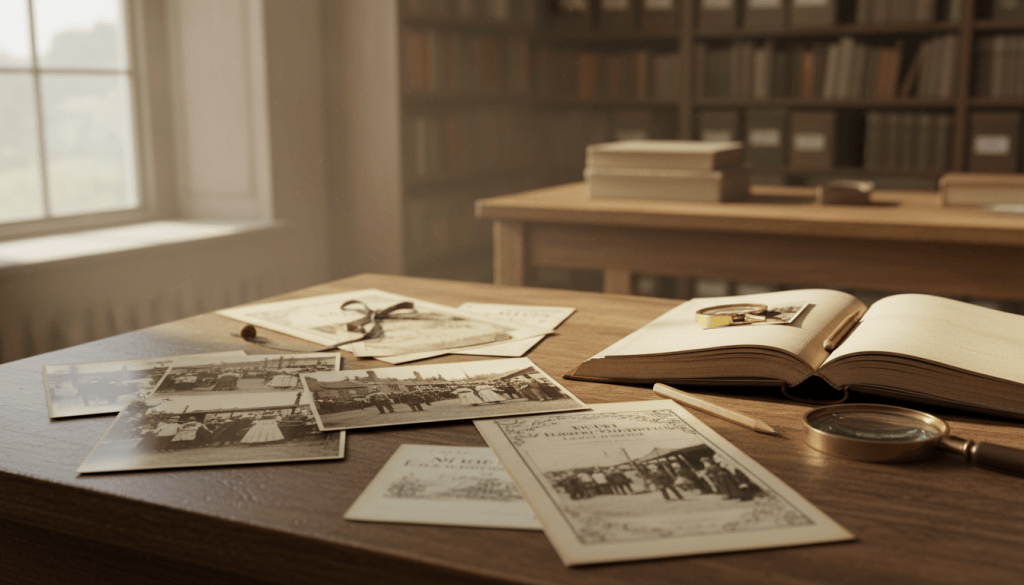
A photograph can show banners, prize tables, hall interiors, clothing, and objects on display. The UK National Archives’ guide to historical photographs explains why pictures are often dispersed among archival record series rather than collected in one convenient image catalogue. It may establish that a particular craft appeared at an event, but it does not automatically prove who made it, who owned it, or who received an award. A person standing beside a quilt could be its maker, a steward, or merely someone posing for the camera.
Examine the full image before cropping it. Look at background signs, adjoining display labels, numbers on entries, and objects repeated across different photographs. Compare captions written at the time with captions added years later. If the reverse contains handwriting, stamps, or studio details, photograph those too.
Record a source description: who holds the photograph, where it came from, whether you examined the original or a copy, and any known date. Never silently turn a tentative identification into a certain one.
Follow the craft organizations
Many fairs were supported by Women’s Institutes, guilds, stitching circles, gardening groups, schools, religious communities, or local fundraising committees. Their surviving newsletters and minutes may reveal judges, categories, competition rules, and the people responsible for an exhibition.
These records can also explain why credits changed. One person may have entered an object on behalf of a group; another may have supplied the design while someone else completed the stitching. The name on the prize certificate need not tell the whole story of the work.
Use care with historical language. Terms for crafts and prize categories shift across generations. An old “fancy work” category may cover several techniques that today’s craft communities would name individually.
Compare sources to resolve contradictions
Suppose a family album names one maker while a fair programme lists another. Don’t discard either account. Make a simple comparison table recording the claim, original wording, date, creator of the record, and source location. Identify whether one caption was written contemporaneously and another decades afterward.
Seek an independent third source: a dated letter, a committee minute, an award certificate, or a second photograph showing the object with its entry card. Even several sources may repeat one original error. Ask whether each record was created independently or copied from a previous account.
Contradictions may reflect memory, transcription mistakes, shared authorship, a change of surname, or genuine disagreement. A responsible historian leaves uncertainty visible rather than inventing a resolution.
Respect privacy and ownership
Researching a small community can uncover sensitive family information. Ask permission before reproducing privately owned photographs or sharing personal correspondence. Copyright in a photograph is not necessarily owned by the person pictured or the person who holds the print. Libraries and archives may also have reproduction conditions.
When interviewing residents, explain how their recollections may be used, record consent, and distinguish verbatim quotes from your summary notes. People can remember events differently without being dishonest. Avoid turning an unresolved attribution question into a public accusation.
Create a lasting record others can use
Organize findings by date, then by source. Keep full-resolution scans of materials you are permitted to copy, and make backup copies. Give each digital item a consistent filename and a short note recording who supplied it and the evidence for its identification.
If you’re building an exhibition or community album, caption each item with the maker, object, event, approximate date, and source where supported. An honest caption such as “Maker not confirmed; possibly from the 1974 parish exhibition” is more useful than an authoritative-looking mistake.
Offer a summary or finding aid to the local history organization if appropriate. That way the research remains accessible beyond the lifespan of one scrapbook.
Why this history inspires fiction
The fictional village of Thimblewick provides the setting for Mabel Thistledown’s The Scrapbook Scene. Its mystery begins with a disputed credit in an old craft-competition photograph and explores why authorship and community memory matter. The story belongs to the Thimblewick Craft Circle Mysteries.
For readers interested in craft traditions and paper-based clues, the Mabel Thistledown author page offers an introduction to the author’s work. When researching inherited photographs, protect original prints and record their provenance before adding notes or displaying them.
The best local history starts with curiosity and ends with a record that future researchers can challenge, verify, and enrich. Even one properly identified image can return a forgotten craftsperson’s work to the story of a community.

