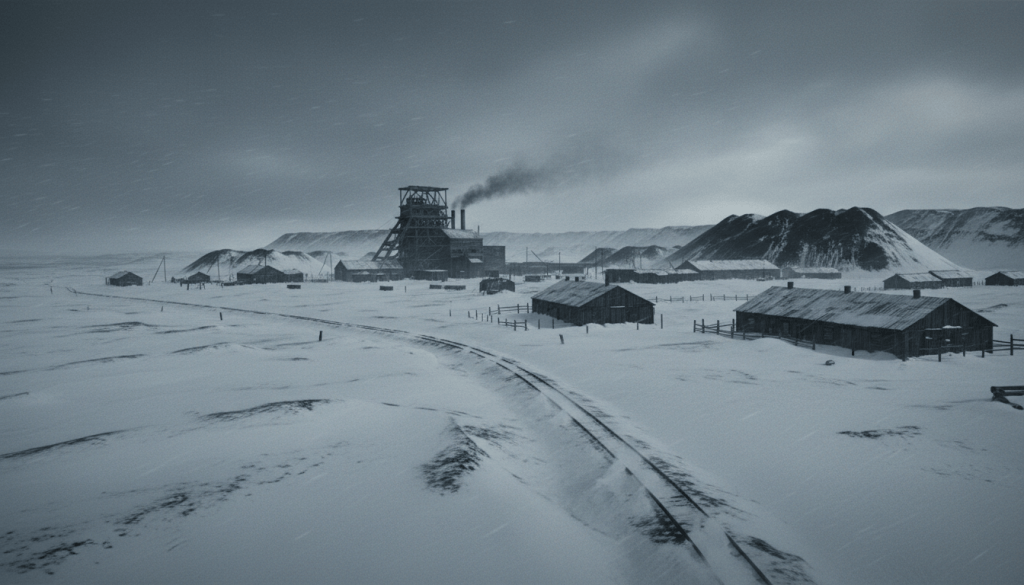
Building a coal industry above the Arctic Circle appears, at first glance, to defy ordinary economic logic. Winters were severe, transport links were limited, and creating mines, settlements and railway infrastructure required extraordinary effort. Yet Soviet authorities made Vorkuta a major coal-producing center. The decision is best understood through the interaction of geology, central planning, forced labor and wartime demand—not through climate alone.
Coal beneath the tundra
In 1930, a geological expedition led by the young geologist Georgii Chernov identified valuable coal deposits in the Vorkuta River area. The discovery promised an industrial resource in the Pechora coal basin, a region far from Russia’s more established mining centers. A coal deposit does not automatically become a functioning mine, however. Geological promise had to be converted into shafts, buildings, fuel supply, transport and a workforce.
The location presented severe difficulties. Permafrost complicated earthworks and foundations; seasonal conditions made transportation and construction unpredictable; and distance from existing industrial infrastructure increased the cost of almost every piece of equipment. The Soviet government’s willingness to commit resources to such a location reflected the priorities of a state that viewed industrial growth and strategic self-sufficiency as overriding objectives.
Why coal mattered to Soviet planners
Coal was fundamental to twentieth-century heavy industry. Mines supplied fuel for railway locomotives, heating, power generation and industrial processes. A large state-directed economy could regard a new coal district as strategically valuable even when private commercial investment might have hesitated at the initial cost.
This does not mean the Arctic coal industry was conceived as a single unchanging master plan. Vorkuta evolved through the 1930s and wartime years as geological discoveries, administrative decisions and changing industrial needs reshaped its role. Historian Alan Barenberg traces this transformation from an outpost of internal colonization to a major wartime coal supplier. The regional industrial project expanded alongside Soviet coercive institutions.
Forced labor changed the calculation
The most consequential feature of Vorkuta’s development was the use of imprisoned labor. The Soviet Gulag system made large numbers of prisoners available for mining, construction and related tasks under compulsion. That did not remove the real costs of developing an Arctic coalfield. It displaced substantial human costs onto people who lacked the freedom to reject dangerous assignments, poor accommodation or inadequate provisions.
Prisoners helped build the physical setting that later prisoners would inhabit: barracks, mine structures, access routes and industrial facilities. Non-prisoners were also part of Vorkuta’s history. Engineers, administrators, civilian workers and families lived in a growing town whose boundaries with the camp economy were more entangled than the image of an entirely isolated prison compound suggests.
A simple claim that the mines were profitable because prisoners were unpaid would therefore be misleading. Guarding, transporting, feeding and housing a coerced workforce required resources, while illness, exhaustion and insufficient nutrition could reduce productivity. Forced labor enabled a project with enormous human consequences, but it was not an efficient or cost-free substitute for a healthy workforce.
The railway made Arctic coal usable
Extracting coal is only half the economic challenge. Fuel that cannot reach factories or consumers has limited strategic value. Railway construction was therefore central to the Vorkuta project. Developing a transport connection across northern terrain required bridges, embankments, earthmoving and repeated efforts to manage frozen ground.
On December 28, 1941, temporary train service began on the Kozhva–Vorkuta railway, making it possible to dispatch Pechora coal beyond the Arctic region. The northern Pechora railway route was formally transferred into permanent operation in 1950, after additional completion work. Distinguishing the start of provisional traffic from later completion avoids giving the misleading impression that the entire railway was finished in 1942. The mines and railway were parts of the same industrial system.
What changed during the Second World War?
The German invasion of the Soviet Union in 1941 intensified the pressure to keep industrial production running. Established industrial regions faced occupation, disruption and shifting military priorities. Coal produced far from the main European battlefront gained importance as one component of the Soviet wartime supply network.
Vorkuta’s expansion was therefore not explained solely by the discovery of coal or by a desire to populate the north. Wartime needs made the transport link and mining output particularly significant. Documentary evidence of Vorkuta coal shipments to Leningrad in 1943 illustrates how the Arctic operation became connected to broader wartime industrial and political aims.
What did the environment cost workers?
The physical conditions of coal production in the far north deserve attention in their own right. Severe cold made outdoor labor dangerous, while moisture trapped in clothing could compromise insulation. Coal dust, underground work and primitive sanitation added hazards that did not disappear simply because a prisoner returned to a barracks after a shift.
The geographic remoteness also affected food, medical attention, housing and repairs. These pressures interacted: insufficient nutrition made hard labor harder; exhaustion affected the ability to stay warm and work safely; and poor accommodation could prevent effective recovery. Conditions varied by period, camp division and assignment, so no single account should be treated as describing every Vorkuta prisoner’s experience.
The environmental dimension is central to Luke Halden’s historical nonfiction VORKUTA GULAG: The Air Itself Was Punishment, discussed within the VORKUTA EXPOSED series. Rather than treating the Arctic as scenery, the book explores how cold, smoke, coal contamination and institutional pressures operated together.
Was Vorkuta only a prison camp?
No. Vorkuta was a complex of camps and an emerging Soviet mining city. Its history involved prisoners and civilians, state administrators and industrial specialists, as well as the relationships connecting them. Barenberg’s Gulag Town, Company Town specifically cautions against treating the prison complex as detached from the surrounding society.
That distinction matters because the consequences of forced labor persisted beyond individual camp sentences. The railways, mines, neighborhoods and occupational structures that emerged in the Stalin era influenced the region’s subsequent urban life. The legacy of Vorkuta cannot be reduced either to coal statistics or to a single fenced enclosure.
What Vorkuta reveals about Soviet industrialization
Vorkuta illustrates how a centrally directed state could make difficult resource extraction a political and economic priority, mobilize a coerced workforce, and connect a remote frontier to nationwide demands. The same history also reveals the limits of evaluating industrial achievement only by tonnage or completed infrastructure. A railway could be finished and coal could be shipped while those who built and mined suffered severe deprivation.
To understand why Stalin developed coal mines in the Arctic, the essential answer is not simply that coal existed there. It is that the Soviet state combined geological opportunity, strategic industrial objectives, extensive railway construction and compulsory labor to turn that resource into a major production center. The human cost was inseparable from the method.
Further reading
Historical research: Komi regional statistical service (rail service begun December 28, 1941; full operation in 1950); Soviet Council of Ministers Resolution No. 2703, June 29, 1950; Alan Barenberg, Gulag Town, Company Town; Barenberg, “From the Margins to the Home Front”. Explore more nonfiction by Luke Halden.

