How to Preserve Old Photographs in Handmade Scrapbooks Without Damaging Them
A scrapbook can be a wonderful home for family photographs, but not every beautiful album is safe for an original print. Some papers, tapes, adhesives, and decorative materials accelerate deterioration. The good news is that you can preserve photographs and still enjoy creative layouts—provided you choose materials carefully and avoid permanently attaching irreplaceable originals.
Start by identifying what you have
Before reaching for scissors or glue, examine each photograph. Is it a modern print from a digital file, an old black-and-white snapshot, a delicate nineteenth-century studio portrait, or an instant photograph? Different processes have different vulnerabilities. Older prints may have brittle supports, lifting image layers, tears, or fading. If a photograph is historically valuable, unique, or already damaged, seek advice from a photograph conservator before altering its storage.
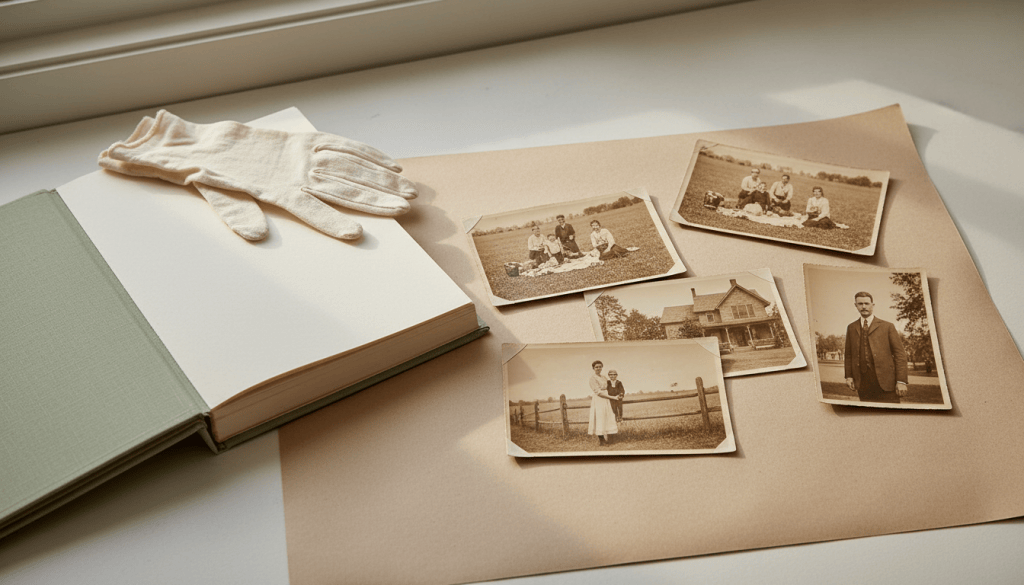
When handling photographic prints, wash and dry your hands and use clean, well-fitting gloves if the photograph’s format and condition allow; fingerprints can permanently mark some image surfaces. The US National Archives recommends gloves for photographs and negatives while noting that clean hands are suitable for many ordinary paper records. Touch edges where possible and use a clean work surface. Fragile or deteriorating originals may need individual guidance from a conservator. Never flatten a curled photograph by force. Photograph the front and back before arranging anything; inscriptions, stamps, and studio marks may be as informative as the image itself.
Choose stable albums and papers
Look for materials sold specifically for long-term photograph preservation and from suppliers who explain their testing standards. Acid-free is a useful starting point, but by itself it is not a complete guarantee of photographic safety. Ideally, enclosures should pass the Photographic Activity Test (PAT), which evaluates whether storage materials are likely to harm photographic images. For practical guidance, see the Library of Congress guidance on caring for photographs and its preservation advice for scrapbooks and albums.
Use stable, lignin-free paper or suitable inert plastic enclosures, and avoid cheap construction paper or self-adhesive “magnetic” album pages. Older magnetic albums commonly contain pressure-sensitive adhesive under plastic sheets. Over time those layers can stick, stain, or damage photographs. If originals are trapped in one, don’t peel aggressively; seek professional help if removal meets resistance.
Choose sturdy binding that supports the weight of filled pages. Heavy embellishments can strain a binding, press into adjacent photographs, and make an album difficult to close. Interleaving with suitable archival tissue or arranging raised decorations away from original prints can reduce mechanical pressure.
Use photo corners rather than permanent glue
For many flat prints, properly sized photo corners can hold a photograph in position without applying adhesive directly to its surface or reverse. Attach the corners to the backing sheet, not the photograph. Check that corners don’t grip too tightly, abrade vulnerable edges, or allow the print to slide out.
Photo sleeves or separate archival enclosures are often better for irreplaceable originals. Avoid ordinary tape, rubber cement, glue sticks, spray adhesive, hot glue, and unknown craft adhesives on original photographs. Even products marketed as “photo safe” may not be suitable for every historic photographic process.
Decorative adhesive can still have a place on pages containing copies. If you love collages, lace, paper flowers, and distressed backgrounds, consider building those designs around high-quality reproductions while keeping the original photographs protected elsewhere.
Keep captions without marking originals
A short caption transforms an unidentified photograph into a usable family record. Write down who appears in the image, the approximate date, the location, the occasion, and—crucially—how you know. “Possibly taken at the village fair, around 1952, according to Aunt Jean” is more honest and helpful than an unqualified guess.
Place identification on an adjacent archival sheet or in a separate catalog. Do not write with ballpoint pen across the back of an original print, and avoid adhesive labels stuck to the image or reverse. If details are uncertain, distinguish family tradition from independently verified evidence.
Record the physical order of a collection before rearranging it. The original sequence can reveal relationships among photographs, letters, and events. A seemingly trivial handwritten note or mount may later prove important to a family historian.
Control light, heat, and moisture
Photographs can fade and yellow in sustained light, especially direct sunlight. Keep albums closed when not in use and store them away from windows, radiators, attics, damp basements, and locations with dramatic temperature changes. A cool, dry, stable indoor environment is usually preferable to one with intermittent heating or humidity.
Don’t store valuable photographs near food, drinks, leaking pipes, or craft liquids. Water damage can cause image layers to stick together; trying to separate wet photographs without proper guidance may make losses worse. If a collection becomes wet or develops mold, consult a qualified conservator promptly and prioritize safe handling.
Build a reversible layout
A good preservation-minded scrapbook can be both attractive and easy to update. Plan the page first on scrap paper. Keep prints away from the gutter, where bending increases with every page turn. Position labels separately. Leave enough space that items don’t overlap or scratch each other.
For particularly valuable photographs, scan or photograph them accurately and print working copies. That allows you to trim, layer, stamp, or decorate creatively without losing original evidence. Keep high-resolution digital masters, with backup copies stored separately, and record dates and identities in filenames or associated metadata.
What about an inherited scrapbook?
If you inherit an album with unusual mounts or handwritten annotations, resist the urge to “improve” it immediately. An old layout has historical meaning. Take overview photographs of every page, close-ups of captions, and images of the cover and binding. Note loose items before they slip out.
If the album is deteriorating, consider storing it intact in an appropriately sized protective box and making a separate viewing copy. A conservator can help determine when stabilizing an existing album is safer than dismantling it. Preservation does not always mean making an object look new.
A simple photo-safe scrapbook checklist
- Document originals before moving them.
- Use tested photograph-safe paper or sleeves.
- Keep adhesives off original photographs.
- Prefer non-damaging mounts and reversible arrangements.
- Separate known facts from caption guesses.
- Keep albums away from light, moisture, and unstable temperatures.
- Create digital copies and backups.
Why small paper details matter
In Mabel Thistledown’s The Scrapbook Scene, a fictional village album and subtle changes in paper materials become significant to an amateur investigation. The novel is part of the Thimblewick Craft Circle Mysteries, where the seemingly ordinary work of preserving community memories has unexpected consequences.
For a real family album, the goal is less dramatic but equally important: preserve the photograph, the story around it, and the evidence that connects the two. You can explore more of the author’s craft-centered fiction on the Mabel Thistledown author page. Check local archives and historical records before assigning people, places, or dates to unidentified photographs.

