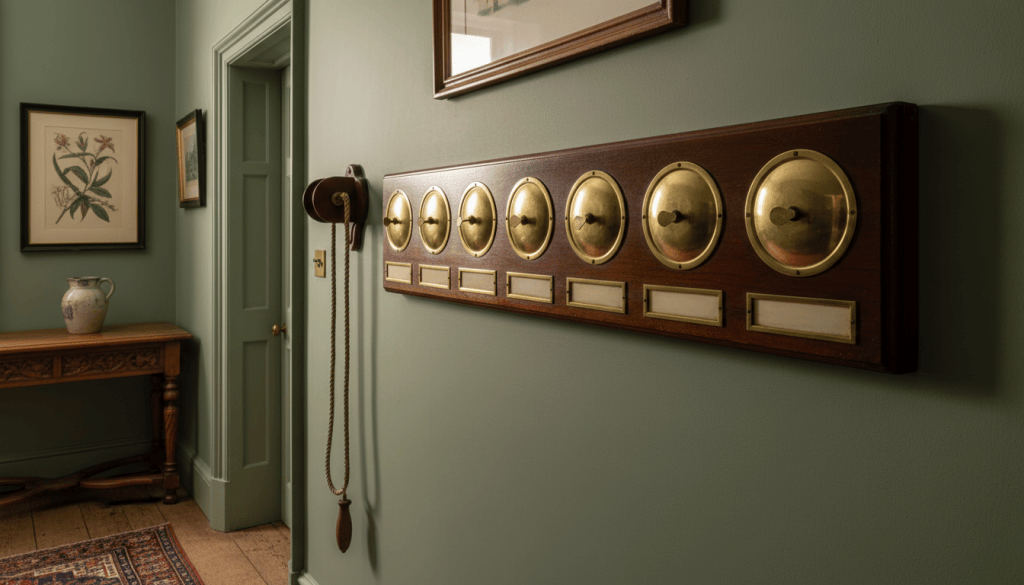
From the eighteenth century onward—and widely in nineteenth-century country houses—many large households used mechanical service bells: a cord or handle in one room moved a bell somewhere else. These systems predated Victorian technology, even though surviving Victorian examples are especially familiar. At a servants’ station, a sudden ring could tell staff that somebody upstairs needed attention. The mechanism was simple in principle, but its wiring and room indicators reveal much about the organization of a Victorian country house.
Not every estate used the same arrangement. Installations varied by date, size, budget and later alterations. English Heritage records bell systems at Audley End from the 1760s; the National Trust explains how wire-operated household bells worked. Understanding their basic operation, however, can help visitors interpret the rows of bells and labeled indicators still found in historic houses.
From bell pull to bell: the mechanical chain
The person requesting service typically pulled a cord, handle or fitting connected to a system of wires. The tension traveled through the house, around corners and between floors. Cranks, pivots and pulleys changed its direction until it reached a spring-mounted bell. That movement set the bell ringing.
This was not an electrical signal in the familiar modern sense. It was a physical movement transmitted across a distance. A well-maintained system could cover considerable ground, but the longer and more complicated the route, the more important correct tension and alignment became.
A pull could hang beside a fireplace, near a bed or at a convenient point in a reception room. Different households installed fittings in different locations, and many systems changed over time. Surviving photographs, household descriptions and conservation surveys can help identify what belongs to the original arrangement.
Why there was a board of bells
In a large building, a single ringing bell would not be much use if nobody knew which room had summoned assistance. Separate bells or indicators allowed a servant to distinguish, for example, the drawing room from a bedroom or study. A typical board could display room names beside mechanisms connected to different locations.
The ringing sound called attention to the board. Depending on the design, a bell or indicator could continue to move briefly after the initial pull, allowing someone arriving a moment later to determine which room was responsible. This was an early solution to a communication problem: identifying the source of a request without speaking directly.
Room labels should be treated carefully. A board marked ‘Library’ does not guarantee that the library stayed in the same place throughout the building’s history. Renaming, subdivision or relocation could make the bell-board labels a record of an older household arrangement.
What happened inside walls and service passages
Mechanical call systems required routes for their wires and fittings. In a house with several floors, these routes might pass through ceiling voids, cupboards or accessible service areas. Small changes in direction called for angled cranks or wheels so that a pull in one room could activate a bell far away.
An architectural plan alone may not show every detail of this infrastructure. The original installer could have followed available construction routes, and later alterations might disconnect a line without removing its fittings. Thus a decorative pull in a principal room and a surviving bell board elsewhere do not necessarily mean the system is still complete.
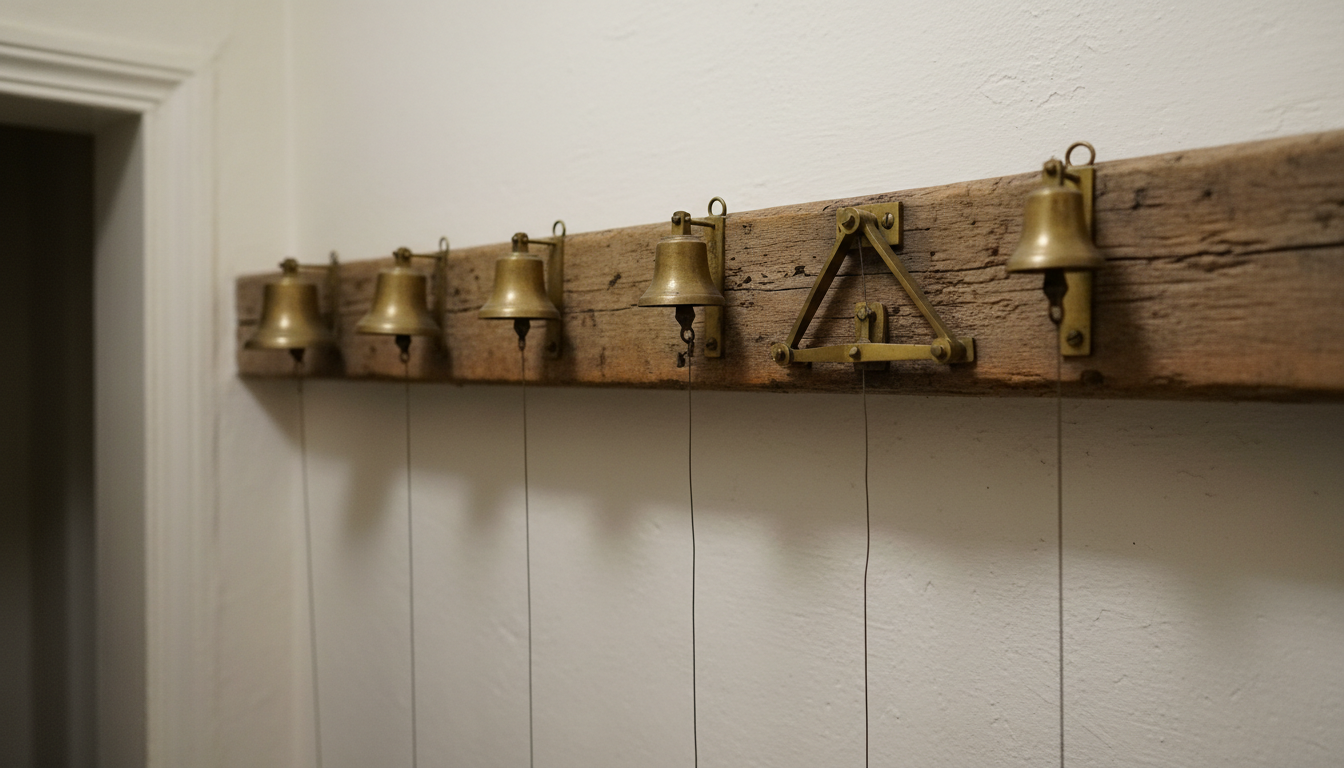
Historic restoration teams documenting such a network often pay attention to where the wire runs, whether the components are original, whether springs or joints have been replaced and what evidence remains of previously connected rooms. A missing link in the mechanism is not proof of a hidden chamber; it may simply show that a section was removed during modernization.
Who answered—and what the bell did not explain
The bell system communicated that assistance was wanted, not precisely what the caller needed. A servant still had to go to the room to receive instructions. The device made the request fast to transmit while preserving the social distance built into domestic service.
The board also tells us about the staff’s working geography. Principal rooms were designed for comfort and display, while service spaces had to support cooking, cleaning, heating, laundry, deliveries and movement through the building. Bell systems helped coordinate work across this separation, but they were only one part of the wider household routine.
It is tempting to picture every Victorian mansion operating like a perfectly choreographed drama. In reality, smaller homes used simpler arrangements, households differed in staffing and budgets, and equipment could fail. A ringing bell might be ignored briefly because the intended worker was occupied elsewhere.
What could go wrong with a mechanical bell system?
Wires stretched, loosened or corroded. Dust, friction and displaced fittings interfered with movement. A pull that once worked freely might become stiff after painting or replastering; a repaired wall might trap a line. Over decades, an apparently intact bell could cease to respond because a connection somewhere in the building had been severed.
Even when a bell rings during a demonstration today, that does not necessarily establish that every component is Victorian. Conservation projects sometimes stabilize, replace or reconstruct parts to make the system legible and safe. The most responsible presentation distinguishes original material from later intervention.
How to read a surviving call-bell board
Begin with location. Was the board placed near a staff workroom or circulation route? Next inspect the number of indicators and the names attached to them. Do the labels correspond to current room names, or to spaces that have since changed? Finally, consider whether the mechanism is mechanical, electrical or a combination altered during the building’s long life.
Look closely, but do not pull historic fittings unless the property explicitly invites a supervised demonstration. Fragile cords, bells and wiring can be damaged by casual handling, particularly where a system has been conserved as evidence rather than restored for everyday use.
A house guide, collections catalogue or conservation report can place a surviving example in context. Ask what period the arrangement represents and whether the bell labels themselves have been dated. The answers may reveal as much about changing room use as about technology.
Why an ordinary bell can become a literary clue
For a writer of country-house mysteries, the value of an old bell system is that it creates testable questions. Which room could send a signal? Was a wire still connected? Could a label have outlived the room’s former purpose? The mechanism lets an investigator study material evidence rather than rely on atmosphere alone.
That makes service technology a fitting detail in Nora Ashwell’s The House That Remembers, where Nell Hartwell examines contradictions inside the fictional Ravensworth Manor. Explore the Ravensworth Manor Gothic Cozies series or read Why Gothic Manor Mysteries Never Lose Their Appeal for more about architectural atmosphere in fiction.
A small sound with a larger history
The familiar image of a row of brass bells represents much more than picturesque decoration. It combines engineering, architecture, labor and household hierarchy. Understanding how a cord could transmit a signal through an old building brings both its machinery and its human history into sharper focus.
More about the author is available on Nora Ashwell’s page.

