In the summer of 1953, thousands of prisoners in the Soviet Arctic refused to go to work. At Vorkuta, a coal-mining center built around a network of forced-labor camps, a strike challenged authorities who relied on prisoners’ labor and strict discipline. The protest became one of the most significant episodes of prisoner resistance in the post-Stalin Gulag. It also ended in deadly violence.
Understanding the Vorkuta strike requires more than recounting the shooting on August 1. It means asking why prisoners believed change might be possible, how the work stoppage spread, what they demanded, and why Soviet authorities chose force.
What was Vorkuta, and what was Rechlag?
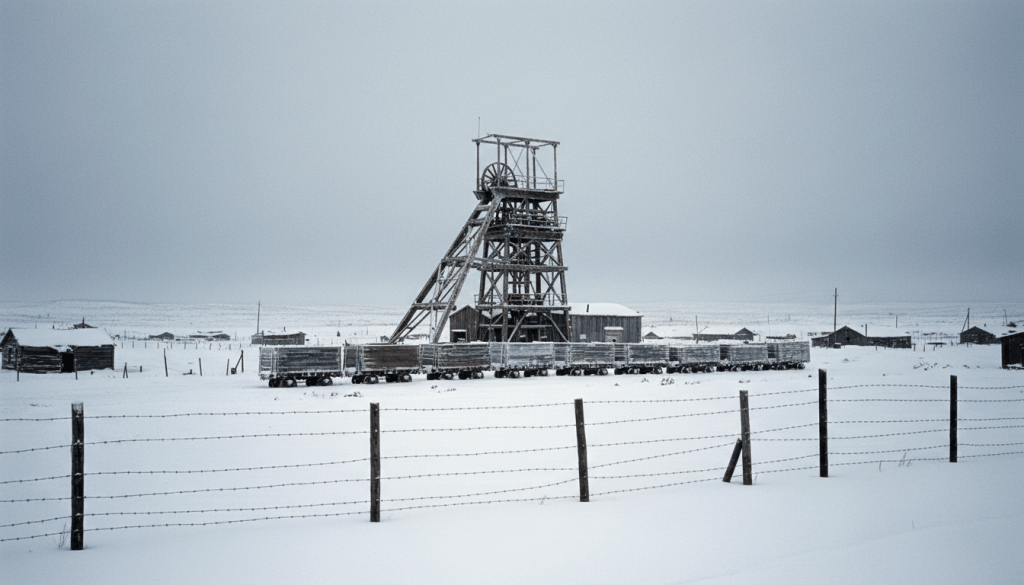
Vorkuta was not one prison surrounded by one fence. It was an Arctic coal-mining region in the Komi Autonomous Soviet Socialist Republic, with multiple camps, mines, settlements, and industrial installations. The word Gulag refers to the broader Soviet forced-labor camp administration and its system, not to a single site.
Rechlag, often called Special Camp No. 6, was a high-security camp organization for prisoners categorized under especially restrictive rules, including many political prisoners. Its detachments were dispersed around the industrial region. The distinction matters because events at one section of the camp did not always occur simultaneously in another.
Why 1953 changed the political atmosphere
Joseph Stalin died on March 5, 1953. His death generated uncertainty throughout the Soviet Union, including inside the camps. Prisoners hoped the political transition might bring reviews of sentences, improved conditions, or release. The amnesty announced in March, however, did not offer freedom to most long-sentenced political prisoners.
That disappointment was joined by further upheaval. Lavrentiy Beria, the powerful security official, was arrested in late June. For prisoners who received only fragments of news, the changes suggested that even seemingly permanent structures of power might be unstable. Expectations and rumors became politically significant.
A strike did not emerge simply because prisoners were hungry. Harsh labor, inadequate provisions, punitive conditions, long sentences, and the sense that legal redress had been denied all mattered. The transition after Stalin’s death gave those longstanding grievances a new context.
How the work stoppage began
The Ukrainian Institute of National Memory’s chronology dates the first recorded refusals to work in Rechlag to July 19, 1953, with participation spreading among divisions over the following days. Rather than imagine one synchronized uprising, it is more accurate to describe an expanding series of refusals to work that culminated in armed suppression on August 1.
The action was powerful because coal production depended on organized labor. Prisoners could not easily leave the guarded camp, and they generally lacked arms. Their immediate leverage came from declining to report for shifts, creating a visible interruption in a vital industry.
This also explains why the word ‘uprising’ can mislead. Although the episode is commonly called the Vorkuta uprising, a central tactic was a labor strike, and much of the protest was initially nonviolent. There were moments of confrontation, but the mass refusal to work should not be confused with a conventional armed rebellion.
What did the prisoners demand?
The demands varied across groups and stages of the protest. Contemporary and retrospective accounts describe calls for improved living and working conditions, better food, less abusive treatment, and review of sentences. Prisoners also challenged restrictions that cut them off from families and the legal system.
A defining issue was unequal access to the possibilities implied by political change. Prisoners convicted under political provisions often found that the March amnesty did little for them. For people serving long sentences, discussion of legal review was not an abstract constitutional question; it concerned years of confinement and whether they could ever return home.
How news and solidarity crossed camp boundaries
Information moved in a difficult environment. Prisoners were separated across work sites, mail was restricted, and official announcements could not be treated as neutral explanations. News traveled through personal contact and informal networks, while the cessation of mining activity itself made the strike visible beyond any one detachment.
The participants were not a single national or political group. Rechlag held people from various Soviet republics and other backgrounds. Their experiences and aims differed, but the work stoppage created a shared point of pressure. Collective action did not require complete agreement about every political question.
It is important not to turn this solidarity into a simple tale of inevitable success. Prisoners acted with incomplete information and faced armed authorities. Refusal to work could expose organizers and ordinary participants to punishment regardless of whether their demands were met.
The authorities respond
The camp leadership and officials arriving from Moscow faced an industrial shutdown and a political challenge. Talks and demands for a return to work occurred during the confrontation. The precise sequence varied among detachments, and records should be examined carefully rather than treating the entire camp complex as one meeting place.
By the end of July, the authorities increasingly moved toward coercion. Arrests and efforts to isolate protest leaders intensified the confrontation. On August 1, 1953, forces opened fire on striking prisoners in Rechlag’s tenth camp division at Yur-Shor. The Ukrainian Institute of National Memory cites 53 deaths and 138 wounded in official figures, while other estimates differ. A Soviet list of prisoners killed or later dying of wounds, compiled August 6, 1953, survives in the state-archive documentary collection. These numbers refer to that violent suppression, not automatically to every Vorkuta camp or every kind of loss.
What happened on August 1, 1953?
The shootings on August 1 marked the decisive violent suppression of the strike. Prisoners were killed and injured. Historical accounts and memorial sources do not always agree on casualty figures, partly because they count different groups or use different records. A reliable article should therefore identify the particular source and its method before quoting an exact total.
The German Federal Foundation for the Study of the Communist Dictatorship in Eastern Germany preserves documentary material based on former prisoners’ recollections. Other historical and memorial projects document graves connected with the violence at Yur-Shor. These sources make clear that the repression was lethal, even where details of individual tallies remain debated.
The strike did not immediately dismantle the Gulag. Nor did suppression erase the political importance of prisoners demonstrating that coordinated resistance was possible within a tightly controlled labor system.
Why the Vorkuta strike matters
The event exposed a contradiction in the Soviet camp economy. Authorities sought productivity through coercion, but large numbers of prisoners could disrupt work by acting together. It also demonstrated that political uncertainty after Stalin’s death could be felt far beyond Moscow, including in remote places where the state expected obedience.
The strike belongs in the wider history of camp resistance in the early 1950s. It should be studied alongside other protest movements while preserving its own circumstances: an Arctic mining economy, a dispersed special camp, political detainees with long sentences, and rapidly changing expectations after Stalin’s death.
How historians reconstruct the event
Evidence includes official records, former prisoners’ statements, memorial documentation, and later historical scholarship. Each source has limitations. Administrative documents may minimize institutional responsibility, while recollections preserve lived experience but can disagree on dates or numbers. Reading across source types is essential.
One especially useful distinction concerns Vorkuta versus Rechlag. General figures about all prisoners in the mining region should not be presented as exact counts of strikers in one Rechlag detachment. Similarly, a casualty total from one shooting location should not automatically be used as a universal total for the whole episode.
The Bundesstiftung’s documentary feature draws on interviews with former detainees. The Map of Memory entry for Yur-Shor provides context on burial sites and subsequent commemoration.
Remembering resistance without simplifying it
The strike’s history is about agency under extreme constraint, not a romantic image of unarmed courage alone. Some prisoners pursued modest changes to immediate conditions; others hoped for much wider political consequences. Families lived with the aftermath, and survivors often carried physical and psychological consequences for years.
Luke Halden explores the mental pressures surrounding hunger, work, uncertainty, and survival in MIND BELOW ZERO. These pressures belong to the larger history of coercion, but they should not be treated as the sole explanation for a political work stoppage.
For additional books in this historical setting, visit VORKUTA EXPOSED: Inside Stalin’s Arctic Gulag or Luke Halden’s author page.
The lasting historical question
The 1953 Vorkuta strike reminds us that a prison system can control movement, labor assignments, and communication without fully controlling political expectations. The prisoners’ refusal to work forced a response from the state, even though that response was deadly. Their story asks what collective action can mean when every participant stands behind a fence and the authorities hold the weapons.

