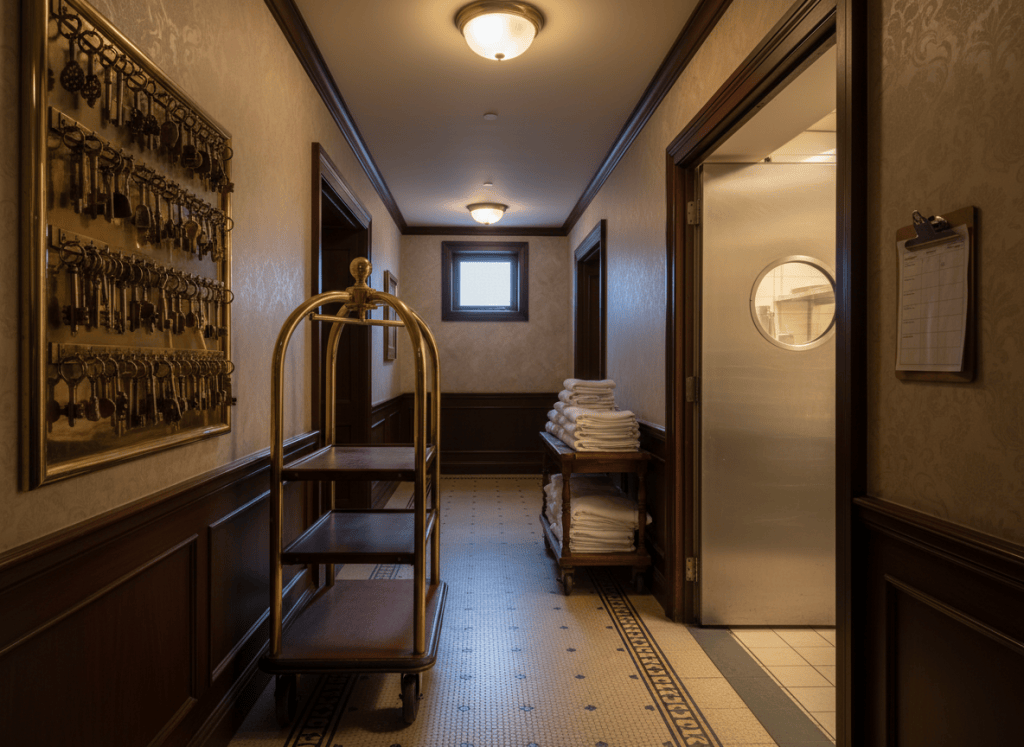
The most revealing moment in a hotel mystery may happen nowhere near the grand staircase. It might occur when a porter checks a delivery, a housekeeper notices that a room has been reset twice, or a chef compares an event menu with the dishes that actually left the kitchen. Staff often know the building through repeated tasks rather than through its polished public appearance.
In the fictional Grand Marivelle, home of Pippa Marlowe’s Secrets on the Marivelle Pass culinary cozy mysteries, the working routines of hospitality offer a particularly satisfying kind of puzzle. This is a look at the overlooked professionals and practical observations that make a hotel mystery feel fair, human and rich in detail—not a retelling of any novel’s solution.
Why the people working backstage see a different hotel
Visitors experience a sequence of destinations: reception, restaurant, terrace, suite and perhaps a private event. Staff experience a network of handovers. Linen travels to rooms; ingredients reach the receiving area; guest requests move between teams. The hotel therefore has two overlapping maps: one organized around guest comfort, the other around getting work done.
This difference can change the interpretation of a clue. A guest may remember a hallway as empty, while a staff member knows that linen carts always pass through it just before lunch. Neither observation is automatically dishonest. Their knowledge comes from different routines.
The concierge’s clue: a request that doesn’t fit
A concierge may notice a guest asking to move a reservation, use a different entrance or arrange an unexpected collection. Such requests are not suspicious by themselves. Their meaning comes from timing and context: when was the request made, who handled it, and what other records confirm it?
In a well-plotted mystery, the significant detail need not be a secret code. It can be the difference between a request someone remembers making and a task that the hotel actually completed.
The kitchen’s clue: the meal that had to happen in sequence
Professional kitchens work through preparation, service and cleanup. A plated course depends on decisions made earlier: ingredients were received, a batch was prepared, an order was communicated and the dish was sent out. That chain offers a natural timeline.
Executive Chef Sophie Delacourt’s kind of expertise is useful because she can ask practical questions rather than dramatic ones. Could that dish have been made after the kitchen closed? Would a substitute ingredient require a fresh delivery? Which team would notice a change on the service sheet? The answers narrow possibilities without replacing the need for evidence.
The housekeeper’s clue: the room’s ordinary condition
Housekeeping staff may notice a moved chair, a missing towel, an untouched welcome tray or a room marked ready at an unusual time. The key is not to treat small differences as proof of wrongdoing. A credible investigator tests whether a change has an innocent explanation before giving it significance.
This also gives the story an ethical dimension. A guest’s private space is not an invitation to speculate freely, and the staff’s professional knowledge deserves respect. Cozy mysteries often become more compelling when people whose labor is usually invisible contribute to the truth.
The supplier’s clue: a delivery with a history
Hotel restaurants depend on outside growers, fishmongers, bakeries and specialist producers. Goods arrive with quantities, dates and sometimes batch details. If a story hinges on a flavor, an ingredient or a particular delivery, those ordinary records can help distinguish what was possible from what was claimed.
For a deeper look at this mechanism, read How Food Provenance Becomes a Clue in Culinary Cozy Mysteries.
The strongest evidence comes from comparing viewpoints
No staff member has a complete picture. A chef may know that a tray left the kitchen, but not who carried it upstairs. A concierge may know that a guest requested refreshments, but not what was prepared. A housekeeper may have seen the tray later without knowing when it arrived. Each perspective is partial.
When a writer combines these observations carefully, the reader can follow the reasoning. A receipt, a witness memory and a service routine might agree—or expose a discrepancy worth investigating. This is the pleasure of fair-play mystery fiction: clues mean more when the reader understands how people really work.
Return to the Grand Marivelle
Secrets on the Marivelle Pass explores a fictional grand hotel through its culinary world, working relationships and mysteries. For readers who enjoy observant professionals, intelligent clues, a supportive ensemble and a touch of romance, the appeal lies not only in the building but in the people who keep it running.
Explore more of the author’s mysteries on the Pippa Marlowe author page, or read why grand hotels make rich settings for cozy mysteries for the broader atmosphere and setting-focused perspective.

