
A budget does not need a spreadsheet to be useful. For many people, the obstacle is not understanding that bills must be paid or that spending needs limits. The obstacle is the amount of detail traditional budgeting systems ask them to maintain.
If every purchase has to be categorized, every account has to be reconciled, and every category has to be adjusted throughout the month, the system can become another task to avoid. A simpler approach starts with a different question: what are the few numbers you actually need in order to make everyday money decisions?
Why Some People Abandon Detailed Budgets
Detailed budgets can be useful, especially for people who enjoy tracking and want a precise record of where every dollar goes. But precision has a maintenance cost. The more categories a system contains, the more often it needs attention.
That becomes difficult when money already feels stressful. Someone may delay opening a budgeting app because they expect to see mistakes. A spreadsheet may sit untouched because updating it feels like an hour-long project. One overspent category can create the sense that the whole plan has failed.
A simpler budget reduces the amount of information that must be maintained. It does not remove responsibility. It narrows attention to the numbers that change what you can safely do next.
The Four Numbers That Can Organize a Simple Budget
In The 1-Hour Budget, Marcus Weston organizes the system around four core numbers: income, fixed obligations, protected priorities, and flexible spending. The value of the framework is not that these ideas are exotic. It is that each one has a distinct job.
1. Income
Start with the take-home income you realistically expect to receive. If income varies, a conservative estimate is more useful than building the month around the best recent paycheck.
2. Fixed obligations
These are the commitments that already have a claim on your money: housing, utilities, insurance, transport, minimum debt payments, childcare, phone service, and other recurring obligations. The exact list differs from household to household.
3. Protected priorities
This is money you deliberately reserve before flexible spending absorbs it. A protected priority might be emergency savings, extra debt repayment, a car repair fund, an annual bill, a medical expense, school costs, or another future need.
4. Flexible spending
What remains is the money available for everyday choices such as groceries, fuel, household purchases, personal spending, takeout, entertainment, and other expenses that can vary from week to week.
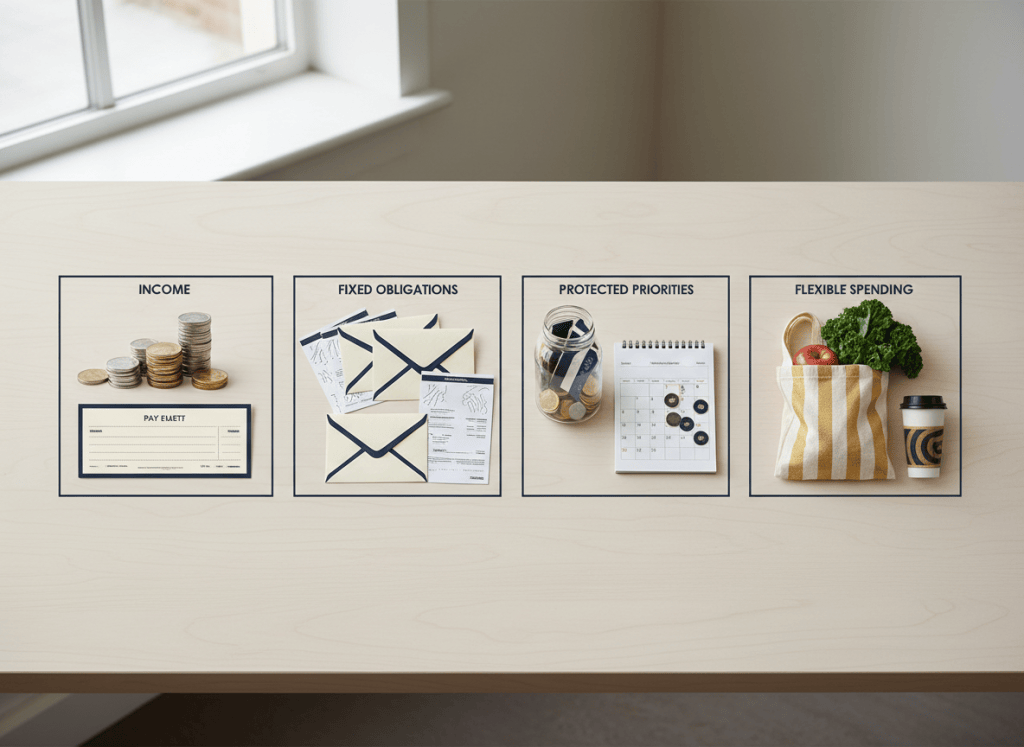
The basic relationship is straightforward: income minus fixed obligations minus protected priorities leaves the amount available for flexible spending. The point is not to create a mathematically perfect month. It is to make the boundary between committed money and spendable money easier to see.
Why a Weekly Number Can Be Easier Than a Monthly One
A monthly flexible-spending number can still feel abstract. If you have $1,200 available for the month, it may be difficult to judge on the fifth day whether a $70 purchase fits comfortably.
Turning that monthly amount into a simple weekly guide can make decisions more concrete. A weekly number does not have to become a rigid allowance. It acts as a reference point. You can see whether the current week’s spending is roughly in line with the plan before small decisions accumulate.
This can be particularly useful for readers who dislike logging every transaction. The question becomes less about documenting the past and more about protecting the amount still available for the rest of the week.
A Simple Budget Still Needs a Check-In
Low-maintenance does not mean no maintenance. Even a simple system needs a regular point of contact. A short weekly check-in can be enough to answer three questions:
- How much flexible money has been used?
- How much remains?
- Has anything changed that requires an adjustment?
The goal is to notice changes while they are still manageable. If groceries cost more than expected, a repair appears, or income shifts, the budget can be adjusted instead of ignored until the end of the month.
The Budget Should Be Allowed to Change
One reason people abandon budgets is that they treat the original numbers as a test they have either passed or failed. Real life does not cooperate with that approach. Bills change. Travel appears. A child needs something. A car breaks. A week of higher spending can happen even when the overall plan is sensible.
A useful budget has to include adjustment as part of the method. If a plan repeatedly fails because one category is unrealistic, the better response is to revise the plan rather than repeatedly blaming the person using it.
This is also why protected priorities should be realistic. Saving an ambitious amount on paper is not helpful if it forces the rest of the month into an impossible spending limit. A smaller amount that can be maintained may create more stability than a larger target that is constantly reversed.
Who May Prefer a Four-Number Budget
This type of system may appeal to people who have stopped using spreadsheets, feel overwhelmed by detailed tracking, want a beginner-friendly structure, or need a clearer way to separate obligations from everyday spending. It can also suit readers who want to save or reduce debt but do not want every purchase treated as a moral decision.
It is not intended to replace individualized financial, tax, debt, or legal advice. Complicated financial situations may require more detailed planning. But for ordinary household money management, reducing the number of moving parts can make a system easier to return to week after week.
Simplicity Works Only When It Clarifies the Next Decision
A simple budget is not valuable because it contains fewer rows. It is valuable if those fewer numbers help you answer practical questions: What is already committed? What am I protecting? What is actually available? Do I need to adjust this week?
That is the central practical idea behind Marcus Weston’s The 1-Hour Budget: the budget should reduce decision fatigue rather than create more of it. Readers interested in his broader approach to money, self-trust, and practical financial habits can visit the Marcus Weston author page and read Why Wealth Is More Than a Number: Building Financial Confidence from Self-Worth, Not Fear.
If the difficulty is not building the budget but returning to it after a disrupted month, continue with How to Reset a Budget After Overspending or an Unexpected Expense.

