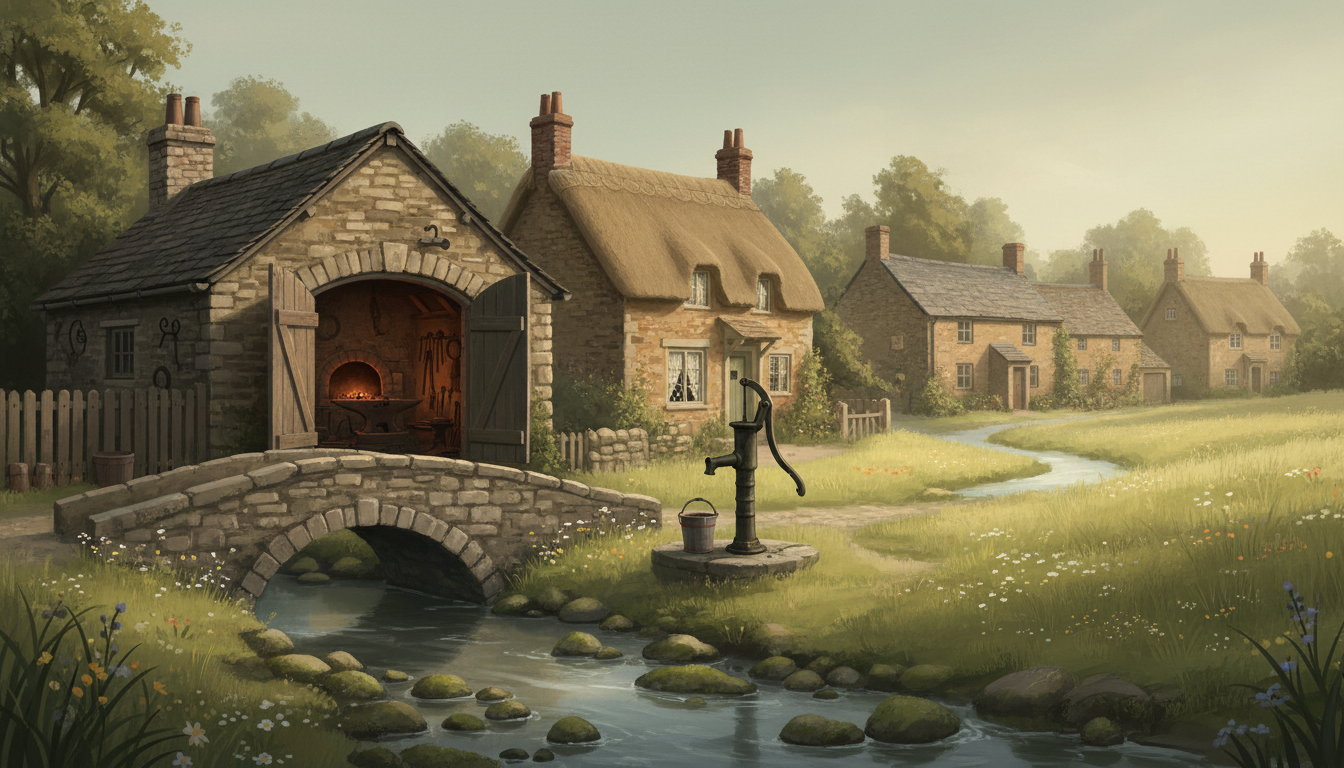
Two original, spoiler-free bonus stories set in fictional Brackenfell, Yorkshire, during the spring and summer of 1922, before the events of Poison After Harvest. They explore everyday challenges at Harwood Forge and the Copper Kettle rather than repeating the novel’s investigation. A short historical companion guide follows.
By Miriam Perevell · The Brackenfell Mysteries · Book 3 reader extras. · Find the book on Amazon.com.
Bonus Story 1: The Pump That Would Not Draw
The pump behind St Hilda’s parish room gave up on a Thursday morning in May, three hours before Brackenfell was due to welcome thirty children, seven mothers, and anyone else who could be persuaded to buy tea for the school reading cupboard.
It made a noise like a man disagreeing with his dentist, delivered one reluctant spoonful of water, and refused to do anything further.
“Perhaps,” said Edie Fawcett, “it wants encouragement.”
“Have you tried being kind to it?” Nell Harwood asked.
“I have tried being kind to everything since six o’clock. The pump is the only thing that has made an honest objection.”
Nell stood beside the old iron head with her tool bag in one hand and the taste of unfinished breakfast in her mouth. The pump was fixed to a stone trough at the back of the parish yard. Beyond the wall, apple blossom shook in a breeze cold enough to remind the village that May had not promised anybody comfort.
Ada Pritchard was holding a notebook as though it might contain the answer.
“We have a very particular arrangement,” she said. “The children are to read in the parish room. Their mothers will sit outside if it stays fair. Edie is to serve tea. Agnes is bringing the cakes. The pump is required for washing, rinsing, filling the handbasin and rescuing every child who puts a foot in the beck.”
“An ambitious programme for a pump,” Nell said.
“It has done all those things before.”
“Not at once, I hope.”
Edie put both hands on her hips. “Can you mend it?”
“I can look at it.”
“That sounds less useful.”
“It is what I say before I know whether I can mend something.”
Nell had not come empty-handed. She had been on her way to fit a strap hinge on the far side of the green when Ada intercepted her. A village could find a smith remarkably quickly when something failed and remarkably slowly when an invoice reached its proper address.
Ada turned to a boy standing just beyond the trough. He was thirteen or fourteen, thin under a coat that had lost two buttons, and held a square biscuit tin with its lid missing.
“William Rigg,” she said, in the voice with which she announced undelivered letters, “you may tell Miss Harwood what you were doing here.”
The boy looked at Nell, then at the pump, then at his tin.
“I was fetching water.”
“Before that,” Ada said.
“There wasn’t a before that.”
“I saw you with your sleeve rolled up and something in your hand.”
“A rag.”
“Why?”
“Because it was dripping.”
“The pump was dripping?” Nell asked.
“Yes. Yesterday. Not now.”
Edie sighed. “That is the difficulty. Yesterday it gave too much water, and today none at all.”
Will Rigg rubbed one shoe against the other. Nell knew him by sight. He delivered loaves for his uncle when the uncle’s knees troubled him and could carry more than he looked capable of, though he preferred not to be watched doing it.
“Did you take anything off the pump?” Nell asked.
“No.”
“Did you turn the handle?”
“Yes.”
“Did anyone tell you not to?”
“No.”
“Then you have answered my questions.”
Ada looked surprised. “But I saw—”
“You saw a boy attempting to get water from a thing made for getting water,” Nell said. “It is evidence of ambition, if nothing else.”
The boy’s mouth twitched.
Edie lowered her voice. “I am not accusing him of anything.”
“Good. There will be no need to stop.”
Nell put down her bag and worked the handle slowly. It travelled freely for the first third of its stroke, then stiffened, then fell with an unpleasant knocking sound. No water followed. A little dark moisture clung to the lip of the spout.
“The well is low,” Ada declared.
“Possibly.”
“Samuel said the spring has been poor.”
“Samuel says that about most things in spring.”
“He is a farmer.”
“That explains it.”
Nell crouched to examine the base. The cast-iron body had old paint in its crevices, and the bolts along one flange carried several seasons’ rust. She ran a finger around the joint, found grit where grit ought not to be, and straightened.
“Who used it last?”
“Everyone,” Edie said.
“That is an answer suited to a parish meeting.”
“Will used it yesterday afternoon,” Ada said. “Mrs Crowther filled a pail this morning, or says she did. Agnes washed the cups here at eight.”
“I rinsed them,” Agnes Rycroft corrected from the open gate. She arrived carrying a basket under a cloth. “Not washed. Edie would not let me use parish soap on her china.”
“Parish soap smells of the vestry,” Edie said.
“It would be very surprising if it smelled of roses.”
Agnes set her basket on the wall and considered the pump. “Is this a gathering to admire it, or are we to have water?”
“We are trying to discover what happened,” Ada said.
“That is what Nell does when people leave her room to do it.”
Nell smiled at Agnes. Of the five adults present, she was the only one who had brought something that might reasonably be called lunch.
“Did it draw water at eight?”
“Yes, after a little pumping.”
“How much?”
“Two pails, perhaps. Then a trickle. I thought the trough was draining slowly.”
“And what did you do?”
“Put the pails down and fetched the kettle.”
Nell nodded. The detail was useful. A well that had gone dry would not generally produce two pails and then empty itself in an instant without another sign. Nor did the ease of the handle feel like a seized mechanism. Something inside the pump was failing to lift the water.
The sound of a motor lorry announced Ned Lister before the lorry itself appeared. It came around the church wall with the determination of a horse being led toward a puddle.
Ned leaned out. “I hear you have run out of water.”
“Only in one place,” Nell called.
“I could take the children to the river.”
“You could take them as far as the first hill,” Ada said. “Then we would need another lorry to fetch yours.”
Ned ignored this and came over to inspect the pump.
“Needs a new one,” he said.
“You haven’t touched it,” Nell replied.
“I can see it.”
“Then I can see your lorry needs a new engine.”
“It does not.”
“Your assessment appears to differ from mine.”
Ned grinned. “I brought chairs. Where do you want them?”
“Inside,” Edie said. “Away from the rain.”
“It isn’t raining.”
“Which gives us a chance to succeed.”
He went to unload them, whistling badly.
Nell removed her coat and rolled her sleeves. She had a gate hinge still to fit, a small shoeing job after dinner, and her own forge fire to mind. She was not indifferent to the reading afternoon. The school cupboard contained more books with missing pages than entire books, and the little ones read the same adventure twice because there was not another to choose. But she had learned that affection for a village need not require donating one’s whole trade to it.
“I’ll need the top off,” she said. “I can do that here if the bolts move. If something’s cracked inside, I cannot conjure a casting out of my apron.”
“Will it cost much?” Ada asked.
“I cannot know until I have opened it.”
“Could you put down the inspection as a gift?”
Nell met her gaze. “If I put everyone’s first hour down as a gift, Harwood Forge will become an unusually unprofitable charity.”
Ada flushed. “I did not mean—”
“I know. That is why I said it gently.”
Agnes took out her purse. “We have money in the collection box for the reading afternoon. We can pay someone to keep it possible.”
Edie nodded at once. “And we shall.”
Nell turned to the pump with more pleasure than she cared to display. There were occasions when the practical recognition of work was warmer than any compliment.
The first bolt resisted. She wetted it, waited, and applied a steady pull rather than wrenching at the head. The second loosened with a dry squeal. By the time Thomas Bellamy entered the yard through the gate, she had the upper plate free and a line of parts arranged in order on a clean board.
Thomas carried a veterinary case and looked from the open pump to the spectators.
“Has there been an accident?”
“Only to everyone’s assumptions,” Nell said.
“An injury I see frequently.”
“Can you treat it?” Edie asked.
“Not without prolonged rest.”
He set his case beyond the reach of damp and looked at Nell rather than leaning over her shoulder.
“Do you need anything?”
“A pail of clean water, when I ask for it.”
“I can manage that.”
“Not from this pump.”
“I had understood that much.”
Will had been standing silent. Now he crouched at a respectful distance, examining the pieces without touching them.
“Is that the bit that sucks?” he asked.
Nell held up the plunger with its old leather cup. “That is the part that helps make the lift. Look at the edge.”
The leather was stiff, dark and cracked. A little flap at one side had curled away from the metal. When she pressed it, the split widened.
“It’s torn,” Will said.
“Yes.”
“Did I do it?”
“That would be a remarkable achievement with a rag.”
“I pulled the handle hard.”
“The handle is meant to be pulled. Leather ages. It dries and wears. If the seal fails, moving the handle may no longer bring water up.”
Ada bent closer, her notebook forgotten.
“So the well is not empty?”
“I haven’t proved that yet. But I’ve found something that needs replacing whether the well is full or not.”
Nell set the part on the board. “Has anyone a piece of sound, thick leather?”
Thomas examined the torn cup. “Not the right sort in my case.”
“Good. I should dislike to think you kept pump washers beside your medicine.”
“I try to keep my cases from becoming a general hardware shop.”
“I have scraps at the forge,” Nell said. “I can cut a temporary cup if one is thick enough. But I’ll have to fetch them.”
“I’ll go,” Will offered.
“No,” Ada said immediately. “You cannot go into a workshop alone.”
“I was not going to invite him to light the hearth,” Nell replied. “And I can fetch my own tools.”
Will looked down.
Nell considered the boy. He had done nothing worse than fail to revive an old pump, and he was plainly hoping for a chance to be useful.
“You can carry the board to the forge with me,” she said. “If you keep your hands away from the sharp pieces and leave the hammer alone.”
He stood so quickly that his tin clattered against the trough.
Edie pressed a folded cloth into Nell’s hand. “Take this for the parts. That board has had a parish history I do not wish inside my cups.”
“An excellent distinction.”
On the way to the forge, Will kept pace without being asked. The beck moved briskly under the bridge, and rooks argued in the trees above St Hilda’s wall.
“My uncle says the pump failed because I used it too much,” he said.
“Does your uncle mend pumps?”
“No.”
“Then his opinion may be worth exactly what it cost.”
“He says there is always a reason for a thing stopping.”
“That part is true.”
“He says there’s generally a person.”
“Sometimes there is. Sometimes there’s a leather cup older than the person.”
Will studied the board. “Would you have known without opening it?”
“No.”
“People said you would.”
“People say a great many things. One of them is that I can repair anything that is made of iron. Another is that I ought to do it before breakfast.”
He gave a quick laugh.
At the forge, she spread a few offcuts on the bench, choosing the firmest. None was an exact replacement for a properly made pump cup. She explained this before she did anything else.
“If it works, it will serve until the parish buys a proper part. The old leather has told us it cannot be trusted. A patch is not a promise of a lifetime.”
“How do you make it round?”
“By marking it and cutting carefully.”
“That sounds easy.”
“Most trades do when described badly.”
She showed him how to mark a circle without wasting the whole piece. He held the board steady and watched the knife travel in short, measured strokes. When he wanted to reach over the work, she stopped him.
“Tools are not polite,” she said. “They do not move aside because you meant well.”
He drew his hands back.
“Sorry.”
“Better to be sorry before an accident than after it.”
Thomas appeared at the door with a pail drawn from the cottage well beside the green and a piece of clean cloth over the top.
“Edie says it is for the pump only,” he told Nell. “Tea water has its own arrangements and must pass through a kettle. She was emphatic.”
“Edie is usually emphatic.”
“Agnes has also discovered a spare washbasin and has issued three instructions to Ned. He is obeying the first.”
“Good progress.”
Thomas looked at the little leather shape in Nell’s hand. “Will it do?”
“For the afternoon, I think. If I am not wrong.”
“And if you are?”
“We shall carry water.”
“Then the worst likely outcome is exercise.”
“Do not tell Edie. She is counting on engineering.”
Thomas let Will take one handle of the pail.
“Your uncle says you were trying to put water into the pump yesterday,” he told the boy.
Will’s ears reddened. “I was. It used to make a dry noise first. I saw Grandad pour water in once when it did that.”
Nell stopped packing her tools.
“How much did you pour in?”
“A tinful.”
“Did it help?”
“For two strokes. Then it stopped again.”
She looked at Thomas.
“That fits,” she said. “A little water might help a poor seal draw briefly. It was a good thought.”
Will shifted the pail carefully to his other hand. “I thought I’d broken it when it stopped.”
“You did not tear that leather by giving the pump water,” Nell said. “You were trying to mend a problem you had noticed. Next time, tell somebody first. Old machinery has more ways to hurt the helpful than the careless.”
They walked back in a silence that felt much lighter than the first.
At the parish yard, Ned had unloaded the chairs in three improbable towers. Agnes was counting cups. Ada had found a new use for her notebook: a list of families who could lend pails if the repair failed. Edie had decided to serve the first round of tea from hot water brought from the Copper Kettle, and was treating this as victory rather than inconvenience.
“Have you fixed it?” she demanded.
“Not until you let me put it back together.”
“That is what I meant.”
Nell fitted the leather, seated the plunger, checked the parts she had removed, and returned the head with care. The work was awkward with so many observers, though they did at least step back when she asked.
Will held the cleaned bolts in his palm until she needed them. He passed each one rather than throwing it, a courtesy that improved Nell’s opinion of him considerably.
Then she poured water into the pump and began to work the handle.
Nothing.
Ada inhaled.
Nell worked it again.
A low gurgle came from the pipe. The handle stiffened. One thin stream spat into the trough, followed by air.
Edie crossed her arms.
Nell kept her hand on the lever and waited a moment. Then she worked it slowly, feeling the resistance through each stroke instead of trying to bully it into success.
Water came at last in a steady, uneven run. It splashed against the stone with a sound that drew everyone nearer.
Ned cheered.
“Now it works,” he said, as though he had carried the spanner himself.
“For now,” Nell replied.
Thomas took the pail and set it where it could catch the stream.
Will grinned so openly that Ada lowered her notebook.
Agnes said, “We shall call this a good morning, then.”
“Not until we have dealt with the reason the leather went so far,” Nell said. She touched the metal collar. “This pump needs regular attention. A proper replacement cup, a look at the valve, and someone responsible for reporting a leak before it becomes a crisis. It cannot live indefinitely on goodwill.”
Ada wrote rapidly.
“What shall I put for the responsible person?”
“Not the thirteen-year-old,” Nell said.
A short silence followed. Then Samuel Bell, arriving from the lane with a sack over one shoulder, said, “You can put my name. I pass it most mornings.”
Ada looked as if the notebook had made a demand of its own and been obeyed.
“Will you check it?”
“I shall look at it. If it leaks, I’ll tell the parish. I won’t take it to pieces.”
“An excellent policy,” Nell said.
Samuel examined the pump with narrowed eyes.
“Did the boy do something to it?”
“He noticed it failing before the rest of us did,” she replied.
Will stood straighter.
Samuel nodded at him. “Then you’ve a useful pair of eyes.”
Will’s grin returned. It was not a ceremony of forgiveness, because no one had formally convicted him. Nell thought that was just as well. Forgiveness could be a poor reward for someone who ought never to have needed it.
By two o’clock the parish room was full of children examining the thin stack of books in the reading cupboard. Edie had stationed herself at the tea table and Agnes was dispensing slices of cake with the precision of a banker dividing gold. A late shower hurried the outdoor chairs inside. Ned declared the rain a personal insult to motor transport, then made himself useful shifting the heaviest benches.
Nell lingered by the entrance, inspecting the sleeve of her blouse for a grease mark she knew would not come out. She had lost more than an hour at the forge, but the bill in her pocket bore the proper amount for inspection and repair. Ada had insisted on paying from the collection fund without haggling.
Thomas joined her with two cups of tea.
“Edie has instructed me to give you one.”
“She might have asked.”
“She did. I said you would take it.”
“That is dangerously confident.”
“You have been on your feet since breakfast. It seemed reasonable.”
She accepted the cup.
Inside, Will was showing a younger child how to turn a page without tearing the corner. The child tried once, failed, and tried again. Will waited without snatching the book away.
Nell watched him.
Thomas followed her gaze. “You seem pleased.”
“He listened. That does not happen every day.”
“Is that the only reason?”
“He noticed the pump was sick before anyone called it a disaster. Most people would rather have been right about blame than wrong about a solution.”
Thomas took a sip of tea. “And you?”
“I prefer a thing working.”
“A modest ambition.”
“It keeps me occupied.”
Edie called from within, “Nell, do you want cake?”
“Yes.”
“Then come in before Ned has the last piece.”
Nell hesitated at the threshold. She could hear the children reading aloud, each one a little louder than the last. Beyond them, Agnes was explaining to Samuel why payment for work was not a donation merely because the work benefited a church. Ada was writing the date of the next maintenance check beside his name.
The pump ran quietly behind the building. For the present it would serve. In a few days she would have to fit a proper replacement and make sure it drew as it should.
That was the kind of ending a smith trusted: not a miracle, not a promise, just a good repair and someone willing to look after it.
Thomas held the door.
“You will miss the cake,” he said.
“Then you had better stop being civil and move.”
He stepped aside, smiling. Nell went in, and the parish afternoon carried on as though a small and entirely necessary victory had been won.
Bonus Story 2: The Pattern in the Blue Thread
Edie Fawcett had a rule about embroidered cloth: it was allowed on a table only if nobody expected her to serve anything that might stain it.
The rule had been broken before. Usually by Edie herself.
On the first Saturday in June, she stood in the Copper Kettle holding a length of pale linen at arm’s length while Agnes Rycroft examined the corner.
“It isn’t a tablecloth,” Agnes said.
“It has the shape of a tablecloth.”
“That does not oblige you to put a teapot on it.”
“It was made for a table,” Edie replied. “One cannot expect a piece of cloth to discover its vocation after twenty years.”
The linen had belonged to Edie’s mother. Along its edges ran a narrow pattern of blue flowers, hand worked so delicately that some of the stems seemed no thicker than a hair. Edie had kept it in a drawer above the bakery tins, wrapped in unbleached muslin. She brought it out for the midsummer exhibition only because Agnes had persuaded her that a village display ought to include something older than the newest jar of marmalade.
“I am prepared to exhibit it,” Edie said, “provided no one touches it, folds it, breathes on it or asks whether it could be sold.”
“Then we shall put it behind the window glass.”
“The window is where I display scones.”
“Then the scones may be honoured by its company.”
Ada Pritchard appeared from the back room carrying six small labels, each ruled with the same exactness as a postal register.
“I have the cards,” she said. “Name of maker, approximate date, and whether the work is on loan. The parish committee agreed we ought to be precise.”
Edie looked at one.
“Why does it say ‘Mrs Fawcett, deceased’?”
“Because your mother is deceased.”
“Thank you, Ada. I remember.”
“It distinguishes her from you.”
“My mother had a Christian name.”
Ada peered at the card. “What was it?”
“Margaret.”
“Then I shall write Margaret. It is an improvement.”
Agnes folded the end of the linen so the flowers could not drag against the floor.
“Nobody would think you were being disrespectful,” she told Edie.
“Disrespect is not what bothers me. Being catalogued like a piece of old crockery bothers me.”
“Then no one shall be catalogued,” Agnes said. “We shall record the work and let it speak.”
Edie gave her a look. “You have spent forty minutes deciding where a tablecloth should go. You have never let anything speak without a committee.”
The bell over the door rang.
Nell Harwood entered with a paper bag of nails from her own workshop, which was an unusual way of visiting a tea room but an entirely ordinary way of passing through it. She set the bag on a chair and took in the linen, the labels, and Ada’s ruler.
“Has a surveyor died?” she asked.
“No,” said Edie. “We are organising beauty.”
“Then the ruler is essential.”
Ada ignored them. “We need a practical person. The little brass rods for the display have become separated from their brackets. Agnes says you can fix them.”
“I can look at them after breakfast.”
“You have had breakfast.”
“Not one I approve of.”
Edie brought a plate from the kitchen and set it before her.
“There. Toast and butter. There is no jam until you promise not to put greasy hands on my mother’s linen.”
Nell lifted both hands.
“Have I ever done such a thing?”
“No.”
“Then I am being punished in advance.”
“An efficient arrangement.”
The display was intended to occupy the Copper Kettle’s front room until the following Thursday. It was not a competition, although Ada had produced a list with a column headed “merit” before Agnes persuaded her to cross it out. Village women had offered embroidered handkerchiefs, a christening gown, a lace collar, a sampler, and a square of fine drawn-thread work. Each object had been made by someone who lived in Brackenfell or had a family connection to it. Edie had promised tea for the contributors; Agnes had promised that the pieces would be kept safe; Ada had promised an accurate list.
Only the last promise was causing difficulty.
Nell ate her toast while Agnes laid the pieces across a clean table. She recognised some names and not others. Mrs Crowther had sent a sampler in red wool. Someone called Mrs Paling had offered a collar that looked too fragile to have survived a wash, much less a decade of family life. From the post office came a narrow linen strip covered with tiny blue crosses.
“That is yours?” Nell asked Ada.
“My aunt’s. She made it before I was born.”
“It’s very fine.”
Ada permitted herself a brief smile. “She could do a border without counting aloud.”
“I count nails aloud,” Nell said. “It makes them less likely to escape.”
The bell rang again. Thomas Bellamy stepped in carrying a folded parcel, which turned out to be a piece of linen backed with faded pink cotton.
“Edie asked if I could collect this from Mrs Lorne,” he explained. “She wasn’t certain it would fit through the post-office hatch.”
“Everything fits through the post-office hatch if it is supposed to,” Ada replied.
“The parcel seemed reluctant to accept that.”
He put it down in a clear space.
Nell noticed that he had mud on one cuff and a small scratch on his wrist. She did not ask. Veterinary work provided enough injuries without encouraging a recital of them.
“Tea?” Edie asked.
“Gladly.”
“You will have to fetch your own cup. I am occupied.”
Thomas went behind the counter with the easy caution of a person who knew Edie tolerated certain trespasses only while she was looking elsewhere.
The parcel contained a patchwork square, cream at the centre and edged in the palest blue. Its stitches were uneven in places, and one corner had been reinforced with a wider band of thread that shone differently under the light.
Agnes laid it beside the other work and read the attached note.
“‘With compliments. Could be useful for a cushion.’ No name.”
“That is inconvenient,” Ada said.
“Mrs Lorne gave it to Thomas,” Edie replied. “Perhaps she made it.”
Thomas shook his head. “She told me it came from someone else. She did not say who.”
Ada frowned. “Then we cannot display it. The list will be incomplete.”
“It is a perfectly good piece of sewing,” Agnes said.
“No one disputes that.”
“Then perhaps it may be displayed without an account of its parentage.”
Ada was not persuaded. She set the square apart, under the edge of a folded towel, where she expected it to wait for clarification.
By midday, the front room was unrecognisable. The ordinary shelves held rolled cloth instead of tins. The brass rods were secured, the borrowed pieces hung clear of spills, and Edie’s mother’s linen lay in the window beneath a sheet of glass borrowed from the picture framer at the next village. Nell had fitted two brackets and refused a third on the grounds that the wall was not sound enough.
“An exhibition is not improved by falling upon the visitors,” she said.
“It might keep them attentive,” Edie suggested.
“It would keep the coroner busy.”
At half past one, the first visitors arrived.
Among them was a young woman called Ruth Marr, who worked at the laundry outside Brackenfell. Nell had seen her on the green carrying bundles almost as large as herself. She came in slowly, in a plain dark dress, and stopped before the display of fine work.
Edie offered her tea.
“Just looking, thank you.”
“Looking is free,” Edie said. “Tea costs twopence, but I may be persuaded to offer you the first cup because you have had the honesty to refuse.”
Ruth smiled. Her eyes travelled to Ada’s labels and then to the folded towel on the side table. She appeared about to speak but said only that her shift began early on Monday and she had little time to stay.
A few minutes after she left, Agnes discovered that the patchwork square was gone.
“It was here,” she said, lifting the towel.
Ada immediately checked her list.
“Not entered,” she said.
“It still existed.”
“Of course it existed. But if it had been entered, we would have a proper record.”
“An entry would not stop a person from carrying it away.”
“That depends on whether the person could read the entry.”
Edie put down the kettle. “Can we establish whether it was taken away at all before we begin issuing moral instruction?”
The three women looked around the room. It was small, crowded, and filled with cloth. A lost item could have been hidden under a cup, folded into a parcel, or carried with someone else’s work without a dishonest thought in the world.
Nell had gone back to the forge to finish a shoeing job. When Agnes fetched her near four o’clock, she returned with her apron still tied at the waist and a streak of coal dust across one cheek.
“I hope,” she told Edie, “that you have called me here because the wall is falling down. That would be at least within my profession.”
“The blue square has disappeared,” Agnes said.
“A different kind of falling down.”
Ada was seated at the counter with the labels arranged before her like small white accusations.
“I believe the young laundry girl took it,” she said.
Edie looked up sharply. “You cannot say that.”
“I am stating the order of events. Ruth Marr came in. She looked at the table. She left. Then the square was gone.”
“Three events do not make a theft,” Nell said.
“I did not say theft.”
“You said she took it.”
“Perhaps she thought it belonged to her.”
“That possibility might be worth asking before you tell anyone else.”
Ada’s face coloured, but she held Nell’s gaze.
“I saw her look at it,” she said. “I also saw her look at the label cards. She had reason to be dissatisfied with the exhibition.”
“Did she tell you so?”
“No.”
“Then you have a reason to ask her a question, not a reason to answer it for her.”
Edie set three cups on the counter. “I will not have the girl talked about as if she were a suspect in her own village. Mrs Lorne has had washing done by her for two years and has never had a handkerchief go missing.”
“Handkerchiefs are not an alibi,” Ada said, and then sighed. “I know. That was an unfortunate remark.”
Agnes accepted her tea and looked at the empty space beneath the towel.
“I would like to find out who made it,” she said. “That seems the proper beginning.”
Nell examined the table. No thread had caught on its rough edge. The towel had been moved, though not by much. Near the leg lay one loose strand of blue cotton, so small it might have come from a dozen pieces in the room. It was not a discovery on which to build a conclusion.
“Who moved things after Ruth left?” she asked.
“Everyone,” Edie said.
“I collected the small labels,” Ada replied. “Agnes moved the towel. I shifted the cups. Mrs Crowther asked to see the sampler again and I took it down. The minister came for his tea and stood in front of the window until I reminded him that the linen was the object of attention.”
Nell smiled despite herself.
“Then we can abandon the idea that the room stayed still.”
She looked at Agnes. “Did Thomas know whose square it was?”
“He knew only that Mrs Lorne asked him to bring it.”
“Then we might begin with Mrs Lorne.”
“She is expecting you,” Agnes said.
Nell raised an eyebrow. “Am I?”
“I have not sent word. But she always expects someone to come when she has a story.”
Mrs Lorne lived up the lane beyond the church, in a cottage with two lavender bushes and a bench that leaned decisively toward the garden. She received Nell and Agnes in her sitting room, where a large tea cloth was spread over the arm of a chair.
“Of course I did not make it,” she said when Agnes asked about the square. “My eyes are no longer fit for such small stitches. I have given up anything finer than a patch.”
“Then who did?” Agnes asked.
Mrs Lorne studied her hands.
“I was asked not to say.”
Nell leaned back, content to wait. Agnes did not ask the question again.
At last Mrs Lorne said, “It was offered because you wanted local work. The maker was worried it was too plain. She was willing to have it shown if her name needn’t be attached.”
“Then we should have displayed it without a name,” Agnes said.
“Yes.”
“We intended to.”
Mrs Lorne’s expression suggested that she found this less comforting than Agnes hoped.
“Not at first,” Nell said. “Ada wanted the record complete.”
“Records are all very well,” Mrs Lorne said. “Some people would like one afternoon in which they are not told what they lack.”
Agnes glanced at Nell. “I think we have made a muddle.”
Mrs Lorne’s mouth softened. “You have tried to do a good thing. Muddles are often how good things begin.”
Nell returned to the Copper Kettle alone. She had no wish to drag Agnes into a conversation she might feel obliged to manage. The square’s maker had asked for privacy, and privacy was not a parcel that could be opened for everyone’s curiosity.
Edie was washing cups. Ada stood behind the counter rewriting the list.
“Did you find it?” Edie asked.
“No.”
“Did you learn who made it?”
“I learned that the person wished not to be named.”
Ada put down her pencil.
“Then the label could have said ‘Anonymous’.”
“It could.”
“Why did nobody tell me?”
“Perhaps they were afraid that you would insist on a surname.”
The remark landed harder than Nell intended. Ada looked at the cards, then at the ruler, and for a moment there was no defence in her face.
“I wanted it right,” she said.
“So did they.”
“Right is not always the same for two people.”
“No.”
Edie wrung out her cloth. “Then we must ask what the maker wanted before we decide whether to put it back. And first we must find it.”
Nell looked around the room again. The larger pieces remained in the window; the smaller ones had been rearranged to make space for afternoon tea. A corner of cream fabric showed beneath Mrs Crowther’s red sampler.
“What is that?” she asked.
Edie lifted the sampler.
Nothing.
Only the folded muslin backing.
“We could have lost a sheep in here,” Edie said.
“A small one,” Nell replied.
The next morning brought a change. Ada came to the forge shortly after nine with a parcel under her arm. She looked cross, which was common, but also uncertain, which was not.
“I owe you something,” she said.
“Money?”
“No.”
“Then I fear disappointment.”
“A correction.”
Nell set down the file.
Ada unwrapped the parcel. Inside lay the missing square, folded so the blue border could not be seen.
“It was among the cloths I took home,” she said. “I had collected three pieces to keep them out of the tea room overnight. I put the square between the others and forgot it was there.”
Nell looked at her.
Ada continued quickly, “I went over the list before bed and realised I had not accounted for the small one. I looked everywhere. Then I remembered that when the minister stood in front of the window, I moved the towel and the parcel together.”
“So Ruth never had it.”
“No.”
“Then you may wish to tell Edie.”
“I shall.”
Nell waited. Ada did not move.
“There is something else,” Ada said. “I have been thinking about labels.”
Nell was careful not to smile.
“A rare and dangerous occupation.”
“I have always thought a proper record protects a thing from being forgotten. But perhaps one can record a thing without claiming the maker.”
“Perhaps.”
“What would you write?”
Nell considered the square. The cream centre was plain, and the blue border had been worked with care. The thread changed shade in one corner, not from error but from using what had been available.
“I would write what it is,” she said. “Not what someone ought to tell us about themselves.”
Ada nodded slowly. “Then that is what I shall do.”
They went together to the Copper Kettle, where Edie was setting bread on a rack to cool. She listened to the account without interruption.
When Ada finished, Edie said, “So the square was not taken.”
“No.”
“And you have not yet told anyone Ruth took it.”
“No.”
“Good. That will save us from having to correct something cruel.”
Ada looked down. “I should like to speak to her anyway.”
“Why?”
“To apologise for considering it, even though I said nothing to her.”
Edie shook her head. “You need not burden a girl with a suspicion she never knew existed simply to make yourself feel better. You can treat her properly next time she comes in. That will do more good.”
Agnes arrived before the argument could continue.
She took the square from Ada and smoothed it on the counter.
“This is neat work,” she said. “Especially the border.”
“Not as neat as Mrs Crowther’s,” Ada replied automatically.
Agnes’s hand stilled.
“There is a reason I removed that column headed merit.”
“Yes,” Ada said. “I remember.”
“Then perhaps this is the morning we begin to act as though it mattered.”
No one said anything for a moment. Outside, the village green was filling with carts, and a cockerel behind the cooper’s cottage was crowing as though he had invented daylight.
Edie picked up her mother’s linen, still carefully folded, and laid it beside the square.
“My mother was praised for this stitching every time someone saw it,” she said. “She hated that people thought it made her a better woman. She was good at one kind of work. That was all.”
“Did she like sewing?” Nell asked.
“On rainy afternoons. Not when people praised her for it. Then she would put it away.”
Agnes smiled. “That sounds familiar.”
Edie turned the linen to catch the light. “When she was young, she had no fine cloth of her own. Someone gave her a length of leftover linen, and she made the border from thread bought in odd lots. She never claimed the colours matched. She said the flowers would do.”
Nell looked at the delicate blue line. Its irregularity, almost invisible from a distance, was what made it seem alive.
Ada took out a fresh card.
“Shall I write a description of the square?”
Edie nodded.
Ada wrote, in her small exact hand: “Blue-edged patchwork square, cotton and linen, made locally. Lent for exhibition. Maker wishes to remain unnamed.”
It was enough.
Ruth Marr came in near noon, carrying a parcel from the laundry for Mrs Crowther. When she saw the patchwork square in the window, she stopped.
Edie came around the counter.
“Would you care for tea?” she asked.
Ruth looked at the square, then at the new card.
“Is that what it says?”
Ada approached and read the label aloud. She did it plainly, without making the anonymity into a spectacle.
Ruth’s shoulders loosened.
“It’s nicely done,” Edie said. “The border’s especially good.”
Ruth hesitated. “The corners aren’t even.”
“Corners rarely are,” Nell said from the window.
“I can see it from here.”
“So can I. That means someone worked on it, not that it ought to be hidden.”
Ruth looked at the cloth again.
“My mother used to tell me that every stitch should sit like a soldier,” she said. “She worked in a big house before she married. The lady there inspected the linen.”
“Your mother was not the first to have met an inspector,” Ada said dryly.
Something in the remark made Ruth laugh. The room felt less formal at once.
Agnes held out a chair.
“Would you like to sit?”
“Only for a minute.”
“Then for a minute.”
Ruth took the chair, and Edie brought tea without mentioning twopence. There was no public announcement about who had made the square. No one asked Ruth whether it was hers. Ada kept the card in place. The choice belonged where it had begun.
When Ruth left, Edie watched her from the doorway.
“Do you think it is hers?” she asked.
“I think she recognised it,” Nell replied. “That is not the same thing as permission to say so.”
Edie considered that and nodded.
By the following Thursday, the exhibition had drawn enough visitors to make the Copper Kettle unusually crowded. Mrs Crowther had inspected every label and offered improvements that Ada did not write down. The minister had praised the stitching and nearly brushed the window glass with a sticky finger. Agnes had sold a surprising number of plain cakes to people who said they had come only to look.
One elderly man spent ten minutes examining the red sampler and declared that he could not read the letters. Another told Edie that a woman in his family had repaired sailors’ clothes so neatly that one could never tell the cloth had been torn. Edie asked him how many times he had personally tried the work. He admitted he had not.
“Then we have established at least one difficulty,” she said.
On the final afternoon, Ada removed the labels while Agnes took down the borrowed pieces. Edie supervised the wrapping of her mother’s linen with such vigilance that even Nell kept her distance.
The anonymous square was the last item on the table.
“Where shall it go?” Agnes asked.
“To Mrs Lorne, since she lent it,” Ada said. “Unless the maker has asked for it elsewhere.”
“She has not.”
Nell noticed that Ada had folded the square with the blue border outward, so the work could be seen even when put away. That was a small act, and not the kind anyone would celebrate with tea. It pleased her all the same.
Thomas appeared in the doorway carrying his case. He had been summoned to a horse outside the village and had stopped for a cup on his way home.
“Is everything over?” he asked.
“The exhibition is finished,” Edie said. “The washing up is not.”
“Then the public portion has been successful.”
“Do not encourage me,” she replied. “I may begin another.”
Nell put down the parcel she was tying.
“What would you exhibit next?”
“Things people have repaired,” Edie said promptly. “Without anyone asking who broke them.”
Thomas looked at Nell.
“That could be a substantial collection.”
“It would fill the room,” Nell said. “And half the village would refuse to lend us anything.”
Ada examined the last label, then put it into her notebook.
“You know,” she said, “I still believe in records.”
“So do I,” Nell replied.
“But I think the maker may choose how much of herself goes on one.”
Nell looked at the anonymous square, its uneven blue border catching the last of the afternoon light.
“That,” she said, “is a record worth keeping.”
Edie clapped her hands.
“Enough philosophy. Someone carry these chairs.”
The four of them set to work. Outside, the warm air smelled of rain on stone and the first cut grass. Inside, plates clinked, chairs scraped, and the Copper Kettle returned to itself.
When the last cloth had been packed, Ada slipped the anonymous label into the back of her notebook. She did not write a name beside it. She did, however, draw a little blue flower in the margin.
It was not a perfect flower. One petal was too wide.
She left it that way.
Historical Companion: A Brackenfell Village Guide
The Brackenfell Village Companion: Places, Trades, and Everyday Words
Brackenfell is a fictional Yorkshire village. This guide offers a spoiler-free orientation to the world of Nell Harwood and explains selected words and routines associated with rural Britain in the early 1920s. The details are offered as historical context, not as a claim that every Yorkshire village worked in exactly the same way.
Harwood Forge
A forge is the smith’s workshop and also the heated hearth in which iron or steel is brought to working temperature. Nell’s professional life includes repairs, fitting jobs, horseshoes, household ironwork, estimates, and accounts. A smith needed judgment as well as strength; overheating metal or fitting an object poorly could undo hours of labour. Jobs might come from a farmer needing equipment mended, a shopkeeper with damaged fittings, or a neighbour whose gate would no longer close.
Anvil: The heavy metal block on which hot metal is shaped. Different surfaces and edges serve different purposes.
Tongs: Long-handled tools used to grip hot metal. Their jaws must suit the shape and size of the work.
Punch: A tool used to make or enlarge a hole or to drive out a pin.
Rasp: A coarse file. In a farrier’s work, a rasp is used on the hoof and during fitting.
Farrier: A specialist in shoeing and caring for horses’ feet. In small communities, farriery and general smithing could take place in the same workshop, though the skills are not identical.
Staple: A U-shaped metal fitting used with a hasp, latch or gate fastener. It is a working object, not a paper fastener.
Trough: A long receptacle, usually used for water or animal feed. Its design and materials vary with use.
The Copper Kettle
Edie Fawcett’s tea room is an informal meeting place. A tea shop offered more than hot drinks: it might be where people arranged deliveries, shared parish news, waited for weather to improve, or sought help with a village task. None of those informal exchanges had the authority of an official record; being widely repeated did not make an assertion true.
Parish Room and St Hilda’s
The parish room provides space for gatherings, charitable work and village meetings. A parish event could need borrowed chairs, volunteer labour, refreshments, cleaning arrangements and someone to keep track of small practical details. Such events depended on the time and energy of neighbours, not simply on the wishes of a committee.
Pritchard’s Post Office
A village post office connected households and businesses to wider systems of letters, telegrams and, where telephone facilities existed, calls. Access to communication was uneven. Not every house had its own telephone, and urgent news could still require a visit or messenger.
The Green, Beck, and Stone Bridge
A green is an open common or public area within a settlement; its precise legal status varied. A beck is a small stream, a familiar term in northern England. A stone bridge matters to walkers, carts and deliveries in a place where roads are part of everyday working life.
Village Work and Money
Account or ledger: A written record of work, transactions, money received and amounts outstanding. Different tradespeople used their own arrangements, sometimes combining formal accounts with practical notebooks.
On account: Goods or services supplied now with payment due later. Trust could be important, but so could reliable recordkeeping.
Cooperative: An organisation jointly owned or used for a common purpose, such as marketing produce or securing supplies. The details of membership and governance differed.
Carriage: The transport or delivery of goods, and sometimes the charge for moving them.
Consignment: Goods sent from one place or person to another, often accompanied by paperwork that identified the shipment.
Railway goods yard: A place for loading, unloading, storing or collecting freight transported by rail. Goods traffic was a major part of trade before motor transport became dominant.
A Lorry and a Horse
By 1922 motor vehicles were increasingly visible, but horses remained important in farming, local transport and many trades. Maintenance was necessary in both worlds, though the tools and working knowledge differed. The change from horse power to engines did not happen everywhere at the same pace.
Clothing, Weather, and Household Details
Paraffin lamp: A lamp fuelled by paraffin oil, used where electric lighting was unavailable or inconvenient.
Range: A cooking and heating appliance, often coal-fired, found in homes and businesses. A kettle could be kept hot on or beside it.
Muslin: A lightweight woven cotton fabric, frequently used for wrapping, straining or household purposes.
Drawn-thread work: A form of decorative needlework in which some threads are withdrawn from woven fabric and the remaining threads are worked into patterns.
Sampler: A piece of embroidery made to practise or demonstrate stitches, lettering or designs. Some samplers were practical exercises; others became cherished household objects.
Mending and Public Respectability
Repair could be routine household work rather than a sign of failure. It also required skill, attention and time. The two bonus stories use ordinary repairs and handmade objects to explore how easily a community can undervalue the person doing the work. They are fictional episodes, not documentary reconstructions of actual Brackenfell people.
Reading Brackenfell Without Spoilers
The Brackenfell Mysteries follows Nell Harwood, a working blacksmith, rather than an investigator detached from daily responsibilities. The forge, tea room, post office and parish spaces give the village its social shape. In these bonus stories, nothing depends upon a murder, a hidden criminal, or a major revelation about later books. The questions are smaller: who deserves trust, how people repair what matters, and whether neighbours can learn to make room for one another.
More to explore
Return to The Brackenfell Mysteries or discover more free companion material.

