You bought a money order, filled it out for your landlord, and handed it over or mailed it. Weeks later, you are told the rent was never paid. What can you show? The answer depends on which part of the payment you need to prove: purchasing the money order, delivering it, or having it cashed.
This distinction matters for tenants who pay without a traditional checking account. A money order can create a paper trail, but that trail is strongest when you preserve several different records. The following steps explain a practical U.S. rent-payment system, including what postal money-order tracking can and cannot establish.
Three different records serve three different purposes
- Purchase record: The issuer’s receipt or detachable stub may show when and where you bought the money order, its amount, and an identifying number.
- Delivery record: A signed landlord receipt, written acknowledgment, or documented delivery method can support your account of when and how payment was submitted.
- Payment-status record: The issuer may be able to say whether the money order was cashed, and may have an inquiry process for obtaining additional information.
No single record automatically proves all three steps. A purchase stub alone generally shows that you acquired a payment instrument, not that the landlord received it. A delivery-tracking notice may show that an envelope arrived, but not necessarily what was inside. Collect records that answer the specific question in dispute.
1. Fill out the money order according to your lease instructions
Before paying, check the lease or landlord’s written instructions for the exact payee name and accepted payment methods. Use the proper name of the landlord or property-management company, not a nickname. If there is a memo or purchaser field, write identifying details the issuer allows, such as the apartment number and the rental month. Do not alter the printed security features or leave the payee blank.
If your rent exceeds the maximum value of one money order, you may need more than one. Number and record each instrument separately. Avoid assuming that paying a third party is authorized; confirm who is entitled to receive rent.
2. Save the purchase receipt before sending anything
The U.S. Postal Service specifically advises customers to keep money-order receipts to track payments and handle problems. For USPS money orders, information on the receipt helps with the status-checking process. Other issuers have their own record requirements and fees.
Before delivery, write down the purchase date, amount, payee, money-order number, issuer, and any purchase fee. Photograph or scan the completed front of the money order if doing so is permitted and keep the image private; the receipt or detachable stub belongs in the same folder. Store originals where they cannot be easily lost or shared.
3. Ask for a rent receipt that identifies the payment
The strongest everyday habit is to request written confirmation from whoever actually receives the rent. The receipt or acknowledgment should, where possible, identify the tenant, apartment, date, rental period, amount, payment method, and the person accepting the payment. If you deliver payment in person, ask for confirmation at the time of handoff.
State and local landlord-tenant laws differ on when receipts are mandatory and what they must contain. Even where a receipt is not automatically required, asking politely in writing can create a useful record. An email or message acknowledging the amount and month may also help clarify a later disagreement.
4. Choose a delivery method you can document
If you mail rent, use the address and delivery method permitted by your lease. Mailing options with tracking may help show when an item was delivered, but they cannot establish the envelope’s contents by themselves. Write down when you mailed it, retain the mailing receipt, and save any delivery confirmation. If you use a drop box, check whether the management company offers a timestamp or other acknowledgment.
Allow enough time for postal delivery and any payment-processing rules in your lease. A money order purchased before the due date is not necessarily the same as rent received by the required date. Local law and your agreement determine which timing rules apply.
5. Check the status of a USPS money order when necessary
The USPS offers a Money Order Status tool for postal money orders. It asks for the serial number, Post Office number, and issue amount, which are available from your receipt. This can help you find out whether the money order was cashed. It is not the same as a signed receipt from your landlord.
If the item appears missing or there is a disagreement about who cashed it, ask the issuer about its formal inquiry process and what records may be available. USPS explains that a purchaser can start a Money Order Inquiry at a Post Office using the purchase receipt; processing may involve a fee and take time. Postal money orders cannot simply be stopped like ordinary personal checks.
6. If the landlord says the payment is missing
- Ask which month and amount the landlord’s records show as unpaid, and request a copy of the payment ledger if available.
- Check your purchase stub and delivery record for an incorrect payee, address, amount, or date.
- Contact the money-order issuer to confirm status and learn what documentation it can provide.
- Send copies of relevant records to the landlord and request written acknowledgment; do not surrender your only original receipt.
- Keep a dated record of every call, email, message, and response.
- If a notice, late fee, or possible eviction is involved, seek prompt advice from a local tenant legal-aid organization.
Do not assume a missing entry means the money order was stolen—or that the landlord received it. Equally, do not buy a duplicate payment without understanding the status of the first one and any immediate legal deadlines. A qualified local adviser can help you decide what to do if timing matters.
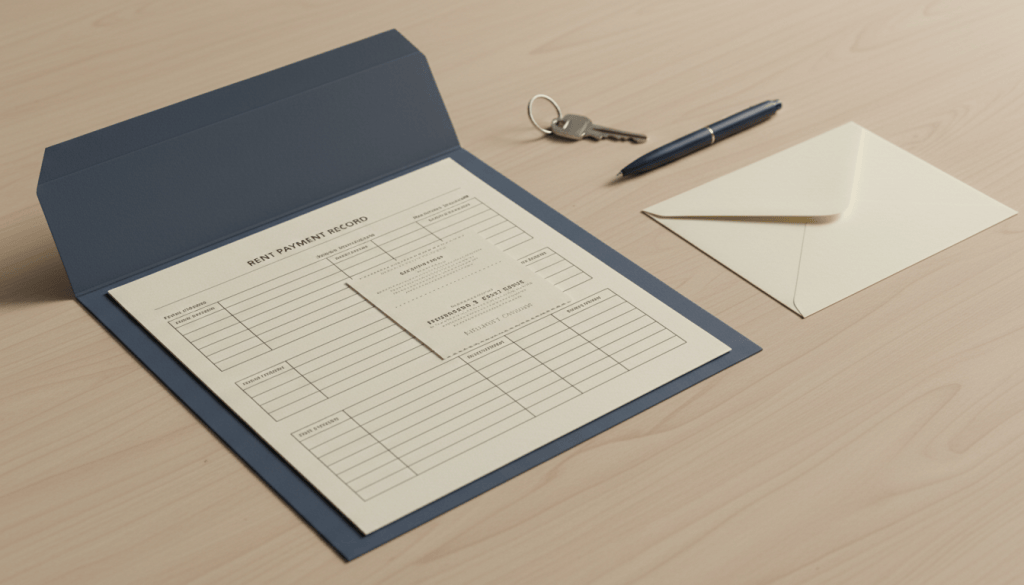
A simple rent-payment log you can copy
Use one page, notebook, or secure spreadsheet for every rental month. A useful record has the following fields:
- Rental month and amount due — for example, the month covered, not just the purchase date.
- Payee and property — the full name on the money order and the apartment number.
- Money-order issuer and identifying number — kept securely and not posted publicly.
- Purchase date and receipt location — where the original stub is filed.
- Delivery date and method — in person, mail, approved drop box, or other agreed route.
- Receipt or acknowledgment — when and from whom it was obtained.
- Status or follow-up — any issuer inquiry, landlord response, and final resolution.
Make a second digital copy of essential receipts where you can access it if the original goes missing, but use a password-protected account or other secure storage. Do not publish full money-order serial numbers or identifying documents on social media.
Build the habit before there is a dispute
The best proof-of-payment system is one you can repeat every month: fill out the instrument carefully, keep the stub, obtain delivery evidence, request acknowledgment, and file everything together. It may take only a few minutes, but it gives you a clearer timeline if an error appears later.
If rent is hard to fit into an uneven budget, see Which Bills Should You Pay First When Money Is Tight? and How to Plan for Irregular Expenses Before They Become Financial Emergencies. Keeping payment evidence is also one of the practical routines discussed in Marcus Weston’s Banking After Prison, in The Second Chance Money Guides.
This article offers general information for U.S. tenants and is not legal advice. Money-order rules, landlord receipt requirements, and rent-payment deadlines vary by issuer, lease, state, and locality. Confirm the rules that apply to your situation.

