
When money is tight, paying bills in the order they arrive can feel sensible. It is also one of the easiest ways to let urgency, guilt, or a loud reminder decide what happens to limited cash.
A better question is not simply Which bill is due first? It is What happens if this bill is not paid right now? That shift turns a stressful pile of demands into a consequence-based decision.
Start with consequences, not pressure
Two bills can have the same due date and very different consequences. One may affect housing, electricity, transportation to work, medication, or essential communication. Another may result in a late fee, a reminder, or a temporary inconvenience.
That does not make the second bill unimportant. It means the first one may need protection sooner.
When cash is limited, a practical triage system helps separate actual risk from emotional pressure. A useful first pass is to ask what each payment protects: basic functioning, income, health, housing, communication, transportation, or a service that can safely wait or be changed.
Protect the expenses that keep daily life functioning
Before deciding what is available for every other payment, identify the minimum amount needed to keep the next few days or weeks workable. Depending on the household, that may include food, transportation, medication, essential phone service, hygiene basics, utilities, or another unavoidable need.
This is different from paying every recurring bill automatically. The goal is to reserve enough money for necessities that would create a larger problem if they disappeared.
- What do I need to stay housed and safe?
- What keeps me able to work or reach necessary appointments?
- What protects health or essential communication?
- What expense would create an immediate disruption if ignored?
Once those amounts are protected, the remaining balance becomes a more realistic number for handling other obligations.
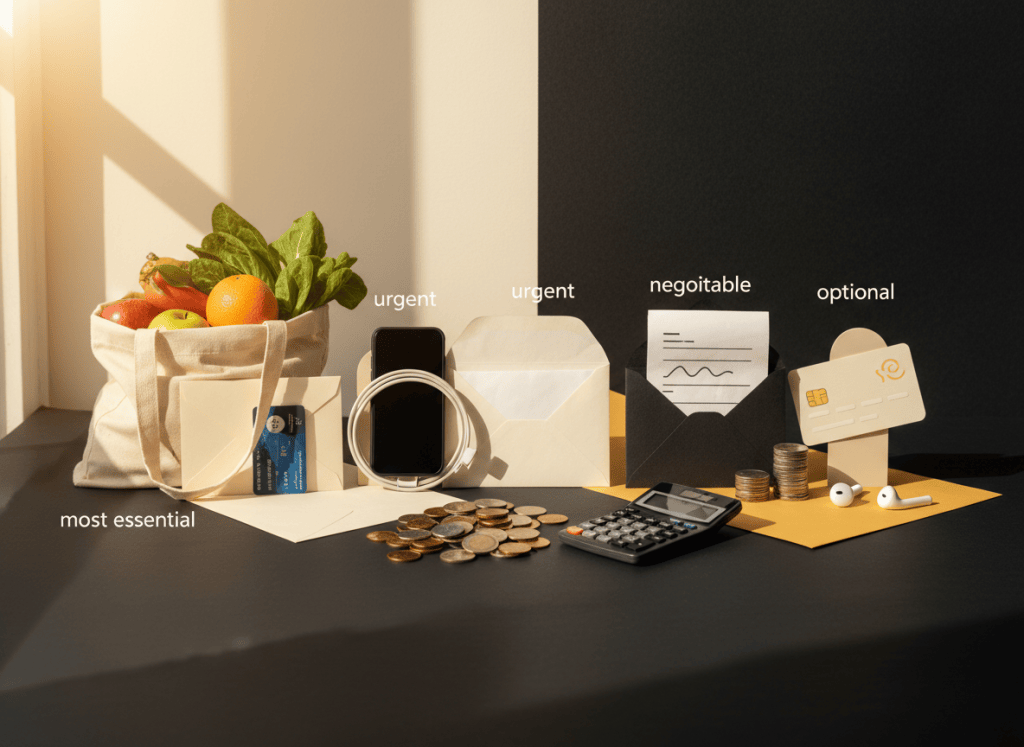
Separate urgent bills from negotiable bills
Some expenses are fixed in amount but flexible in timing. Others may have hardship options, payment arrangements, due-date changes, temporary reductions, or lower-cost alternatives.
That makes a phone call, account message, or online plan change part of the budgeting process. If a payment can be moved safely, the decision is no longer only “pay or do not pay.” It becomes a timing problem that may have more than one solution.
This is especially important when several bills are competing for the same small pool of money. A bill that looks non-negotiable on paper may become manageable once the provider explains the available options.
Use a four-level financial triage
A simple way to sort bills is to place each one into one of four categories.
1. Protect now
These are expenses where delay could quickly threaten housing, utilities, health, essential transportation, required insurance, employment, or another core need.
2. Contact before paying
These bills matter, but the provider may allow a different date, reduced payment, temporary arrangement, or hardship option. The key action is communication before the problem grows.
3. Can wait briefly
These obligations have a consequence, but delaying them for a short period does not immediately interfere with basic functioning. They still belong on the plan; they simply may not belong at the top of today’s list.
4. Remove, pause, or replace
Some recurring costs can be canceled, downgraded, paused, borrowed, substituted, or handled differently. In a tight month, replacing one cost can protect another that matters more.
Do not let the loudest bill become the highest priority
Automated reminders, repeated emails, and collection-style language can create a sense that the most persistent demand must be handled first. That emotional intensity is not the same as financial consequence.
In Budget on $500 a Month, Marcus Weston uses the memorable distinction between bills that “bark” and bills that “bite.” The idea is useful because it asks the reader to look past noise and identify what a payment actually protects.
This matters even more when scarcity stress is already affecting concentration and decision-making. The companion article Why Scarcity Stress Makes Spending Decisions Harder looks more closely at why money pressure can make ordinary choices feel unusually difficult.
What if the essentials still cost more than the money available?
Sometimes careful prioritization does not solve the problem because the gap is structural. If basic needs exceed available cash, the answer cannot be “budget harder.”
At that point, the task changes. Instead of trying to squeeze every category further, identify which lever can realistically close part of the gap:
- Reduce: lower a cost where possible.
- Delay: change the timing through an agreed arrangement.
- Replace: meet the same need in a less expensive way.
- Increase: look for additional income or legitimate assistance.
One lever may not be enough. The point is to diagnose the shortage accurately instead of treating every negative balance as a discipline failure.
A 10-minute bill-priority check
If the pile feels overwhelming, keep the process short. Write down the money currently available, the next reliable income date, and the essential costs that must be protected until then. Then take each bill and ask only three questions:
- What happens if this is not paid now?
- Can the amount or date be changed safely?
- Does paying this today put a more essential need at risk?
That is enough to create an order of operations. It does not eliminate the underlying pressure, but it can reduce the number of decisions that have to be made at once.
The goal is a safer next decision
Bill prioritization is not about deciding which obligations “matter” morally. It is about deciding which consequences matter most when the same money cannot cover everything at the same time.
Readers interested in a broader, shame-free approach to tight-money planning can explore Marcus Weston’s author page on Wonder Shelf Books. His practical finance work focuses on simple systems, scarcity pressure, and rebuilding confidence around everyday money decisions.

