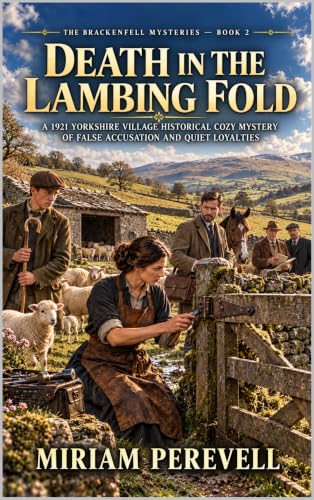
Book: Death in the Lambing Fold · Author: Miriam Perevell · Series: The Brackenfell Mysteries, Book 2. An original, spoiler-light reader extra set in fictional Brackenfell, Yorkshire, during 1921.
BONUS STORY 2 — The Mare Who Wouldn’t Drink
The first indication that Samuel Bell was worried came when he entered Harwood Forge without complaining about the bill.
Nell looked up from a shoe she was fitting to the anvil.
“Good morning,” she said cautiously.
“Morning.”
“You have not asked whether the last shoeing was expensive.”
“No.”
“Nor explained why my father used to charge less.”
Samuel took off his cap and turned it twice between his hands.
Nell set down the hammer.
“What’s happened?”
“It’s the bay mare.”
“The one who considers every visit to this place a personal insult?”
“That’s her.”
“Has she lost a shoe?”
“No.”
“Gone lame?”
“Not that I can see.”
“Then what?”
“She won’t drink.”
Nell watched his face. Samuel liked to sound certain about things, including matters on which certainty was available only to Samuel. Today there was none.
“How long?”
“Since yesterday evening. At least, I haven’t seen her take any.”
“You called Bellamy?”
“Left word. They said he was out toward the upper holdings.”
“Then we shall not decide she is dying before he gets here.”
“I never said she were dying.”
“You came without mentioning cheese.”
Samuel sat on a packing case.
“Fair point.”
Outside, Bracken Beck moved over its stones, and a cart passed towards the dairy with churns clanging faintly behind it. The village continued its business as if the mare’s thirst were not a matter requiring the entire population’s concern.
Samuel said, “She’s eating.”
“That’s something.”
“She looks at the trough, turns away, and comes back again. I put fresh water in it this morning.”
“Was the trough empty yesterday?”
“No.”
“What else has changed?”
“Nothing.”
Nell had heard that answer from men who had replaced half a cart and called the result original.
“Nothing at all?”
“Nothing that would account for it.”
“Those are different answers.”
Samuel rubbed his forehead. “I’ve been doing repairs. A loose board. New hook on the outside. Moved the feed bin out of the way.”
“What about the trough?”
“Cleaned it.”
“With what?”
“Water. Scrubbed it.”
She waited.
“And moved it,” he admitted.
“Where?”
“Other side of the yard. Better sheltered.”
“Did you ask the mare?”
He gave her an exhausted look.
“Helpful, Nell.”
“I am trying to discover whether she dislikes the water or your improvements.”
He managed something close to a smile.
Nell hung the unfinished shoe on its hook. “I’ll come and look, but Bellamy must check her. A horse not drinking is not a blacksmith’s problem to diagnose.”
“I know.”
“Good. We have established one thing before breakfast.”
Bell Fold stood beyond the village in a stretch of pasture divided by walls that followed the slope in a series of stubborn lines. Samuel had kept the lane clear. The yard beyond was neat in the way yards became neat when their owners had moved all the untidy things into one shed.
The broad-backed bay stood in the shade beside an open stable door. Her ears turned at the sound of Nell’s boots. She looked sound enough from the doorway, although Nell knew better than to make a pronouncement on an animal merely because it had the good manners to stand upright.
Samuel pointed to the trough.
It was a long wooden structure, scrubbed pale and set under the overhang of a low outbuilding. Clean water reflected the sky. Two iron straps held the boards together. The top edge was low enough for the mare to reach.
“Well?” he said.
Nell examined the fastening rather than the mare.
“The hook looks sound.”
“I made that myself.”
“It shows.”
“Is that praise?”
“Not yet.”
She took a step back. The mare watched her. Nell waited until the animal lowered her head toward the trough.
Just before her muzzle reached the water, the mare lifted her head, took two sideways steps and stopped. A moment later she tried again. This time she did not get quite so close.
Samuel spread his hands. “There. She does that every time.”
Nell looked behind them. The stable door was open. A length of rope hung on a peg. A stack of sacks leaned against the wall. Nothing moved.
“Have you offered her water anywhere else?”
“In a pail yesterday. She wasn’t interested.”
“Where did you put the pail?”
“Next to the trough.”
“Try it over there.”
She pointed to the opposite wall, where a patch of morning sun lay on the stones.
Samuel filled a clean bucket from his water barrel, carried it across and set it down. The mare turned towards him.
“Come on, then,” he said.
He did not pull her. She came under her own direction, stopped, and dipped her muzzle towards the bucket.
Then she drank.
Samuel stared at the water.
Nell felt the small relief of seeing an ordinary action resume. It did not tell them everything, but it told them more than the words stubborn or poorly had done.
“She’ll drink from that,” Samuel said.
“Yes.”
“Same water.”
“From the same barrel, certainly.”
“Then what’s wrong with my trough?”
“Something about the trough, its position, or what she associates with it. That is not a diagnosis. Wait for Bellamy.”
Samuel looked at the mare. “She’s making a fool of me.”
“The two things may occur together without being connected.”
He ignored that.
The mare drank again, then lifted her head and breathed against Samuel’s coat.
He stroked her neck.
“You old nuisance,” he murmured, with more affection than the words deserved.
Nell noticed that he did not sound angry at all.
Thomas Bellamy arrived before noon, his coat marked by the sort of journey in which a veterinarian traveled from one urgent problem to the next and was expected to regard each as the only one in Yorkshire.
He greeted Samuel, gave Nell a brief nod, and went straight to the mare.
“Tell me exactly what happened,” he said.
Samuel did, managing for once not to include his theory that the animal was putting on a performance.
Thomas asked about feed, manure, behaviour, and when Samuel had last seen her drink normally. He examined the mare and took his time. Nell stood out of the way.
When he finished, Thomas said, “I don’t find an immediate sign of the trouble you feared, but keep watching her. The fact she drank just now is useful, not a licence to ignore it if she stops again.”
Samuel nodded, more obedient than he had ever been over an invoice.
“She’ll be all right?”
“I cannot promise that from one visit. I can say she’s comfortable at present and that we should make water freely available somewhere she will use it. If her behaviour changes, send for me.”
“Right.”
Thomas turned to Nell. “You discovered the bucket?”
“I discovered that moving the water produced a different answer.”
“An important distinction.”
“Please say that in front of Wardle sometime.”
“I doubt he would thank either of us.”
Samuel folded his arms. “I want to know why she won’t use the trough.”
“Then let’s see her approach it,” Thomas said.
They stood along the far wall while Samuel led the mare nearer. She would follow him past the outbuilding, but whenever he allowed her to choose her own position, she stood away from the water.
Thomas watched the animal, then the trough, then the open yard.
“Show me where it used to be,” he said.
Samuel pointed towards the stable.
“Outside that wall.”
“And you moved it yesterday?”
“Day before yesterday. Finished the cleaning yesterday.”
“Why?”
“It was in the way when I brought the carts round. The new place is sheltered.”
“The new place is certainly sheltered,” Thomas agreed.
Nell looked at the shadow under the outbuilding. The sun had shifted. The water surface reflected the underside of the roof and the pale sky beyond it. She moved a little to her left.
Then she noticed something she had overlooked.
A short length of chain hung from a loose bracket above the trough, not touching it. Every few moments the breeze moved the chain against a tin rainwater outlet. It made a thin metallic tick, almost lost in the yard sounds.
She listened.
Tick.
The mare’s ears went forward.
Tick.
The mare drew back.
“Samuel,” Nell said. “What’s that?”
He followed her gaze.
“Rain pipe.”
“I can see it’s a rain pipe. The chain.”
“Old shutter fastening. I left it there.”
Thomas did not look at Nell. He watched the mare.
Another tick came.
She raised her head sharply.
“That might matter,” he said.
Samuel looked offended. “It’s hardly a sound at all.”
“You know what makes it,” Thomas replied. “She may not.”
Nell crossed the yard and looked at the bracket. The chain hung from a hook that had not been tightened after the work on the outbuilding. A gust moved it against the pipe again.
The sound was not loud. It was sudden, and it came from almost directly over the place where the mare needed to put her head.
“We can take it down,” Samuel said quickly.
“Do,” Thomas said. “But don’t force her straight back to the trough. Give her time, and keep the bucket available.”
Samuel fetched a stool and removed the chain. Nell held the stool steady while he worked.
When he descended, he looked embarrassed.
“I fixed that shutter myself.”
“I suspected as much,” Nell said.
“You needn’t enjoy this.”
“I am trying very hard.”
They waited. Samuel returned the mare to the stable entrance and left her there with a bucket of clean water within easy reach. Thomas and Nell walked around the outbuilding, where the chain had been hanging.
“This may not be the whole explanation,” Thomas said quietly.
“I know.”
“She may have been unsettled by the change in location, and the noise merely added to it.”
“Yes.”
“You seem disappointed.”
“Only because I had hoped to accuse the chain of everything and close the matter.”
“An attractive method. Not always reliable.”
Nell glanced at him. “You sound like Wardle.”
Thomas looked wounded. “That is a cruel thing to say before luncheon.”
Samuel emerged from the stable and joined them.
“She always drank outside the door,” he said. “Father kept the old trough there.”
“Perhaps she liked the familiar place,” Thomas suggested.
Samuel nodded, looking at the stable wall.
“I thought I was improving things.”
“Perhaps you were,” Nell said. “For the carts.”
He sighed. “Not for her.”
“Changes have a habit of inconveniencing somebody.”
Samuel leaned on the wall. “Wouldn’t be the first time.”
Nell had known him long enough to hear the larger meaning even when he did not offer it. Samuel held to old practices until they failed, and then resented having to change them. Yet here he had made the alteration himself, with the best intentions, and the mare had supplied a correction he could not argue away.
He looked at Thomas. “Should I put the trough back?”
“You can consider it, but first make sure she has an accessible, comfortable supply and see how she settles. If you do move it again, do it carefully.”
“That means more work.”
“Yes,” Thomas said.
Samuel rubbed a hand over his face.
“And if I ask Nell to move it for me, she’ll charge me.”
“Naturally,” said Nell.
“Even after solving it?”
“I have not solved a medical problem. I have helped identify an unnecessary noise.”
“Would you put that on an invoice?”
“Gladly.”
Thomas smiled. “It would be the most precise invoice in the district.”
“Precision costs extra.”
By afternoon, the story had reached the Copper Kettle without Nell’s help.
This was not unusual. What was unusual was the form it had taken.
“Samuel’s mare has refused to enter her stable because Ned frightened her with his lorry,” Ada Pritchard informed the room.
Nell stopped in the doorway.
“Remarkable,” she said.
Ada turned. “What?”
“That is a great deal of invention for so short a journey from Bell Fold.”
Edie set down a tray. “Sit, Nell. You look thirsty.”
“I am not. I came to order bread for tomorrow.”
“Then you may order it sitting down.”
Nell sat because resistance would have consumed more time than tea.
Ada remained standing.
“Was it not Ned?”
“No.”
“Someone said he had driven past the yard.”
“He drives past most yards.”
“That is hardly a defence.”
“It is not evidence of an offence.”
Edie put tea in front of Nell. “What happened, then?”
“Samuel moved the horse trough. There was a noise over it. The mare was reluctant to drink there. Bellamy examined her and gave instructions.”
“A noise?” Ada said.
“A short chain tapping a pipe.”
“And that frightened her?”
“Possibly. The new position may also have been unfamiliar. No one is putting the mare on trial.”
Ada looked as if she regretted being denied a formal proceeding.
“Has she taken water?”
“Yes, from a bucket.”
“Then she is better?”
“She drank,” Nell said. “Bellamy says that is encouraging and that Samuel must keep an eye on her.”
Edie nodded. “There. A perfectly ordinary explanation for a perfectly ordinary animal.”
Ada folded her hands. “I had heard there was something wrong with the new water barrel.”
“There isn’t.”
“How do you know?”
“Because she drank from it.”
“That is useful.”
“Almost as useful as asking before repeating a story.”
Edie hid a smile behind the teapot.
At the next table, Mrs Crowther leaned towards them.
“Then Ned had nothing to do with it?”
“Nothing,” Nell said.
“Well, that’s a relief.”
“Was there a reason to think otherwise?”
Mrs Crowther looked blank.
“I heard he was involved.”
“From whom?”
A familiar silence followed.
Nell took a drink of tea. She had no wish to spend the afternoon teaching the whole village how to distinguish sound from fiction.
Edie rescued the moment.
“If everyone has finished investigating a horse who is already drinking,” she said, “perhaps someone can tell me whether the parish ladies actually want the large currant loaf or merely enjoy discussing it.”
Mrs Crowther brightened. “I believe they want two.”
“There,” said Edie. “A statement I can test.”
The next morning Samuel came down to the forge with the mare.
Nell heard the animal before she saw her. The bay had a particular way of placing her hooves on the yard stones, with a pause before the last step as though reconsidering whether the business deserved her participation.
Nell came out with a rasp.
“Did Bellamy send you?”
“No.”
“Then what do you want?”
“To show you.”
Samuel stood back. The mare was carrying herself comfortably, ears alert, and looking mildly irritated by the prospect of another visit to a place associated with iron and instructions.
“You’ve brought her here merely to demonstrate that she’s well?”
“She drank from the trough last night.”
“The same trough?”
“Aye.”
“After you removed the chain?”
“Aye. Not straight away. Took her time. Then had a proper drink.”
Nell did not know whether to congratulate the mare or Samuel.
“How is she today?”
“Eating, drinking, moving as normal. I sent word to Bellamy like he asked.”
“Good.”
Samuel looked toward the smithy. “I moved the trough a little, too. Not right back. Just enough that she doesn’t have to stand under the pipe.”
“That sounds sensible.”
He hesitated.
“Nell?”
“Yes?”
“I ought to have told him about the chain from the first.”
“You had forgotten it was there.”
“I was standing next to it.”
“You were accustomed to the sound. That’s not the same thing as hearing it.”
Samuel thought about that.
“She heard it.”
“She had reason to.”
He stroked the mare’s shoulder, careful not to sound sentimental.
“Old fool,” he murmured.
The mare did not object.
Nell looked at him. “Which one of you?”
Samuel gave her a severe look.
“I came here with a compliment.”
“Then deliver it before it spoils.”
“Your idea about the bucket was useful.”
“Bellamy checked her.”
“He did.”
“And the sound may not have been the only problem.”
“Right.”
“Then that is the complete account.”
Samuel sighed. “You never leave a fellow a simple story.”
“Simple stories are how Ada keeps busy.”
He laughed.
Then he said, “I brought you something.”
Nell narrowed her eyes.
“If it is cheese, I warn you that my accounts are already complicated enough.”
“Not cheese.”
He brought a small cloth parcel from his saddlebag and put it on the bench.
Inside was a polished horseshoe. Not new. Nell recognised the mark of the old forge tools on its edge, the shaping left by someone who had worked quickly but accurately.
“Your father’s,” Samuel said.
She looked at it without touching.
“He made it for this mare?”
“Years ago. Found it while moving the feed bin. Kept it because it was sound iron, even after it came off. Thought you might want to see how he worked.”
Nell turned the shoe. It was an ordinary old piece of iron, worn at the outer edge. The nail holes were neat. There was nothing extraordinary about it, and no secret in it that required digging out.
“That was kind of you,” she said.
Samuel shifted his cap.
“I was clearing the shed anyway.”
“Of course.”
He glanced at the mare, perhaps grateful to find an animal that required attention.
“You could use it for scrap.”
“I could.”
Nell set it beside the anvil.
Samuel mounted again, taking his time. The mare stepped towards the lane without needing to be asked twice.
At the yard gate, he turned.
“Are you charging me for yesterday?”
“Bellamy will charge you for his visit.”
“And you?”
“I came because you were worried.”
“That’s no answer.”
“It is the answer I’m giving.”
For a moment he looked as if he might argue. Then he nodded once and rode away.
Thomas found Nell at the end of the day, finishing an ordinary shoe for an ordinary horse whose owner had already tried to explain why the price should be lower than the last time.
“Samuel sent a message,” Thomas said from the doorway.
“So he told me.”
“He says the mare is drinking normally.”
“Yes.”
“He also says you saved him a fortnight of worry.”
“An ambitious estimate. It’s been a day.”
Thomas hung his coat on a peg near the door.
“May I?”
Nell looked at the peg, then at him.
“That depends. Is this a professional consultation?”
“Only if you intend to charge for it.”
“Then the coat may stay.”
He saw the old horseshoe beside the anvil.
“What’s that?”
“Something Samuel found.”
Thomas picked it up only when she nodded.
“An old shoe.”
“My father’s work.”
“Ah.”
He examined the curve, then put it down with a respect that did not demand a speech.
“Good work,” he said.
“It was.”
“Will you keep it?”
“For now.”
Thomas made no attempt to ask whether she had thought of her father’s missing ledger page. She was grateful. One old object was simply an old object tonight.
They sat on the low bench outside while the forge cooled. The beck ran steadily below the bridge. The light had gone soft across the fields, and the calls of lambs came faintly from the hills.
“Samuel seemed embarrassed,” Thomas said.
“He wanted to improve the yard.”
“And did, in some respects.”
“Not the ones the mare cared about.”
Thomas rested his hands on his knees.
“People are rather like that.”
Nell gave him a sidelong look. “Do you intend to diagnose the village?”
“I fear it would take longer than a day.”
“And cost more than Samuel can pay.”
“That too.”
She looked at the shoe through the open doorway.
“The trouble was not that Samuel did a foolish thing,” she said. “He made a reasonable change, then assumed the mare ought to be reasonable about it.”
“She was reasonable,” Thomas replied. “By her own terms.”
Nell considered this.
“That is an inconvenient idea.”
“Most useful ones are.”
He smiled.
She smiled back, briefly enough not to encourage comment.
After a while Thomas stood and reclaimed his coat.
“Will you walk as far as the bridge?” he asked.
“I have three accounts to finish.”
“Then I won’t keep you.”
He took two steps.
“Thomas.”
He turned.
“The accounts will still be there in ten minutes.”
He waited.
Nell closed the forge doors but left the old shoe on the bench where she could see it again in the morning. She joined him on the lane, and they walked down beside Bracken Beck without discussing what the walk might mean.
The mare was drinking. Samuel was worrying less. The village had acquired a less exciting version of its story. The world had not needed a grand solution.
For one evening in Brackenfell, that was enough.
COMPANION BONUS — A Note on Working Animals in Brackenfell
Brackenfell is fictional, but the 1921 setting draws on a working rural world in which horses and ponies remained important to farming, deliveries and travel even as motor vehicles became more visible. A veterinarian’s examination and a blacksmith’s assessment answered different questions: an animal’s wellbeing could not be established from ironwork alone, and a sound horseshoe or fitting did not explain every change in behaviour.
The stories use that distinction deliberately. Nell notices tools, surfaces and practical arrangements; Thomas approaches animal health with caution. Samuel knows his animals through daily work, but familiarity does not mean he can always anticipate their responses to a changed routine.
This is historical-fiction context, not veterinary advice. Modern concerns about an animal refusing water require a qualified veterinarian rather than reliance on a fictional explanation.
Discover the complete Brackenfell Mysteries series and visit the Miriam Perevell author page.
Continue with the Book
This free companion is connected to Death in the Lambing Fold by Miriam Perevell.

