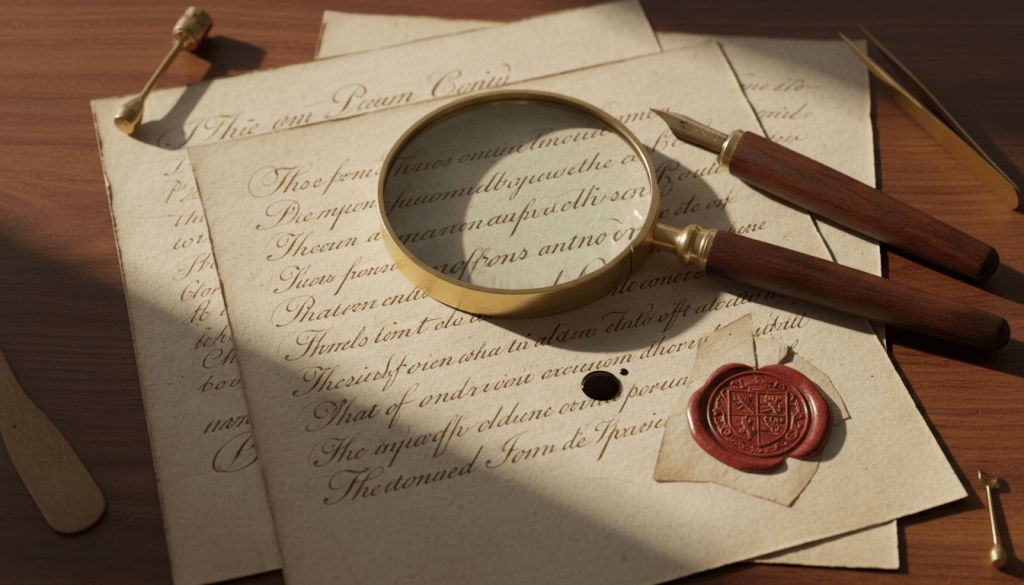
An old letter carries a seal that looks authentic. The ink is dark, the signature elegant, and the paper convincingly aged. Yet a conservator notices an inconsistency: the supposedly original sheet contains a feature that belongs to a much later manufacturing process. What seemed persuasive at first glance is suddenly open to question.
Document authentication rarely depends on a single dramatic discovery. Specialists assess materials, writing, provenance, and the document’s relationship to other records. These methods matter to historians, collectors, archivists, and anyone fascinated by how a small detail can challenge an apparently credible story.
What counts as a forged document?
A forgery is a document created or altered with the intention of passing it off as something it is not. A complete imitation may simulate a historic letter; an altered genuine document might contain an added name, changed date, substituted page, or counterfeit stamp. A reproduction is not necessarily fraudulent: an openly labeled facsimile serves educational or preservation purposes without deceiving the reader.
That distinction matters because physical age alone proves little. A forger might write new words on old blank paper or modify an authentic record. Experts therefore ask two separate questions: are the materials consistent with the claimed origin, and does the content fit the documentary history?
Paper is more than a background
Paper preserves clues about how and when it was made. Handmade sheets may display laid lines, chain lines, distinctive watermarks, and irregular fiber distribution. Later machine-made papers can have different surfaces and manufacturing patterns. Under magnification, paper fibers, repairs, and abrasions may also help identify interference.
A watermark can support an attribution, but it is not automatically proof. Paper could remain unused for years, be reused, or come from a different region than the writer. Specialists compare a watermark with known examples and consider the entire object, not just the attractive mark visible against a light.
Fold patterns, stains, trimming, and holes can also tell a story. If several pages were once folded together, their wear may align. If a signature page looks pristine while the rest of a purportedly continuous manuscript shows heavy handling, the mismatch invites closer inspection rather than an immediate verdict.
Ink reveals the history of a mark
Ink has changed across places and periods, and its appearance depends on composition, paper, storage, and exposure to light. Two strokes that look equally black might have very different chemical profiles. Forensic examiners sometimes employ spectral imaging or analytical techniques to identify variations without consuming a sample, though some tests require careful sampling and specialist judgment. The US National Institute of Standards and Technology (NIST) describes questioned-document examiners using microscopy and infrared inspection to distinguish inks that appear identical under ordinary light.
An alteration may be suggested when a date or figure reacts differently from the surrounding writing under particular illumination. That difference alone does not prove fraud: the writer may have changed pens, refilled an inkwell, or completed the text at another time. The useful question is whether the discrepancy can be explained by the document’s claimed history.
Claims that an ink test can give an exact writing date should be treated cautiously. Aging depends on many variables, and conclusions are often limited to compatibility, comparison, or relative sequence rather than a precise calendar day.
Handwriting and signatures need context
People do not write identically every time. Speed, health, writing surface, and intended audience affect letterforms. NIST’s overview of forensic handwriting examination describes comparison with known handwriting samples and conclusions that may be qualified rather than absolute. An authentic signature may vary, while a carefully copied one may look unusually controlled. Examiners compare repeated features such as spacing, rhythm, stroke movement, letter construction, and pen lifts across suitable known samples.
One isolated flourish is weak evidence. A stronger comparison uses several authentic examples from an appropriate period and acknowledges natural variation. A handwritten label and a ceremonial signature may be inappropriate comparison material, even when both bear the same person’s name.
Seals, stamps, and impressions
Wax seals and embossed marks can be distinctive, but they should not be treated as magical guarantees of authenticity. A seal matrix might be copied, stolen, reused, or passed between people. An impression can be compared for damage patterns, dimensions, placement, and relationship to the fastening mechanism.
Postal cancellations, official stamps, registry marks, and signatures of witnesses may help establish a document’s route through an institution. However, an authentic stamp can be attached to a deceptive record, and an unexpected stamp might reflect an ordinary administrative practice. Context remains essential.
Provenance: the trail before the discovery
Provenance is the recorded history of ownership, custody, or movement of an object. A document with a clear trail from its creator through archives or collections is easier to evaluate than a sensational letter that appears without context. Catalog entries, accession numbers, correspondence, inventories, and conservation reports may help reconstruct that trail.
Gaps are not automatically suspicious: family papers are often incomplete, and records can be lost. But an unsupported claim that a paper belonged to a particular person should not acquire authority merely because it has been repeated in several descriptions.
For a related look at why documentary trails produce strong detective puzzles, read Why Paper Trails Make Such Powerful Clues in Historical Mysteries.
Digital clues and modern forgeries
Electronic documents leave different traces. File metadata, revision histories, document structure, fonts, signatures, and the consistency of archived versions can help investigators test a claim. Metadata, however, can be edited or lost during conversion, so it should be corroborated rather than treated as an infallible clock.
A screenshot of a document is especially limited because it removes much of the underlying file information. When authenticity matters, investigators seek the original file or the best surviving source, preserve copies, and record how the evidence was obtained.
A practical checklist for evaluating a suspicious document
Start with what the object claims to be: who made it, when, where, and for what purpose? Examine whether its paper, ink, typography, seals, language, and formatting fit those claims. Look for an independent record of its existence. Ask whether apparent inconsistencies have innocent explanations. Most importantly, distinguish a reason for doubt from a proven fabrication.
Do not scrape, apply household chemicals, or attempt destructive tests on a potentially valuable original. A qualified archivist, conservator, or forensic document examiner can assess appropriate methods and the limits of any conclusion.
Why forged records make compelling mystery clues
Readers enjoy document puzzles because they can weigh contradictions alongside the detective. A misaligned seal, an impossible date, or a missing ledger leaf creates a question with a potentially discoverable answer. The strongest fictional clues are planted fairly and make sense when the explanation arrives.
In Hollow Creek Witch Mysteries, Marnie Blackthorn uses altered records and counterfeit markings as part of an investigation involving magical remedy certification. The fictional enchantments add atmosphere, but the appeal of checking records against observable evidence is recognizably human. Document authentication is ultimately less about one spectacular trick than about patient, testable comparison.

