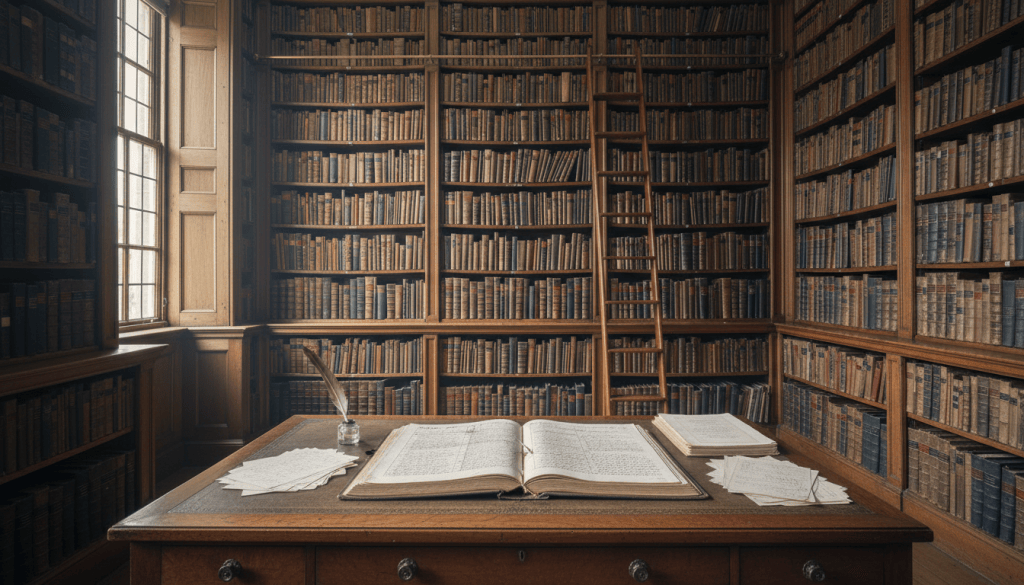
Imagine entering a great English house and discovering a room lined with books from floor to ceiling. A family might have acquired those volumes over generations: sermons and atlases, poetry and politics, travel accounts, natural history, law, and books inherited from relatives. But how did anyone know what was there? The answer was not one universal system. Historic country-house libraries were organised through changing combinations of handwritten inventories, shelf lists, subject groupings, alphabetic catalogues and, sometimes, printed catalogues. To understand a private library, you have to read both the books and the records made about them.
A private library was more than a showpiece
Country-house libraries certainly displayed wealth and taste, but they were also places of reading, study and family memory. A book could arrive as a purchase, gift, inheritance or part of a marriage settlement. Different generations might use the same room for very different purposes. The National Trust’s guide to historic books and libraries emphasises the evidence of use surviving in individual copies, including inscriptions, inserted material, annotations and bindings.
That variety mattered to cataloguers. Two copies of the same printed work could carry different dedications or bookplates. A manuscript might have been rebound long after it was written. A neatly arranged shelf could therefore conceal a complicated history that the title alone could not describe.
Inventories: the earliest answer to “what do we own?”
An inventory is essentially a record of possessions. It might have been made for estate management, inheritance, insurance, a sale or a household review. Some listed books briefly; others recorded enough detail to recognise a particular edition or volume. An inventory was not necessarily a reader-friendly catalogue. It could name only a group of books in one room, or describe a costly set without distinguishing every item inside it.
Historic examples survive. The National Trust Collections database includes catalogues from properties such as Belton, Castle Ward, Scotney Castle and Oxburgh. The records vary in date, purpose and detail—an important reminder that private libraries had different needs rather than a single standard method.
How books were arranged on the shelves
A practical household had to answer two separate questions: what books are in the collection? and where can a particular book be found? A list arranged by author or subject helped with the first; a shelf catalogue or location mark helped with the second. Some collections reflected the intellectual categories favoured by their owners. Others followed the dimensions of the books, the architecture of the room, or inherited arrangements that were inconvenient to change.
A volume’s shelf position could be recorded by press, case, shelf or another local identifier. Yet a location reference was only useful while the arrangement stayed stable. Move a set of volumes into a new room without revising the records, and an apparently precise catalogue could lead a reader to an empty shelf.
Why the physical copy mattered
Modern readers may think first of a book’s title and author. A historian investigating a country-house collection often needs to know which copy survived there. Identifying features can include an owner’s name, a bookplate, handwritten corrections, a distinctive binding, inserted letters or notes, and evidence that the volume was once part of another library. Such details help establish provenance: the documented history of possession and movement of an object.
They can also complicate a simple story. A bookplate may have been pasted in after the volume was acquired. A binding might be newer than the pages it protects. Handwriting in the margin may belong to a visitor or a later owner, not the first reader. Scholars therefore compare copy-specific marks with surviving household correspondence, purchase records and older lists instead of relying on a single clue.
Who actually kept these catalogues?
Responsibility could fall to owners themselves, secretaries, tutors, household employees, scholars or hired specialists. The work required more than elegant handwriting. Someone had to distinguish similar titles, count volumes, recognise variant editions when necessary, and decide how additions should be entered. An experienced cataloguer could also notice when a title in a family list no longer matched the book on the shelf.
Methods changed over time, and surviving records are uneven. It would be misleading to imagine every country house employed a full-time librarian or used a modern card-file system. A small collection might be managed informally. A larger or unusually scholarly one could call for more detailed classification and professional help.
Why a catalogue could become unreliable
Collections were never completely static. Books were lent and not returned. New titles arrived without being entered. Multiple volumes were mistakenly treated as one work. A manuscript could receive a new binding and lose an identifying label. Estate sales divided collections, while inheritance reunited books that had been separated for years.
Even the title written down might be ambiguous. Early works could have long title pages, multiple editions, Latin titles or inconsistent abbreviated names in household records. In historical research, an apparent “missing book” might simply have been recorded differently. Equally, a catalogue entry is evidence that someone listed a work at a particular moment; it is not automatic proof that the volume remained in the same place thereafter.
What historians and conservators can recover today
Historic catalogues help researchers reconstruct reading habits and the journeys of individual books. They become especially informative when combined with ownership marks and physical examination. The National Trust’s account of cataloguing the library at The Vyne describes how close inspection recorded marginal notes, drawings and personal papers while books were checked and returned to their shelves.
Present-day collection records can be far more descriptive than the original household lists. Conservation teams document condition and individual features, while researchers compare historical inventories against what survives. If you want to see how provenance and access records are used in libraries now, our related guide, How Do Libraries Track Rare Books?, follows that modern investigative process.
Why catalogue details make convincing fictional clues
A catalogue is an unusual kind of witness: precise in some respects, silent in others. A newly written entry, a crossed-out shelfmark, or an unexplained gap can prompt questions without proving a crime by itself. This is why a cataloguer’s eye works so well in bookish mystery fiction. The reader can follow the same material evidence as the investigator rather than depend on a sudden confession.
In The Key in the Hartmoor Folio, a novel in Vivienne Hartmoor’s Locked Library Mysteries, Rose Vale draws on skills inherited from her late father, a private-library cataloguer, while examining a murder at the fictional Hartmoor Abbey. The setting is invented, but the central idea is grounded in a real historical practice: books and the records around them do not always tell the same story.
For more historical fiction with archival puzzles, visit Vivienne Hartmoor’s author page.
Related reading: For a related look at rare-book provenance and documentation, read How Do Libraries Track Rare Books?.

