Truffles and Trouble
A complete companion to Truffles and Trouble by Pippa Marlowe, from Sweetheart Harbor Romantic Mysteries.
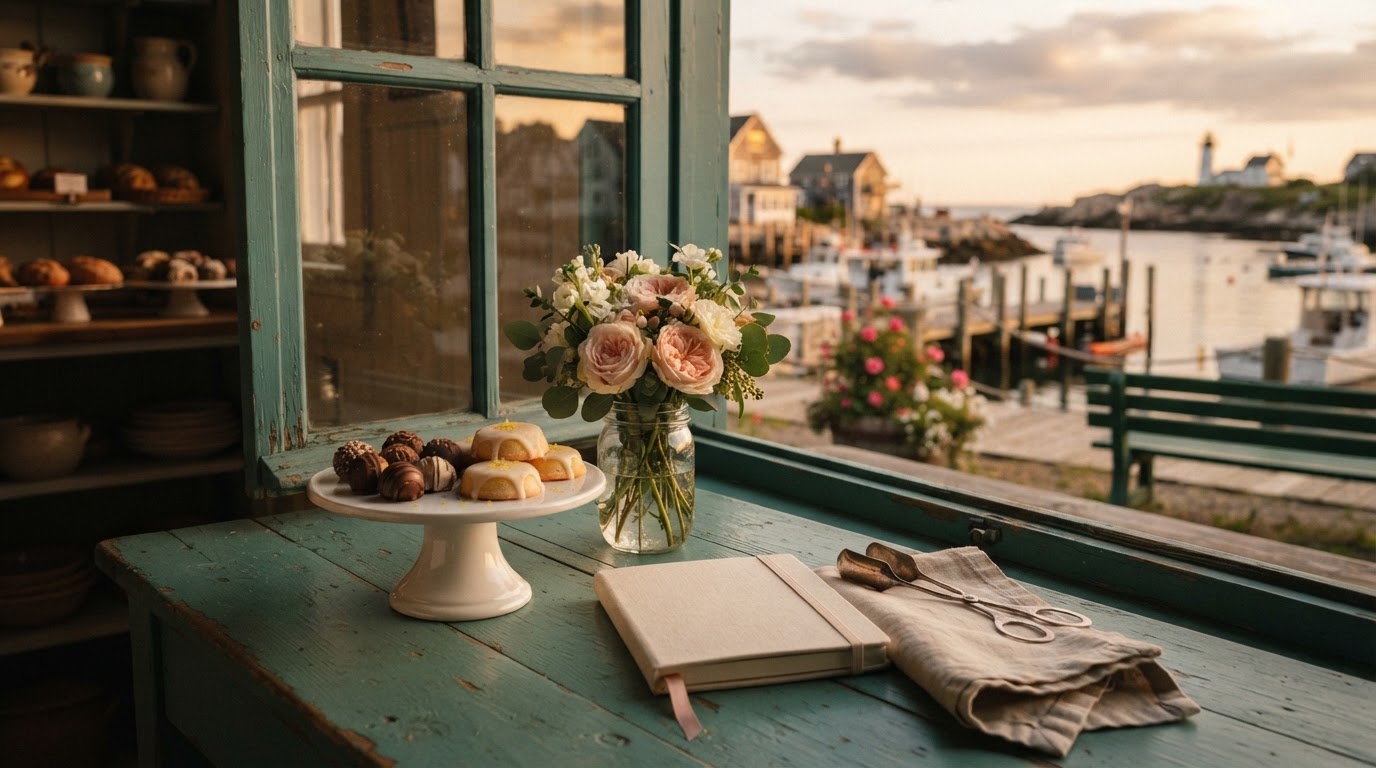
Two original, standalone Sweetheart Harbor interludes and one practical bakery-inspired companion for readers of Truffles and Trouble by Pippa Marlowe. The stories contain no revelation of the novel’s culprit or ending, and they do not require knowledge of later books.
Bonus Story 1: Twenty-Eight for the Table
The first difficulty with a small wedding, Clara Hartwell had discovered, was persuading everyone that small did not mean simple.
At Buttercup & Briar, twenty-eight miniature lemon shortbread cakes waited on wire racks, their pale tops glazed with just enough sugar to catch the light. Clara had made them in two batches because her oven possessed strong opinions about crowded shelves. Behind her, Bea was fastening stems of cream-colored stock into little glass bud vases, and Tilly was counting ivory presentation boxes for the third time.
“Twenty-four,” Tilly announced.
“Twenty-eight,” Clara corrected without looking up.
“Twenty-four guests,” Tilly said. “Two witnesses. One bride. One groom. That makes twenty-eight people if the witnesses aren't guests, which they are, so perhaps it makes twenty-six. I've looked at the list for so long I've stopped believing in arithmetic.”
Bea set down her snips. “Arithmetic is a cruel thing to introduce to weddings. Flowers do not require subtraction.”
“They require invoices,” Clara said.
“An unfortunate modern custom.”
Tilly laid the printed guest list beside the boxes. “The venue wants twenty-four favors on the dining tables. Lily's order says twenty-eight cakes. Mabel says she has room for twenty-four favors and would prefer no surprises, which is a brave wish for anyone running Harbor Hearth.”
The bride, Lily Fenwick, and her fiancé, Sam Rowan, had arranged a brief ceremony followed by lunch in the rose-pink Victorian bed-and-breakfast above the square. Neither wanted a towering cake, a six-piece band, or photographs of relatives pretending to enjoy formal shoes. They wanted food, flowers, and the people who had helped them find each other.
Clara understood the impulse. It was almost enough to make a person overlook what the wedding industry called an intimate event and a baker called a schedule with nowhere to hide mistakes.
“Twenty-eight cakes,” she said. “Twenty-four table favors, four kept separately. Lily was quite clear.”
“About the number,” Tilly said. “Not about where the four go.”
Bea eyed the little cakes. “Are we certain all twenty-eight need to travel? I could keep four here, say they were quality-control casualties, and resolve your mathematics with astonishing efficiency.”
“You've already eaten one of the trial batch.”
“That was scientific work.”
Clara checked the order. In her own handwriting, beneath the flavors and the instruction to keep fresh flowers away from edible surfaces, were the words Four quiet ones. Ask Sam. She remembered Lily saying it in a low voice while Sam examined an arrangement of white stock: the four additional cakes mattered, but she wanted to keep the reason between them until the day itself.
Sam had been due to confirm the details yesterday. He had instead taken his elderly grandfather to a medical appointment in the neighboring town and left a message saying he'd be at Harbor Hearth before the ceremony. Clara was not going to make Lily explain a private plan in the middle of her wedding morning simply to spare the rest of them mild discomfort.
“We pack the twenty-eight,” she decided. “Twenty-four together. Four separately in a plain tray, clearly marked for Sam, not for a guest table. We deliver directly to Mabel and ask her to keep the tray in the service room.”
Tilly entered the instructions into her tablet with the gravity of a court stenographer.
“That's settled,” Clara said.
The shop bell chimed and Mrs. Opal Whitcomb appeared, wearing her rain bonnet beneath a sky that was not raining.
“I hear there's to be a wedding with no wedding cake,” Opal said. “I came to make certain civilization had not been entirely abandoned.”
“Twenty-eight little ones,” Clara said, showing her the rack.
Opal inspected a cake through narrowed eyes. “Acceptable. But why twenty-eight?”
Bea smiled sweetly. “Because civilization insisted.”
Opal left with a lemon biscuit and the warning that the harbor wind would turn by noon. For once, Clara hoped the older woman was wrong.
She was not.
By the time Clara and Tilly loaded the van, wet gusts were pushing loose sand across the square. Bea rode ahead with the flowers so the delicate stock would not spend the journey arguing with a box of cakes. Clara followed with the larger crate, the separate four-cake tray, and Tilly, whose tablet kept offering cheerful weather updates unrelated to the weather outside their windows.
Harbor Hearth stood above the square with its lace curtains and rose-pink facade looking improbably serene. At the service entrance, Mabel Finch met them in an apron patterned with teapots.
“Thank goodness,” she said. “The florist arrived and told me your cakes were nervous.”
“That was Bea describing the weather,” Clara said.
“Ah. Well, the groom is here, his grandfather is resting upstairs, and I've already put out more chairs than anyone can reasonably occupy. The kitchen is yours for ten minutes, then mine again. I am serving lunch to people who will insist they aren't hungry and then eat every potato in the county.”
A volunteer named Finn, borrowed from the hotel's usual weekend staff, helped carry in the crates. He was a thin young man with red ears and the solemn expression of someone who had been entrusted with expensive porcelain too early in life.
“Dining room through there?” Clara asked.
Finn nodded toward a pair of folding doors. “The tables are ready. The kitchen trolley's over by the stairwell. We moved it because the old wheel squeaks.”
“Does moving it make it squeak less?” Tilly asked.
“No,” Finn said. “But the guests can't hear it from there.”
He delivered that answer so earnestly that she had to turn away to hide a smile.
Clara arranged the twenty-four table favors on a large, shallow tray. She kept the four extras in their own lidded container and placed that on the shelf Mabel pointed out, beside folded linen napkins. She showed Finn the labels, counted aloud with Tilly, and confirmed the shelf position with Mabel before returning to the dining room to help Bea set the vases.
It was, Clara thought, a model of good communication.
Twenty minutes later, Mabel came into the dining room holding an empty tray.
“Clara,” she said, very calmly. “Where are the wedding favors?”
Clara looked at the twenty-four place settings. Each had a folded napkin and a sprig of stock. Not one held a shortbread cake.
Bea looked up from a vase. “That's a question with an unfortunate amount of emptiness in it.”
“We carried them in,” Tilly said. “I counted them.”
“And I saw them,” Mabel said. “But when Finn went to set them out, the large tray was gone from the service shelf.”
Clara's stomach tightened. There were less than ninety minutes before the ceremony, and her carefully made cakes had apparently gone for a walk.
Tilly examined the empty tray as though it might confess under pressure. “If a tray is missing, that isn't the same as the cakes being missing. We should be precise.”
“Detective Reed would approve,” Bea said.
“Detective Reed would probably ask us not to form a search party,” Clara replied. “Fortunately, no one is accused of anything. We're simply looking for twenty-four lemon cakes in a building with six rooms and a chronic shortage of shelves.”
Mabel pressed a hand to her forehead. “Six guest rooms. Eight other rooms. Two cupboards with identities of their own. There is a difference.”
Sam Rowan appeared in the doorway carrying a small wooden stool. He was broad-shouldered and soft-spoken, with the helplessly cheerful expression of a man who had agreed to get married and discovered that everybody else possessed stronger views about the furniture.
“Is there a problem?” he asked.
“No problem,” Mabel and Clara said together.
Bea looked between them. “A fascinating duet.”
Sam set the stool down. “Lily is upstairs with her mother. I can help.”
Clara hesitated. “Actually, we need to confirm the four extra cakes. Lily said to ask you.”
Something warm and private crossed his face. “Oh. Yes. I can explain, but can it wait until we've found the regular ones? I'd rather keep those four quiet a little longer.”
“Of course.” Clara believed a promise ought to be useful even when it complicated one's day. “Can you remember which room the staff were moving things into?”
Sam considered. “I was carrying the stool in from the covered porch. Finn went toward the kitchen with a trolley. Then a woman in a gray cardigan went past with folded linen. Somebody asked for a table to be cleared because guests were beginning to arrive.”
“The woman in gray was Mrs. Finch's afternoon helper,” Mabel said. “Cora. She has gone to collect fresh cream from the dairy. Her sister's car broke down, so she's walking.”
“Lemon cakes don't need cream,” Clara said. “Which means we've no reason to chase her.”
“We could send a question by telephone,” Tilly said.
Mabel dialed. There was no answer. The harbor sometimes treated phone reception as an expensive optional service.
Clara went back to the service entrance. She inspected the shelf where she had left the trays, then the floor beneath it. There was no broken packaging, no sticky glaze, no sign that anyone had opened the favors. The only disturbance was the pale rectangle where a wooden tray had sat, beside the separate container holding four extra cakes. At least that one was still there.
“Those are safe,” she told Sam when he followed her. “It's the twenty-four we're hunting.”
He nodded, his shoulders releasing slightly. “Twenty-four. Right.”
“Don't apologize for needing extra,” she said. “People are not a single line in a spreadsheet.”
“Neither are weddings,” he replied. “That's what I'm learning.”
The hallway gave a long, complaining squeak.
Finn appeared with the empty kitchen trolley, guiding it around the stairwell. One of the wheels made an oddly musical ee-ah, ee-ah with every turn. He stopped when he saw them.
“I know,” he said quickly. “It's loud. I told Mrs. Finch I would oil it. But she said not today because oil and white tablecloths have a history.”
“Finn,” Clara asked, “when we brought the cakes in, where did you take the large tray?”
“To the service shelf.”
“And after that?”
He looked blank. “I collected a crate from the front hall. Then I came back for the trolley.”
“Was anyone near the shelf?”
“Cora. She was trying to fold the big screen in the front parlor. She said the room needed to look ready for the guests.”
Mabel's face changed. “The parlor screen! I told her to hide the spare serving things before the photographer arrived.”
“Hide spare serving things,” Bea repeated. “A phrase with room for disaster.”
Mabel led them around the hall to the front parlor, where winter sun had found its way through lace curtains. A three-panel folding screen stood near the bay window. Behind it, an empty pitcher, two rolls of table linen, and a vase of dried hydrangeas shared a small table.
No cakes.
“I don't understand,” Mabel said. “She was tidying. Where else would she put them?”
Tilly touched the screen's wooden edge. “Maybe the question isn't where she hid them. Maybe she carried them through here because the route was clear.”
Clara looked past the parlor doors. From this angle she could see a narrower corridor leading to the breakfast room, usually closed to guests between services. Its door stood partly open, but a rolled carpet blocked the threshold.
“Why is the carpet there?” she asked.
“New runner,” Mabel said. “Cora unrolled it to check the length. It was the wrong size, of course. The universe does not believe in measuring tapes.”
Finn brightened. “I helped her move the table out. The little one, with a flap on one side.”
“And the trolley?” Clara asked.
He thought. “No. I didn't take it in there.”
The sound of voices grew louder from the dining room. Guests were arriving, and Mabel had to go greet them. She left Clara with a look that conveyed gratitude and a very clear expectation that the missing cakes would become found cakes promptly.
Clara took a careful breath. “Let's separate what we know. We brought the cakes inside. Finn put them on the service shelf. We haven't seen anyone carrying an open tray, and no wrappers are lying about. Cora was clearing the parlor. The trolley was moved. None of that tells us someone stole the cakes.”
Bea nodded approvingly. “Nor does the fact that cakes are worth stealing. We must resist flattering ourselves.”
“Is that difficult for you?” Tilly asked.
“Extremely.”
Clara glanced at Finn. “You said you helped with a table. Where did you put it?”
“In the breakfast room. But not the trolley. I remember because the table catches on the door unless you fold down its leaf.”
They entered the breakfast room. Along one wall stood a covered buffet sideboard, its linen cloth hanging low, while the little folding table was stacked beneath a window. The room smelled faintly of coffee and furniture polish. There were no cakes visible.
Clara was about to turn back when she noticed two fine golden grains on the floor by the sideboard. She crouched and touched one with a clean finger: sugar, dry enough to crumble. A tiny flake of pale glaze lay beside it.
“Does Cora make lemon shortbread?” she asked.
“She makes excellent scones,” Finn said. “But she doesn't glaze them.”
Clara straightened. “Let's check the sideboard.”
Bea lifted the hanging linen. Beneath it sat two large trays, one empty and one covered with a white cloth. On the covered tray rested twenty-four carefully wrapped miniature cakes. Each wrapper was intact. The cakes had not been eaten, appropriated, or replaced with another assortment. They had simply been put away under the sideboard when someone cleared the service route.
Finn gasped. “They're there!”
Tilly placed her hands on her hips. “Twenty-four little fugitives.”
Bea looked at Clara. “You do appreciate that we have solved a mystery involving a cloth and a cupboard.”
“I appreciate that we can feed the wedding guests.”
Clara lifted the cloth, checked the wrappers, and counted all twenty-four twice. One box near the edge had shifted and the cake inside had a small crack in its glaze. The cake itself was sound, though the box looked as if it had been subject to minor turbulence.
“We can repair the glaze,” she said. “There are spare pieces in the kitchen.”
Mabel appeared in the doorway before they could call her, her eyes traveling from the trays to Clara's face.
“You found them.”
“All twenty-four. There was a covered space under the buffet sideboard.”
Mabel put a hand on Finn's shoulder. “Good. Then nobody needs to be told they're in trouble.”
“Was somebody going to be?” Finn asked, looking alarmed.
“No,” Mabel said. “But you look so relieved I felt it should be said.”
Clara met the young man's gaze. “You carried the trays exactly where you were asked. Next time, just let the next person know when you move something. All of us, actually.”
He nodded with the solemnity of a new recruit receiving important harbor rules.
Bea looked at the cracked cake. “And our first aid station?”
“Kitchen,” Clara said. “Now.”
Twenty minutes later the dining room held twenty-four miniature cakes, each in its own box beside a linen napkin. The repaired one had been given a fresh dab of lemon glaze and set where Clara could keep an eye on it, although nobody other than Clara would have recognized its difficult morning. Bea's little vases softened the white tablecloths without obscuring anyone's face. Tilly checked the place settings against Mabel's list and, for the first time all day, arrived at the same number twice.
Lily entered wearing a simple cream dress and the expression of someone who had expected marriage to be emotional but not quite so noisy. Her mother followed, carrying a cardigan no one needed, and Sam came from the stairs with his grandfather's arm linked through his own.
“It's beautiful,” Lily said, looking around the room.
Bea accepted the praise with appropriate modesty, which for Bea meant only a small movement of her eyebrows.
Lily turned to Clara. “The four separate ones? Sam told me you kept them aside.”
“Yes,” Clara said. “They're safe in Mabel's service room.”
Sam glanced at Lily. She nodded, the sort of private agreement that required no performance.
“We have four friends working the harbor today,” he said. “Two on the early ferry, one at the boatyard, one on the weather station shift. They couldn't leave. They helped us get ready for this, though, and Lily didn't want them to be an empty space in the photographs.”
“We're bringing them their cakes afterward,” Lily added. “No special speeches. They hate speeches.”
Clara understood at last why Lily had called them the quiet ones. They weren't uninvited guests or forgotten places at a table. They were a way of letting people know they were part of the celebration without demanding that they abandon their work to prove it.
“Good,” Bea said, her voice softer than usual. “A sensible definition of a guest.”
Sam's grandfather looked at the tables. “When I married his grandmother, there were eleven of us at the ceremony and fourteen at supper. We ran out of forks. We still had forty-three good years.”
“That is an encouraging statistic,” Mabel said. “Though I would prefer not to test it with cutlery today.”
The ceremony was brief, as the couple had wished. From the service-room doorway, Clara heard voices rise on a promise, then laughter, then the warm confusion of people deciding when to applaud. She and Bea were too busy pouring tea to see much, but Clara did glimpse Lily and Sam emerging into the dining room with the unmistakable ease of two people who had stopped arranging a wedding and started enjoying their marriage.
During lunch, Finn carried a tray of teacups past Clara with unusual care.
“Mrs. Finch says we should write down where things go,” he told her. “I'm going to keep a notebook.”
“That's excellent.”
“I'm calling it Things That Went Somewhere.”
“It will be a bestseller in the hospitality industry.”
He grinned and disappeared toward the kitchen.
When the guests had finished eating, Lily and Sam collected the four separate cakes. No elaborate packaging had been added. Clara had written the ingredients on a small card and made sure the boxes would travel upright. The couple set them in a simple basket beside a thermos of tea.
“Thank you for not making a fuss,” Lily said.
“I make cakes,” Clara replied. “Not all the decisions around them.”
“Today you made those too, a little,” Sam said. “But you were kind about it.”
Outside, the wind had settled. The late light lay gold on Sweetheart Harbor, and the lighthouse shone pale above the roofs. As Lily and Sam headed down the hill toward the working waterfront, Bea stood beside Clara on the steps of Harbor Hearth.
“You know what the lesson is,” Bea said.
“Never leave twenty-four cakes under a sideboard?”
“A useful secondary lesson.”
“What is the primary one?”
“That you cannot count the people who matter merely by looking at the chairs.”
Clara watched the newlyweds grow smaller along the square, basket between them. “I think I already knew that.”
“Of course you did. I was reminding you so that you could pretend to teach me.”
Back at Buttercup & Briar, Tilly added a note to the delivery procedure: Count the boxes. Name the room. Tell the next person. She taped it beside the packing bench, directly beneath Bea's more philosophical reminder: No flowers in direct contact with the cakes.
Clara read both notices and smiled. Love, she thought, might always resist being made entirely orderly. But a small kindness deserved careful handling, particularly if it had spent half an afternoon hiding under a tablecloth.
Bonus Story 2: The Bench That Kept Moving
In Sweetheart Harbor, a bench could become controversial without anyone sitting on it.
Clara Hartwell learned this on a bright, cold morning when Mrs. Opal Whitcomb marched into Buttercup & Briar wearing her clear rain bonnet and carrying an expression usually reserved for improperly pruned roses.
“They've moved the bench again,” she announced.
Bea looked up from a bucket of white stock. “Which bench? We have several. The town is overqualified in places to sit and discuss other people.”
“The new bench at the pier. The one paid for by the Bellweather Books winter sale. It was installed to look toward Harbor Heart Lighthouse. Now it has been moved down by the ferry office, where the view is completely unsuitable.”
“Unsuitable for what?” Clara asked.
“Looking at.”
“That does sound a serious drawback in a view.”
Opal accepted the humor with the dignity of a woman refusing a bargain. “Yesterday I had it put back. This morning it was gone again. Someone is treating a public improvement like movable garden furniture.”
Bea's snips stopped. “You had it put back? Yourself?”
“Of course not. My shoulders aren't municipal property. I asked the maintenance crew to do it.”
Clara laid down the pastry brush she had been using to glaze a tray of lemon buns. She could picture the bench: a handsome green-painted seat with a slatted back, solid enough to withstand harbor gusts, its arms shaped by a local woodworker. Henry Bellweather had organized a secondhand-book sale to pay for it after noticing that people browsing the waterfront had nowhere comfortable to pause. The town had promised a spot overlooking the water, but permanent installation was waiting on an inspection of the promenade paving.
“Could the weather have caused the move?” she asked.
Opal looked offended on behalf of the weather. “A northerly wind can turn a weather vane. It cannot carry a bench along a paved path and park it neatly beside a ferry timetable.”
“Fair,” Clara admitted.
“Nor can it move it back again the previous afternoon. That was a maintenance crew, not a gust.”
“Then perhaps ask the maintenance crew who requested today's move.”
“I did. They said their job was to return it to the marked position and that they had not touched it this morning.” Opal folded her hands over her handbag. “I am not accusing anyone, Clara. I am collecting facts, in an appropriately severe manner.”
Bea leaned toward Clara. “You are being invited to a bench investigation. That's different from being asked, because in this town the invitation comes with expectations.”
“I'm delivering the pastry order to the harbor office,” Clara said. “I can look at it on my way.”
Opal's expression softened by one very small degree. “Good. And you might ask Captain Gus what he thinks. He has been unhelpfully quiet.”
“Quiet can be a form of kindness.”
“Not when you're discussing public furniture.”
Ten minutes later, Clara walked down the sloping street with a paper bag of lemon buns under one arm and the morning's sea wind tugging at her coat. The working harbor was already busy: a boat engine coughed, ropes creaked against cleats, and gulls protested the lack of an official breakfast program. Near the ferry office, the new bench stood on a wide, level part of the lower promenade, facing the water through a gap between two bollards.
It was not a terrible view. From here one could see the ferry landing, fishing boats, and a slice of lighthouse beyond the outer wall. The bench's front legs were neatly squared to the paving joints, and a folded scrap of cardboard had been placed under one short foot to stop it rocking. Whoever had moved it had taken care.
Mabel Finch was standing beside it, a wool scarf looped around her neck.
“Clara,” she said. “I was just deciding whether sitting down on a disputed bench would count as taking sides.”
“Have you reached a conclusion?”
“I've been standing for six minutes, so the issue is becoming urgent.”
Clara set down her pastry bag and studied the paving. A narrow set of wheel marks crossed a damp patch toward the lower promenade. One track was deeper than the other and had a little zigzag at regular intervals, as though the wheel had worn unevenly. The marks stopped beside the bench.
“Someone used a trolley,” Clara said.
Mabel bent to examine them. “Could be half the working harbor. We have more trolleys than places to put them.”
“True. But the bench was meant to be up there.” Clara pointed to the upper promenade, where a line of pale chalk marked its original position. “Why move it down, put it neatly in place, and wedge it steady?”
“Because someone wanted to sit here?” Mabel suggested.
“That would be the least dramatic motive available.”
They heard a low chuckle behind them. Captain Gus Mariner approached with his cap pulled down against the wind and an old leather satchel swinging at his side.
“Good spot for a seat,” he said.
“Opal doesn't think so,” Mabel told him.
“Opal doesn't think weather should happen without consulting her.”
Clara pointed to the trolley tracks. “Do you know who moved it?”
Gus looked at the marks, then at the bench. “Know who keeps shifting boxes and chairs around a harbor? Might as well ask who moves clouds.”
“I'm not asking about clouds.”
“No,” he said. “Benches are heavier.”
He took the pastry bag from her to deliver to the office, but before he walked away, his gaze moved toward the upper promenade. Clara followed it. Between the paved square and the old railing, a narrow section of stone had been roped off with a temporary barrier. A repair warning hung from one post.
“Is the paving unsafe?” she asked.
“Needs checking. One edge has settled near the drain. Nothing worth excitement until someone puts their foot wrong.”
“Does Opal know?”
“She knows there's an inspection. Doesn't think the bench needs to wait for it.”
Captain Gus tipped his cap and went into the office, leaving Clara with two facts and a suspicion she could not yet name.
“Do you think he's hiding something?” Mabel asked.
“He's definitely choosing which parts of his opinion to give us.”
“That's nearly a profession among fishermen.”
They looked again at the bench. A neatly folded dark-green scarf lay on one arm, dry despite the damp paving. Someone had used the seat recently, and cared enough about it to leave a cloth ready for the next visit.
Before Clara could pick it up, a quiet voice behind them said, “That's mine.”
A woman with close-cropped gray hair and a cane approached along the broad lower path. Clara recognized Nell Dorsey, who had worked for years at the old ferry ticket window and still greeted boat crews by name. Nell walked carefully, not painfully exactly, but with the measured attention of someone who had learned to respect uneven ground.
“Forgive me,” Nell said, reaching for the scarf. “I came down earlier and left it here.”
“No harm done,” Clara replied.
Nell touched the bench's smooth armrest. “I hope they don't take it away again. I like being able to see the boats from here.”
“Why here?” Mabel asked gently. “There's a lovely view from the higher promenade.”
Nell glanced toward the steps. “There is. For people who can get there easily.”
The words were quiet. They settled between the three women while a ferry horn sounded out beyond the breakwater.
Nell settled on the bench after Clara moved the scarf aside. From the seat, her gaze followed the ferry slipping toward the channel. Her face had the particular calm of someone who had found the right place to be and feared that other people would make it complicated.
“I used to take the upper path most mornings,” she said. “I still do when the stones are dry and my knees feel sensible. Lately it's not so easy. Here I can come along the lower walk from the square. No steps and no loose gravel.”
“Did you ask anyone to move the bench?” Clara asked.
“Good heavens, no. I'd never arrange other people's furniture.” Nell's smile flickered. “I only told Captain Gus it was a shame I couldn't use it where they put it.”
Mabel looked thoughtful. “That isn't asking for very much.”
“Perhaps. But when you're the one who can't manage the steps, it starts to sound like a great deal.”
Clara sat for a moment at the other end of the bench, keeping a comfortable distance. The seat was level, and from it she could see a ferry passenger waving from the upper deck. A woman on the path behind them passed with a small shopping trolley and nodded to Nell. The lower promenade was not an afterthought. It was where much of the town actually moved.
“People sit in different ways,” Clara said. “A view should belong to more than the quickest legs.”
Nell considered that. “You sound like your cousin when she's explaining why a flower arrangement ought not to block a doorway.”
“Bea is surprisingly practical beneath the flowers.”
“Don't tell her I said so. She'd become unbearable.”
They were still smiling when Opal appeared at the top of the path, marching toward them with the concentrated fury of someone who had been personally corrected by street furniture.
“There it is,” she declared. “Every morning a different address.”
Mabel rose, making room. “Opal, you know Nell.”
“Of course I know Nell. I bought ferry tickets from her when tickets were printed on paper and a person could understand the schedule without learning to use a pocket computer.”
“I still have some of those old tickets,” Nell said.
“Keep them,” Opal advised. “They might yet prove civilization once existed.”
She turned to Clara. “You see the problem. The committee agreed on the upper promenade. Now the seat faces the ferry office and not the lighthouse. Henry raised money for a harbor view. We ought not to change the promise in the middle.”
“It does face the water,” Clara said.
“Part of it. Not the best part.”
Nell carefully folded her scarf. “This is the part I can reach.”
Opal stopped. She looked at Nell, then the lower path, then the steps above. For once her answer did not arrive immediately.
“I wasn't aware,” she said.
“It's hardly a municipal announcement,” Nell replied.
“No,” Opal said. “I suppose not.”
A gull landed on a bollard and regarded them with the arrogant composure of an uninvited committee member.
Clara spoke before anyone could make the conversation heavier. “The interesting thing is that the bench keeps moving between two quite reasonable places. One has the view the book-sale donors expected. The other has a route more people can use. And the wheel marks tell us someone is using a proper handcart to move it, not simply pulling it across the paving for a joke.”
“I never suggested a joke,” Opal said.
“You said it was being treated like garden furniture.”
“That is an administrative criticism, not a theory of motive.”
Mabel hid a laugh inside her scarf.
“Let's ask Henry,” Clara said. “He helped pay for the bench, and he's open by now.”
Opal glanced toward the ferry landing, where Captain Gus had reappeared with an empty blue handcart. One wheel made a peculiar little hop every few feet: a thin double track followed by a zigzag groove in the damp pavement.
Clara recognized the pattern immediately. “Actually, we may want to ask Captain Gus first.”
Gus saw them looking and stopped the cart with a sigh of someone who knew the tide had turned against him.
“Morning, Opal.”
“Captain,” she said. “Did you move this bench?”
Gus considered the handcart. “Not by myself.”
“That's not a denial.”
“No,” he said. “It's a correction. The bench weighs enough to flatten a fool.”
Clara pointed at the wheel. “Your cart leaves a very distinctive mark.”
“Aye. Been meaning to have the rubber repaired.”
“Was that the cart used to bring the bench down?”
“Yesterday evening, yes. And the evening before.”
Opal drew a sharp breath. “You moved it back after the maintenance crew put it in the agreed spot?”
“I did.”
“Twice?”
“Seems I don't learn quickly.”
“Then why did you let them believe someone was playing a prank?”
“Didn't know there was a prank story going. I knew there was an argument about the view, which seemed a lesser emergency than a loose edge on the upper paving.” He pointed toward the cordoned section. “Until the inspection says it's sound, I don't want people waiting next to that bit with a heavy bench for encouragement.”
Clara looked at the upper promenade again. The chalk rectangle had been drawn close to the closed-off edge. It was probably an excellent place for photographs. The repair barrier made it a much less excellent place for an occupied seat.
“You should have told me,” Opal said.
“I told the maintenance foreman there was a problem. He said he'd passed a note along to the town office. It seems the note hasn't learned to swim.”
“That's a terrible metaphor,” Mabel said. “I like it.”
“Then why move it down rather than leave it in storage?” Opal pressed.
Gus looked toward Nell. For a moment Clara thought he might mention her by name. He did not.
“Because the lower path has a flat approach, and people had been asking for somewhere to pause,” he said. “I checked the paving with the harbor office. It's sound enough for a movable bench while we sort out a permanent place.”
Nell's expression changed, not with embarrassment exactly, but with the uncomfortable recognition of kindness performed in public without her asking for a spotlight.
“That's generous, Captain,” she said.
“Generous would have been a second bench.” He glanced at the sky. “This was mostly common sense with a trolley.”
Opal looked from Gus to Nell and back. “And my maintenance crew moved it up because I asked them to put it where the committee had agreed.”
“Aye.”
“And you moved it down because the committee's position isn't usable until someone checks the stone.”
“Aye.”
“So two groups of adults have spent three days moving the same bench up and down a hill rather than speaking to one another.”
Gus's mouth twitched. “When you say it like that, it sounds municipal.”
“It's absurd,” Opal said, and then, unexpectedly, she laughed.
Nell joined her. Mabel followed. Clara felt the last tightness in the morning loosen as the laugh traveled among them, a small harmless current crossing the working harbor.
The mystery had its answer. But the bench still had nowhere officially to live.
By noon they had gathered in Bellweather Books, where Henry Bellweather listened to the entire account with his hands folded over a stack of unsorted paperbacks. Mabel insisted that important civic decisions were best taken indoors with tea, while Opal declared that the town had already had quite enough movement for one piece of furniture.
Henry glanced through the window toward the pier. “I raised the money so people could sit beside the harbor, not to produce a permanent argument about compass points.”
“The donors were promised a lighthouse view,” Opal reminded him.
“Then I was imprecise,” Henry said. “I promised a place to rest and see the water. A bookshop should know that the difference between what is written and what is understood can matter.”
“A remarkably dangerous position for a bookseller,” Clara said.
“I take risks,” Henry replied. “Occasionally I stock books without shipwrecks on the cover.”
Tilly had come in to collect a new display book for the shop window. When she heard what had happened, she offered to take a simple photograph of both locations for the town office, clearly marking which one was temporarily closed off. Clara asked her not to post the argument online; Tilly agreed at once.
“An accurate photograph can help people decide,” she said. “A dramatic one can give the bench a fan club.”
Mayor Celeste Wren met them at the harbor office later that afternoon. She wore the determined expression of someone prepared to address a small civic concern as if it were an international conference, but to Clara's surprise she listened without interrupting.
“The inspection report is not in,” the mayor said at last. “Then we will not secure a permanent seat on that upper section until it is. The lower spot can be used temporarily if the harbor office confirms it remains clear of working access and safe for pedestrians.”
“I've already looked,” Gus said. “But an official check is sensible.”
“I am capable of being sensible,” Celeste replied.
“Didn't say you weren't.”
“You implied it with considerable skill.”
The harbor officer checked the lower landing, measured the clear walkway, and agreed that the bench could remain there temporarily without obstructing the ferry approach. It was not a promise of permanent placement. The town would consider both positions after the upper paving inspection, with attention to the route people actually used as well as the view shown in photographs.
Opal accepted this with the air of a general consenting to a treaty she intended to read thoroughly.
“And I want it recorded,” she said, “that a bench's usefulness should count as heavily as its scenery.”
Celeste looked faintly startled. “Mrs. Whitcomb, that is a most reasonable suggestion.”
“Do not sound so surprised. I make one or two each year.”
They returned to the lower promenade together. Gus removed the worn cardboard shim and fitted a proper temporary support so the bench sat level. He also agreed, under firm questioning from Opal, that the trolley wheel would be repaired before it marked every pavement in town. Henry set down a weather-resistant sign with the plain words Harbor Rest Seat; no names, no dedications, no tale about which resident might need it.
Nell arrived as the others were preparing to leave. She paused at the edge of the group, eyeing the bench with suspicion.
“Have I become a local cause?” she asked.
“Not at all,” Opal said before anyone else could answer. “We have discovered the scandalous fact that furniture ought to serve the people who use it.”
Nell studied the group and, slowly, smiled. “That seems an idea worth trying.”
She sat down with her scarf across her knees. Mabel sat beside her. There was room for one more, but Opal chose to stand for a moment and look toward the upper promenade, where the better-known view was still waiting for a safety inspection.
“It's pretty up there,” she said quietly.
“It is,” Nell replied.
“And it's pretty here.”
“Yes.”
Opal took the empty place at the other end of the bench. She sat upright, handbag in her lap, rain bonnet catching the afternoon light. Beyond the ferry office, a fishing boat rounded the outer marker. Nell lifted a hand to wave, though the crew was too far away to see.
Clara stood with Captain Gus a few steps down the path.
“You could have spared yourself three journeys with that trolley,” she told him.
“Aye.”
“Next time, tell the committee before moving the furniture.”
“Aye.”
“And get the wheel fixed.”
He gave her a sidelong look. “You've been listening to Jonah Reed, haven't you? All these tidy instructions.”
Clara smiled. “Sometimes good advice survives its source.”
“Sometimes,” Gus allowed.
The ferry horn sounded again, low and steady. Sunlight opened a bright path across the water between the moored boats. It reached the lower promenade just as easily as the higher one.
By evening the bench was still where the harbor officer had approved it. Nobody moved it. Nobody needed to. People passed, paused, and sometimes sat. The town had not acquired a perfect view so much as a little more room for whoever happened to need a rest.
Clara thought that was a respectable ending for a mystery about a bench. Even Opal, who demanded rather a lot from endings, seemed satisfied.
Companion Bonus: The Buttercup & Briar Small-Celebration Notebook
Three practical recipes and a simple gift-and-favor planner inspired by the atmosphere of Truffles and Trouble. These are new reader recipes, not recipes quoted from the novel.
Some celebrations need a three-tier cake and a procession of chairs. Others need a good biscuit, a cup of tea, and one person who remembers how you take your chocolate. Clara and Bea's fictional bakery-florist shop offers an appealing model for the second kind: make something carefully, present it simply, and never confuse elaborate packaging with real attention.
These three recipes are designed for home kitchens and small gatherings. Use clean food-contact surfaces and containers, check each ingredient's labeling, and tell recipients about common allergens such as milk, wheat, nuts, or seeds when present. Never place florist flowers or leaves directly against unpackaged food.
Recipe 1: Harbor Sea-Salt Dark Chocolate Truffles
Makes: Approximately 16 small truffles
Hands-on time: 25 minutes
Chilling time: 1½–2 hours
Ingredients
- 225 g (8 oz) dark chocolate, roughly 60–70% cocoa, finely chopped
- 120 ml (½ cup) heavy cream
- 15 g (1 tbsp) unsalted butter, optional
- 2 tbsp unsweetened cocoa powder, for rolling
- A small pinch of flaky sea salt, for finishing
Method
- Place the chopped chocolate in a heatproof bowl. Warm the cream in a small pan until steaming with tiny bubbles at the edge; do not let it boil vigorously.
- Pour the hot cream over the chocolate and leave undisturbed for two minutes. Stir gently from the center until the mixture becomes smooth. Stir in the butter if using.
- Cover and refrigerate until the ganache is firm enough to scoop, usually 90–120 minutes. If it becomes too hard, let it stand briefly at room temperature.
- Using a teaspoon, divide into about sixteen portions. Roll quickly with cool, clean hands. Dust lightly with cocoa and finish each with just a few flakes of sea salt.
- Keep the truffles in a covered container in the refrigerator and serve cool but not ice-cold. For a small home-made batch, plan to enjoy them within three days and transport them chilled.
Shopkeeper's note: The sea salt should sharpen the chocolate flavor, not make the truffle taste salty. Skip it rather than adding a generous pinch. This is a dark-chocolate variation; the novel's fictional sea-salt caramel confections are a different preparation.
Recipe 2: Lemon and Rosemary Shortbread Hearts
Makes: Approximately 20–24 small biscuits
Hands-on time: 20 minutes
Chilling time: 30 minutes
Bake: 12–16 minutes
Ingredients
- 200 g (1⅔ cups) plain/all-purpose flour, spooned and leveled if measuring by volume
- 150 g (10½ tbsp) unsalted butter, softened
- 65 g (⅓ cup) superfine/caster sugar
- Finely grated zest of one unwaxed lemon
- ½ tsp very finely minced fresh rosemary leaves
- ¼ tsp fine salt
Method
- Heat the oven to 170°C / 340°F (conventional setting; for fan/convection ovens, reduce to about 160°C / 320°F). Line two baking trays with parchment.
- Cream the butter and sugar until combined and smooth, not excessively airy. Stir in the lemon zest and rosemary.
- Add the flour and salt. Mix only until a soft dough forms. If it seems crumbly, press it together gently with your hands rather than pouring in water.
- Flatten into a disk, wrap, and chill for thirty minutes. Roll out between sheets of parchment to roughly 6 mm (¼ inch) thick and cut small hearts or rounds.
- Arrange with space between them and bake for 12–16 minutes, until the edges are lightly golden but the centers remain pale. Cool on the tray for five minutes, then transfer to a wire rack.
Shopkeeper's note: Rosemary should whisper, not announce itself. A little finely chopped herb complements lemon; large needles can make the texture unpleasant. Let the biscuits cool completely before boxing them, or trapped moisture will soften the crisp edges.
Recipe 3: Orange and Chocolate Celebration Bark
Makes: Approximately 16–20 small pieces
Hands-on time: 15 minutes
Setting time: 30–45 minutes
Ingredients
- 300 g (10½ oz) dark or milk chocolate, chopped
- 25 g (about 2 tbsp) finely chopped candied orange peel, drained and dried if sticky
- 30 g (about ¼ cup) lightly toasted pumpkin seeds, optional
- A little flaky sea salt, optional
Method
- Line a small baking tray or shallow 20 × 20 cm (8 × 8 inch) tin with parchment.
- Melt the chocolate gently in short microwave bursts of 15–20 seconds, stirring between each, or over a barely simmering water bath. Keep water away from the chocolate. Stop heating when a few small pieces remain and stir until they melt.
- Spread the chocolate in an even layer, roughly 5 mm thick. Scatter the orange peel and pumpkin seeds over it and press them gently into the surface. Finish with a tiny pinch of flaky salt if desired.
- Let set in a cool, dry place or refrigerate briefly until firm. Break into uneven pieces. Store sealed in a cool place away from heat and strong odors. The appearance may develop a pale bloom if the chocolate was not tempered; this does not automatically mean it is unsafe, but the texture may be less glossy.
Shopkeeper's note: A few broad shards look more elegant in a food-safe paper sleeve than many tiny crumbs. If using seeds, note them on the ingredient label; check all packaged ingredients for allergen information.
The Small-Celebration Parcel Planner
Use this one-page checklist before making favors or gift boxes. It works for weddings, thank-you visits, birthdays, community suppers, and ordinary afternoons when an unannounced kindness might be welcome.
Recipient / occasion: ____________________________
What this person actually likes (flavor, texture, memory): ____________________________
Number of recipients: _____ Number of extra portions: _____ Total to prepare: _____
Recipe or purchased treat: ____________________________
Allergens and ingredient notes to communicate: ____________________________
Food-safe packaging and storage requirements: ____________________________
Decorative flower or greenery on the OUTSIDE only: ____________________________
Short personal message: ____________________________
Where the parcels must go / who will receive them: ____________________________
Time prepared: _____ Time handed over: _____ Named person responsible for delivery: _____
Five useful rules from a busy fictional bakery
- Count the people and then count the boxes. A guest count does not always include absent friends, staff thank-yous, or sensible spare portions.
- Keep labels practical. Name the contents, major ingredients, allergens, and storage needs. Decorative notes should not replace food information.
- Protect the food from flowers. Florist roses, eucalyptus, sea lavender and other decorative stems are not automatically food-safe. Keep them outside a sealed food container; do not use ornamental sea lavender as a culinary ingredient.
- Build in transport time. Chilled ganache and fragile biscuits behave differently from shelf-stable packaged sweets. Use suitable containers and keep perishable treats cold.
- Make the handoff unmistakable. Write down the destination room and the receiving person's name. It is much easier to preserve the magic when nobody is searching under a sideboard for the cake.
At Buttercup & Briar, Bea would probably insist that the last detail on any gift is a flower chosen with care. Clara would probably insist that the lid closes securely and the ingredients are correct. Both would be right. A thoughtful celebration needs some beauty and a great deal of practical kindness.
Discover More Sweetheart Harbor
Explore Sweetheart Harbor Romantic Mysteries or visit Pippa Marlowe’s author page for the series and other cozy mysteries. For more extras, see Wonder Shelf Books Reader Extras.

