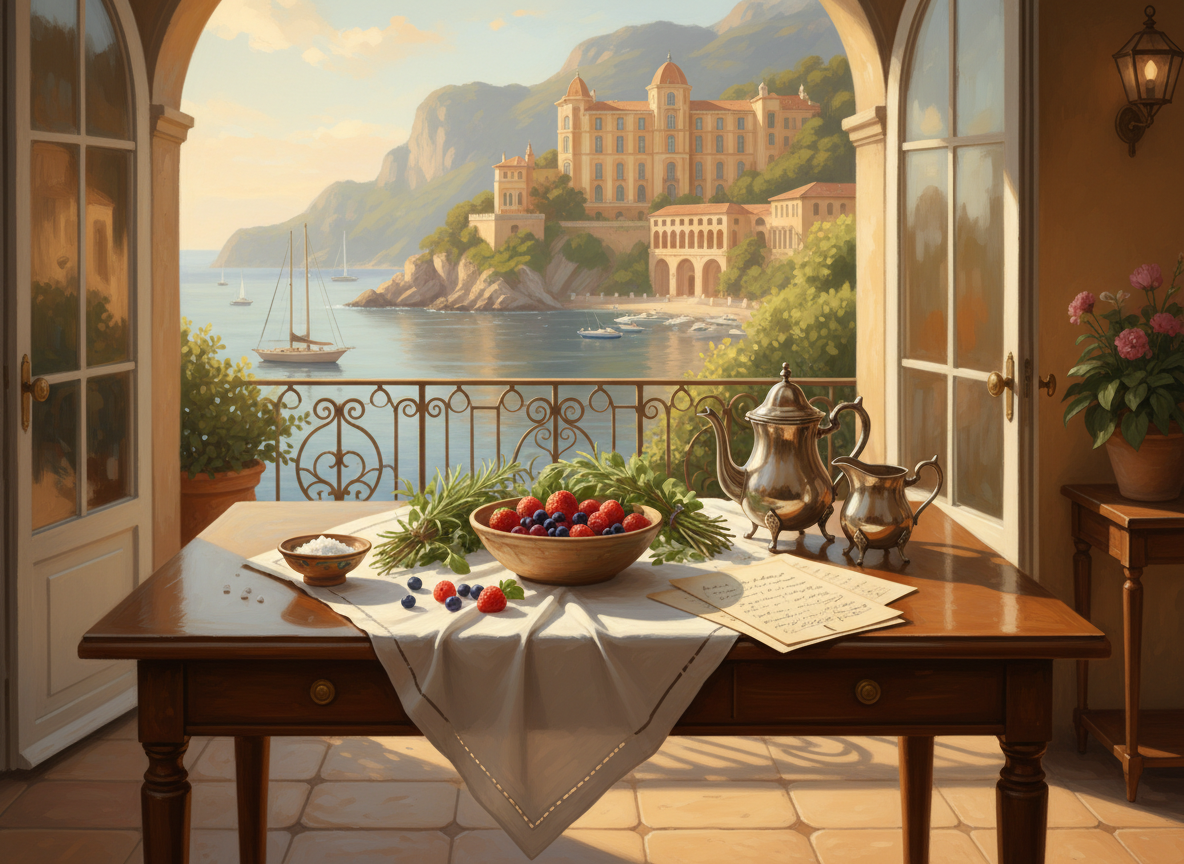
This reader bonus belongs to Pippa Marlowe’s Secrets on the Marivelle Pass. The two stories are designed as quiet extra incidents around Sophie Delacourt and the Grand Marivelle world. They do not retell the novel’s central case, reveal its culprit, or resolve the series’ slow-burn romance. The original novel remains complete without this material.
The Breakfast That Wasn’t Ordered
A room-service tray appears for a guest who never asked for it—and then appears again.
The Strawberry Crate at Lantern Quay
One crate, three destination cards, and a summer market determined to claim it.
Sophie’s Summer Notebook
Three practical recipes inspired by the Grand Marivelle’s coastal summer atmosphere.
The Breakfast That Wasn’t Ordered
A quiet Grand Marivelle incident between larger cases.
At six twelve on Tuesday morning, the Grand Marivelle produced a breakfast no one had ordered.
Sophie Delacourt knew this because the tray was sitting at the room-service pass beneath a silver dome, accompanied by one soft-boiled egg, two fingers of toast, a pot of Assam tea, a small dish of marmalade, and a handwritten ticket that said:
214 — seven minutes. Tea first.
“Who wrote this?” Sophie asked.
Niko Serrano looked up from the omelette station. “Not me.”
“Tansy?”
From pastry, Tansy Pike called, “If I had ordered breakfast at six twelve, there would be cake.”
“Room service?”
The morning waiter, Piers, lifted both hands. “Nothing in the system for 214.”
Sophie looked again at the tray.
Nothing about it was dangerous. That was precisely what made it irritating.
The egg was correctly timed. The toast was cut exactly. The tea leaves were measured rather than bagged. The marmalade came from the current breakfast batch. Someone had assembled the whole thing with the confidence of a person obeying an instruction.
“Who is in 214?” Sophie asked.
Piers checked the tablet mounted by the service door.
“Mrs. Evelyn Mercer. Three nights. Arrived yesterday from Bristol.”
“Dietary notes?”
“None.”
“VIP flag?”
“No.”
“Standing preference?”
“No.”
Sophie pointed at the tray.
“Then this is either hospitality or haunting.”
Tansy emerged holding a piping bag. “At this hour I vote haunting.”
Niko inspected the ticket without touching it. “That handwriting isn’t kitchen.”
“No,” Sophie said.
It was upright, narrow, and old-fashioned. The numerals were particularly careful. The two had a flat base. The one was serifed.
Piers said, “Do we send it?”
“Not until we know why it exists.”
“The egg won’t survive an inquiry.”
“Then eat the egg.”
Piers brightened.
“After you ask the guest whether she ordered breakfast.”
Piers dimmed again.
Five minutes later he returned.
“Mrs. Mercer is awake. She did not order breakfast. She says she never eats before eight thirty.”
Tansy looked toward the abandoned tea.
“Can ghosts drink Assam?”
“Only if they sign the room charge,” Sophie said.
She should have forgotten the matter. The Grand Marivelle was full enough that misplaced food appeared from ordinary human causes at least once a week: wrong room numbers, duplicate tickets, breakfast cards hung on the wrong door, guests who ordered in the lounge and forgot, spouses who ordered for each other and then denied responsibility when the porridge arrived.
But there was no electronic order, no paper breakfast card, no lounge ticket, and no charge instruction.
There was only the handwritten note.
At seven ten, Julian Ashcombe appeared in the kitchen doorway carrying Sophie’s tea.
He did not announce himself. He never needed to. The room changed around him in tiny ways: Piers stood straighter, Niko stopped pretending not to see Sophie’s untouched water glass, and Tansy acquired the expression of someone who had been offered a private joke by the universe.
Julian set the cup near Sophie.
“Assam. Milk separate.”
Sophie stared at the cup, then at the abandoned breakfast pot.
“There is too much Assam in this hotel.”
“A serious operational concern.”
She handed him the handwritten note.
“Room 214 received a breakfast order from no one.”
Julian read it.
His eyebrows lifted slightly.
“This is familiar.”
“The order?”
“The phrasing.”
“You recognize ‘tea first’?”
“I recognize an institution that once believed tea timing was part of moral character.”
Tansy whispered loudly to Niko, “He has found his people.”
Julian ignored her.
“Before the current guest system, the concierge desk kept preference cards for returning guests. Handwritten. Some remained in use for decades.”
Sophie looked at the note again.
“Decades?”
“The Marivelle has always taken repeat custom personally.”
“And sometimes posthumously?”
“Only in low season.”
Sophie almost smiled.
Julian continued, “Seven minutes may refer to steeping plus lift travel. Tea first means the pot should be poured before the egg is opened. Some guests were specific.”
“Was Evelyn Mercer specific?”
“I don’t know.”
He looked toward the corridor.
“But I can find out.”
By eight fifteen, Julian had confirmed that no current concierge note instructed breakfast for 214. The desk had not called the kitchen. No guest assistant had entered a manual request. The night porter denied sending one.
And yet at six twelve the next morning, another tray appeared.
This time Sophie was waiting.
The ticket printer remained silent.
No room-service tablet flashed.
Piers had been forbidden to improvise.
Niko had warned the breakfast cooks that anyone producing a mystery egg before coffee would be assigned stock rotation.
At six eleven, nothing.
At six twelve, one of the dish-room assistants wheeled a tray through the side door.
Sophie stopped him.
“Where did that come from?”
The young man blinked.
“Cold lift.”
“Who put it in the cold lift?”
“I don’t know. It was on the shelf with a note saying kitchen finish.”
The tray was incomplete. Tea things, marmalade, crockery, toast rack. No hot food.
A second handwritten slip lay beneath the saucer.
214 — seven minutes. Tea first. Egg soft.
Sophie picked up the house phone.
“Julian.”
He answered on the second ring.
“I’m listening.”
“The ghost has prep access.”
There was a pause.
“I’ll come down.”
The cold lift connected several service levels, but access was not mysterious. Housekeeping, banquet service, room service, and certain back-of-house teams used it. By seven, Mae Kersey had joined them with the expression of someone whose purchasing department had been dragged into a breakfast séance.
“You called me for marmalade?” she asked.
“You know labels,” Sophie said.
Mae read the note.
“Old stationery.”
Sophie looked at her.
“How old?”
“Not ancient. But we stopped using this stock before I moved Purchasing to the new order pads. Look at the watermark.”
Julian tilted the paper toward the light.
A faint crest appeared.
“That version of the hotel mark was retired years ago.”
Tansy had arrived with two croissants and the absolute certainty that this was now entertainment.
“So the ghost is economical.”
Mae ignored her. “Where would old stationery still be kept?”
Julian answered immediately.
“Archive cupboards. Some offices. The old guest-relations room on the mezzanine.”
“Who uses that room?” Sophie asked.
“Almost no one.”
“Almost is doing work in that sentence.”
Julian gave her a measured look.
“Temporary night administration has been using one desk there while the main office is rewired.”
Mae folded her arms.
“Name?”
“Elise Rowan.”
At eight forty, Elise Rowan appeared in Julian’s office looking terrified enough that Sophie immediately decided she had probably not stolen anything.
She was twenty-three, efficient, and three weeks into a six-week temporary contract. She had dark hair in a severe knot and the posture of a person who had been told that luxury hospitality depended on never visibly needing a chair.
“I didn’t order breakfast,” she said before Julian had finished explaining.
“Did you write this?” he asked.
Elise looked at the note.
Her face changed.
“I copied it.”
Sophie leaned back.
“From where?”
Elise swallowed.
“A guest card.”
Julian’s voice remained calm.
“Which guest card?”
“Mercer.”
There it was.
Not crime. Not haunting.
Hospitality, badly supervised.
Elise explained.
On her first night in the mezzanine office, she had been asked to sort a stack of old preference cards that had been pulled from storage during rewiring. Most were clearly archival. Some bore names still known to the hotel. She had been told that current repeat-guest notes should be checked against active reservations and flagged for concierge review.
She found a card for Mrs. E. Mercer.
It listed Room 214.
It listed Assam tea.
It listed a seven-minute breakfast sequence.
And it included one underlined instruction:
Tea first. Egg soft. Never knock twice.
“The arrival list had Evelyn Mercer,” Elise said. “Same surname, same initial, and she was in 214. I thought that meant the preference was active.”
Julian closed his eyes very briefly.
“How did you send it?”
“I didn’t want to alter the guest profile until someone approved it. So I copied the breakfast instruction onto a note and left it for room service.”
“Where?”
“In the service dispatch folder.”
“And the second day?”
Elise’s face reddened.
“The first tray came back untouched. I thought room service had missed the guest. So I prepared the cold items myself and sent them down.”
Mae said, “That is not better.”
“I know that now.”
Sophie asked, “Did you ever ask Mrs. Mercer whether she wanted breakfast?”
Elise looked miserable.
“No.”
“Then we’ve found the error.”
Julian picked up the old card from the desk.
“Not the whole error.”
He turned it over.
There, in faded ink, was a date.
1988.
Tansy had somehow obtained permission to be present and was now silent.
Elise whispered, “Oh.”
Julian said, “Evelyn Mercer is not this Mrs. Mercer.”
“Then who was she?” Sophie asked.
He looked toward the active reservation screen.
“I suspect we should ask before we assume anything else.”
Mrs. Mercer agreed to speak with them in the Winter Garden at ten.
She was perhaps forty-five, with silver beginning at her temples and a blue notebook open beside a coffee she had ordered herself.
Julian apologized first.
He explained the duplicate breakfasts, the old card, and the hotel’s mistake without blaming Elise by name.
Mrs. Mercer listened.
Then she laughed.
Not politely.
Fully.
She covered her mouth and shook her head.
“Of course she had breakfast instructions.”
Sophie glanced at Julian.
“You know the other E. Mercer?” he asked.
“My grandmother. Eleanor Mercer. She brought me here twice when I was a child.”
She wiped her eyes.
“She believed breakfast was the only civilized meal because everyone had had fewer opportunities to disappoint you.”
Tansy, standing discreetly near the palms with no reason to be there, nodded in profound agreement.
Mrs. Mercer took the old card carefully.
“Room 214 was hers?”
“Apparently,” Julian said.
“Every summer?”
“Several stays are attached to the record.”
Mrs. Mercer studied the faded handwriting.
“She died twelve years ago.”
The table became quiet.
Sophie expected sadness.
What she saw instead was recognition.
“I booked this room because it was the one number I remembered,” Mrs. Mercer said. “I didn’t know whether I remembered correctly.”
Julian said nothing.
He was very good at silence when silence belonged to someone else.
Mrs. Mercer smiled.
“Apparently I did.”
She looked at Sophie.
“What happened to the breakfast?”
“The first egg was eaten by room service.”
“Good.”
“The second did not reach cooking temperature.”
“Even better.”
She tapped the card.
“Could I ask for the tea tomorrow?”
Sophie raised an eyebrow.
“Seven minutes?”
“Absolutely not. Five. Grandmother over-steeped everything.”
Julian’s mouth moved at one corner.
“Tea first?”
Mrs. Mercer considered.
“Tea first.”
That afternoon, Mae built a new line into the temporary procedure:
Legacy preference records must never be activated without current guest confirmation.
Julian added a second:
Matching surname and room number are not identity verification.
Sophie added a third in pencil:
Do not let ghosts order eggs.
Mae crossed it out.
Tansy wrote it back in.
The following morning, at eight thirty exactly, Sophie passed through the Winter Garden and saw Mrs. Mercer by the windows with a pot of Assam tea.
No soft-boiled egg.
No seven-minute instruction.
One slice of toast, ordered by the living.
Julian appeared beside Sophie without warning.
“You’re staring at breakfast.”
“I’m observing a successful correction.”
“Of course.”
He handed her a cup.
Assam.
Milk separate.
Sophie looked at it.
“Current preference?”
“Confirmed repeatedly.”
She took the cup.
“Five minutes?”
“Six.”
“Acceptable.”
They stood for a moment watching sunlight move across the glass roof and the harbor beyond.
Then Sophie went back to the kitchen, where the living had already begun ordering lunch.
The Strawberry Crate at Lantern Quay
A Merehaven market puzzle with no corpse, no police tape, and far too many labels.
The strawberry crate arrived at Lantern Quay at four twenty in the afternoon carrying three different destinations.
The first card said GRAND MARIVELLE — PASTRY.
The second said ST. BRIDGET’S SUMMER TEA — SIX O’CLOCK.
The third, tucked beneath the handle, said HARBOUR LIGHT CAFÉ — PAID.
Tansy Pike held all three cards in one hand and looked at Sophie.
“This is why fruit should stay on plants.”
Sophie looked into the crate.
Six neat punnets of strawberries sat beneath a layer of damp muslin. The fruit was small, red to the shoulders, and smelled properly of strawberry rather than refrigeration.
Mae Kersey crouched beside the crate.
“No invoice.”
“There is always an invoice,” Sophie said.
“There is always supposed to be an invoice.”
“That is a darker sentence.”
The three of them stood beside the Saturday market while Merehaven continued around them with aggressive cheerfulness.
Children carried paper windmills. A fish seller argued about mackerel. Someone at the far end of the quay was playing an accordion with more enthusiasm than accuracy. The Grand Marivelle rose above the harbor in pale stone and glass, looking entirely innocent of the fact that its Executive Pastry Chef was considering custody proceedings over six punnets of berries.
Tansy turned over the first card.
“My handwriting.”
Sophie looked at her.
“You labelled it for yourself?”
“I labelled a crate yesterday. Twelve punnets. From Edith Parry’s stall. Delivery this morning.”
Mae checked her phone.
“Your delivery arrived.”
“Exactly. Which means this is not my crate unless Edith has developed a duplication problem.”
Sophie lifted the muslin.
“Six punnets, not twelve.”
“And mine had shallow wooden trays, not these paper ones.”
Mae pointed to the second card.
“Who is St. Bridget’s?”
“Parish hall tea,” Tansy said. “Half the town is baking something inappropriate for hot weather.”
“And Harbour Light?” Sophie asked.
“Café near the east steps.”
Mae stood.
“Then the answer is simple. We ask all three.”
Tansy looked offended.
“Where is the drama in that?”
“Purchasing tries to avoid drama.”
“You work with us.”
“I said tries.”
Harbour Light Café was twenty paces away.
Its owner, Lina Gorse, was polishing glasses beneath a blue awning.
She recognized the third card immediately.
“Mine,” she said.
Tansy pointed at the crate.
“The strawberries?”
“No. The card.”
Mae closed her eyes for one second.
Lina explained that she had bought three trays of cherries from Edith Parry that morning and paid in cash. Edith’s grandson had written HARBOUR LIGHT CAFÉ — PAID on a card and tucked it into the top tray.
“The cherries arrived at noon,” Lina said. “Card wasn’t with them.”
“So your card migrated,” Sophie said.
“Apparently.”
“With the strawberries.”
“Apparently.”
“Do you want the strawberries?”
Lina considered.
“Always. But I didn’t buy them.”
They crossed the quay to St. Bridget’s stall, where two volunteers were arranging cake stands beneath bunting.
Mrs. Pell, who seemed to be in charge because everyone else was moving around her, recognized the second card.
“That was tied to six punnets we ordered,” she said.
Tansy looked triumphant.
“Solved.”
Mrs. Pell shook her head.
“Those arrived at one.”
Tansy stopped being triumphant.
“Where are they?”
“In the hall kitchen.”
Mae asked, “Same supplier?”
“Edith Parry.”
Sophie looked back at the mysterious crate.
“So all three cards originally belonged to different orders from the same stall.”
“Which means,” Mae said, “someone stacked used cards together.”
Tansy sighed.
“I preferred haunting.”
They found Edith Parry’s stall at the far end of the market.
The stall was closed.
Not empty.
Closed.
Canvas tied down. Cash box gone. Handwritten sign:
BACK SOON.
Mae looked at the crate.
“Did she leave this behind?”
A neighboring cheese seller called, “Edith went home.”
“The sign says back soon,” Sophie said.
“She wrote that before she decided not to be.”
“Why did she go home?”
“Her grandson came for her. Said she’d done too much in the heat.”
Tansy’s face changed.
“Is she ill?”
“Tired. Cross. Therefore probably fine.”
The cheese seller pointed at the crate.
“That hers?”
“We’re trying to determine that,” Mae said.
“Everything here was hers at some point.”
“Helpful.”
He shrugged.
“Market.”
Sophie looked at the closed stall.
On the table beneath the canvas was a roll of string, two pencils, an empty stack of paper fruit trays, and one metal clip holding a bundle of destination cards.
Mae noticed it too.
“We are not opening someone’s stall.”
“I know.”
“You looked like you were about to know less.”
Sophie stepped back.
Tansy examined the crate without touching the fruit.
“These berries are different from mine.”
Mae said, “You already established that.”
“No. I mean different from all the market fruit.”
She lifted one punnet by the paper edge.
“Look at the calyx.”
Sophie leaned closer.
The leaves at the tops of the strawberries were long and pale. The fruit itself was smaller than Edith’s standard stall berries.
“Late row?” Sophie asked.
Tansy shook her head.
“Could be. But they’re packed too carefully. Not market rush.”
Mae studied the crate.
“There’s no supplier stamp.”
That mattered.
Even Edith’s informal market deliveries carried a pencilled farm mark or surname. This crate had none.
“Maybe it didn’t come from her stall,” Sophie said.
The cheese seller overheard them.
“It came on Parry’s handcart.”
“You saw it?” Mae asked.
“Saw the boy wheel it over.”
“Which boy?”
“Grandson. Tall one. Hair like he lost an argument with weather.”
Tansy nodded. “Cal.”
“He left it where your lady there found it.”
“Did he say who it was for?”
“Said, ‘Don’t let anyone take that until I come back.’”
All three women looked at the crate.
Tansy said, “That instruction has not gone perfectly.”
Sophie checked the time.
Four forty-six.
The Grand Marivelle needed her by six for dinner service.
St. Bridget’s tea began at six.
Harbour Light had already paid for cherries.
The strawberries were warming in the afternoon air.
“We need refrigeration,” Sophie said.
Mae nodded.
“We can take them to the hotel receiving room as unidentified hold stock. No use, no service, no assumption of ownership.”
Tansy looked at her.
“You can make strawberries sound like disputed cargo.”
“Today they are disputed cargo.”
Julian was at the east entrance when they carried the crate in.
He looked at Sophie, Mae, Tansy, and the fruit.
“Should I ask?”
“Not if you value your afternoon,” Sophie said.
“I do.”
He opened the service door anyway.
The crate went into a labelled quarantine shelf in the receiving refrigerator.
Mae wrote:
UNASSIGNED — LANTERN QUAY — DO NOT USE.
Tansy added beneath it:
VERY GOOD STRAWBERRIES.
Mae crossed that out.
At five twenty, Cal Parry arrived at the hotel loading court breathless and furious.
He was nineteen, sunburned, and had exactly the hair the cheese seller described.
“You have my crate.”
Mae said, “We have a crate.”
“Blue handles. Six punnets.”
“Who owns the fruit?”
Cal stared at her.
“My gran.”
“Then why no supplier mark?”
“Because she wasn’t selling them.”
Tansy appeared from pastry.
“Now that is interesting.”
Cal looked defensive.
“They’re hers.”
Sophie said, “No one is disputing that. We need to know where they were meant to go.”
His anger collapsed into embarrassment.
“I don’t know.”
Mae went still.
“You delivered a crate to the quay and told people not to take it, but you don’t know who it was for?”
“Gran knows.”
“Can we ask her?”
Cal looked toward the street.
“She’s at home asleep. Doctor told her to rest. She wouldn’t leave the market until I promised I’d finish the last thing.”
“Which was?”
“Put the blue crate at Lantern Quay and wait for someone.”
“Who?”
“She wouldn’t say.”
Tansy folded her arms.
“Your grandmother is dramatic.”
“You’ve met her.”
“Fair.”
Sophie asked, “Why were there three old destination cards on it?”
Cal looked horrified.
“There were?”
Mae handed him the cards.
He groaned.
“I put them under the handle so they wouldn’t blow away. I was going to bin them.”
Tansy closed her eyes.
“We have spent an hour investigating litter.”
“Efficient litter,” Sophie said.
“That does not help.”
Cal looked from one to another.
“Can I take the crate?”
Mae asked, “To whom?”
“I still don’t know.”
“Then no.”
“It belongs to us.”
“The fruit may. The destination does not.”
Sophie almost felt sorry for him.
Almost.
Then Julian appeared at the loading court holding a folded envelope.
“Is this connected to the strawberries?”
Everyone turned.
He held up an envelope addressed:
For the person with the blue crate.
Tansy said, “Of course there is a letter.”
Julian handed it to Cal.
“A woman left it at the concierge desk twenty minutes ago. She said the bearer would know what it meant.”
Cal opened it.
Inside was one line.
Six thirty. Old lifeboat steps. Bring bowls. — E.P.
Cal stared.
“Gran.”
Sophie checked the time.
Five thirty-eight.
“Who is meeting you?”
“Still don’t know.”
Mae said, “Your family communicates like a smuggling ring.”
Cal looked insulted.
“We grow fruit.”
“Today those occupations are overlapping.”
At six twenty-five, Sophie should have been nowhere near the old lifeboat steps.
She had dinner service.
She also had Niko.
“Go,” he had said when she explained.
“You can hold the pass?”
“I can hold the pass.”
“For twenty minutes.”
“Thirty.”
“Twenty-five.”
“Chef.”
She heard the warning.
She went.
The old lifeboat steps were at the quieter end of the harbor where the quay curved toward the headland. By six thirty the heat had softened. The sea had turned silver-blue. Gulls stood on the railings with the officious posture of minor officials.
Cal carried the crate.
Tansy carried bowls.
Mae carried nothing because, as she explained, Purchasing did not carry unassigned fruit after working hours.
Julian had somehow come too.
“Why are you here?” Sophie asked him.
“The envelope was delivered to my desk.”
“That is not an answer.”
“It is a professional justification.”
At six thirty-two, three elderly women appeared from the far path.
Mrs. Pell from St. Bridget’s.
Lina Gorse from Harbour Light.
And a woman Sophie recognized vaguely as a former seamstress who had worked at the Grand Marivelle years ago.
They stopped when they saw the group.
Mrs. Pell looked at the strawberries.
“Good. Edith managed it.”
Cal said, “Managed what?”
The women exchanged glances.
Lina laughed first.
“Your grandmother has been growing those for us for forty-one years.”
Cal looked at the crate.
“Those?”
“That row,” Mrs. Pell said. “The little pale-topped ones.”
The former seamstress sat on the stone wall.
“We planted them when we were nineteen.”
Tansy’s expression softened.
“All of you?”
“Four of us. Edith too.”
Lina nodded toward the crate.
“It started as a joke. We were working summers—hotel, café, parish kitchen, market garden. None of us had money. Edith’s father gave us a strip at the edge of the field. We planted strawberries and said we’d eat the first bowl together every year.”
Mae asked, “Every year?”
“Most years.”
“Forty-one years?”
Mrs. Pell shrugged.
“People survive longer than plans.”
Cal looked stricken.
“Gran never told me.”
“She assumed you knew.”
“How would I know?”
“That,” Lina said, “is a problem common to families.”
The fourth woman looked at the crate.
“Where is Edith?”
Cal explained about the heat, the doctor, and the enforced rest.
No one panicked.
Mrs. Pell nodded decisively.
“Then we go to her.”
Tansy held up the bowls.
“I approve this plan.”
Mae looked at Sophie.
“The fruit has now been assigned.”
“Finally.”
Cal began to lift the crate.
Sophie stopped him.
“Wait.”
She took one berry from the top punnet.
Everyone looked at her.
“Quality control.”
Tansy gasped.
“Executive theft.”
Sophie bit into the strawberry.
It was softer than the market fruit, intensely fragrant, almost too ripe to travel. Exactly the sort of berry that belonged in a bowl ten minutes from the field, not on a plated dessert after a refrigerated journey.
She nodded.
“Good.”
Tansy took one too.
“Obviously.”
Mae stared at them.
“Neither of you owns those.”
Mrs. Pell waved a hand.
“There are six punnets. We are not litigating two strawberries.”
Julian looked at Sophie.
“A disappointing end for a disputed cargo.”
“No. A correct end.”
The women left with Cal and the crate.
Tansy went with them, claiming professional interest in forty-one-year-old strawberry traditions.
Mae returned to the hotel because Mae believed in endings that included paperwork.
Sophie and Julian walked back along the harbor.
The Marivelle’s windows were beginning to glow above the bay.
“You missed twenty-seven minutes of dinner service,” Julian said.
“Niko had it.”
“You let him?”
Sophie looked at him.
“Careful.”
“I said nothing.”
“You implied something.”
“I observed professional development.”
“Yours?”
“Possibly.”
They reached the lower hotel steps.
Sophie stopped.
“Do you think the old preference cards should be kept?”
Julian looked surprised by the shift.
Then he understood.
“Yes.”
“Even after the breakfast problem?”
“Especially after.”
“Why?”
He glanced back toward the harbor, where four women and one grandson had disappeared around the corner with a blue-handled crate.
“Because records are not instructions forever,” he said. “But sometimes they are evidence that people were here.”
Sophie thought of a breakfast card from 1988.
Of a strawberry row planted by four nineteen-year-old women.
Of kitchens that changed and preferences that did not.
“That sounds dangerously sentimental.”
“I’ll deny it.”
“Good.”
They went inside.
Niko had the pass under control.
Tansy returned forty minutes later with an empty blue-handled crate, two strawberry stains on her sleeve, and a handwritten note from Edith Parry.
It read:
Next year, fewer detectives. More cream.
Sophie pinned it above the pastry desk.
Mae did not cross it out.
Sophie’s Summer Notebook
Three practical recipes inspired by Merehaven’s coastal-summer atmosphere.
Note: These are reader-bonus recipes inspired by the fictional Grand Marivelle setting. They are not presented as exact recipes served in the novel. Use ordinary commercially sold ingredients; do not forage wild coastal plants unless you are qualified to identify and legally harvest them.
1. Lemon, Fennel & Herb New Potatoes
Serves: 4
Ingredients:
- 700 g / 1½ lb small new potatoes
- 2 tbsp olive oil
- 1 tbsp butter
- 1 tsp finely grated lemon zest
- 1½ tbsp lemon juice
- 2 tbsp chopped flat-leaf parsley
- 1 tbsp chopped dill
- 1 tbsp finely chopped fennel fronds, if available
- ½ tsp fine sea salt, plus more for the cooking water
- Black pepper
Method: Put the potatoes in a saucepan, cover with cold water, salt lightly, and bring to a boil. Simmer until tender when pierced, about 15–20 minutes depending on size. Drain well and let the steam escape for two minutes. Return the potatoes to the warm pan. Add olive oil, butter, lemon zest, lemon juice, herbs, sea salt, and several turns of black pepper. Toss gently until glossy. Serve warm or at room temperature.
Marivelle note: The pleasure here is contrast rather than complexity: warm potato, cool green herbs, bright lemon, and enough salt to sharpen rather than dominate.
2. Strawberry, Oat & Cultured-Cream Cups
Serves: 4
Ingredients:
- 350 g / 12 oz ripe strawberries
- 1½ tbsp sugar or honey
- 1 tsp lemon juice
- 200 ml / ¾ cup thick Greek yogurt, crème fraîche, or cultured cream
- 120 ml / ½ cup whipping cream
- 1 tsp vanilla
- 60 g / ½ cup rolled oats
- 25 g / 2 tbsp brown sugar
- 20 g / 1½ tbsp butter
- Pinch of salt
Method: Quarter the strawberries and toss them with the sugar or honey and lemon juice. Leave for 15 minutes. Meanwhile, melt the butter in a frying pan, add oats, brown sugar, and a pinch of salt, and cook over medium heat until toasted and fragrant, 4–6 minutes. Cool completely. Whip the cream to soft peaks, then fold through the yogurt or cultured cream and vanilla. Layer cream, strawberries, and toasted oats into glasses. Serve immediately or chill for up to one hour, adding the final oat layer just before serving so it stays crisp.
Marivelle note: Use the ripest berries you can find. If they are excellent, do less to them.
3. Coastal-Style Herb Butter Fish
Serves: 4
Ingredients:
- 4 skinless white-fish fillets, about 150–180 g / 5–6 oz each
- 1 tbsp olive oil
- 40 g / 3 tbsp softened butter
- 1 tbsp chopped parsley
- 1 tbsp chopped dill
- 1 tsp chopped chives
- 1 tsp lemon zest
- 1 tbsp lemon juice
- ½ tsp sea salt
- Black pepper
- Optional: a few capers, rinsed and chopped
Method: Heat the oven to 200°C / 400°F. Place the fish in a lightly oiled baking dish. Mix the butter with parsley, dill, chives, lemon zest, lemon juice, salt, pepper, and capers if using. Spread a little over each fillet. Bake for 10–14 minutes, depending on thickness, until the fish flakes easily and is opaque through the center. Spoon the melted herb butter from the dish over the fish before serving.
Marivelle note: Serve with the lemon-fennel potatoes and a simple green salad. The recipe aims for the clean, bright flavor profile suggested by a coastal hotel kitchen without depending on specialty foraged ingredients.
More from the Grand Marivelle
Visit the series page for the complete reading order, or browse the Wonder Shelf Books Reader Extras library for more bonus stories and companion material.

