Wonder Shelf Books · Reader Extra · Victorian Cozy Mystery
More Stories from Silverglass Rooms
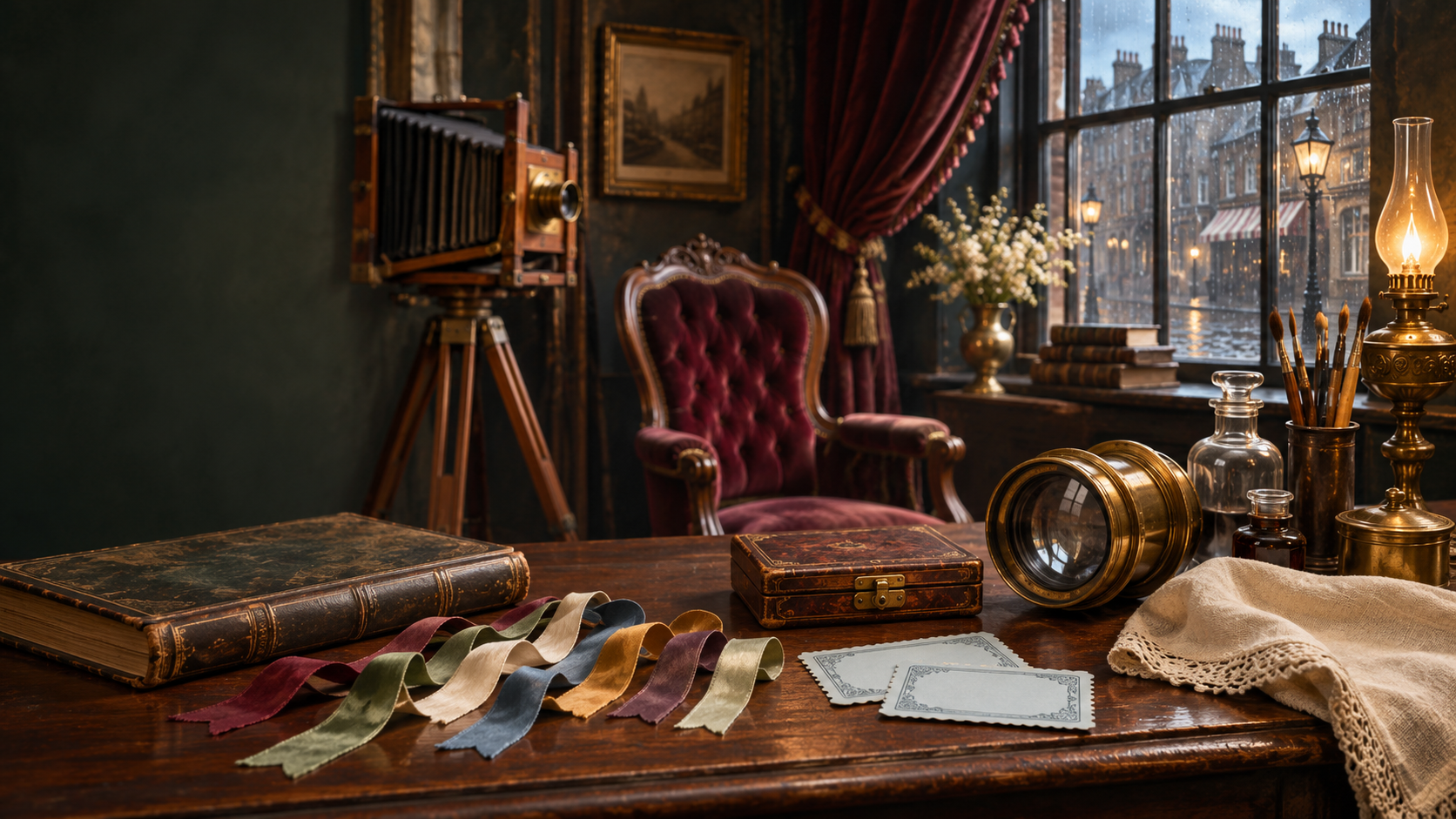
Two original, self-contained, spoiler-free mysteries from the world of The Second Figure on the Plate, plus a practical reader’s guide to the people, objects, and working vocabulary of a Victorian photography studio. No murder, no solution spoilers, and no promises about the next book.
Clara Rolt · The Silverglass Mysteries · Book 1
Story 1: The Seventh RibbonStory 2: The Two Blue TicketsStudio NotebookExplore the series · Meet Clara Rolt · Read the Kindle eBook
Bonus Story 1: The Seventh Ribbon
The trouble with a group portrait, Cecily Marr had discovered, was that the number of people in a room seldom agreed with the number who wished to be remembered.
That morning she had prepared for six.
Six chairs of varying dignity stood beneath the skylight at Silverglass Rooms. Two belonged to the studio. Three had been borrowed from the Blue Teapot, where Agnes Lobb had announced that their absence would be charged against the first person who spilled gravy. The sixth, an uncompromising little stool, came from a neighbouring bookbinder and had required a folded cushion to make it respectable.
Bess Priddy looked at the arrangement with evident satisfaction.
“It almost resembles a drawing room.”
“It resembles a drawing room that has been burgled by people with particular requirements,” Cecily said. “Put the stool farther to the left.”
Bess moved it a fraction.
“Your other left.”
“I have only two.”
“Then the choice should not prove difficult.”
Outside Bellglass Court, wheels rattled over damp stone. A thin, uncertain spring sun made the glass roof shine but had not yet quite overcome the smoke above Great Marlborough Street. The light might hold long enough for one carefully managed exposure. Cecily had declined another appointment to secure it, which made the prospect of disorder particularly expensive.
At a quarter before eleven, a messenger arrived with a paper parcel.
“For Mrs. Venn’s party,” he said, setting it on the reception desk. “From her workroom.”
Bess opened the parcel while Cecily signed the messenger’s receipt. Within lay seven lengths of narrow ribbon, neatly folded: claret, moss green, primrose, blue, lilac, grey and a warm brown like polished walnut. Each had a small piece of paper pinned to it bearing a woman’s name in the same careful hand.
“Seven,” Bess said.
“Six sitters,” Cecily replied.
“Seven ribbons.”
“Perhaps one belongs to a hat.”
“Mrs. Marr, they all belong to hats, if one is determined enough.”
Cecily examined the papers. Mrs. Constance Venn was written on the claret ribbon, followed by five names Bess had copied into the appointment book. On the brown was a sixth name she had never seen: Milly Grant.
“Perhaps it is a mistake,” Cecily said.
Bess aligned the little strips on the desk. “Then somebody has taken a good deal of trouble over it.”
Mrs. Venn arrived at eleven precisely, with five employees, three umbrellas, an enormous hatbox and opinions about chairs. She owned a small workroom near Berwick Street where parasols were repaired and covered, and the portrait was intended to celebrate the establishment’s tenth year under her management. The photograph would hang in the workroom, provided Cecily could persuade seven—or, according to the booking, six—persons to sit without blinking at once.
Mrs. Venn was a broad-shouldered woman whose gloves showed more wear than her bonnet. She looked at the arrangement, counted the chairs, and nodded.
“Very well. Where shall we put the ribbons?”
Bess held up the seventh strip.
“Who is Milly Grant?”
The younger women glanced at one another.
Mrs. Venn’s expression changed, not greatly but enough for Cecily to notice.
“An outworker,” she said. “She does the fine binding at home.”
“Was she expected?” Bess asked.
“No. She doesn’t work at the premises.”
One of the women, Miss Calder, reached for the brown ribbon. “I put that in. We each chose a colour for the photograph.”
“Six of you did,” Mrs. Venn replied.
“Seven,” Miss Calder said quietly.
The word made a small, stubborn space in the room.
Cecily set her hand on the camera stand. “May I clarify? The sitting was ordered for six, and I am equipped for six. The ribbon is not the difficulty. I need to know whether another sitter intends to arrive.”
“She cannot,” Miss Calder said.
“Why not?”
“Because she loses a morning’s pay by leaving her work.”
Mrs. Venn flushed. “That is not entirely fair. Miss Grant is paid by the piece. She chose the arrangement.”
“After her mother became unwell,” another woman said.
“And I have never withheld a penny owed to her,” Mrs. Venn answered.
Cecily believed both statements could be true. She had learned that a disagreement seldom became simpler merely because one person was plainly wrong and another plainly right. Here there might not even be that comfort.
“We cannot photograph an absence,” she said. “Nor can we extend the exposure to accommodate a quarrel. If you wish to proceed, I suggest we do so.”
The women stood in uneasy silence.
Bess looked from the ribbons to the empty sixth chair and then at the light overhead.
“Mrs. Marr, may I show them how we have arranged it?”
“You may. You may not promise anything.”
“I never promise anything.”
Cecily raised one eyebrow.
“Very seldom,” Bess amended.
She arranged the women in the chair grouping: Mrs. Venn in the centre, two older workers to either side and the three younger ones behind. At the last moment Miss Calder held the brown ribbon across her palms.
“It looks wrong,” she said.
Mrs. Venn stared at her. “It is a perfectly ordinary arrangement.”
“It isn’t about the chairs.”
“What, then?”
“We’re calling it the workroom portrait,” Miss Calder replied. “Milly makes the most difficult bindings. Half the parasols in your window have her stitches in them.”
“You think I don’t know the quality of her work?”
“I think you know it very well.”
That was the answer which hurt. Cecily saw it arrive and settle on Mrs. Venn’s face.
The proprietor removed her gloves with surprising care. “I ordered this portrait because ten years in business ought to amount to something.”
“It does,” Cecily said. “But the question seems to be what it amounts to, and for whom.”
Bess looked at her with startled approval.
“You needn’t look so impressed,” Cecily said. “I occasionally assemble a sentence.”
The sound of a passing cart filled the silence. Miss Calder lowered the brown ribbon.
Mrs. Venn turned toward the door. “I cannot run a business according to the feelings of every person who has ever mended a seam for me.”
“No,” Cecily said. “You cannot. But this particular morning is already paid for, and you may decide what you want before we spend it.”
For a moment Cecily expected the woman to demand her money back. Instead Mrs. Venn asked, “How long will the light last?”
“Not forever.”
“Could I call again?”
“With notice and another appointment. Today’s deposit may be applied to the rearranged sitting, less the cost of preparations already made.”
“And one additional person?”
“Would mean a different arrangement. Not necessarily impossible.”
Mrs. Venn looked at the six chairs, as though one of them might provide a definitive answer. At last she said, “I will speak to Miss Grant.”
Miss Calder let out a breath.
“I did not say she would come,” Mrs. Venn warned.
“No,” Cecily agreed. “That would be for Miss Grant to decide.”
The party left without a plate. The sun, as if insulted by the waste of its efforts, came out properly at once.
Bess closed the studio door and stood still.
“Do you think we’ve lost the commission?”
“Possibly.”
“You let them go.”
“They were going. I preferred not to charge them for a photograph nobody wanted.”
“The brown ribbon—”
“Was a ribbon.”
“It was a name.”
Cecily turned to her. “That is the better observation.”
Bess smiled, then became solemn. “May I take it back to the workroom?”
“Why?”
“Because somebody ought to know it wasn’t thrown away.”
Cecily considered the ink marks on her appointment book and the bell for the noon meal beginning to sound from nearby streets. “After luncheon. And take the receipt with you. I will not have anyone claim we kept seven ribbons when only six were booked.”
“You worry too much about receipts.”
“And you worry too little.”
“Between us, we must reach the correct amount.”
“Go and find Agnes. She has soup.”
“Already?”
“Bess.”
“Yes, Mrs. Marr.”
The girl was down the stairs before Cecily could add that eating it did not confer ownership of the bowl.
At the Blue Teapot, Agnes Lobb listened to the account while wiping a table that had been clean before she began. At fifty-six she had acquired the authority of a woman who neither required agreement nor particularly enjoyed receiving it.
“Seven workers, six paid for,” she said. “Sounds like the beginning of a bad account.”
“Mrs. Venn pays her,” Bess protested. “By the piece.”
“Then she can pay her to come to a photograph. It is not theological.”
“Cecily says Milly must choose.”
“Both things can be true. People make it complicated so they can avoid paying for the simple part.”
Bess laid the brown ribbon on the table between two bowls of soup.
Agnes rescued it from the danger of gravy. “Take that away from my customers’ elbows.”
“I thought you might know where she lives.”
“I know where a good many people live. That is not a license to summon them.”
“I don’t mean to summon her.”
“What do you mean?”
Bess hesitated. “To deliver the ribbon and perhaps ask whether she’d like to be asked.”
Agnes’s expression softened by one small degree. “Now there’s a civil distinction.”
She gave Bess directions to a turning off Berwick Street, warning her not to mistake the green grocer’s yard for the entrance to the rooms above it. She also supplied a heel of bread wrapped in paper.
“For Miss Grant?” Bess asked.
“For you. You are likely to forget food while conducting moral business.”
“I have eaten soup.”
“Then this will astonish you by coming afterward.”
The air outside carried rain without yet producing it. Bess passed vegetable stalls, a costermonger mending his scales and two boys disputing whether an apple counted as stolen if it had already fallen from the cart. At the turn Agnes had described, she found the stairs behind a shop that sold buttons in shallow drawers.
Milly Grant opened the door with a length of narrow tape looped around her wrist.
She was perhaps twenty, with brown hair escaping a plain cap and a measuring pencil tucked behind one ear. On the table behind her lay three unfinished parasol covers and a pair of gloves, one repaired and one waiting. A kettle stood on the hob, and from a curtained alcove came the quiet cough of an older woman.
“Miss Grant? I’m Bess Priddy, from Silverglass Rooms.”
Milly looked at the brown ribbon in her hand. “Something’s happened at the workroom?”
“No. Everyone is well.”
“That is a good beginning.”
“I came because this was sent by mistake.”
Milly took the ribbon without unfolding it. “It wasn’t a mistake.”
Bess waited.
“The others chose colours for the portrait,” Milly said. “They thought I ought to have one too.”
“Do you want to be in it?”
Milly turned the ribbon over. “Mrs. Venn didn’t ask.”
“Would you say yes if she did?”
“That depends how much it costs.”
“The sitting is being paid for.”
“I meant what I lose by going.”
There was no reproach in her voice. That made Bess feel the full weight of her own thoughtlessness.
“You sew at home because your mother needs you?” she asked.
“Sometimes. Mostly because the hours can be made to bend around everything else. A shop day is a whole day. A parasol binding can be finished after supper.”
“Do you enjoy the work?”
“I am good at it.”
The answer was immediate, almost stern.
Bess noticed a completed cover draped over the chair. Its narrow edge had been bound smoothly around a curved rib, the stitches set so close that the seam seemed to have grown there.
“My own stitches aren’t half so even,” Bess said.
“Then you haven’t done enough of them.”
“No. I suspect Mrs. Marr would say exactly that.”
Milly looked up. “You are learning photography?”
“Yes. Mostly I learn what I’m not allowed to touch yet.”
“Sounds familiar.”
They exchanged a look of sudden comradeship.
Bess explained the abandoned sitting. She did not describe Mrs. Venn as cruel or the other workers as heroic. She told Milly about six chairs and seven pieces of ribbon, about a proprietor who had been surprised, and about a photographer who would not put anyone in a portrait without asking.
Milly sat on the edge of the chair. “I thought if they took it without me, at least it would prove I was never really there.”
“But you are there,” Bess said.
“Not every day.”
“Your stitches are.”
Milly looked at the parasol cover, then at the folded ribbon.
“That’s a good line,” she said. “Did Mrs. Marr give it to you?”
“No. I can occasionally assemble a sentence.”
Milly laughed so suddenly that the older woman beyond the curtain called, “What have I missed?”
“Someone from the photographer’s,” Milly called back. “She is being clever.”
“Then ask her to fetch more coal before she goes.”
Bess smiled. Milly’s face grew thoughtful.
“I might go,” she said at last. “If Mrs. Venn asks properly. And if she pays for the time. And if my mother is comfortable.”
“Those sound like fair terms.”
“They sound like expensive ones to an employer.”
“Mrs. Marr says employers are always teaching us what costs money.”
“Does she?”
“No. She says the bills teach her.”
Milly gave Bess a small wrapped bundle. “Tell Mrs. Venn these two bindings are finished. And tell her I can come on Thursday afternoon, if the light permits. Not before.”
Bess took the bundle as carefully as if it contained silver plates.
On the way back she stopped at the workroom. Mrs. Venn sat beside the window, checking a line of repairs with a narrow measuring rule. The five women were busy at separate tables and looked up together when Bess entered.
“I brought the ribbon back,” Bess said.
Mrs. Venn looked puzzled. “That is not the ribbon.”
“No. I brought it to Miss Grant. She has kept it.”
“Ah.”
“She has conditions.”
Miss Calder bent over her work to hide a smile.
“Conditions?” Mrs. Venn repeated.
“Thursday afternoon, if the light allows. Her mother must be looked after. And she must not lose her pay.”
Mrs. Venn’s measuring rule tapped once against the table.
“Did you go to her and make these terms?”
“No. I asked whether she wanted to be asked.”
The proprietor’s shoulders loosened, very slightly.
“Of course,” she said. “I should have thought to ask.”
She opened her account book. “Half a day of her ordinary average work should be easy enough to reckon. I can send a note.”
“And the photograph?” Miss Calder asked.
Mrs. Venn looked around at the women who had given ten years of stitches, errands, late evenings and corrections to her business, some for less than ten years, some for rather more.
“I want it to show my workroom,” she said. “Apparently I have been counting the room and not the work.”
Nobody applauded. In a functioning workroom there were still needles to thread and orders to complete. But Miss Calder straightened, and one of the younger women smiled at the back of Mrs. Venn’s head.
Bess delivered the finished parasol bindings, collected a written acceptance of the additional sitter’s fee, and returned to Silverglass with an expression of unbearable satisfaction.
Cecily read Mrs. Venn’s note.
“Very well,” she said.
“That’s all?”
“What were you expecting?”
“I don’t know. A remark about justice.”
“Justice rarely pays the invoice. This one has agreed to.”
Bess laughed.
Cecily studied the appointment book. “Thursday afternoon is uncertain. We shall need light, and seven people who can remain still.”
“Milly says she can be still.”
“After this morning, I should ask whether the others can.”
On Thursday, against the usual expectations of London weather, the sun emerged just after luncheon. By two the light through the skylight was steady enough that Cecily could prepare without bargaining with the clouds.
Seven women came upstairs. Milly entered last, dressed in the same neat working clothes as the others and wearing the brown ribbon at her throat. Her mother had arranged for a neighbour to sit with her. The arrangement was neither grand nor free; it had merely been made.
Mrs. Venn carried a small envelope.
“For the loss of the earlier sitting,” she told Cecily.
“That was accounted for in the revised fee,” Cecily said.
“Then this is for the borrowed chairs.”
“Those belong to Mrs. Lobb.”
“I know.”
Bess whispered, “She knows everything.”
Cecily chose to ignore her.
The first arrangement failed because one woman could not keep her shoulders level, the second because Milly was placed behind a bonnet large enough to provide shade for a horse. The third held. Mrs. Venn sat in the centre, the others arranged around her with their ribbons visible against the sober cloth of their dresses.
Cecily adjusted the camera.
“Remember,” she told them, “you are not required to look cheerful. You are required to remain still.”
“That is a mercy,” said Miss Calder. “Cheerfulness is more work.”
“Now,” Cecily said.
The room settled into silence. Bess watched the light. The exposure was made.
Afterward, while Cecily carried the protected plate away for processing, Bess showed the party downstairs. Milly lingered by the reception desk.
“Will it look like us?” she asked.
“Rather better than we feel, I hope,” Bess said. “Though Mrs. Marr would never promise such a thing.”
Milly smiled. “You were right to bring the ribbon.”
“You were right to make conditions.”
“I worried they would say I was troublesome.”
“Did they?”
“Mrs. Venn wrote my name in the workroom account, beside the others. She says the portrait will be hung where customers can see who makes their things.”
Bess thought of the appointment book upstairs: lines for names, times and payment, all of them rather more important than she had imagined when she first came to Silverglass.
“That’s something,” she said.
“It is.”
Milly gathered her gloves and followed the others into the court.
When the finished image was ready, Cecily brought it into the reception room and allowed Bess to see it before it was closed in its protective setting. Seven women looked toward the camera with varying degrees of patience. The ribbons made small, orderly points against their dresses. Milly was clearly visible, neither hidden behind a bonnet nor thrust absurdly to the front.
“It isn’t a perfect arrangement,” Bess said.
“No.”
“Mrs. Venn’s shoulder is a little high.”
“It is her shoulder.”
“And Miss Calder looks as though she knows something we do not.”
“She probably does.”
Bess smiled at the plate.
“Seven,” she said.
Cecily closed the case carefully. “Seven who chose to be there.”
Below them Agnes called up the stairwell that her chairs would have to be returned before supper, whether the people in the picture were famous or not.
Cecily glanced at Bess.
“Take the chairs down.”
“All six?”
“All three that belong to her.”
“Only three,” Bess said, as though numbers had suddenly become her strongest subject.
Cecily opened the appointment book and drew a clean line beneath the completed commission.
For once, the figures agreed.
Bonus Story 2: The Two Blue Tickets
Agnes Lobb had three rules about a room full of hungry people. They must know where they were going, they must arrive when they were expected, and somebody must have agreed to pay for them.
On a damp Thursday afternoon, she discovered that thirty people had found ways to disobey all three.
The first warning lay on the counter of the Blue Teapot, beside the bowl in which customers sometimes left coins too small to justify a purse. It was a printed ticket on pale blue card, with a decorative flourish above the words:
Evening of Readings and Refreshments. Thursday, six o’clock. At the Blue Teapot.
Agnes read it twice. She had authorized refreshments for a small gathering on Thursday, but there had been no mention of readings. There had certainly been no mention of a second gathering, for her book contained one deposit and eighteen suppers.
She rang the counter bell.
Ned Simmonds, a printer’s apprentice who had come in to deliver a wrapped parcel, appeared from the side passage with a face suggesting that he had heard the sound and already regretted it.
“Where did this come from?” Agnes asked.
“From the press, ma’am.”
“I did not expect it to grow on a tree. Who ordered it?”
Ned straightened. “Mr. Seddon does the orders. I carry them. Those are for the ladies’ gathering.”
“Which ladies?”
“The ones coming on Thursday.”
“Again: which ladies?”
Ned swallowed. “I believe there are two sets.”
Agnes put both hands on the counter.
“Do you mean two sets of tickets,” she asked with dangerous calm, “or two sets of ladies?”
Ned considered the distinction. “Yes, ma’am.”
“Go and fetch Mr. Seddon.”
The boy fled.
By the time Cecily Marr came down from Silverglass Rooms for coffee, Agnes had placed the ticket in the centre of a clean table, as one might display an insect of uncertain intentions.
“Don’t sit there,” Agnes said.
Cecily stopped. “Have I acquired an enemy?”
“Only if you’re planning to bring thirty strangers for supper.”
“I can barely afford to bring myself.”
“Then sit.”
Cecily sat. Agnes brought coffee but did not let go of the pot immediately.
“Read that.”
Cecily examined the printed card.
“Thursday evening. Six. Here.”
“Did you know I had agreed to host a reading?”
“No.”
“Neither did I.”
“Perhaps it’s a surprise.”
“I dislike surprises that require chairs.”
Bess Priddy arrived a moment later, drawn by the smell of warm bread and the expression on Agnes’s face. She was given the ticket and instructed to tell Agnes exactly what it said, without improving its meaning.
“Evening of Readings and Refreshments,” Bess read. “Thursday, six o’clock. At the Blue Teapot. In the upper room.”
Agnes went still.
“In the what?”
“The upper room.”
“We don’t have an upper room.”
“Silverglass is upstairs,” Bess offered.
“Silverglass is a photographer’s business,” Agnes said. “If people start dining among Cecily’s chemicals, I’ll be sending up the bill with the undertaker.”
Cecily took back the card. She had missed the last line, set in narrow type beneath the ornamental flourish. There it was: In the upper room.
“The printer copied more than a date,” she said.
“Do not start looking for ghosts,” Agnes said.
“I was going to suggest a mistake.”
“That is worse. A ghost might contribute to the rent.”
Agnes fetched her account book. The entry was cleanly written: Miss Adelaide Marsh, eighteen suppers, six o’clock, lower room, deposit received. The event was a farewell evening for a seamstresses’ mutual society whose treasurer was moving to Bath. The society had paid for soup, bread and tea, and intended to supply its own speeches. Their tickets were cream, not blue.
“Eighteen,” Agnes repeated. “Not thirty. And not readings.”
“How many blue tickets?” Cecily asked.
“Twenty-four delivered. How many distributed, I don’t yet know. Mr. Seddon will explain it once I’ve finished being polite.”
“Have you begun?” Bess asked.
“No.”
The young woman looked relieved. “Then we have time.”
Agnes shut the book. “You two will be useful if you can discover who is coming. You will be less useful if you order them anything.”
“Agreed,” Cecily said.
Bess opened her mouth.
“And you,” Agnes added, “will eat before you go on an expedition. I have seen what happens when you investigate on an empty stomach.”
“That only happened once,” Bess said.
“It happened twice. You forgot the second time because you were hungry.”
The matter might have ended as a simple printing error had Mr. Seddon arrived promptly and admitted it. Instead, a brisk woman in a plum-coloured bonnet entered with an armful of tickets and asked whether the reading desk would fit near the fireplace.
“Mrs. Gilling?” Agnes asked.
“Yes. You must be Mrs. Lobb.”
“I am.”
“Excellent. I have been meaning to thank you for helping with our benefit.”
“What benefit?”
“The evening readings for the Retired Compositors’ Fund. We shall have a modest audience. Twenty-four at most, if the weather holds.”
Agnes watched the woman set the tickets on the table.
“The room,” she said, “has not been booked.”
Mrs. Gilling’s smile faltered. “Mr. Seddon arranged it.”
“Did he give you a confirmation?”
“His clerk said the tickets were ready.”
“That was not the question.”
Mrs. Gilling drew herself up. “Are you suggesting that the printer invented the engagement?”
“I’m suggesting that someone has sold tickets for a room whose proprietor hasn’t agreed to receive you.”
The woman looked at Cecily and Bess as if they might provide an alternative proprietor.
Cecily held out a chair. “Perhaps you could tell us exactly what was arranged.”
Mrs. Gilling sat but did not surrender her expression of injury. She explained that a charitable reading had been planned for men retired from the printing trade and their families. The programme included a few passages of poetry, one address about the dignity of skilled labour, and bread and tea after. A printer, Mr. Seddon, had offered to produce the tickets at a reduced charge and said he could confirm the venue.
“Did he say this venue?” Cecily asked.
“He spoke of a blue room near Wardour Street.”
“Blue room?” Bess echoed.
“The Blue Lantern,” said Mrs. Gilling, impatiently. “I had thought that was the name of the establishment, but this is the address on the tickets. How was I to know?”
Agnes’s eyes narrowed. The Blue Lantern was a small assembly room farther west, above a stationer’s shop, with a narrow staircase and a landlord who counted the seats more carefully than his children. Its principal virtue was that it possessed an upper room.
“So there is an upper room,” Bess said.
“Somewhere else,” Agnes replied. “The most useful kind.”
Mrs. Gilling examined her ticket. “But it says Blue Teapot.”
“Yes,” Agnes said. “Which is why we’re having this conversation.”
The problem remained. Mrs. Gilling had promised her audience an evening out, with tickets already sold. Some guests would follow the printed address rather than any correction. Agnes’s own eighteen diners were due at the same hour. The fire could boil only so much water, and her supply of bread would stretch to twenty-four suppers with care, not forty-two.
“Perhaps you could move my party to Friday,” Mrs. Gilling suggested.
“I could,” Agnes said. “But you haven’t booked Friday either.”
The woman’s cheeks reddened.
Cecily intervened before a sentence beyond repair could leave either mouth.
“If the Blue Lantern was the intended venue, someone may already have paid for it. We ought to confirm that before discussing anything else.”
“I shall go there,” Mrs. Gilling said.
“Good. Bess may accompany you if she wishes.”
Bess brightened.
“After she returns the cup,” Agnes said, removing the empty vessel from her hand.
They had scarcely reached the door when Mr. Seddon arrived. He was a narrow man with ink on his left cuff and a manner that usually suggested deadlines were the fault of other people.
“An unfortunate error,” he began.
“Whose?” Agnes asked.
“Apparently an apprentice’s.”
“Apparently is a slippery word.”
“Ned had the tickets in his care.”
“Carrying them isn’t the same as printing them.”
Mr. Seddon blinked, unaccustomed to having his own trade explained by someone whose chief instrument was a teapot.
“The addresses were confused,” he said.
“How?”
“The apprentices sometimes reuse the heading line from an earlier job to save setting time.”
“Did you approve the proof?”
“It was a busy morning.”
“That doesn’t answer the question.”
Mr. Seddon’s mouth tightened. He said the proofs were in his office, that he would examine them, and that he hoped the misunderstanding need not become a public embarrassment.
“It already is one,” Agnes replied. “We are simply trying to decide who should be embarrassed.”
The printer left to fetch his records. Cecily regarded the ticket again.
“The letterpress flourish is the same on both batches,” she observed. Agnes had now brought out one of the cream cards printed for Miss Marsh’s supper. The ornament above the text resembled a sprig with a small broken curl on the right.
“That doesn’t mean they’re the same invitation,” Agnes said.
“No. It means somebody may have kept part of the type standing when they changed the words.”
“Which is an ordinary printer’s practice,” Agnes answered.
“Exactly. The trouble may be in the words they did not change.”
Agnes smiled grudgingly. “You’re becoming reasonable in your old age.”
“I have only just begun.”
“Then don’t make a habit of it.”
Cecily returned upstairs. She had appointments to keep; a mystery did not excuse losing the work that paid the rent. Agnes appreciated the decision. She had no intention of allowing someone else’s error to turn her kitchen into a courtroom.
At four, Bess came back alone with damp hems and a note from the proprietor of the Blue Lantern. The room was booked and paid for in the name of the Retired Compositors’ Fund. It would hold twenty-four people, but the landlord had been expecting them to come at half past six, not six.
Mrs. Gilling had stayed to arrange access and send messengers to those she knew could be reached. The others would still follow the printed tickets.
“That means some will come here,” Agnes said.
“Yes.”
“And some will go there.”
“Yes.”
“And when they find no supper here, they may believe I refused them.”
Bess looked down at her boots. “That seems unfair.”
“Unfairness is not a rare commodity in trade,” Agnes said. “What matters is whether it can be corrected without making forty people hungry.”
She stood very still for a moment, considering the size of her oven, the soup left from the midday service, and the dozen bread rolls she could obtain if a baker had not yet sold his last tray. She remembered an earlier venture, a public house that had failed. People in that room had praised her kindness while running up accounts they never paid. Kindness, she had learned, did not pay coal merchants. Neither did a reputation for feeding anyone who arrived at the door.
She opened her account book and ruled a new line.
“What are you doing?” Bess asked.
“Making room for a charge.”
“What charge?”
“Extra broth, bread and use of the tables for those who come to the wrong door. If the printer made the wrong address, the printer may pay for the wrong-door supper.”
“Will he agree?”
“He has not yet been asked in a way he will remember.”
Bess laughed. Agnes did not. She sent Bess for rolls and instructed the kitchen girl to keep the broth warm. The order was for enough to feed anyone who arrived before being redirected, not the whole reading party. Agnes counted out the cost on paper before she allowed herself to feel charitable.
At five, Mr. Seddon returned, bringing Ned and two proof sheets.
“Miss Priddy said you wished to see the corrections,” he began.
“I wished to see what you sent to the press,” Agnes answered.
He laid the sheets on the table. One showed Miss Marsh’s cream ticket, properly headed for the Blue Teapot. The other was for the Retired Compositors’ Fund. On the second, the words Blue Lantern, upper room had been crossed through and Blue Teapot written above them in a hand not belonging to Ned.
“Who corrected that?” Agnes asked.
Mr. Seddon looked at the sheet.
“Ned,” he said.
The boy shook his head immediately. “No, sir.”
“You carried it to the composing room.”
“I carried it where you told me.”
“You must have mistaken which—”
“Stop,” Agnes said.
Both men looked at her.
“I asked who made the correction. Not who carried the paper. There is a difference between the hand and the errand.”
Mr. Seddon was silent. The correction bore his large, unmistakable S in the word Teapot, an S Cecily might have studied for its character had she been present. Agnes needed no specialist. She had seen the same loops on the printer’s bill.
“Your handwriting,” she said.
Mr. Seddon took a breath. “Yes.”
“Why?”
“I thought the committee had changed the room. Mrs. Gilling had called to ask if the address was near Wardour Street, and I misunderstood. The first job was already on the press. I asked for the same heading and inserted what I believed was correct.”
“Did you check with her?”
“No.”
“Did you check with me?”
“No.”
“Did Ned decide any of that?”
Mr. Seddon’s shoulders dropped. “No.”
Ned looked at the table, his ears crimson.
“What have you told people?” Agnes asked.
“Nothing,” the printer said quickly.
“Then you may begin by telling the truth to the boy you accused.”
Mr. Seddon turned toward his apprentice. “I was mistaken, Ned. I should not have said the error was yours.”
“Thank you, sir,” the boy said, so quietly Agnes scarcely heard him.
“And now,” Agnes said, “we shall discuss the bill.”
She produced her ruled account. Mr. Seddon read it with evident surprise. He had expected shouting, perhaps demands for compensation beyond measure. Instead he found quantities of bread, broth, coal and service, all plainly calculated.
“Eight extra suppers?” he said.
“Up to eight. We will charge for what is used. Those who can walk to the proper venue should do so.”
“Reasonable,” he admitted.
“I prefer the term accurate.”
He agreed to pay. He also agreed to send his own messenger to the corner so visitors would receive directions before reaching the wrong door. When he offered to print notices, Agnes said he might do so only after she approved every word.
At six, the Blue Teapot was full of Miss Marsh’s company, whose bonnets and damp coats occupied nearly every peg. Agnes served the soup exactly as ordered. They had come to honor a departing treasurer, a woman who had spent years making small sums stretch and had no intention of accepting a sentimental speech before she had checked the accounts.
“Sound woman,” Agnes said to Bess as the first toast was proposed.
“Do you know her?”
“Not well. Her ledger speaks highly of her.”
At a quarter past six, three men and two women arrived holding blue tickets. The first gentleman announced that he had come for the readings and would be most displeased if his ticket were not honored.
Agnes examined it. “You have a valid invitation to a different room, with an invalid address. You may sit by the fire while my messenger gets you there.”
“I paid sixpence.”
“Yes. You have my sympathy. Would you like broth while you wait?”
“Is that included?”
“The printer will cover the cost of the mistake.”
The man’s expression softened instantly. “Then I should be pleased.”
Agnes served five small bowls, not to reward bad manners but to warm five wet people. Their coats began to steam gently beside the fire. They spoke with the departing treasurer, who discovered that one of them had once set type for the newspaper that had published her society’s first appeal. For a few minutes the two events overlapped in a conversation no one had planned.
Then Ned arrived with a hired cab and directions to the Blue Lantern. The five took their places, full of broth and apology, leaving the right change for the extra tea they had ordered separately.
At half past six, the last of the blue-ticket party had been redirected. The seamstresses’ treasurer had delivered her farewell remarks, and the kitchen girl was counting spoons. Mr. Seddon came in to settle the additional account. Only five suppers had been needed, and Agnes crossed out the unused quantities before he could speak.
“You could have charged for eight,” he observed.
“I could have written twelve,” Agnes said. “That would not make it true.”
He paid the amount, including the extra coal, and glanced uneasily toward Ned, who was stacking returned cups.
“I’ve offered him an apology,” he said.
“Good.”
“And a half-day’s leave next week.”
“That will not undo a public accusation. Tell your workroom which hand made the correction.”
Mr. Seddon hesitated, then nodded.
Agnes accepted the coins and closed the book.
“Will you continue sending us your printing business?” he asked.
“Provided you learn the names of the establishments you print upon your tickets.”
“That sounds fair.”
“Fairness is more expensive than it sounds,” she replied. “But usually cheaper than error.”
When he had gone, the Blue Teapot settled into its familiar evening disorder. A pair of customers argued about a newspaper. A delivery boy dropped crumbs beneath a chair. The fire had reduced the room’s dampness to a tolerable smell of wool, coal and tea.
Cecily came down after her last customer had left Silverglass and found Agnes bent over her ledger. Bess sat nearby, making a small pile of blue cards with one hand and a small pile of cream cards with the other.
“Have we avoided disaster?” Cecily asked.
“Entirely,” Agnes said.
“Any ghosts?”
“Only an incompetent printer.”
“More common.”
Bess held up the last blue ticket. “It was the upper room that told us.”
“Partly,” Agnes said. “The room that did exist, the room that didn’t, and who had paid for which one. A ticket is not a contract with every woman whose establishment happens to share the word blue.”
Cecily smiled. “That is a sentence I may borrow.”
“Pay for it.”
“On account?”
“Absolutely not.”
Bess laughed. Agnes closed the ledger and lifted the counter bell, testing its weight in her palm before setting it back. She had not changed the world. She had prevented a small piece of type from making a large hole in her earnings, and had sent people to the places where they were expected.
It was enough.
“Tea?” she asked.
“Please,” Cecily said.
“Two cups,” Bess added.
“I can count,” Agnes replied, reaching for the kettle. “Unlike certain people, I intend to make that a permanent habit.”
Companion Bonus: The Silverglass Studio Notebook
A spoiler-free reader’s field guide to the objects, words, and working habits behind a Victorian photographic portrait.
The two stories in this Reader Bonus take place in the fictional world of Silverglass Rooms, a small photographic studio in Soho. The studio, Cecily Marr, Bess Priddy and Agnes Lobb are fictional. The craft vocabulary below is drawn from historical photographic practice, with links to museum and preservation resources for readers who want to explore further.
A working glossary
1. Daguerreotype. A one-of-a-kind photographic image formed on a highly polished, silver-coated copper plate. The process was publicly introduced in 1839 and remained an important form of portrait photography through the 1840s and 1850s. It does not create a conventional reusable negative, which is why ordering another identical copy is not as simple as ordering a second print from a negative. The Library of Congress explains the medium and its history.
2. Plate. The prepared metal surface on which the image was made. In everyday conversation, the plate might mean both the object and the likeness it carried. It was valuable because the materials, preparation, exposure and finishing all represented cost and labour. A poor result could not be corrected simply by deleting a file; a fresh exposure meant starting substantial parts of the process again.
3. Positive and negative appearance. Daguerreotypes are famously reflective. Depending on the viewing angle and surrounding light, a sitter’s face may appear clear, pale, shadowy or almost reversed in tone. This is an optical property of the medium, not proof that the sitter changed or that another image lies underneath. The Canadian Conservation Institute describes the appearance of these images.
4. Reversal. Early camera-made daguerreotypes ordinarily reverse left and right. A ring, a parting in the hair or lettering within the scene may therefore appear on the opposite side from its real-world position. A reversing prism or other optical arrangement could alter that result, so a viewer should not make a firm historical claim about a person from a single mirrored detail.
5. Skylight. A nineteenth-century portrait studio needed dependable daylight. Glass roofs and upper windows helped bring light onto the sitter, while curtains and screens could soften or redirect it. This dependence made weather a genuine business problem: a rain-darkened morning could delay an appointment and disrupt the day’s accounts. Capital Collections’ overview of Victorian studios describes glass roofs, backdrops and movable furnishings.
6. Posing chair and headrest. Sitting still was not always easy during a long exposure. Photographers used furniture and sometimes discreet supports to reduce movement. A sitter could look stiff or unusually solemn for practical reasons. This does not mean that all photographed Victorians were joyless; it means portrait-making demanded more deliberate stillness than many modern cameras do.
7. Exposure. The interval during which light recorded the scene on a prepared plate. Exposure times changed markedly as photographic chemistry and lenses improved. There is no single correct number for every photograph made in the 1850s: the light, equipment, process and individual photographer all mattered. A successful group portrait required both reasonable illumination and patient sitters.
8. The chemical room. A studio needed a workspace for preparing and processing plates away from ordinary portrait traffic. Historical daguerreotype practice involved hazardous chemicals, including mercury vapour; those techniques must not be reproduced casually or used as a home restoration method. Modern readers should regard descriptions of nineteenth-century processes as history, not instructions. The National Portrait Gallery outlines the photographic process.
9. Cover glass. A protective glass sheet placed over a fragile photographic image. It was part of the original presentation and protection system. The glass might become dirty, cracked or clouded; that does not justify lifting it away. An untrained attempt to open an old mounted photograph can permanently damage the sensitive image beneath.
10. Brass mat. A thin decorative metal surround that framed the visible portrait and kept protective glass from resting directly against the image. Mats came in varied shapes and patterns. Their design can be informative about the way a photograph was presented, although ornament alone rarely proves who made the image or who owned it.
11. Preserver. A thin metal binding or frame holding the different parts of an encased photograph together. The Library of Congress glossary describes preservers and notes their widespread use in the 1850s. The parts surrounding a picture are historical evidence in their own right and should be documented rather than treated as disposable packaging.
12. Case. A protective enclosure, often wood covered in decorated leather or embossed paper, which could close like a miniature book. Some later cases used moulded thermoplastic materials. Cases could be worn, repaired or exchanged; their age and style may help date a presentation, but do not automatically establish when the image itself was made. A case and its contents need to be assessed together, with appropriate professional care.
13. Hand-colouring. Fine pigments or dyes could be added to selected parts of a monochrome portrait, such as cheeks, jewellery, ribbons or garments. The colourist’s work required restraint, skill and knowledge of the surface. Hand-colouring was not necessarily fraudulent manipulation: it was an accepted service and an artistic choice. The Royal Collection Trust discusses the practice, including the delicate tinting of early royal portraits.
14. The appointment book. Not a photographic invention but a vital studio tool. A small enterprise needed to record customers, light-dependent sittings, deposits, materials owed and collections promised. In fiction, a neat list of names can look like a clue. In business, its first job was simpler: ensure that a commission could be completed and paid for without confusing the customers.
15. Studio props. Curtains, chairs, decorative columns, tables and backdrops allowed a photographer to create an orderly setting for a formal portrait. A prop might be chosen for comfort, status, composition or a practical need to keep people arranged. A carefully staged picture should not be mistaken for an unplanned glimpse of everyday life.
16. Changing processes. The daguerreotype did not remain the only kind of photograph. Glass-based collodion processes and photographs made from negatives began to compete with it during the 1850s, eventually changing how portraits could be priced, reproduced and displayed. A mid-century photographer might hear claims that a newer method was faster, cheaper or more fashionable, while still valuing the distinctive surface of a silver plate. The Victoria and Albert Museum’s photographic-process guide explains these transitions.
Five questions to ask when you find an old photograph
What is the physical object? Record whether the image is on metal, glass or paper; note its size, covering, housing and condition. Do not assume that every small image in a hinged case is a daguerreotype.
What information is attached to it? A studio label, inscription, album position, family note or purchase record can provide context. Transcribe wording carefully, and distinguish what the object states from a later family recollection.
Can you see it without disturbing it? Examine an encased image through its protective glass in ordinary, indirect light. Do not force hinges, remove seals or touch the image surface. The Library of Congress recommends professional oversight for daguerreotype treatment.
Which claims are certain, and which are guesses? “A woman wearing a dark dress” may be visible. “This must be Great-Aunt Eleanor in mourning in 1854” requires independent evidence. A persuasive story is still a hypothesis until records support it.
How can you preserve the object? Keep a fragile cased photograph protected from handling, extreme conditions and damp. Do not use household polishing products, adhesives or solvents. The Library of Congress care guidance gives a starting point; consult a qualified photograph conservator when a valuable object is damaged.
Explore the fictional studio
In The Second Figure on the Plate, Clara Rolt uses the material culture of photography as the setting for a Victorian cozy mystery. Cecily’s work depends on knowing what an image can show and, equally, what it cannot prove. The two new stories in this bonus return to the ordinary human problems that persist beneath any skylight: work, wages, fairness, accounts and who gets included in a community.
Meet Clara Rolt · Explore The Silverglass Mysteries · The Second Figure on the Plate — Kindle eBook
Enjoyed this extra visit to Silverglass Rooms?
The Silverglass Mysteries · Clara Rolt · The Second Figure on the Plate — Kindle eBook

