The Offshore Wife
A complete companion to The Offshore Wife by Conrad Ellison, from The Offshore Files.
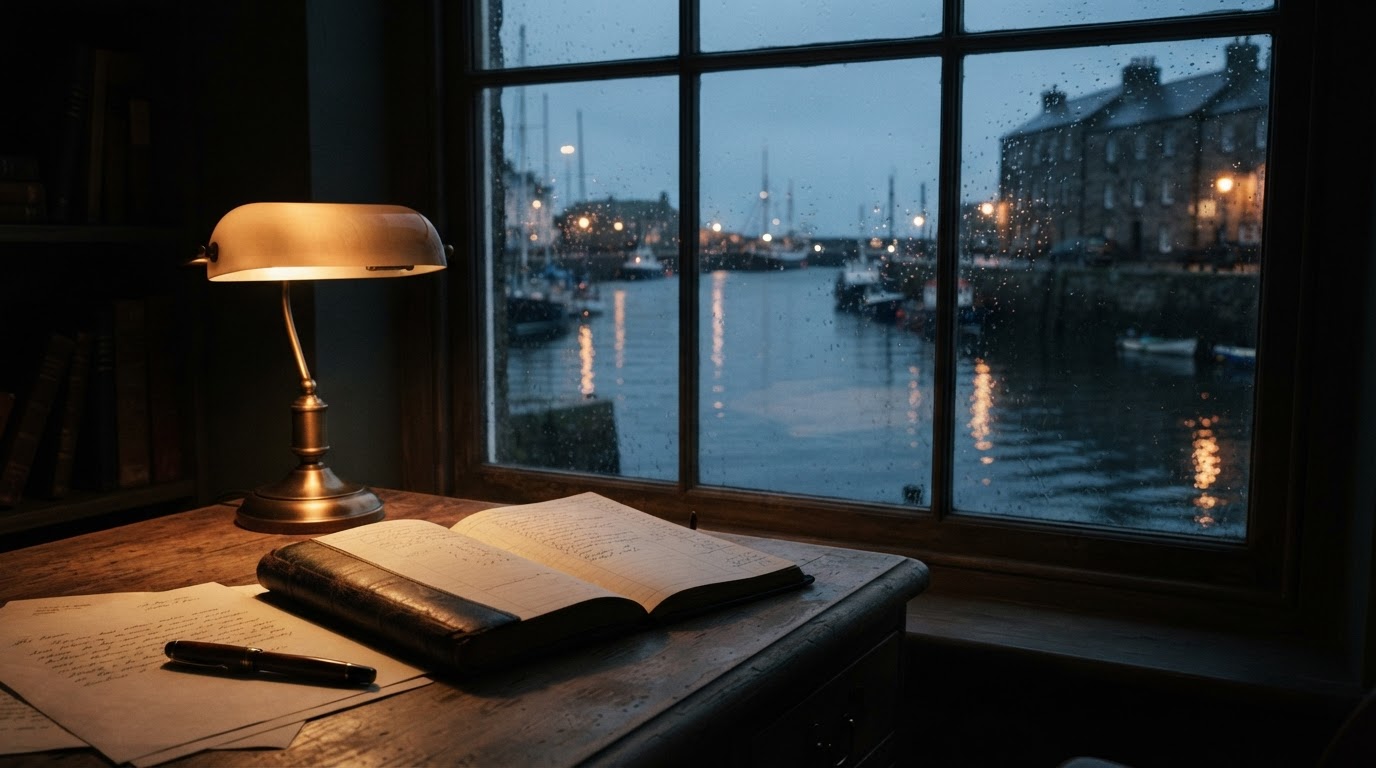
Welcome to Greyhaven
Two new, spoiler-free short stories and a companion for readers of The Offshore Wife, Book 3 of The Offshore Files by Conrad Ellison.
The following fiction is set before the main events of the novel. Each incident has a complete resolution and introduces no new secret about the central case. The first returns to a rainy Greyhaven and Lena Hart; the second follows Mara Voss and Clara Ivers through an unrelated London investigation. The companion offers a reader-friendly guide to documentary clues, trust, and discussion questions.
The Fourth Name
An independent Greyhaven story, set before the events of The Offshore Wife.
The first problem with Greyhaven’s Harbour History Weekend was the weather. The second was the photograph.
By nine on Saturday morning, rain had found its way through the seal above the bank’s front window, leaving a narrow, silver line down the glass. Lena Hart had brought an extra cloth from home, although she knew perfectly well that a cloth would not mend the seal. Across the counter, an exhibition board stood propped against a chair, its title printed in imposing navy letters: THE THREE MEN WHO HELD THE LIGHT.
Underneath was a picture of four people.
Lena was the first to count them, but she was not the first to object.
“There’s someone else,” said Bea Crowther, the seventeen-year-old student helping the town history society mount the display. She pointed at the far edge of the black-and-white print. “You can see half her face. Why isn’t she named?”
“Perhaps she was passing by,” said Mr. Preece.
Alan Preece chaired the exhibition committee and possessed an enviable ability to make a question sound resolved without answering it. He wore a brown wool coat that had absorbed the rain on the walk from the council rooms. Its damp hem left an irregular outline on the bank’s clean floor.
“It’s an old newspaper picture,” he continued. “The caption named three men. We have used the caption. That’s what archives are for.”
Bea looked at the narrow figure behind the men. “The fourth person is carrying a lantern.”
“The men are carrying a lantern as well.”
“One lantern,” Lena observed. “The woman is holding the handle. The man beside her is holding the rope attached to it.”
Preece gave her a disappointed smile. “Deputy managers should never take up history. They ask for receipts.”
“Usually there’s a reason for that.”
Behind them, the bank’s ordinary Saturday business continued, a young father trying to persuade a small child that a queue was not a personal insult, a shopkeeper asking for change, and the sound of Eleanor Pike explaining to a customer that the deposit machine had not been invented to test anyone’s patience. Eleanor had agreed to let the history society use the lobby after closing. The bank had polished its brass sign for the occasion. Greyhaven liked an anniversary, especially one that involved the harbor, weather severe enough to be remembered fondly, and people who could no longer challenge the story.
The photograph was dated November 1983. A fishing boat had lost power outside the eastern breakwater during a gale. Three harbor men had guided it toward shelter using a lantern and a length of rope from the old watch platform. The headline, reproduced above the board, read: LOCAL HEROES KEEP THE LIGHT BURNING.
Lena read the names below it. Peter Goss. Leonard Vick. Thomas Reeve.
The woman had been cut almost entirely out of the newspaper’s original crop. In the larger print being prepared for the bank window, she remained at the edge, her hand wrapped round a metal handle, her face turned toward the water.
“I’ll check the wording before we hang it,” Lena said.
Preece’s smile disappeared. “We open at six. The plaque is already paid for.”
“I wasn’t proposing a new plaque at this moment.”
“Then what are you proposing?”
“That we don’t call something complete while part of it is missing.”
Bea’s expression brightened. Preece’s did not.
An hour later, after the exhibition committee had left with its damp coats and immovable timetable, Lena found a square of folded paper pushed through the bank’s letter slot. It contained no name and no demand for money, only five carefully printed words.
PLEASE DON’T SHOW IT CROPPED.
She stood by the door for a moment, listening to the rain hit the awning. Anonymous messages were generally best handled as problems rather than invitations. The exhibition was a community event, not a bank investigation, and she had neither the authority nor the desire to turn a forty-three-year-old photograph into an accusation. Still, someone had gone to the trouble of bringing the note to her workplace before the display opened.
Eleanor crossed the lobby, drying her hands with a paper towel. “That exhibit is giving you the same look you give an unbalanced till.”
“There is a fourth person in the photograph.”
“There were probably twenty people on the quay that night.”
“One of them has been left out of the caption.”
“And you intend to put her back before six?”
“If I can find out who she was.”
Eleanor considered the note, which Lena had placed on the counter without offering it for closer inspection. “Don’t make a scene at a civic occasion, Lena. People have been looking forward to this.”
“So have I.”
“Then help them remember the right thing.”
It was a reasonable instruction. It also depended on what the right thing was.
Lena took her lunch break early and walked to the stationer’s two doors beyond the pharmacy. The shop smelled of pencil shavings and damp cardboard. A bell over the entrance announced her with a bright sound that seemed indecently cheerful for the weather.
Miriam Fenner, who had inherited the shop from her father, stood behind a till covered in envelopes. She knew everybody’s handwriting and could remember the price of a postal order from seventeen years before. She had also, according to Bea, supplied the photograph for the exhibition.
“Not supplied,” Miriam corrected. “I allowed them to make a copy. There’s a difference.”
She opened a cupboard beneath the counter and produced a flat brown envelope. Inside were three photographs of the same harbor scene: the published newspaper crop; a larger, slightly damaged print; and a contact strip showing five exposures taken within seconds of one another.
“My father took them,” Miriam said. “He was standing on the quay when the boat came in. He wasn’t a professional photographer, but everyone wanted pictures.”
Lena bent over the strip. In the first image, the woman stood behind the lantern. In the second, she was closer to the center. In the third, she turned toward the men, her mouth open as though calling instructions. By the fifth, the boat had entered the calmer water and the lantern had been lowered.
“She’s not a passerby,” Lena said.
“No.”
“Do you know her?”
Miriam hesitated. “I knew her sister. That is not the same as knowing her.”
“What’s her name?”
“If you intend to put a name on a public board, you’d better ask the person first.”
It was the first sensible thing Lena had heard all morning.
“Can you tell me where to find her?”
Miriam slid the contact strip back into its envelope. “There’s a little yellow house above the old rope walk. Blue gate. She still puts a lamp in the kitchen window when the weather’s bad.”
Lena glanced at her watch. She had twenty-two minutes before Eleanor would expect her back.
“Could you perhaps telephone her?” she asked.
“I could,” Miriam said. “But you went looking for an answer, not permission to avoid the question.”
It was irritating to be given good advice by someone who sold greeting cards with messages about taking charge of your own life.
Lena left the shop with a borrowed copy of the contact strip and walked uphill toward the rope walk. The rain had weakened into mist, but the harbor still wore the colors of an evening that had arrived early. Down on the quay, men in fluorescent jackets were setting out barriers for the commemorative lantern walk. Somebody tested a loudspeaker, and a burst of cheerful music drifted up the slope before cutting off mid-note.
The yellow house had a blue gate. Its kitchen window held a lamp, switched on despite the daylight.
Lena knocked.
For a long minute there was no answer. Then a woman in a charcoal cardigan opened the door just far enough to see her. She was in her sixties, with white streaks through neatly cut hair and the direct expression of someone who had spent years explaining things to people who preferred not to listen.
“Mrs. Tern?” Lena asked.
“Ms. Tern. There’s no husband for you to discuss.”
“I’m Lena Hart, from Greyhaven Bank.”
“I’m not moving my account.”
“It’s not about banking. It’s about a photograph.”
The woman looked past Lena toward the harbor. Her hand tightened on the door.
“They’ve got it wrong again,” she said.
Inside the little kitchen, the lamp glowed against a curtain printed with faded blue anchors. Ms. Tern offered no tea. Lena was grateful; people often made tea when they wanted a difficult conversation to feel domestic, and it seldom helped. She set the contact strip on the table and sat only after being invited.
“I’m in that picture,” the woman said. “Joan Tern. Twenty-four years old, a fool for wearing shoes with smooth soles on a stone quay. I nearly went into the water twice that night.”
“Then the caption should include you.”
“That is not what I said.”
Joan touched the third exposure. “Look where I’m facing.”
Lena looked. Joan’s body was turned toward the boat, but her chin tilted up the slope, away from it, toward the shuttered watch house behind the photographer.
“The men had the rope,” Joan said. “Peter Goss threw it. Len Vick caught the running end before it slipped into the water. Tom Reeve kept his feet long enough to secure it. They did remarkable work. But none of us would have been standing there if Nora hadn’t called.”
“Nora?”
“Nora Caskey. She kept the harbor telephone and the radio in those days. She heard the engine fail. The lights had gone out on the east side and nobody could see the boat clearly. She sent me with the lamp, told Peter where to position the rope, then kept calling corrections from the watch room. I listened for her voice. That’s what I’m doing in the picture.”
Lena looked again at Joan’s open mouth and raised chin. It was not the triumphant pose suggested by the exhibition headline. It was a person trying to hear.
“She isn’t in the photograph,” Lena said.
“Precisely.”
“Why didn’t the paper name either of you?”
Joan gave a small laugh without humor. “The photographer arrived late, the reporter later still. They spoke to the men first. Nora had gone home with a headache after keeping watch for nineteen hours. I had gone to change my shoes. The first report described three harbor men, so the second report described three harbor men, and the anniversary booklet took the second report as history. A story acquires a spine long before anyone asks whether its bones are in the right order.”
“Did you tell them?”
“Years ago, when they held the twenty-fifth anniversary. I sent a letter. A gentleman from the committee wrote back to say the original caption was authoritative.” She folded her hands. “This photograph was printed in full at the library that year. Someone pinned a sheet over my half. It was probably intended to make the display tidy. It was a very tidy insult.”
Lena felt irritation rise on Joan’s behalf, then checked it. Joan had not asked for indignation. She had asked for a record that made sense.
“Is Nora still in Greyhaven?” Lena asked.
“She died six winters ago. Her daughter lives inland. There’s a grandson who brings flowers to the harbor wall on the anniversary. But they have no reason to trust an exhibition committee.”
The lamp made a circle of light on Joan’s table. Beyond it lay a small stack of books, two pairs of spectacles, and a coastal bus timetable, rolled and tied with thread. Nothing resembled a hidden archive. People ought not need a private museum to prove they had been present in their own lives.
“What would you like us to do?” Lena asked.
Joan looked surprised at being offered a choice.
“Don’t put my name on that plaque as an afterthought,” she said. “Don’t put me on a pedestal to make the men seem smaller. And don’t add Nora because it makes a nice tale of forgotten women, unless you can establish what she did. Tell it properly or leave the picture in its envelope.”
Lena nodded. “I can try to establish it. I can’t promise you’ll like the result.”
“That’s more honest than anything Mr. Preece said to me.”
Lena returned to the bank seven minutes late. Eleanor gave her the pointed look of a woman who had calculated the length of a lunch break with the precision usually reserved for cash shortages.
“I went to speak with a witness,” Lena said.
“Of what, exactly?”
“Of why our sign has the wrong title.”
Eleanor looked over the board, now resting flat on a table. “We are a bank, Lena. Not a tribunal.”
“That’s why I need to ask the harbor society to decide. We can refuse to display an inaccurate caption in our window.”
A long moment passed. Then Eleanor said, “Put that in writing for Alan. Polite, factual, and short. People forgive impertinence more readily when it comes with a definite alternative.”
Lena almost smiled. Eleanor knew exactly how to make a firm answer seem like good customer service.
At two, she rang the retired harbormaster listed on the exhibition’s planning sheet. Leonard Vick answered on the fourth ring, the sound of a television audible behind him. He listened to Lena’s questions, then said, “Of course Nora was there. Someone had to tell us where that cursed boat was.”
“Can you explain what she did?”
“She was in the watch house. That was her shift. She sent Joan with the lamp when the lights went. Told us to take the rope to the upper steps because the lower bollard was under water. We would have worked it out eventually, but eventually wasn’t much use to the men on board.”
“Would you be willing to tell Mr. Preece?”
“I told his predecessor thirty years ago. Nobody asked me to put it in a commemorative speech.”
“I’ll ask you again, then.”
Vick sighed. “I’ll come down after four. Can’t stay long. My granddaughter’s baking something and expects me to pretend it’s good.”
The call mattered, but it was still an account given decades later. Lena wanted something contemporaneous, not because she doubted him but because Joan had asked to be believed for a reason stronger than a new committee’s generosity. She returned to Miriam Fenner’s stationer’s and asked about any surviving image of the watch-house telephone.
Miriam pulled down a battered folder of pictures taken from the opposite quay. Two showed the storm. One showed nothing but a spray-soaked stone wall and the square dark shape of the watch house. In the next, taken shortly after the boat entered shelter, the window was open and a woman stood beneath a hanging signal flag, a telephone receiver pressed to her ear.
“That could be Nora,” Miriam said. “My father took it for a later story about the watch service. He wrote the name on the back.”
Lena turned the print over. In narrow pencil script were the words: N. Caskey, east watch, after rescue.
It was not proof of every instruction Nora had given. It was evidence that she had been there. Together with Vick’s independent recollection and Joan’s, it was enough to challenge an incomplete caption without inventing a better legend.
“Could we use it?” Lena asked.
“If Nora’s family agrees.”
“Will you help me locate her daughter?”
“I have the number in my Christmas card book. That’s not permission for you to call her without introducing yourself properly.”
Miriam said it almost sternly, but she was already opening the drawer.
By half past four, Lena had spoken to Nora’s daughter, Helen, who remembered the family keeping the watch-room picture on the mantel. Helen asked to see the wording before anything was displayed. She did not want to attend the evening event, and Lena did not press her. Leonard Vick arrived at the bank carrying a collapsible umbrella and an expression of great disappointment at a poster that had managed to turn his youthful face into a local monument.
“Three men who held the light,” he read. “We mostly held a very wet rope. Joan had the lamp, and Nora did the thinking.”
Preece arrived moments later and found them gathered around the display board: Lena, Bea, Eleanor, Miriam, Vick, and two people from the committee who had come to arrange biscuits on the refreshment table. He looked at the photographs and his shoulders fell.
“You have made this considerably more complicated than it needed to be,” he said.
“It was already complicated,” Lena replied. “We were going to print the simple version.”
“The plaque was commissioned weeks ago.”
“Then preserve it as an example of what earlier sources said. We can display it with a correction until the committee decides what to commission next.”
“People will think we didn’t do our research.”
Bea spoke before Lena could. “They’ll think you did some more.”
It was an excellent sentence. Lena wished she had said it, but credit ought to go where it belonged.
Vick set his umbrella against the chair. “Alan, I don’t mind being called brave. I mind being remembered as a man who never had to listen to anyone else.”
Preece looked toward Eleanor, perhaps hoping the host institution would rescue him. She folded her arms and said, “The bank can provide a plain temporary caption. We have a printer. We also have a sign in the window that says we value accurate information. It would be unfortunate to contradict it on Saturday evening.”
That settled the matter more effectively than indignation could have done.
They drafted a new title. The Night Greyhaven Kept Watch. Under it, a short paragraph described the damaged fishing boat, the harbor crew, the watch-house operator, and the local volunteer who carried the lamp. The text named Peter Goss, Leonard Vick, Thomas Reeve, Joan Tern, and Nora Caskey, with their different contributions recorded separately. Lena insisted on one more line: Accounts of this event have been revised as additional testimony and photographs became available.
Nobody had to pretend the first account was perfect. Nobody had to suggest the revised one was the final word.
At five, Bea confessed that she had put the note through the letter slot.
“I didn’t want Mr. Preece to think I was trying to embarrass him,” she said as they straightened the printed pages on the board. “He told me I was being sensitive.”
“You were being observant,” Lena said.
“He might still think I’m difficult.”
“Sometimes difficult is another word for someone who won’t let a question disappear. But next time, sign your name. An anonymous note tells us there’s a problem without telling us who can help solve it.”
Bea held the edge of the photograph while Lena fixed it in place. “Will he put it in the official booklet?”
“I don’t know. He said he’d bring the matter to the society meeting.”
“That’s not very satisfactory.”
“No. But it’s the part we can honestly say.”
The first visitors arrived before the exhibition opened properly. Rain blurred the streetlights, and the bank’s polished brass letters shone against the dark. Vick stood near the display and answered questions with the impatience of a man who preferred boats to ceremonies. Miriam stayed long enough to watch two schoolchildren read Nora’s name aloud. Preece introduced the revised photograph without mentioning a rescue of his own reputation.
Joan came in at seven. She stood near the door with her cardigan buttoned to the throat, looking as if she might retreat at any moment. Lena did not approach her. This belonged to Joan now, not to the person who had helped correct a caption.
Joan crossed the room on her own. She read the text twice, then studied the additional picture of the watch-house window.
“She’ll be pleased,” Joan said at last.
“Nora?”
“Helen. I rang her. She said her son is coming to see it tomorrow.”
Lena looked at the photograph of the five people and the boat drawn close to shore. There was nothing tidy about it. The figures leaned at awkward angles against the gale, faces half-hidden, limbs blurred by movement. It was not a perfect portrait of courage. It was a record of people listening to one another while the weather refused to cooperate.
“Your lamp,” Lena said. “Do you still have it?”
“No. The watch service took it back the next morning. I was glad to be rid of it. The handle burned my hand.”
She glanced toward the window, where the harbor lights swayed in the rain.
“Funny what they choose to preserve,” Joan said.
After the last visitor left, Lena helped Eleanor turn off the lobby lights. The new caption remained behind the glass, visible from the high street. Preece had promised to submit the corrected material to the town archive, and Vick had offered to record a longer account while his memory was still available for questioning. Those were modest commitments, not a victory over history. Lena preferred them that way.
She stepped out into the damp night. Up the slope beyond the old rope walk, one kitchen lamp was still burning behind a curtained window. Farther down, on the quay, the exhibition lanterns made short, broken paths across the black water.
The photograph had not changed. The people in it were exactly where they had always been.
Only the words beneath them were different.
The Unlit Floor
An independent Mara Voss story, set before the events of The Offshore Wife.
The message reached Mara Voss at 11:17 on a Thursday night, which was an unfortunate time to begin believing a building had lied.
She had been at her kitchen table in London, reading a report she disliked for reasons she could not yet put into words. Her phone lit up beside the cold remains of a sandwich. The number was unfamiliar. The attachment was a photograph of a corridor: six identical doors, a dark rectangular fitting above the far stairwell, and a notice taped to a wall.
ALL SYSTEMS TESTED. ALL FLOORS CLEAR.
The accompanying message said: It wasn’t clear. We were here. Nobody heard anything.
Mara set down the report. A second photograph arrived, this one of an ordinary elderly woman standing beside a shopping trolley. Beneath it was a name: Mrs. Olive Grant, sixth floor, Heddon House.
Mara had spent enough time around allegations to mistrust neat arrangements. A frightened witness, a dramatic photograph, and a claim that an official account was false could mean an urgent problem or a misunderstanding made sharper by poor communication. There was nothing useful in deciding which before she knew who had sent it.
Who are you? she typed.
The answer came almost at once. Leila Rahman. Residents’ association chair. We have tried every normal route. The building manager says the test passed. Please come and listen before they print the next report.
Mara looked at the clock and resisted the temptation to call immediately. Late-night urgency sometimes served the person reporting an event. Sometimes it served someone who wanted to dictate the investigation’s pace. She sent a request for the date of the test, a contact number, and permission to speak to the woman in the photograph. Then she put her phone on the table and read the hated report one more time.
The next morning, she rang Clara Ivers.
“I have a building problem,” Mara said.
“That sounds like something a surveyor should have.”
“A residential block. The manager says the safety alarm test passed. Residents on one floor say it didn’t sound.”
“Then contact the responsible authority and have it checked.”
“They have. The complaint came back as resolved.”
Clara was quiet for a moment. Mara could hear a mug set down on a hard surface.
“A closed complaint isn’t a completed investigation,” Clara said at last.
“That,” Mara replied, “is why I called you.”
They met near Heddon House at eleven. The building stood on a broad London road between a pharmacy and a shuttered betting shop, ten floors of beige concrete and windows that reflected the sky unevenly. It had been renovated in stages. New cladding met older brick around the service entrance; a line of fresh paint stopped abruptly beneath the sixth-floor windows. From the street it looked maintained, which was not the same as maintained well.
Leila Rahman waited in the lobby holding a folder against her chest. She was thirty-something, tired, and suspicious of people who arrived with useful vocabulary but no obligation to stay. Her coat was buttoned despite the warm interior. Beside her stood Olive Grant, whose shopping trolley contained a folded umbrella, a packet of biscuits, and a sturdy torch.
“I brought it to show you,” Olive said, lifting the torch. “I’ve been told to keep one. I do. It doesn’t mean I should have to guess when to use it.”
Mara introduced herself without promising a remedy. Clara explained that she worked in compliance and risk review, not fire engineering. Leila seemed relieved by the distinction. People had apparently been generous with titles at Heddon House and less generous with answers.
“The test was Tuesday at six,” Leila said. “A notice went up on Monday saying we’d hear the alarm for a few seconds and shouldn’t worry. My sister is on the third floor. She heard it. My son was visiting a friend on the eighth. He heard it. Olive was at home on six. Nothing. Not even a chirp.”
“Could it have been difficult to hear inside her flat?” Clara asked.
Olive looked at her. “I’m seventy-nine, not a decorative cushion. I hear the buses from three streets away. And my neighbor’s television through a wall thick enough to be listed as a national monument.”
Clara accepted the correction without defensiveness. “Were other residents on six there?”
“Four that we know of,” Leila replied. “All say the same. The building office says the alarm sounded correctly, and their record proves it.”
She opened the folder to a printed email. It was brief, official, and reassuring: The scheduled alarm test completed successfully across the site, and the issue is considered closed. No individual floor results were attached. A later reply said the residents’ recollections were inconsistent with the contractor’s certificate.
“The word ‘inconsistent’ did a lot of work there,” Mara said.
“We aren’t trying to get anyone fired,” Leila replied. “We want the bell to ring.”
Mara asked whether the three of them could see the sixth-floor corridor with Olive’s permission. Olive nodded, parked her trolley neatly near the lift, and took them upstairs.
The sixth-floor landing smelled of new paint and the faint lemon polish of a well-scrubbed hallway. A dark rectangle above the stairwell door carried a tiny, unlit indicator. Beneath it someone had recently applied a fresh white label with an indistinct maintenance code. Mara did not touch it. Clara photographed the label and the surrounding wall after Leila confirmed the association could document the common area.
“Can you hear the alarm from the floor above?” Mara asked Olive.
“I don’t know. I wasn’t going to stand on the stairs during a test to compare notes.”
“Good,” Clara said. “You shouldn’t have to conduct your own safety inspection.”
Olive folded her arms. “Somebody ought to tell the people who said we imagined it.”
At the far end of the corridor a door opened. A man in a dark fleece stepped out, carrying a small toolbox. He glanced at the group and stopped. His ID card read E. STOKES — BUILDING SERVICES.
“Test was completed,” he said, before anyone had asked him a question.
“Is that what you were about to tell us?” Mara asked.
“I’m only doing a door closer. The building office knows about the alarm complaint.”
“Are you the engineer who tested it?”
“No. Different contractor.”
“Then we won’t ask you to certify it.”
That seemed to unsettle him more than an accusation would have done. He shifted his toolbox from one hand to the other.
“Listen,” he said quietly. “The sixth floor was painted last month. It was supposed to be empty for a weekend. Maybe the paperwork got confused. I wasn’t on that job.”
“Who was?” Leila asked.
He looked toward Olive’s open doorway. “The office should tell you. I don’t have their records.”
Mara thanked him. Stokes retreated to his door closer, clearly grateful not to be made responsible for a system he did not manage.
“Supposed to be empty,” Clara repeated when they reached the lift. “That’s a description of a plan. Not a description of what happened.”
Leila let out a breath. “We told them people couldn’t all go away. Two residents have hospital appointments, and one has nowhere else to stay. They repainted in sections. Everyone stayed home.”
Mara looked back at the unlit fitting. A closed complaint could be the product of incompetence, poor record-keeping, or a decision to conceal a known failure. She had learned the dangers of assigning intention too early. A false conclusion became its own form of cover.
“May I see the renovation notice?” she asked.
Leila produced it from the folder. She had kept everything: letters about paint fumes, schedules for scaffolding, promises about noise, two apologies printed on matching stationery. The contractor had described the sixth floor as temporarily vacant for works. At the bottom, in smaller print, was a note that residents remaining in place would receive individual notification.
“Did they receive it?” Mara asked.
Olive shook her head. “They slid a paper through the letterbox telling us not to touch the wet walls.”
Clara read the phrase again. “Temporarily vacant. In the schedule, not in reality.”
“It might be an innocent mistake,” Mara said.
“An innocent mistake that repeats itself in a safety record becomes something else,” Clara answered.
They found the building manager in a ground-floor office with a view of the service yard. Gillian Frost sat behind a desk that was too small for its paperwork and too clean to suggest she had much time to complete it. A poster on the wall reminded staff to report hazards promptly. Three reports lay beneath an empty stapler, each marked actioned in green ink.
“The contractor was qualified,” she told them. “The certificate confirms a successful test.”
“Have you seen the floor-by-floor observations?” Clara asked.
“I’ve seen the certificate.”
“Those aren’t necessarily the same thing.”
Gillian closed a drawer with unnecessary care. “I’m accountable for the building, Ms. Ivers. You don’t need to explain what a record means.”
“Then you’ll understand why a summary isn’t enough to answer a resident who says her floor was silent.”
The manager looked at Mara, perhaps hoping for a more sympathetic interpreter. Mara offered none.
“We aren’t asking you to agree with an allegation,” Mara said. “We’re asking whether there is evidence that directly tests it. A statement that the site passed doesn’t tell us which devices operated, or whether a particular floor was included.”
“The contractor says every floor.”
“Can we speak to the contractor?”
“I can arrange an appointment.”
“For when?”
“Next week.”
Leila’s face hardened. “You’ve had the complaint since Tuesday.”
“And I have dealt with it.”
Olive’s torch rested across her knees. She placed one hand on it, not dramatically but in the way someone might hold a handbag when a bus braked too sharply.
“If it goes wrong tonight,” she said, “what will you tell my neighbor? That a certificate thought it was safe?”
Gillian looked at her for the first time. The question changed the shape of the meeting because it did not accuse anyone of fraud. It simply brought the consequence of an unanswered doubt into the room.
She opened her computer and searched for an appointment number. She would contact the fire-safety contractor that afternoon, she said. She would also ask the building owner to obtain independent technical advice about the sixth floor. Mara requested that the association receive written confirmation of those steps. Clara made sure the request included a date and contact person.
Outside, Leila asked, “Do you believe her?”
“I believe she’s heard you,” Mara said. “That is not yet the same as fixing it.”
They sat in a café across the road to compare notes. Clara brought out her own ceramic mug from a canvas bag, set it on the table, and ordered a pot of tea to fill it. The waitress examined the mug with mild curiosity, then proceeded without argument.
“I could have left the mug at home,” Clara said, watching Mara notice it.
“You could.”
“I’m trying not to turn a personal preference into a theory of the world.”
“A worthy ambition. How’s it going?”
“Badly.”
Mara smiled, briefly. Her friend had spent too long in rooms where proper procedure had become a substitute for knowing what was happening. She understood the reflex. A familiar object could become a kind of talisman after a public failure. It was less dangerous than believing any unfamiliar one was a threat.
“We shouldn’t make this into an organized scheme,” Clara said. “We have three competing possibilities. The alarm sounded but wasn’t audible on six. Six was excluded from the test. Or witnesses are mistaken about when and where the sound occurred.”
“And the maintenance worker mentioned a vacant floor.”
“He mentioned an instruction about painting. He didn’t claim to know the alarm system.”
“Good,” Mara said. “You still correct me when I’m impatient.”
“Only when you make it easy.”
Mara read through Leila’s papers again. The test notice promised a short audible signal in each occupied area. The contractor’s certificate asserted a whole-building pass. Between them was the renovation schedule with its phrase about temporary vacancy. The gap was obvious, but a gap was not proof of a particular cause. She made a list of questions for the engineer instead of trying to infer the answer from paperwork alone.
At four, Gillian rang with a new proposal. A supervised audible test would be conducted the following morning. The building owner would notify residents. The contractor would attend with an independent specialist, and the residents’ association could appoint two observers to stand with a member of management. Mara asked whether Leila and Olive could be those observers. Gillian hesitated, then said yes.
“And if the sixth floor fails?” Mara asked.
“We’ll follow the appropriate safety advice.”
“Please get that advice before the test, not after it.”
A pause. “I’ll make the call.”
It was progress. Mara did not confuse it with resolution.
On Friday, the sky above Heddon House was colorless and the air smelled of rain before it arrived. Notices announced the timing of the test. Leila had knocked on the doors of the residents who were worried and encouraged them to discuss any immediate safety concerns with building management or the relevant emergency service. She had not asked anyone to wait for an alarm that might not work. That distinction pleased Clara.
At five minutes to ten, Mara and Clara stood in the sixth-floor corridor beside Leila, Gillian, a contractor named Miles Kerr, and an independent engineer introduced only as Ms. Price. Olive had chosen to wait in the ground-floor sitting room, where another resident had agreed to keep her company. She had done enough demonstrating for one week.
“We’re going to conduct a controlled check,” Price said. “No residents should treat this as a replacement for normal precautions. If anyone is concerned by what they observe, tell the building team immediately.”
Miles consulted a tablet. “We already know the system passed.”
Price looked at him. “Then this will be a useful confirmation.”
Mara noticed Clara pressing the ridge of her thumb against her notebook. She did it when someone used certainty as an argument instead of a conclusion. Mara herself was staring at the dark fitting above the stairwell, though she had already been told it was not necessarily the alarm sounding device. She deliberately looked away. The greatest risk during a test was measuring the wrong thing with extraordinary confidence.
A sound came faintly through the wall from the floor below: a short, unmistakable electronic tone. Leila raised her head.
Nothing sounded on six.
There was a muffled click in the corridor, then silence again. A second tone rose through the ceiling from seven, distant enough to be recognized but not loud enough to serve as a local signal.
Price held one palm up to stop conversation. She waited for the test sequence to finish, examined her own instrument, and spoke into her radio to the colleague supervising the system. The exchange was technical and brief. She did not explain its meaning until she had checked the result against the expected observation for the floor.
“The audible warning on this floor has not operated during the test,” she said.
Leila closed her eyes. It was not triumph. Mara recognized relief, anger, and exhaustion arriving in the same breath.
Miles started to speak. “The panel indicates—”
“The panel doesn’t change what we just observed,” Price said. “We need to assess the cause and the implications before anyone certifies the area as covered.”
Gillian looked pale. “How did the last test pass?”
“We don’t know yet,” Price replied.
That was the hardest answer for everyone to hear, because it was also the responsible one.
They returned to the office. Price requested access to the relevant records and installation information through the authorized building team. No one attempted to open equipment or improvise a repair in the hallway. Leila insisted that residents receive an immediate notice explaining the observed failure and the steps being taken. Gillian agreed to contact the responsible safety professionals for interim arrangements. Mara watched the conversation closely. A building’s risks were not made smaller by a careful choice of euphemism.
“Could you put ‘the alarm did not sound on six’ in the message?” Leila asked.
“We usually say ‘a device irregularity was identified,’” Gillian began.
Olive, who had come in from the sitting room, heard the exchange at the door.
“You can say device irregularity to the device,” she said. “For us, tell us what happened.”
This time Gillian did not argue.
The afternoon became a sequence of conversations and waiting. Price and her team reviewed the testing records, then compared them with the occupancy plan that had been supplied during the painting works. Mara and Clara stayed nearby, speaking to residents who wanted to explain what they had heard on Tuesday. They took no photographs of private flats and asked permission before recording testimony. Three people described silence on six. One recalled a faint sound through the stairwell. None had been asked to take part in the contractor’s original test.
By late afternoon, Price could explain the discrepancy in ordinary language. During refurbishment, the sixth floor had been incorrectly treated as an unoccupied area in the works schedule. The subsequent testing and reporting had not adequately verified audible coverage for that occupied floor. The summary certificate had been issued without the necessary direct observation there. She would report the technical cause separately after further inspection; the immediate finding was enough to require action.
Miles stood by the office window, his expression closed. “I signed what the export showed,” he said.
“And what did you think it showed?” Mara asked.
“A completed site test.”
“Did you attend six?”
“No. I relied on the schedule.”
“That is the part your certificate doesn’t say.”
He looked down. The admission did not make him a villain. Nor did it restore an alarm that people might have needed. Mara had learned that systemic failure often had no single theatrical moment of choice. It accumulated in shortcuts that each person could describe as ordinary.
Clara asked for the distinction to be preserved in the corrected record: what had actually been observed, what had previously been assumed, and what remained to be confirmed by specialists. Gillian, to her credit, did not ask to soften it. She arranged for the independent team to oversee the corrective work and for the building’s responsible parties to implement interim safety measures with professional guidance. Where those measures could not ensure safety, residents were to be offered alternative accommodation rather than told that a certificate was reassuring enough.
Leila read the new notice before it went up. It said plainly that the audible warning had failed to operate on the sixth floor during the supervised check. It apologized for dismissing earlier reports. It gave a named contact for immediate concerns and explained that a further verified test would follow the remedial work.
“Better,” she said. “Still not the sentence I wanted to spend my Friday reading.”
“No,” Gillian answered. “I don’t imagine it is.”
For the first time, the manager seemed to understand that professionalism included admitting when a procedure had protected a report more effectively than the people it described.
Mara left at dusk, when the streetlights began to reflect in the thin rain. Clara walked with her toward the station. For several minutes neither spoke. A bus pulled out from the stop, its windows bright with tired commuters. Somewhere on the next street a delivery driver argued into a phone with the weary conviction that an address had personally betrayed him.
“I’m glad we didn’t publish the accusation before the test,” Clara said.
“So am I.”
“It wouldn’t have been fair to claim someone deliberately disabled the system.”
“No.”
“But if we’d waited for a perfect explanation, people might have continued living with a known doubt.”
Mara turned toward her. “That’s the difficult part. Action doesn’t have to wait for certainty. Accusation usually should.”
Clara considered the distinction. “You should write that down.”
“I suspect someone already has.”
On Monday, Leila sent a short message: the corrective work had been completed, independently checked, and explained at a residents’ meeting. The building manager had also agreed to review how renovation schedules were handed to contractors. Olive had attended the meeting with her torch on the table in front of her, although she had decided to leave it at home for the next gathering.
A photograph followed. It showed a new notice on the sixth-floor board. The first line read: CORRECTED TEST CONFIRMED. Beneath it were dates, contacts, and an invitation for residents to report any further concerns without having to prove they had experienced them alone.
Mara saved the photograph beside her notes. The folder was short, containing no dramatic confession and no proof of a grand scheme. It documented something harder to sell as a story and more useful to the people involved: a question had been heard, tested, and answered in a way that could be checked.
She closed the file.
The building would still need people willing to listen next time. She hoped the notice would help them remember that.
The Trust Notebook: A Spoiler-Free Financial Thriller Reader’s Guide
For readers of The Offshore Files, including The Offshore Wife by Conrad Ellison.
A compelling financial thriller does not need a suitcase of cash, a secret island or a villain explaining a scheme in a darkened boardroom. Sometimes the most unsettling moment is a familiar person saying, “It’s already been taken care of.” The words might be a genuine kindness. They might also mean that a decision has been made without the person most affected ever understanding it.
This short notebook offers a way to read stories about money, institutions and trust without needing professional banking knowledge. It contains general vocabulary, observation prompts and questions for discussion. It does not reconstruct the plot or reveal the solution to the novel’s central case.
The distinction that makes the genre work
In a well-built financial thriller, three things often appear together but should not be mistaken for one another:
A record shows that a document or system contains a particular statement. It does not, by itself, explain everything that happened.
An authorization indicates that an action was supposedly permitted. Whether it reflects genuine, informed agreement is a separate question.
A motive gives a possible reason for what someone did. A plausible motive is not proof that a particular person acted on it.
This distinction matters to fictional investigators because they work among incomplete facts, human loyalties and systems that do not always describe reality in ordinary language. It matters to readers because it keeps a clue from becoming a premature verdict.
Eight useful terms, in plain English
Audit trail: A record of actions or changes, such as when something was entered, reviewed or amended. It may be incomplete, and interpretation still requires context.
Beneficiary: A person or organization designated to receive a benefit in a particular arrangement. The word can mean different things in different legal and financial settings.
Dormant account: An account with prolonged inactivity under a provider’s applicable rules. In real life, definitions and reactivation procedures vary; inactivity alone does not mean funds belong to someone else.
Escrow: An arrangement in which money or other assets are held by a third party under agreed conditions. Details vary with the transaction and jurisdiction.
Intermediary: A person or institution that stands between participants or stages in a transaction. It may be part of an entirely legitimate process.
Probate: A legal process associated with administering a deceased person’s estate. Procedures differ by jurisdiction, so a fictional solicitor’s actions should not be taken as a guide to handling a real estate.
Compliance review: A check against relevant rules, policies or legal duties. A review’s existence is not a guarantee that every problem has been recognized.
Supporting evidence: Information that helps test an explanation against other sources. It is stronger when independent, appropriately obtained and specific about what it does—and does not—establish.
Some labels used inside the novel are created for its fictional institutions and networks. They should not be confused with standardized banking terminology or treated as evidence about any real company.
Five questions to ask while reading
1. Who knows the most, and who has the most power? These are not always the same person. Someone may possess crucial knowledge yet lack the authority to use it.
2. Which statement is being treated as a fact? Notice when a character says a form was signed, a procedure was followed or an account was reviewed. Ask what those assertions establish—and what remains open.
3. What does professional language conceal? Terms such as routine, exception, protection and closure may be entirely innocent. They may also discourage a useful follow-up question. Pay attention to who defines the terms.
4. How does local familiarity change judgment? A bank employee may know a customer by name; a solicitor may be a family friend. Familiarity can make service more humane, but it can complicate accountability.
5. What would a fair investigation protect? In a story about hidden money, evidence matters. So do innocent people who may be affected by suspicions, publicity and rushed conclusions.
Eight discussion questions for a reading group
- Does a person’s technical knowledge make them more trustworthy, or simply more persuasive?
- When does helping someone with paperwork become speaking for them?
- Why are ordinary locations such as branch offices and kitchens effective settings for suspense?
- What makes an apparently harmless administrative phrase unsettling in a novel?
- How should an investigator balance speed with the risk of accusing the wrong person?
- Can someone do real harm while believing they are protecting another person?
- Which forms of courage matter most in a quiet, clue-driven thriller: confrontation, patience, admitting a mistake, or asking for help?
- What information would you want to see before trusting an institutional explanation in the real world?
Two small reading exercises
The single-sentence test: Pick an important statement made by a character. Rewrite it beginning with “What we can verify is…” If the sentence becomes shorter, you have identified the boundary between a claim and its evidence.
The missing-viewpoint test: Choose a scene that takes place in an office, meeting or public space. List who is present, who has been discussed but not consulted, and whose absence changes how the event is understood. This can reveal how the author creates tension without relying on an action sequence.
A note about real financial concerns
Fiction is not financial or legal advice. If something unexpected appears on a real account or you are uncertain about a document you’ve been asked to sign, use your bank’s verified contact details or consult an appropriately qualified professional. Do not rely on phone numbers or instructions contained in an unexplained message. A thriller can make uncertainty entertaining; real people deserve clear answers and appropriate support.
More from Wonder Shelf Books
Readers looking for related investigations and the full series order can visit The Offshore Files or the Conrad Ellison author page.

