The Estate That Lied
A complete companion to The Estate That Lied by Lenora Valerood, from The Ashbourne Inheritance.
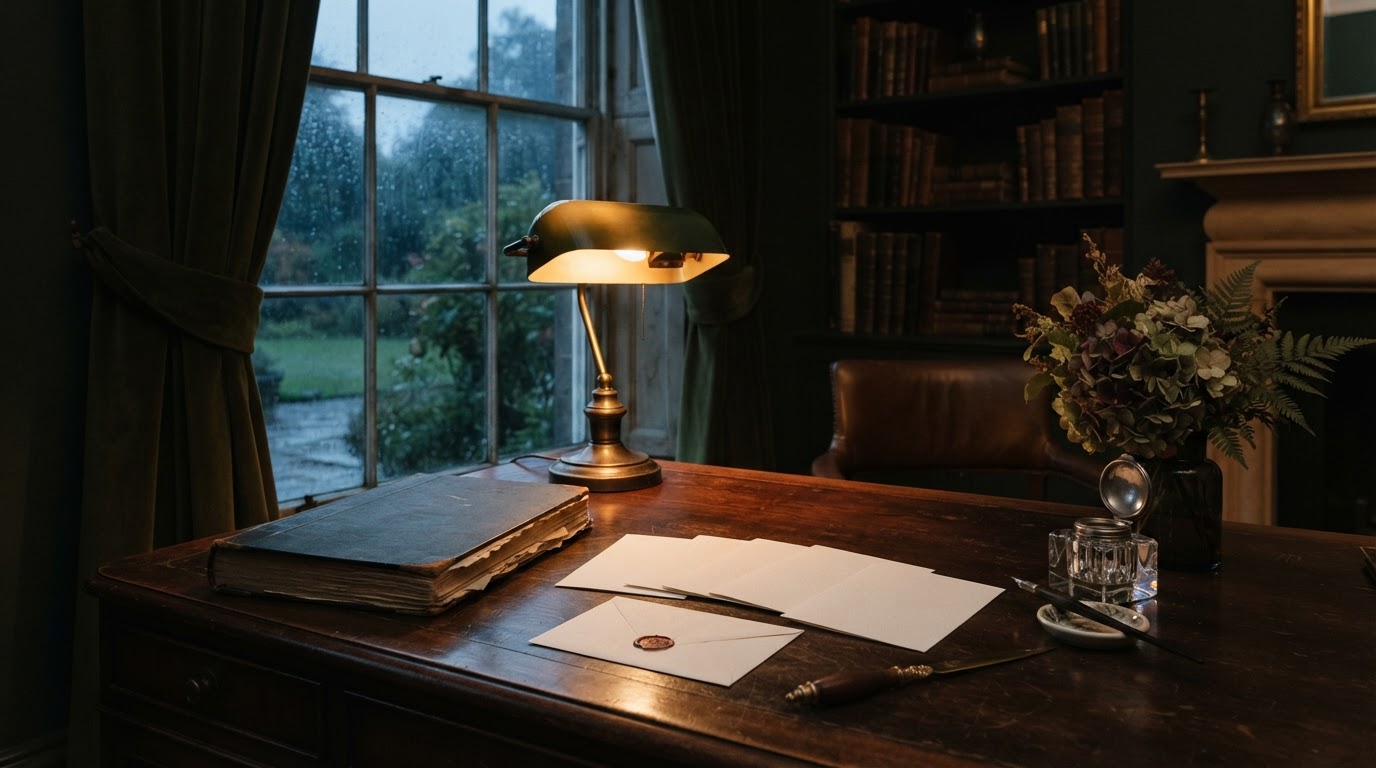
Two complete, spoiler-safe stories from the world of The Ashbourne Inheritance, plus a companion guide to rooms, rituals, and quiet power.
These are independent extras, not missing chapters. You can read the novels without them; the incidents below do not reveal the core mystery, its solution, or future-series answers.
Jump to: Story 1 · Story 2 · Companion guide
In this collection:
- Bonus Story 1 — A Seat Without a Name. Before the estate’s legal turmoil, Higgins encounters a charity recital whose organisers have confused gratitude with obligation.
- Bonus Story 2 — The Light Above the Archive. Iris Bell’s routine closing round turns into a tense search for a missing exhibition object during a rainstorm.
- Companion — The Ashbourne House Guide to Quiet Power. A reader-friendly tour of the fictional rooms and social rituals that shape this series.
BONUS STORY 1 — A SEAT WITHOUT A NAME
An Ashbourne House story, set before Arthur Ashbourne’s death. This independent incident does not resolve the events of the novels.
The first alteration appeared in pencil, which was why Higgins noticed it.
Ink had a way of making small decisions look permanent. Pencil suggested a mistake that somebody hoped would disappear beneath the next clean copy. Across the dining-room seating plan for Ashbourne House’s winter recital, a careful line had been drawn through the name Ada Dacre. A second, heavier stroke crossed out her place number. Beneath it, in the narrow margin, someone had written: Leave open until instructed.
The rest of the plan was immaculate. Fourteen guests would dine before the music, twenty-six more would come for the recital, and the local hall restoration fund would receive whatever the evening persuaded people to part with. Mrs. Ashbourne had approved the order of courses, the flowers, and the placement of chairs with the sort of attention a less experienced household manager might have mistaken for enthusiasm.
Higgins had served the house long enough to know that enthusiasm was seldom the object of such precision. Precision prevented surprises. Or, at least, it gave those responsible someone to blame when surprises occurred.
He lifted the sheet toward the pale morning light. The erased name showed through. Whoever had changed it had pressed hard enough to leave an indentation in the paper below.
Outside, rain moved across the front lawns. Beyond the glass, the cedars stood as still as witnesses who had learned to keep their opinions to themselves. A delivery van turned in at the gate, its tyres disturbing the gravel. Higgins folded the seating plan once and placed it in his inside pocket, where it would remain dry until he knew whether it was a mistake.
In the morning room, Eleanor Ashbourne was reviewing the evening’s printed programmes. They lay in a stack beside a silver paper knife, each one bound in cream card with a narrow green ribbon.
“The roses are too pink,” she said without looking up.
“I have already asked for white replacements, madam.”
“Then we agree about the roses. An encouraging start.”
Higgins set the programme beside her tea. “There is a question regarding one of the guests.”
“There is always a question regarding one of the guests.”
“Miss Dacre was confirmed for dinner. Her name has since been removed from the seating plan.”
Eleanor’s fingers stopped against the edge of the ribbon. “Who removed it?”
“I have not yet established that.”
“Has she declined?”
“The reply card says she accepted.”
“Then she has a chair.”
It ought to have been the end of the matter. Higgins knew better. A guest’s chair was not simply furniture in this house. It was a declaration of inclusion, a visible statement of where the household believed a person belonged. Taking it away invited explanations. Leaving it empty invited more.
“Mrs. Harker is overseeing the recital programme,” Eleanor said. “Ask her. But do not invent an embarrassment in the course of preventing one.”
Higgins inclined his head. “No, madam.”
He did not mention that the programme itself already carried an embarrassment. On page three, beneath the title of the final selection, appeared the words: A special tribute to Miss Ada Dacre, whose years of music teaching helped shape the life of this community.
A tribute was ordinarily a welcome thing. It became less welcome when the person being honoured had been removed from the room.
Mrs. Nell Harker arrived at ten minutes past eleven wearing a dark green coat and a look of cheerful urgency. She had chaired the hall restoration committee for six years and had developed the habit of calling every difficulty “a little awkwardness” until somebody else solved it. Her umbrella shed rain onto the hall tiles. She noticed, apologised, and continued dripping.
“Higgins. Wonderful. We are nearly there, aren’t we?”
“Very nearly, Mrs. Harker. May I ask about Miss Dacre?”
Her smile tightened. “Ah. A little awkwardness.”
“So I suspected.”
“She has been difficult about the tribute. Modest to the point of ingratitude, if you ask me.”
“Did she withdraw her attendance?”
“Not exactly.”
“Then her dinner place was struck through in error?”
Mrs. Harker inspected her gloves. “We thought it better to keep the seating flexible.”
“Who thought so?”
“The committee.”
Higgins had learned that “the committee” could mean seventeen people, three people, or one person who had not yet found the courage to say I. He waited.
Mrs. Harker lowered her voice. “There is another guest involved. Frances Pike. The pianist.”
The name was familiar. Frances had performed at the hall as a girl and would return that evening for a short recital in aid of the roof. Her name appeared in heavy type on the programme’s cover. Higgins had not known she had anything to do with Miss Dacre beyond the obvious: Dacre had taught generations of local children, and Frances had been one of them.
“Miss Pike is appearing,” he said. “Miss Dacre is attending. I see no obstacle.”
“They haven’t spoken in years.”
“That is their concern.”
“But think what a lovely moment it would make. Teacher and pupil, brought together at last, in the hall where it all began. People would remember it. They might give quite generously.”
Higgins looked at her with the stillness of a man who had just heard a cupboard door close on someone’s fingers.
“Does either lady know about this moment?”
Mrs. Harker’s silence was answer enough.
He took out the seating plan. “Who crossed out Miss Dacre’s name?”
“I did. Only provisionally. We were going to ask her to come in after the final piece. A surprise, you see. Frances would be onstage already.”
“And Miss Dacre?”
“She couldn’t very well refuse in front of everyone.”
The sentence arrived in a voice so cheerful that, for a moment, Higgins wondered whether Mrs. Harker had heard herself.
“That,” he said, “is perhaps the difficulty.”
Mrs. Harker frowned. “It’s not a punishment. It’s gratitude.”
“People may still wish to choose how they receive it.”
“You sound like Miss Dacre.”
“Then I may have saved myself a journey.”
But he had not. There were two names on the programme and only one explanation in the hall. Higgins wanted to hear the other.
Miss Ada Dacre lived in a narrow house behind the old bakery, where a climbing rose had taken possession of the front railings and showed no interest in being pruned. She opened the door before Higgins could knock a second time. A small woman in a navy cardigan, she held a dishcloth in one hand and regarded him with professional suspicion.
“If you’re from the committee, tell Nell I have made myself plain.”
“I am from Ashbourne House.”
“That is not an improvement.”
He allowed the judgment to stand. “May I explain why I am here?”
She stepped aside, though not with much enthusiasm.
The sitting room contained more music than furniture. Scores sat upright in crates, their corners softened by use. A narrow piano stood against the wall. A shelf above it held a framed photograph of a girls’ orchestra wearing stiff dark dresses and expressions of heroic discomfort. On the mantel stood a cracked metronome. Its pendulum had been removed and placed in a saucer, as if even time had been asked to wait.
“Tea?” she said.
“No, thank you.”
“Good. I haven’t any clean cups.”
Higgins remained standing while she sat by the window. He told her about the seating plan, the printed tribute, and the proposal for a surprise reunion. He used the committee’s words without improving them.
When he finished, Ada looked at the photograph above the piano.
“Frances doesn’t owe me a reunion,” she said.
“I would not presume to say she does.”
“And I don’t owe them a performance of being pleased.”
“Nor that.”
She folded the dishcloth once, very precisely. “Do they tell everyone I was her great inspiration?”
“The programme describes you as an influential teacher.”
“That’s a polite way of saying I was hard on her. I was hard on all of them. I thought I had to be. There was no money in that school, no properly tuned piano for half the term, and children who practised on kitchen tables because their families couldn’t afford an instrument. If I wanted them to be taken seriously, I thought they had to be better than everyone else.”
Higgins looked at the old photograph. The girls stood shoulder to shoulder, their bows angled at different heights.
“Sometimes they were,” Ada continued. “Sometimes they were frightened. Frances told me that after she left. She was not wrong.”
It was not a confession offered for sympathy. Her voice contained too much irritation with the old self who had produced it.
“I wrote to her,” Ada said. “Years ago. An apology. She replied kindly. She said she wished me well, but she did not want to discuss her childhood on a stage or in an interview. I thought that was clear.”
“Did she agree to the tribute?”
“They said she had.”
“Who said?”
Ada lifted one shoulder. “Nell. Who else?”
Higgins glanced toward the rain. The story had acquired a second absence: not merely a chair, but a conversation nobody had bothered to have.
“Why accept the invitation?” he asked.
“Because Frances plays beautifully,” Ada said, as though the answer were obvious. “I wanted to hear her. I don’t need to be thanked for listening.”
He stood a little straighter. “Would you attend if there were no tribute and no introduction?”
Ada’s eyes narrowed. “As a paying guest?”
“As a guest whose terms have been heard.”
“I suppose that depends on whether you can persuade your employers that I exist without being displayed.”
Higgins considered the question. It would not have occurred to many people that a house as large as Ashbourne could make a person feel small. He had seen it happen often enough that the proportions no longer surprised him.
“I can ask,” he said.
“I have already asked.”
“Then perhaps I can listen.”
Ada looked at him for several seconds. She set the dishcloth down.
“Tell Nell I will not be summoned onto that stage,” she said. “Tell her I am coming because I chose to come. If she cannot bear that, she can return my ticket money.”
“I shall be exact.”
“One more thing, Mr. Higgins.”
He paused at the door.
“If Frances asks me to speak, I will. If she doesn’t, I won’t.”
“Understood.”
Outside, the rain had strengthened. Higgins walked back toward the estate with his hat pulled low and the uncommon feeling that the morning’s trouble had become simpler while the committee’s solution had grown more complicated.
At three o’clock the flowers were replaced, the chairs were aligned, and Mrs. Harker’s secret plan was still intact. This last fact irritated Higgins more than the roses had irritated Eleanor. The recital programme could not be reprinted in time, but nothing required the person named in it to become its captive.
He requested a minute with Eleanor in the morning room. She was counting place settings against a ledger. Her pencil paused when she saw his face.
“You have found the awkwardness,” she said.
“Yes, madam.”
He explained what Mrs. Harker intended and what Miss Dacre had asked. Eleanor did not interrupt. When he finished, she turned one page of the ledger and closed it.
“A public reconciliation,” she said. “How theatrical.”
“It is intended to encourage contributions.”
“People will donate to repair a roof if they believe the roof matters. We need not display two women as evidence that kindness has occurred.”
Higgins was not often surprised by Eleanor Ashbourne. He had lived in her household long enough to know that she understood the uses of courtesy far better than she understood the comfort of its recipients. Nevertheless, a small part of him had expected her to side with the committee, if only because the committee’s plan promised an orderly photograph for the local newspaper.
“Shall I remove the tribute?” he asked.
“From the speeches. The programme is already printed. We cannot pretend it isn’t. But we can refrain from reading it aloud.”
“And Miss Dacre’s seat?”
“Give her a place where she can watch the pianist without the entire room watching her.”
He inclined his head.
Eleanor added, “You may tell Mrs. Harker that I dislike surprises. She will understand the principle, even if she misses the point.”
Mrs. Harker understood neither at first. She stood beneath the portrait in the front hall, holding a box of ribboned programmes, and spoke of tradition, generosity, reconciliation, and the responsibilities of a host. Higgins allowed the words to expend themselves.
“Mrs. Ashbourne has made the decision,” he said at last.
“But Frances agreed to a tribute!”
“Did she agree to meeting Miss Dacre onstage?”
“She said she was willing to thank her teachers.”
“All of them?”
“Yes. In general.”
“Then let her do so in general.”
“You make it sound so simple.”
“It is simple to arrange,” Higgins said. “It may not be simple for either of them to live.”
Mrs. Harker looked offended. Then, slowly, she looked uncertain. It was an expression Higgins had rarely seen on her and did not immediately distrust.
“I thought a surprise would be lovely,” she said.
“Perhaps it would have been. But the choice of whether to take part cannot belong to the audience.”
He returned her the programme box. At the bottom, the cream cards were bent slightly where their ribbons had pressed against them. Something about the sight reminded him of how an apparently delicate object could hold a room’s expectations in place.
By seven, the rain had stopped. A silver line of sky appeared above the west roof, and the gravel reflected the lamps set along the entrance. Cars arrived in pairs. Higgins received coats, answered questions, gave directions to the withdrawing room, and prevented a gentleman in a damp tweed jacket from carrying an umbrella into the music room.
Miss Dacre arrived alone.
She wore a navy dress and a small silver brooch shaped like a treble clef. She had abandoned the cardigan but retained the expression of someone who expected an argument. When Higgins greeted her, she searched his face for signs that the arrangement had changed.
“Your seat is ready,” he said. “No introduction is planned.”
“Good.”
She handed over her coat. Her fingers lingered on the cuff before releasing it.
“You may leave at any point,” he added.
“I know where doors are, Mr. Higgins.”
“Of course.”
Then she smiled, very briefly. “Thank you.”
He led her to a chair just behind the centre aisle. From there she could see the piano without being visible to the audience as a special guest. The chair beside hers remained unoccupied until moments before the recital began, when a stranger in an orange scarf took it without ceremony and immediately dropped a programme.
Miss Dacre picked it up for her. They exchanged a few words. Higgins, observing from the doorway, experienced the peculiar relief of seeing a guest do something ordinary.
Frances Pike entered from the far end of the music room. She was tall, with dark hair pulled back tightly and the alert posture of someone who had spent much of her life walking into other people’s attention. Higgins watched her scan the rows, perhaps looking for familiar faces, perhaps calculating the distance to the piano.
Her gaze paused on Ada.
For a moment, the woman at the piano and the woman in the audience looked at one another. There was recognition. There was a hesitation that might have contained anger or memory or simply the difficulty of deciding whether to smile. Frances inclined her head. Ada returned the gesture.
Nothing more occurred.
Higgins saw Mrs. Harker near the front row lean forward as if disappointed. He hoped she would have the grace to be disappointed privately.
The music began.
The first piece was quiet. Frances played with a restraint so controlled that people seemed almost afraid to breathe. The second opened abruptly into movement, its notes quick and hard-edged, but then relaxed into something light enough that the room changed around it. Higgins did not know enough about music to describe the effect properly. He knew only that the audience listened without rustling programmes, and that Miss Dacre did not take her eyes from the pianist.
At the end of the final piece, applause rose slowly, then filled the room. Frances stood, acknowledged it, and returned to the piano to say a few words about the hall’s roof, the committee’s work, and the teachers whose patience and demands had shaped her early playing.
She did not name Ada.
She also did not pretend the past was simple.
“Some of the lessons I remember best,” Frances said, “are ones I had to decide what to do with after I left. I am grateful to the people who taught me to listen closely. Tonight, I hope we can listen to one another as carefully.”
Higgins watched Miss Dacre lower her hands into her lap. Her expression did not soften all at once. It changed as slowly as light moving across a carpet. She clapped with everyone else.
The programme’s printed promise of a special tribute had become irrelevant. The evening possessed a more modest truth: two people had occupied the same room without allowing anyone to dictate what their presence meant.
After the recital, Miss Dacre did not join the receiving line. She stood near a side door, looking toward the quiet garden. Higgins approached with her coat.
“Did you enjoy the music?” he asked.
“Very much.”
“I’m glad.”
She put one arm into the sleeve. “She has learned to leave space,” Ada said.
Higgins waited, uncertain whether the remark was criticism.
“In her playing,” Ada added. “I never taught her that. I was always filling every silence with instruction.”
He held the coat steady while she found the other sleeve.
“You cannot teach someone everything,” he said.
“I tried. That was rather the trouble.”
From the doorway came a soft sound: a shoe striking the threshold and stopping. Frances Pike stood a few feet away, her hands empty, her expression more tired than it had been onstage.
“Miss Dacre,” she said.
Ada turned. “Frances.”
Higgins stepped back. He did not leave. Service had taught him to remain available and almost invisible in moments when somebody might need an ordinary excuse to end a conversation.
“I saw you from the piano,” Frances said.
“I hoped you would.”
“I wasn’t sure you wanted me to.”
“I wanted to hear you play. That is all I can honestly promise.”
Frances looked at the floor, then up again. “That is enough for tonight.”
Ada inclined her head. “You were excellent.”
“Thank you.”
They stood for another second. Then Frances smiled a little, as though recalling a shared inconvenience.
“Do you remember the old piano in the school hall? The one with the dead middle C?”
“It wasn’t dead,” Ada said. “It was ill-mannered.”
Frances laughed. It startled both of them.
“Good night,” she said.
“Good night, Frances.”
No apology was demanded. No future visit was arranged. The conversation did not become the photograph Mrs. Harker had imagined. It ended where its participants chose to end it, which made it smaller than a public reconciliation and considerably more their own.
Higgins walked Ada to the front door. She thanked him again, this time without embarrassment, and stepped carefully across the damp stone to the waiting taxi.
He watched the tail-lights fade beyond the gate before returning to the music room. Chairs stood slightly out of place. A programme lay under one seat. Glasses had been left on side tables. Evidence of a perfectly ordinary evening waited to be cleared away.
Mrs. Harker came in with her ledger pressed to her chest.
“The donations were excellent,” she admitted. “Better than last year.”
“I am pleased to hear it.”
“Though I still think the tribute might have moved people.”
Higgins looked at the empty chair where Ada had sat.
“It might have,” he said. “We shall never know.”
Mrs. Harker appeared unsatisfied by an answer that refused to justify itself. She left to count envelopes.
Higgins straightened the chairs, collected the programmes, and removed the last abandoned glass. On the seating plan, Ada’s name remained crossed through. He took out his pencil and made one small correction, not to the record of who had been invited, but to the record of who had chosen to come.
Beside the erased name, he wrote: Attended by choice.
He considered the words for a moment. Then he put the pencil away. They were not an estate principle. They would not survive a committee meeting or improve a financial account. Tomorrow someone might erase them because the printed list had no column for anything so inconvenient.
But tonight, at least, the line belonged to the woman who had occupied the chair.
BONUS STORY 2 — THE LIGHT ABOVE THE ARCHIVE
An Iris Bell story, set before the Ashbourne disclosures. Its small mystery stands apart from the family’s case.
At six twenty-three, the light came on in a room Iris Bell had locked seventeen minutes earlier.
She saw it from the pavement across the street. The municipal archive occupied the upper floors of a former schoolhouse, a solid brick building with a clock that had lost the ability to tell reliable time. Most evenings it looked merely tired. Tonight, with rain slipping off the cornices and the windows black except for one rectangle of amber light, it looked as though somebody had stayed behind to make a point.
Iris checked the key ring in her handbag. North gallery: present. Side entrance: present. Ground-floor store: present. She counted them twice because counting was less alarming than deciding what an unexpected light meant.
The exhibition was due to open at ten the next morning. How Our Town Gathered was not an ambitious title, but the objects behind it had taken six months to collect: photographs of public concerts, a brass raffle drum, the board from a long-vanished reading club, hand-painted signs, and a wooden model of the old riverside bandstand. The model belonged to Mrs. Ferris, who had lent it on the condition that it would be treated like something made by a person rather than a decorative object bought for a shop window.
Iris had promised.
She was now looking at a lit gallery on a floor where no one should have been.
Behind her a bus passed, splashing water over the gutter. She stepped back from the kerb and called Mara Quinn, the newest archive assistant, whose willingness to help had been accompanied for three weeks by the apologetic confidence of someone convinced every ordinary mistake might end her career.
“Have you gone home?” Iris asked.
“Almost. Why?”
“Were you in the north gallery after six?”
There was a pause. “No. Is something wrong?”
“There’s a light on.”
“I definitely turned them off.”
“So did I. Don’t come back yet. I’ll look and call you.”
“You sound as if you think I left a door open.”
“I sound as if I’ve been standing in the rain too long. I’ll call you.”
She ended the call before she could make a reassurance she had no grounds to offer.
The side door had not been forced. Its lock resisted in the usual petty way, then yielded. Iris entered the building and waited for her eyes to adjust. The corridor smelled of dust, floor polish, and wet wool drying on an unseen radiator. The familiar sound of the old heating pipes ticked somewhere beyond the staircase.
She called out.
“Hello? Archive staff.”
No answer.
She turned on the hall light and climbed, keeping one hand on the rail. Her shoes left small damp marks on the stone treads. At the landing, she heard a second sound beneath the heating: a thin, irregular tapping, like fingertips against glass.
The north gallery door stood closed. She had remembered locking it. The key turned without resistance, and she opened the door into a room whose lights were indeed on.
Nothing moved.
The first display cabinet held the brass raffle drum. The photographs remained straight. The old reading-club board hung where it should. But at the far end of the room, on its low plinth, the riverside bandstand was gone.
Iris remained by the door. For a moment she felt the childish impulse to call a person into the room simply so the absence would become shared and therefore less ridiculous.
The model was not valuable in the way antique dealers measured value. It had been made of painted wood and bent wire by Mrs. Ferris’s late husband, a carpenter who had known the original bandstand and had spent a winter reconstructing it from memory after the structure came down. Every tiny balustrade was slightly uneven. One of the roof panels had been repaired with a neat strip of different-coloured wood. She had insisted that the mismatched panel stay visible.
“He was honest enough to leave his repairs where you could see them,” she had told Iris when she handed it over.
Now it was missing.
Iris walked the perimeter of the room without touching anything. The gallery windows were shut. A coat stand stood empty. On the plinth lay an oval of pale dust marking exactly where the model had rested. In front of it, the floor had been wiped recently enough to shine under the light. An old metal bucket sat beside the wall, where she was quite certain it had not been that afternoon.
The tapping came again.
Not fingers, she realised. Water.
A drop fell from a hairline crack near the ceiling, struck the bucket, and echoed through its thin sides. Another followed after an uneven pause. There was a faint, dark patch in the plaster above.
Iris stared at the bucket.
Somebody had noticed the leak. Somebody had brought a bucket. Somebody had moved a delicate object and left no note.
And somebody had switched the light back on.
That was not yet theft. It was, however, very poor procedure.
She took out her phone and photographed the plinth, the bucket, and the stain. Then she called Mara again.
“The model is missing,” she said.
Mara went quiet. “Mrs. Ferris’s?”
“Yes. There’s a roof leak. Perhaps someone moved it to protect it. Did you see anyone go upstairs?”
“Mr. Gowan was here at five. He was looking for a ladder.”
“Did he have a key?”
“He has his own maintenance keys.”
“Was the model still there when you left?”
“I think so. I was checking the labels.”
“I need you to be precise.”
“I was precise. That’s what I was doing.”
Iris heard the hurt beneath the words and regretted the sharpness of her question. “I know. I mean the time, not the quality of your work.”
Mara exhaled. “At half past five I came out of the print room. The plinth was there. I couldn’t see the model because Mr. Gowan was standing in front of it. I didn’t think anything of that.”
“Did you ask him what he was doing?”
“No. He’s worked there longer than I’ve been alive.”
There it was: the small assumption that usually escaped an incident form. Familiarity had been treated as an explanation.
“Go home,” Iris said. “I’ll ring when I know more.”
“Are you sure you don’t want help?”
“I do. Tomorrow. For now I want to find out what happened without making you responsible for a question nobody has answered.”
Mr. Gowan answered his mobile on the sixth ring, speaking over the sound of a television. He was the building’s caretaker, a man with a permanent crease between his brows and a practical dislike of anything that required a new form.
“Water,” he said, as soon as Iris described the bucket. “I told the council about that roof in March.”
“Did you move the bandstand?”
“The what?”
“The wooden model on the north-gallery plinth.”
“Oh, that little thing. It was right beneath the leak.”
“Where did you put it?”
“On the trolley.”
Iris closed her eyes. The archive had two trolleys, one for clean handling and one with a wheel that squealed loudly enough to frighten the public. Neither was an acceptable final location for a loaned object.
“Which trolley?”
“The blue one. By the stairs.”
“It isn’t there.”
“Then someone moved it.”
“Who?”
“How would I know? I was trying to stop the ceiling coming down.”
His annoyance was not unreasonable. Neither was hers.
“Did you switch the gallery lights back on?” Iris asked.
“Yes. I was checking the stain. Forgot to turn them off.”
“Thank you. That accounts for one thing.”
“There you are, then.”
“Not quite. I still need the model.”
“You people and your little wooden houses,” he muttered.
“A person lent it to us,” Iris replied. “We promised to return it safely.”
He was silent for a beat. “I didn’t break it.”
“I haven’t said you did.”
“All right. I’ll come back. Ten minutes.”
He arrived in thirteen, carrying a torch whose casing was held together with electrical tape. He pointed out the path of the water, traced the line of the ceiling crack, and showed her the bucket’s dark ring where it had begun to fill. Everything supported his account of the leak. None of it explained why the model had vanished from the trolley.
They searched the landing, the supply cupboards, and the small room used for folding display panels. No model. The blue trolley stood in the lower corridor beside a stack of chairs. Its top shelf was empty.
Mr. Gowan rubbed his forehead. “Maybe the new girl put it away.”
“Mara says she didn’t move it.”
“She could have forgotten.”
“She could have. So could either of us. That’s why we’re checking.”
He looked at her, less annoyed now than baffled. “You’re being very formal about a piece of wood.”
“I’m being formal about responsibility. The piece of wood is the easy part.”
At the bottom of the staircase Iris noticed a small trail of sawdust along the skirting board. She crouched. The particles were pale, fresh, and caught in a fold of the old floor runner. The bandstand had a raw repair strip under its base. But sawdust could also come from the scaffolding stored nearby. She refused to promote it into proof merely because it was conveniently visible.
A door closed somewhere behind them.
Iris stood quickly.
Mara appeared in the main corridor, soaked through her coat and carrying a notebook.
“You said go home,” Iris said.
“I tried. Then I remembered something.”
Mr. Gowan folded his arms. “The model?”
“No.” Mara looked startled by his tone. “A woman who came this afternoon. Mrs. Ferris. She was here just before five. She said she wanted to check the label.”
Iris felt the story change direction.
“Did she go upstairs alone?”
“I didn’t think so. She was standing near the reception desk when I went to the print room. And then she wasn’t.”
Mr. Gowan raised his eyebrows as if the answer were now obvious.
“That doesn’t mean she took it,” Iris said, before he could speak.
Mara nodded. “I know. But perhaps she saw it being moved.”
It was an idea, not an accusation. Iris was grateful for the distinction.
Mrs. Ferris lived three streets away, and she did not enjoy telephone calls after seven. She answered this one on the second ring with a brisk “What has happened?” that told Iris the woman had been expecting trouble of some kind.
Iris explained the leak and the missing model. She did not reduce the problem to “a little mix-up” or promise the object was safe when she had yet to find it.
“Was it insured?” Mrs. Ferris asked.
“We have a loan record, but I need to review the terms before I answer that properly.”
“That was not what I asked.”
“I know. I don’t want to give you a comfortable answer that turns out to be wrong.”
The line went silent. Then Mrs. Ferris asked, “Did you look in the old music practice room?”
“Why there?”
“I saw the caretaker wheeling it away. I told him the model wasn’t to be left beside a radiator. My husband used glue that softens if the wood gets too hot. There is a small room behind the gallery that stays cool. I thought he heard me.”
Iris looked up at Mr. Gowan.
He had heard enough through the phone to change colour.
“I didn’t know she was talking to me,” he said quietly. “I had a ladder in my hands.”
“She says there is a cool room behind the gallery.”
“There is. Used to be a practice room when this was a school. It’s kept shut because the lights don’t work.”
Iris stared at him. “And does anyone else have a key?”
“Facilities. Your office. The council.”
Mara frowned. “The cabinet of spare keys in the staff kitchen?”
“Yes.”
“I checked that cabinet last week,” Mara said. “One of the keys had a paper tag saying music room. I thought it was a joke.”
Iris thanked Mrs. Ferris, promised an update as soon as the object was located, and led the other two back upstairs.
The old practice room lay behind a low door almost hidden by a rolling exhibition panel. Its paint had cracked near the hinges. Iris had passed it a hundred times without thinking about what sort of room it once served. She used the spare key. It turned stiffly.
Inside, the air was cool and dry. Shelves lined one wall. A narrow table stood beneath a boarded-up window. On the table, wrapped in two clean cotton cloths, rested the wooden bandstand.
For a second Iris merely stared at it.
Then she crossed the room and checked it carefully, beginning with the roof. The repaired panel was intact. The tiny rails still stood. Nothing appeared loose. She photographed the object where it sat before moving the cloth, noting the position of each fold.
“I put it there,” Mara said from the doorway.
Iris turned.
Mara looked miserable. “Not at five. Later. After you left. I came back because I couldn’t stop thinking about the water. I found the model on the trolley by the stairs and remembered Mrs. Ferris saying the glue shouldn’t be heated. The nearest dry room had a radiator on. I knew about this one from the key cabinet. So I moved it.”
“Why didn’t you tell me?”
“Because I wasn’t supposed to return after closing. And because I had already made three mistakes with the labels this week. I thought I could put it back in the morning before anyone saw.”
Mr. Gowan shifted behind her. “You should have said.”
Mara looked at him with unexpected firmness. “So should you.”
He opened his mouth, then closed it.
Iris looked at both of them. She could have scolded Mara. She could have scolded Mr. Gowan. She could have made the incident tidy by choosing whichever person was newest and therefore easiest to blame. Instead she asked the question that mattered.
“Did either of you see any damage while moving it?”
“No,” Mara said.
“No,” said Mr. Gowan.
“Then we will inspect it together tomorrow in proper light. And tonight we will write down every move, including the one that was well intended.”
Mara’s relief was so visible that Iris felt a little ashamed of how easily it might have been withheld.
“Am I in trouble?” she asked.
“You made an unrecorded move of a loaned object, using a room that was closed to the public. That is a mistake. We need to deal with it. But a mistake is not a character assessment.”
Mr. Gowan cleared his throat. “What about the leak?”
“We will close the gallery until facilities has inspected it. The opening can use the ground-floor reading room. No one is putting a collection beneath a dripping ceiling so the publicity photographs look right.”
“The council won’t like that,” he said.
“Then they may write their objections on dry paper,” Iris replied.
Mara gave a surprised laugh. Mr. Gowan’s mouth twitched despite himself.
By nine that evening, the bandstand was back under supervised conditions, wrapped and supported on a clean table. Iris had recorded the leak, the unscheduled movements, the people who had handled the object, and what was known about its condition. She left spaces where facts were still missing rather than filling them with plausible guesses.
She rang Mrs. Ferris again.
“We’ve found it,” Iris said. “It’s intact on initial inspection. We will check it in daylight and photograph every side. It will not go back into the north gallery until the roof is safe.”
Mrs. Ferris exhaled audibly. “Thank you for saying where it is. That’s all I wanted this afternoon. Someone told me it was part of the exhibition now, as though that meant it no longer belonged to us.”
Iris sat down in the darkened reception office. “I’m sorry you were given that impression. It remains your loan.”
“My husband wasn’t a famous artist,” Mrs. Ferris said. “He never called himself an artist at all. He made stairs and cupboards. When the bandstand came down, he said somebody ought to remember the shape of it. He spent months measuring photographs and correcting little things. I knew every time he got one wrong because he’d stand in the doorway and ask whether the roof looked disappointed.”
Iris smiled into the phone.
“He was disappointed by that roof quite often,” Mrs. Ferris continued. “I only wanted people to see it properly.”
“They will,” Iris said. “And the label will say who made it, and that you have lent it. We’ll send you the wording before it goes on display.”
“You needn’t ask me to approve every comma.”
“No. But you should be able to say whether we have described the gift as something you never offered.”
Mrs. Ferris was quiet for a moment. “That’s fair,” she said.
The next morning the rain stopped. The exhibition opened late and downstairs. A sign on the entrance explained that the north gallery was closed for maintenance, without excuses about the weather being “unexpected” in a country that practised rain most months of the year. Visitors came anyway.
The bandstand occupied a low display table in the reading room, a little apart from the larger objects. Mrs. Ferris arrived at half past ten, stood beside it for a long time, and finally traced the air above the repaired roof panel without touching the wood.
Mara approached her with the revised label.
Model of the riverside bandstand, made by Daniel Ferris and lent for this exhibition by his family.
Mrs. Ferris read it twice.
“He would have liked that,” she said. “Not the attention. The accuracy.”
Then she looked at Mara. “I hear you saved it from the rain.”
Mara glanced toward Iris, uncertain what had been said about the previous night.
“Several people helped,” Iris answered. “And we have corrected the procedure that made the moves difficult to track.”
Mrs. Ferris nodded. “Good. Things should be looked after properly, and people should know what happened.”
For the first time since the light appeared in the north gallery, Iris felt the incident begin to settle into its actual size. A roof had leaked. An object had been moved. Staff had communicated badly. A promise had frightened its owner when it appeared to change without her consent. The facts were ordinary. The fear they made possible had not been.
In the afternoon, after the visitors left, Mara carried the exhibition cards to the office for filing. Mr. Gowan came to say the roofer had confirmed an inspection date and asked, without much theatricality, whether the incident record should include the time he first noticed the stain.
“Yes,” Iris said. “Especially that.”
He made a face. “I suppose the forms have their uses.”
“A few.”
At the end of the day Iris climbed the stairs and stood outside the north gallery. The door was locked. The lights were off. In the corridor, beside the old practice-room door, a small notice now explained which staff member should be contacted when objects required emergency relocation.
She might have felt proud of it if pride were her usual response to paperwork. Instead she felt something quieter: the satisfaction of a problem made visible enough that the next person would not have to guess.
There had been an hour the previous evening when she could have told herself a theft had occurred, blamed the youngest assistant, and allowed the story to travel through the building as fact. It would have been neat. The people responsible for sorting out the mess would even have thanked her for being decisive.
But decisiveness did not always mean accuracy.
She took out her keys. On the ring, the metal tag for the north gallery pressed lightly into her palm. Beyond the locked door the bucket continued to catch water, one patient drop at a time. She had no intention of calling that solved.
Downstairs, Mara called her name. There was tea in the staff kitchen and, apparently, an argument about whether the little bandstand had been better than the original.
Iris went down to join it. For once, an argument based on memory rather than possession sounded like a pleasure she could afford.
COMPANION BONUS — THE ASHBOURNE HOUSE GUIDE TO QUIET POWER
A spoiler-safe companion to the atmosphere, rooms, and social rituals of The Estate That Lied by Lenora Valerood. All Ashbourne locations and events are fictional. The notes describe the storytelling world, not a guide to an actual estate or its history.
An Invitation Is Not an Instruction
Ashbourne House is an imposing place to enter. Its formal welcome can make a guest feel honoured; the same carefully arranged hospitality can make someone wonder whether a choice has already been made on their behalf. That double edge is central to the atmosphere of The Ashbourne Inheritance. In a household where people know precisely which room should receive a visitor, manners offer comfort and control at once.
The first bonus story, A Seat Without a Name, explores a modest version of this tension. Who decides what a guest should be grateful for? When does a public honour become a demand to perform forgiveness? The story’s small disagreement has no connection to the estate’s central mystery, but it raises an enduring question: can a person decline a kindness without being accused of ingratitude?
The Front Hall: The Moment of Arrival
The entrance hall is where the household announces itself. A guest crosses from the wet outside world into polished stone, arranged flowers, coats taken away, and questions answered in the voice of someone trained never to appear hurried. Even a simple envelope can acquire significance on a hall table beside the silver letter opener.
For a reader, the most interesting detail may be who hesitates at the threshold. A person may be admitted to the house while still feeling that their presence must be justified. A hall can welcome without promising belonging.
The Morning Room: Courtesy Under Pressure
The morning room contains one of the most telling contrasts in the novels: tea laid with care while conversations become difficult. Cups, biscuits, flowers, a writing desk, and the soft sounds of service offer a language of normality. But these objects cannot answer questions of truth, responsibility, or loyalty.
Notice how a routine can create space for thought—or prevent speech. A person who pours a cup of tea may be trying to steady another person, delay a confrontation, preserve appearances, or simply do the only useful thing available. The same action changes meaning according to who performs it and who is allowed to refuse.
The Study: Order Is Not Neutral
Arthur Ashbourne’s study represents a different kind of organisation. A desk, filing materials, pens, and an orderly room can suggest that every matter has been considered and properly handled. Yet polished surfaces do not guarantee fair decisions.
The study is a useful reminder to separate competence from character. Someone may be excellent at recording, sorting, or managing information without being honest about its purpose. In a document-driven thriller, the act of keeping a record matters, but the decision about what to record matters just as much.
Briar Cottage: Warmth Without Easy Answers
Briar Cottage offers a sensory contrast to Ashbourne House: a lived-in kitchen, baking, familiar cups, and the closeness of family members who can argue and apologise within the same hour. It feels more approachable than an estate full of portraits and formal rooms.
The warmth is real. So is the possibility of pain. A welcoming room does not prove that everyone in it has spoken honestly. Nor does a grand room prove that every gesture of kindness is false. The two households are most interesting when the reader resists turning either one into a simple moral label.
The Archive: What Happens Between Discovery and Judgment
In The Light Above the Archive, Iris Bell deals with a small emergency in an ordinary community collection. Her work suggests another kind of authority: one grounded in checking conditions, separating observations from accusations, and accepting when an answer is still incomplete.
The archive is not a magical place where every label is true. It is a place where people are supposed to be able to say what they know, what they do not know, and what they did to find out. That is a quieter form of suspense than a dramatic revelation, but it can be just as revealing about character.
Five Small Questions for a Second Reading
- Who is allowed to ask? Notice which character can demand an answer and which must first justify the question.
- Who sets the terms? Does an invitation, favour, or offer leave the recipient free to refuse?
- What does the room encourage? Does a private kitchen permit an honesty a formal office discourages, or can the opposite be true?
- Which actions are visible? Hospitality, paperwork, and orderly arrangements are easy to see; consent and motive are harder to prove.
- When is silence a choice? A person may choose not to explain. That is different from being prevented from speaking.
A Note About the Bonus Stories
These two stories are deliberately smaller than the novels. Their events neither solve the inheritance puzzle nor supply missing evidence for it. Higgins and Iris encounter manageable problems in which the true difficulty lies less in discovering an offender than in deciding what responsibility looks like after an error has occurred.
Readers who prefer to continue the main mystery immediately may move on to the next book without losing any necessary information. Those who stay a little longer in the fictional world may find that the most unsettling question in Ashbourne House has a life beyond any one document: who gets to decide what happens to someone else—and who gets to say no?
Continue Exploring
Discover more about Lenora Valerood and follow the five-book The Ashbourne Inheritance series. These bonus stories are independent extras, not replacements for the novels.

