The Crochet Code
A complete companion to The Crochet Code by Mabel Thistledown, from Thimblewick Craft Circle Mysteries.
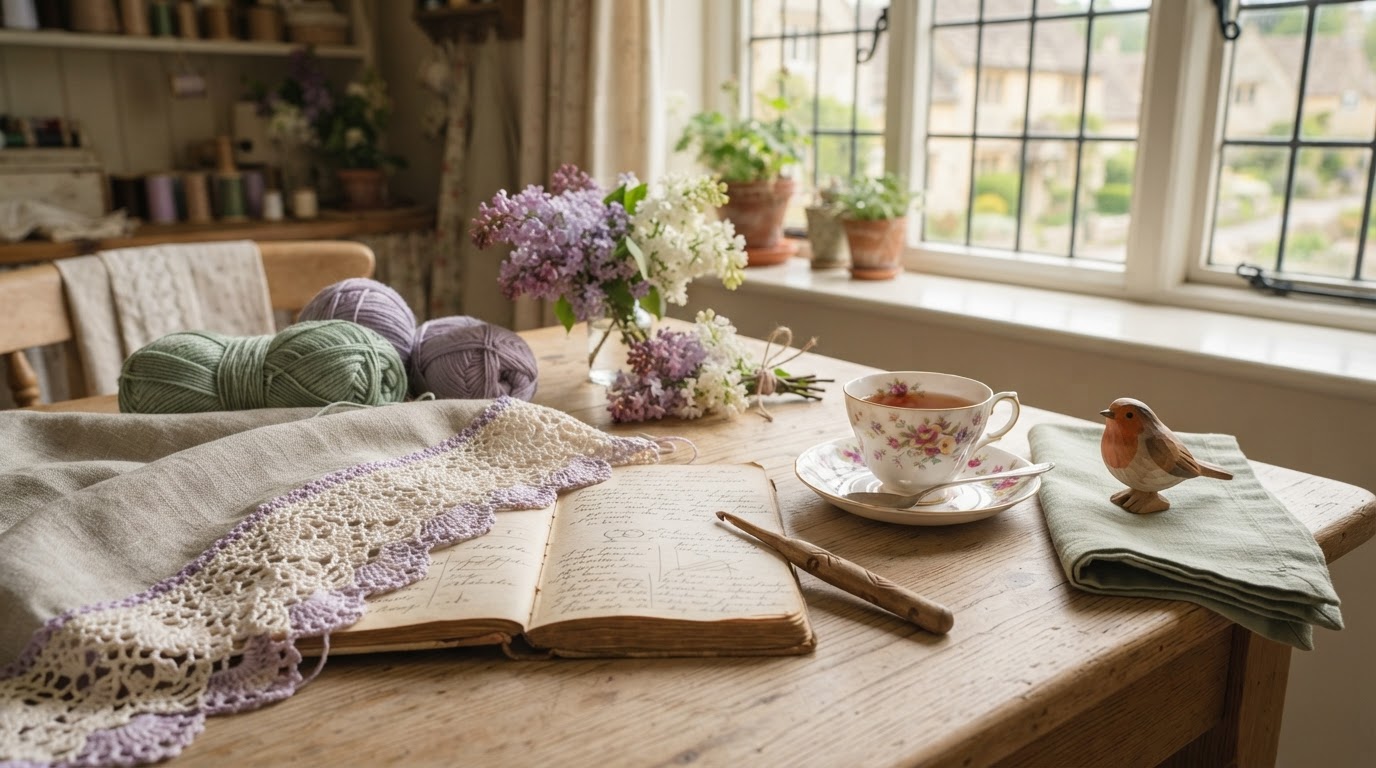
Two original, self-contained Thimblewick interludes and a practical crochet companion for readers of The Crochet Code by Mabel Thistledown. The stories take place during a quiet interval before the novel’s central case and contain no culprit or solution spoilers.
- The Robin That Went Round the Green
- The Quiet Hour That Arrived Late
- A Maker’s Pocket Guide to Reading Crochet Patterns
The Robin That Went Round the Green
A Thimblewick Craft Circle short story
On the Saturday that Thimblewick decided to welcome its newest residents with a trail of decorated shop windows, Pippa Lark lost a robin.
Not a living robin. The living ones were perfectly capable of losing themselves, and generally did so in Clary Puddifoot’s opinion whenever she needed a quiet moment in the garden. This robin was carved from pearwood, painted with a russet breast and a slightly astonished expression, and mounted on a small wooden stand. It was no larger than Clary’s palm.
It was also, according to Pippa, irreplaceable.
“That is a serious word to apply before breakfast,” Marnie Bellweather said.
She was standing in Puddifoot Paper & Thread beside a half-finished window display. A skein of pale-green yarn had attached itself to her cardigan button, where it hung like a very modest vine. Clary had discovered that Marnie could work through a whole afternoon wearing a crochet hook behind one ear and never notice it. The yarn was unlikely to trouble her.
“It was carved by Mr. Rook for his sister,” Pippa said. “She used to paint the village birds. He made it after she died. He said it could sit in the Welcome Windows display because she always thought new neighbours should feel they’ve arrived somewhere that has room for them.”
Clary set down a box of ribbon offcuts. “When did you last see it?”
“At half past eight. On the raised block outside, on the stone sill. I wanted it to greet people on the pavement. I went across to Hettie’s for the little paper flowers. When I returned, the robin was gone.”
“You opened the shop?” Clary asked.
“Only the front door. I didn’t touch your till or the alarm. The display was already in place, apart from the flowers.”
“And the paper garland above the sill?”
“I left one end loose. The paint on the flowers was still damp, and I didn’t want them pressed against the glass.”
Marnie lifted her eyes. “You gave an irreplaceable bird a loose garland in this breeze?”
Pippa looked miserable. “I wanted the flowers to dry.”
“Well,” said Clary, “we know why the display might have become lively.”
They stood in silence before the display: behind the glass were a small cardboard village, a path of folded paper flowers, two toy cottages and a bench made from wooden lolly sticks. On the narrow stone sill outside, the robin’s little pedestal stood empty. The window faced the green. Across the street, The Copper Kettle was opening its striped awning, and Edwin Barrow stood outside Barrow & Bind with a book under one arm, apparently supervising the weather.
The Welcome Windows trail had been Pippa’s idea. Families new to Thimblewick could collect a map at the library and follow painted birds from one shopfront to another, finishing with tea and a community picnic by St. Bartholomew’s. Pippa had persuaded eight businesses to participate. Each window featured a bird; together they were supposed to suggest that a village had many perches and no particular obligation to resemble a flock.
Marnie had called that sentimental. Then she had stayed late to help make the flowers.
“We must find it before Mr. Rook arrives,” Pippa said. “He said he’d come at eleven with his niece.”
“Then we have a little time,” Clary replied. “First, no rumours. Second, nobody decides a person has taken something until we’ve found evidence. Third, Marnie, remove that yarn before you start a second window.”
Marnie glanced down. “I thought I looked especially pastoral.”
Clary examined the pedestal. A strip of reusable mounting putty lay curled on one side, and there was a faint crescent of brown grit on the painted cardboard lane. The block had shifted a fraction towards the outer edge of the sill.
“Was the garland hanging down beside the bird?” she asked.
“It was above it,” Pippa said. “The loose end sometimes brushed the block.”
Clary looked upwards. The garland ran beneath the shop awning, and its untied end was still fluttering against the window frame. That morning the breeze was fresh enough to send the shop’s hanging welcome bell into intermittent arguments with itself.
“A gust might have caught the garland and rocked the stand,” Marnie suggested.
“There isn’t much room for it to fall on the sill,” Pippa said. “I should never have put the bird outside.”
“Nor enough room for it to fly,” Clary agreed. “But something has moved.”
The shop bell rang. Mrs. Biddle entered with a carefully folded newspaper and the expression of someone who had been made to witness a civic failure.
“I hear the little robin is missing,” she said.
Pippa closed her eyes.
“Who told you?” Clary asked.
“Nobody told me. I saw a gap in the window and drew a conclusion. I also saw young Alfie Marsh staring in this direction at nine. His pockets were full of something.”
“His pockets usually are,” Marnie said. “Last month he produced a whole orange and half a tennis ball from the same coat.”
“I am simply reporting what I saw.”
“And we are glad to know it was a boy with pockets,” Clary said. “That does not yet make him a bird thief.”
Mrs. Biddle drew herself up. “I did not use that word.”
“No,” said Clary pleasantly. “Let’s not allow the word to find us by lunchtime.”
After Mrs. Biddle left with her newspaper unpurchased, Pippa sat on the worktable stool. The possibility that Alfie might hear gossip had clearly worried her more than the missing display.
“He only moved here with his father in March,” she said. “The point of the trail was to make families like his feel welcome.”
Clary understood. It was remarkably easy for a village to celebrate hospitality while inspecting newcomers for signs of improper conduct.
“Let’s look outside,” she said.
They crossed to the pavement. The morning had that bright, recently washed appearance of late spring. A breeze stirred the bunting above the door. Clary crouched by the stone sill. The ledge was swept clean except for a few grains of dark soil caught between the window frame and the old brass drain lip.
“That’s odd,” Marnie said. “Your window is not a garden.”
“It was yesterday,” Clary answered. “Pippa brought a pot of marigolds for the photograph.”
“I took them away,” Pippa said, suddenly hopeful. “They were wilting indoors.”
“Where are they now?”
“On Mrs. Vale’s flower cart. She offered to refresh them before the picnic.”
“Did Mrs. Vale come to the shop?”
“Just after eight. She collected two crates of pots from the pavement.”
Clary stood. “Then let’s ask what she saw.”
“You think Mrs. Vale took it?” Pippa whispered.
“I think Mrs. Vale moved flowers,” Clary said. “Those are different statements.”
They found the florist’s cart beside the green, where Mrs. Vale was arranging potted violas into a display that contrived to look natural while requiring an alarming number of wooden supports. She listened to Pippa’s explanation with patient attention.
“Pearwood robin?” she said. “Little stand? No, dear, I haven’t handled it. I loaded the marigolds and three boxes of blue pots. My cart rocked when the wind took the awning, and I had to catch the top crate. That was all.”
“Which side was nearest the shop window?” Clary asked.
Mrs. Vale considered. “The back. Why?”
“Could we see the cart as it was loaded?”
“You can see what remains. Half the plants have gone to the churchyard. Bertie helped unload there. The rest are by the pavilion for the picnic.”
“So the cart made two stops,” Marnie said.
“It made three,” Mrs. Vale corrected. “I took a short detour to The Copper Kettle because Hettie insisted my breakfast was a scandal.”
“She has standards,” Clary said.
“She has authority without office,” Mrs. Vale replied.
The cart was empty except for a watering can and a length of cotton rope. Along one side, a shallow shelf projected beneath the wooden rail. Something had scratched the dust there, leaving a clean square approximately the size of the robin’s stand.
Marnie leaned closer. “A suspiciously tidy place.”
“An ordinary one, perhaps,” Clary said. “What else was stored on this shelf?”
“My secateurs,” Mrs. Vale said. “A bottle of water. A roll of florist’s tape.”
“All taken off?”
“At the churchyard. I needed my secateurs for the trailing ivy.”
They thanked her. Pippa had begun walking towards St. Bartholomew’s before Clary finished tying her scarf.
“If it’s there, Mr. Rook will never know,” she said.
“He may know something has been wrong,” Clary replied. “We don’t have to hide the mistake to make it right.”
At the churchyard, Reverend Wren was negotiating with bunting, which had wrapped itself around a low branch and seemed unwilling to surrender its position. Bertie, the hall caretaker, stood on a stepladder with more confidence than Reverend Wren displayed below.
“If you pull left,” the reverend called, “the entire affair moves right.”
“That,” said Marnie, “sounds like committee work.”
Bertie descended and explained that he had carried the florist’s crates to the shaded wall by the side entrance. Clary examined the neat rows of pots. No robin lay among them. The dark soil on the bases matched the grit from her sill, but there were many ordinary explanations for that. The grounds seemed to have cultivated soil with particular enthusiasm.
“I had thought we’d find it in a marigold,” Pippa said.
“There’s still the pavilion,” Clary replied.
“And The Copper Kettle,” Marnie added. “A robin with any sense might choose pastry over church flowers.”
They took the long way through the green, passing the village noticeboard. Children were beginning the window trail, counting birds and debating whether Pippa’s painted blackbird looked more like a crow. Near a bench, Alfie Marsh was kneeling with two younger children, helping one of them retrieve a dropped pencil from under the seat.
He looked up as Clary approached. There was a guarded expression on his face that had not been present when he had bought glue dots from her the previous afternoon.
“Hello, Alfie,” she said. “How’s the trail?”
“Fine.”
“We seem to have mislaid our carved robin. Have you seen it anywhere?”
He stiffened. “No.”
“That’s all right. We’re checking the flower cart stops.”
His father, standing nearby, looked from Alfie to Clary. “Someone told him people thought he’d pocketed it.”
Pippa’s cheeks flamed. “Oh, I’m so sorry. We didn’t say that.”
“I know you didn’t,” the man said. “He’s only just learned which shop sells what. Being suspected of stealing isn’t a very warm welcome.”
Clary felt the words settle with uncomfortable accuracy.
“You’re quite right,” she said. “We’ve no reason to suspect Alfie. I should have reached you before the story did. I’m sorry.”
The boy stared at the ground. One of the younger children said, “He gave us his spare pencils.”
“He’s clearly an efficient person to have on a trail,” Marnie said. “Do you think you could help us with a different question?”
Alfie looked up cautiously.
“Did you see Mrs. Vale’s flower cart go past the shop this morning?”
He nodded. “It banged against the kerb because the wheel caught the drain. I thought the flowers were going to fall.”
“What happened?”
“Nothing fell. Mrs. Vale caught the top box. But there was a clack under it, like wood knocking wood. Then the cart made a little squeak when she turned.”
Clary’s attention sharpened. “Where were you standing?”
“Across from the shop. I was waiting for Dad.”
“Thank you. That’s useful.”
“Didn’t see a bird,” he added.
“Neither did we,” Clary said. “Not yet.”
They left Alfie with his pencils and a promise that Pippa would personally show him how to make the paper birds when the trail ended. The promise seemed to ease him more than the apology, though Clary knew one ought not substitute activities for admitting a mistake.
At the pavilion, the remaining pots stood on trestles. Clary inspected the underside of each crate. Nothing. Marnie counted the empty carrying slots and discovered that Mrs. Vale had brought six containers but only five were present.
“One is at The Copper Kettle,” Pippa said. “Hettie borrowed it for the doorway.”
“We are touring Thimblewick by flower crate,” Marnie observed. “I have had worse Saturdays.”
They reached the tea shop as the first rush of families came through the door. Hettie Sprig was moving between tables with a tray balanced expertly in one hand. She gave the three women a look that suggested they were either expected customers or an administrative inconvenience.
“Tea?”
“Possibly a robin,” Clary said.
“We don’t serve those.”
“A wooden one. It’s gone missing from the window display.”
Hettie placed the tray down. “Oh, that little thing. I did hear a noise when Mrs. Vale set the crate here.”
Pippa caught Clary’s arm.
“What sort of noise?” Clary asked.
“A knock, then another knock. Thought it was the loose wheel. The crate’s under the coat stand. I haven’t unpacked it yet.”
Beneath the stand, an upturned shallow box held three pots wrapped in brown paper. Pippa lifted the first. Marnie moved the second. The third sat in a corner against a little roll of packing cloth. When Clary lifted the pot, the packing cloth shifted and revealed a curve of russet wood.
Pippa made a small, strangled sound.
The robin lay on its side, its wooden stand wedged between the crate slats, the beak intact and the painted breast unmarked. A fine scratch crossed its base, but the pearwood bird itself looked as indignant as ever.
“How on earth did it get there?” Hettie asked.
Clary pictured the loose garland, the shifted pedestal on the outer sill, and the flower cart rocking against the kerb. “A gust caught the garland and nudged the stand towards the edge. The robin tipped from the outer sill just as Mrs. Vale was loading beneath it. It dropped into the open crate. When the cart jolted, it slid beneath the pots and stopped knocking.”
“And nobody heard it because we were all occupied with a welcome celebration,” Marnie said.
“Which is a lesson in itself,” Clary replied.
Pippa cradled the robin in both hands. “I thought someone had taken it.”
“So did half the village,” Hettie said tartly. “Half the village should have attended to its own business.”
“It might help,” Clary said, “if half the village hears what actually happened.”
By the time Mr. Rook arrived at eleven, the robin had been returned to Puddifoot Paper & Thread, the paper garland properly secured, and the pedestal moved safely inside behind the glass. Pippa met the elderly woodcarver outside with the whole truth, including the scratch on the stand and the careless remark that had reached Alfie.
Mr. Rook listened without interrupting. He turned the robin over once in his hands, tested the stand, and smiled a little.
“My sister used to leave the back gate open when she painted,” he said. “Birds were forever exploring where they shouldn’t. Perhaps the carving has inherited her habits.”
“I should have been more careful,” Pippa said.
“Of course you should. And now you will be.” He put the robin back on its block. “My sister would have said the important thing is what happens after the muddle.”
At noon, when the children gathered to collect their final trail stamps, Pippa invited Alfie to hang the last paper bird in the display. He accepted after some consideration and insisted on a place beside the robin rather than above it.
“That way,” he said, “it has someone to keep an eye on it.”
“A very sensible arrangement,” Marnie said.
Mrs. Biddle, who had come to purchase two cards and learn the result of the investigation, heard the complete story directly from Clary. She listened with visible disappointment.
“Well,” she said, “one could hardly have guessed it was the flowers.”
“One could have waited,” Clary suggested.
Mrs. Biddle straightened her gloves. “Quite.”
It was not precisely an apology. Clary suspected one might arrive by Christmas, if the weather allowed.
Later, as the children and their parents made their way to the picnic, Pippa stood beside the shop window and watched Alfie explain the robin’s adventure to another newcomer. He made the cart sound approximately the size of a delivery lorry, but the essential facts remained sound.
“I wanted the village to show people they belonged here,” Pippa said quietly. “For a moment I helped it do the opposite.”
“For a moment,” Clary agreed. “Then you changed what you did.”
Marnie considered the little carved bird, now secure among the paper flowers. “I suppose it takes more than putting welcome on a map.”
“It does,” Clary said.
“Would a biscuit help?”
“A biscuit frequently helps,” said Hettie from the doorway. “Provided nobody intends to accuse it of leaving the premises unaided.”
Pippa laughed. Clary stepped aside to let the children see the window, and the three friends followed Hettie across the street for tea. Behind them the robin watched Thimblewick with its permanently astonished face, as if pleasantly surprised that a place could make a mistake, admit it, and still find room on the perch.
The Quiet Hour That Arrived Late
A Thimblewick Craft Circle short story
Hettie Sprig did not believe in empty tables when she had gone to the trouble of putting fresh flowers on them.
She believed in empty tables at closing time, naturally. She believed in empty tables when the floor needed scrubbing, and once, during a particularly unfortunate episode involving a broken jam jar, she had believed in emptying the whole of The Copper Kettle at speed. But a table that stayed empty in the middle of an afternoon, after she’d polished the cutlery and cut the cake into civilized portions, felt to Hettie like a small personal defeat.
“It’s only three fifteen,” Clary Puddifoot said.
“The invitations said three.”
“People are occasionally late.”
“People may be late for the dentist. They ought not be late for lemon sponge.”
Marnie Bellweather, who had arrived with a bag of cream yarn and a wish not to become involved in committee work, regarded the table. Four places. Four pale-blue napkins. A little jug of sweet peas. One plate of biscuits that Hettie had arranged so precisely that no biscuit could reasonably complain about its neighbours.
“Perhaps they are admiring it from a safe distance,” Marnie offered.
Hettie regarded her. “I intended this to be welcoming. Not terrifying.”
The table was the centrepiece of Hettie’s newest project, an hour of quiet company for people who found busy village events exhausting. Some might want to read or crochet without having to talk. Some might wish to sit with another person and exchange no more than a nod. Some might simply appreciate a warm room where the radio remained off and nobody was made to explain why they had come alone.
The notion had begun after a crowded parish coffee morning. Hettie had seen a woman step into the doorway, look at the cheerful crush of conversation, and turn quietly away. The woman had not been angry. If anything, she had looked embarrassed to be there at all. Hettie had been unable to forget it.
“People come to a tea shop because there’s company,” she’d told Clary. “It ought to be possible to enjoy some without being made to join a debate about the drainage committee.”
So she had invited several visitors through Reverend Wren’s contacts in Market Barlowe and set aside Wednesday from three to four. The Copper Kettle would be open as usual at the front, with its little back parlour reserved for quiet company. Hettie had borrowed two comfortable cushions from Olive Finch, persuaded Edwin Barrow to bring a few books, and instructed Marnie that a crochet hook did not automatically confer the right to teach someone how to use it.
“I felt that was unnecessary,” Marnie said now, reading Hettie’s expression.
“You were about to teach me a new edging while I was pouring tea.”
“Only because your tray cloth looked curious.”
“It has lived a full life.”
At half past three the parlour remained empty.
Hettie took away the biscuits and brought them back. She checked the street twice. Then she put the biscuits on a different plate, as though a change of china might change the world.
Clary, who had closed Puddifoot Paper & Thread for an hour to help with the welcome, decided it was time to do something other than watch Hettie reorganize her disappointment.
“Who was expected?”
“A few people from the Market Barlowe reading room. Reverend Wren passed along the invitation. The woman I saw at the coffee morning was one of them. Her name is Elsie Ward. I told the reverend that nobody needed to give a reason for coming, and he said he understood.”
“Did they say they’d arrive together?”
“They said they’d travel on the afternoon community bus.”
Marnie raised a finger. “There are two afternoon buses.”
“Yes, and one of them takes so long to reach the green that I sometimes suspect it is visiting every sheep along the route.”
“I mean the ordinary service and the community minibus,” Marnie said. “They’re not the same thing.”
Hettie looked offended on behalf of transport. “Why would they both have the word bus?”
“A question for the ages,” Clary said. “Did the invitation specify a stop?”
“The green. It’s what one puts on a village invitation. People know where the green is.”
“Not always people from somewhere else,” Clary replied.
Hettie went still, a teaspoon in her hand. She had been thinking about the warmth of the room. She had perhaps thought less about getting anyone through its door.
They found Reverend Wren in the side aisle of St. Bartholomew’s, attempting to lift a basket of donated hymnbooks without looking as though he would rather someone else did it. He was delighted to see them until he noticed Hettie’s expression.
“Has something happened to the tea?”
“Nothing has happened to the tea,” Hettie said. “That is the trouble. Nobody has come.”
“Oh dear. They were looking forward to it. Elsie telephoned yesterday to ask whether it was quite all right to sit and listen. I said most certainly.”
“Then why are they not here?”
“I don’t know. She was arranging transport with the reading room.”
Clary asked whether he had a copy of the invitation. The reverend produced a small handbill from his coat pocket. It promised quiet company, tea without obligation, a warm back parlour, and a welcome to those who would prefer not to speak. Underneath were the words The Copper Kettle, Thimblewick Green. Wednesday, 3–4 p.m.
There was no address for a bus stop. No mention of the entrance, which was down a narrow path behind the tea shop if one needed to avoid the busy front room. Hettie’s cheeks tightened.
“I could have explained the way.”
“You still can,” Clary said. “Let’s find out where they might be.”
Edwin Barrow was closing the second-hand book cupboard at Barrow & Bind when they appeared in his doorway. He consulted a timetable with the serious concentration he ordinarily reserved for damaged dust jackets.
“Market Barlowe has an ordinary service at ten minutes past three,” he said. “It comes down the high street.”
“Wonderful,” Hettie said. “Then they ought to have arrived.”
“It hasn’t come for two Wednesdays.”
She stared at him. “Why?”
“Road repairs beyond Little Mere Bridge. The service is diverted past the medical centre until Friday. It stops outside the old post office.”
“The old post office is on the far side of the village,” Marnie said.
“Yes.”
“And nobody told us?”
Edwin pointed to the small yellow notice tucked against the bottom of his window. “I was told.”
Hettie read the notice. It gave a replacement stop, a different time, and a list of departures so cramped that one would have needed excellent eyesight and a patient disposition to untangle them.
“This says three forty,” she said. “Have I invited people for an hour that finishes before their bus reaches us?”
“That is the town service,” Edwin said. “The community minibus is separate. It stops at the reading room, picks up passengers by arrangement, and may bring them closer.”
“May?” Hettie’s voice lifted.
“Its route depends on the bookings.”
Clary folded the handbill. “Then we should find out whether they came on the ordinary bus at all.”
The old post office stood beyond the library, past a row of cottages where pots of geraniums competed with bicycles for space. The diverted stop was marked by a temporary board tied to a lamppost. Under it sat a man with a shopping bag and a small dog who looked as though he disapproved of every available route.
“Did a group from Market Barlowe get off the bus?” Clary asked.
“Three ladies and a gentleman?” the man replied. “Not here. I saw two people earlier, one with a walking stick. They headed back towards the green. Could have been your lot.”
“What time?” Hettie asked.
“About three forty-five, I suppose. The clock in the bakery window was nearly four.”
“That clock is ten minutes fast,” Marnie said.
The man contemplated the information without gratitude. “Then about three thirty-five. You see the problem with clocks.”
“You are not wrong,” Clary said.
Back at the green, an elderly woman in a red hat was asking Pippa Lark for directions to the reading room. She had arrived from another village and had no connection with Hettie’s guests, but she looked so tired of being given instructions that Clary offered to walk her the last street. When Clary returned, Hettie was standing outside her shop with her arms folded tightly.
“This is becoming a hunt,” Hettie said. “I wanted an hour that asked nothing of anyone. Instead we’re searching the district as if someone has missed an appointment.”
“Perhaps that tells us something useful,” Clary answered. “If people want quiet company, they may also want to arrive without having to report to the entire parish. We must be careful how we ask after them.”
Hettie looked down. “You think I’m making a fuss.”
“I think you care. Those are different things. But we haven’t asked what the visitors need.”
Marnie, who had been watching the road, suddenly said, “There’s the little white minibus.”
It was moving along the far side of the green, not towards The Copper Kettle but towards the community noticeboard. The driver slowed, checked a sheet clipped to the dashboard, and continued towards the rear lane. A few seconds later it vanished behind the row of shops.
“That didn’t come by the high street,” Hettie said.
“It may have a different stop,” Clary replied.
They followed at an ordinary pace. At the end of the lane, near a service entrance to the village hall, the minibus waited with its door open. A driver stood beside it speaking to a woman with a silver bob and a dark-green coat. Two other people sat inside. The woman was not distressed, but she was plainly uncertain about what to do next.
“Mrs. Ward?” Hettie asked softly.
The woman turned. “I’m Elsie. Are we in the wrong place?”
“Only for the tea,” Hettie said, breathless from the walk. “You’re entirely right for the village.”
The driver looked relieved. “I was given the Village Hall Annex as the drop-off. Something about an accessible entrance. It said three thirty in my run sheet. Then the bridge diversion cost us another fifteen minutes. I couldn’t find a sign here, and I wasn’t going to leave anyone searching for a café from a service lane.”
“Why the annex?” Clary asked.
Elsie lifted her hand. “That part may be mine. I asked the reading room whether there would be somewhere easy to step down. They booked the minibus to the hall because it has a level path. I didn’t realize the tea shop was on the other side of the street.”
Hettie closed her eyes briefly. “I should have said which door to use.”
“We should all have said a little more,” Elsie replied. “We were worried we’d be imposing.”
Marnie looked at the other passengers. One older man held a book on his knee; another woman had a knitting bag clutched close to her coat. None of them looked eager to be the subject of a village search party.
“If it would suit you,” Clary said, “we can walk through the quiet lane and come in at the back. No audience, no introductions unless you want them.”
Elsie smiled, uncertainly at first. “Is it really all right just to sit?”
“Absolutely,” Hettie said. “I’ll only bother you to ask what kind of tea you prefer.”
“That is a bother I can manage.”
Hettie thanked the driver and asked him to confirm the return collection time. It was half past five. They had an hour and forty minutes, not the sixty minutes on the original handbill. Hettie glanced at her watch as though calculating whether the cake could rise to the occasion. Clary could practically hear the decision being made.
“We shall keep the parlour open until your minibus returns,” Hettie said. “And if anyone asks why, I’ll tell them the cake required a longer conversation.”
The visitors went around by the back lane. The Copper Kettle’s parlour was separated from the bustle of the front room by an old wooden door and a wall of bookshelves. Hettie had chosen the space because its windows faced a small walled courtyard rather than the busy green. The sweet peas on the table had begun to droop, but the cushions were comfortable and the teapot was still warm.
When everyone had settled, Hettie asked what they would like. Elsie chose peppermint tea. The man with the book requested ordinary tea and no conversation about the book, at least until he finished his chapter. The third visitor, a woman named Nora, asked whether it would be rude to knit while other people sat quietly.
“In this village,” Marnie said, “it would be more surprising if you didn’t.”
Nora laughed, then looked apologetic. Hettie shook her head.
“Quiet does not mean that you mustn’t laugh. It means we won’t demand that you do.”
The words eased something in the room. Nora opened her knitting bag. The man returned to his chapter. Elsie sat with both hands around her cup and looked towards the courtyard as though grateful to have a view that did not require a response.
Hettie came back to the kitchen, where Clary and Marnie were waiting. She leaned against the counter.
“I’ve spent days getting the table ready,” she said. “I should have spent ten minutes asking how people would get here.”
“You can do both next time,” Clary said.
“Next time?”
“You wanted the hour to continue, didn’t you?”
Hettie was quiet for a moment. “I did. But I thought nobody wanted it.”
“They wanted it enough to travel here,” Marnie said. “They simply had a longer journey than your invitation allowed.”
“That’s a peculiar sort of encouragement.”
“The best kind,” Clary replied. “They came.”
Before the hour ended, Edwin arrived with a slim stack of books that did not need to be borrowed to be enjoyed. He stopped in the parlour doorway, realized the visitors were content, and set the books unobtrusively on a side table. For once he did not explain why he had chosen them.
Olive Finch appeared next, carrying a soft shawl folded over her arm. She looked at Hettie and said, “I heard you’d discovered the afternoon was on the wrong timetable.”
“It was not the afternoon,” Hettie said. “It was the transport.”
“Naturally. I brought a shawl in case the courtyard makes the room chilly. No need to announce it.”
Olive put the shawl over the back of an empty chair and left with a nod. Clary watched her go, impressed. For Olive to provide help without accompanying instructions was very nearly a public event.
At five, Hettie brought one last pot of tea and a fresh plate of small cakes. Elsie looked up.
“I hope you haven’t kept the shop open for us alone.”
“I keep the shop open for customers,” Hettie said. “You appear to be customers.”
“It was lovely,” Elsie replied. “I wasn’t sure how to join in. I don’t always enjoy the noise of a room full of people trying to be kind to me.”
“Then you need not join in,” Hettie said. “You may come for the tea, or the window, or the company without conversation.”
“Or the cakes?” the man with the book asked, finally closing it.
“Especially the cakes.”
Nora put away her knitting and glanced at Marnie’s project bag. “That colour is lovely.”
“It’s meant to be sea-glass green,” Marnie replied. “It looks more like a cabbage that has attended finishing school.”
Nora laughed again, this time without apology. She and Marnie spent precisely three minutes comparing yarn before returning to comfortable silence. Neither tried to turn the exchange into a lesson.
When the minibus arrived, Hettie walked the visitors out by the level path, carrying the cakes that remained in a small box for the journey. She confirmed the next available travel date with the driver and asked him to check the roadworks beforehand. This time she wrote the details on a card in letters large enough to read without consulting a magnifying glass.
Back in the parlour, the sweet peas had wilted a little and the cushions were crooked. One chair had been moved to face the courtyard. A book lay open on the side table at a page Elsie had marked with her own bookmark.
“Your table is no longer tidy,” Clary observed.
“It is no longer empty,” Hettie replied.
Marnie stacked the cups. “You could call it the Late Hour next time.”
“I shall do no such thing.”
“The Quiet Hour That Arrived Late?”
“Marnie.”
“The Quiet Hour That Eventually Located Its Bus Stop?”
Clary laughed. Hettie resisted for three seconds before smiling too.
She looked at the chairs, the flowers, the books, and the faint ring left by a warm teacup on the tablecloth. She had set out to create a welcome so gentle that nobody would feel obliged to answer it. She had nearly mistaken the difficulty of arriving for the absence of desire.
“Next Wednesday,” she said, “I shall put the exact entrance on the invitation. And the bus arrangement. And a telephone number people can ring without feeling they must explain their life story.”
“That sounds right,” Clary said.
“I’ll also make less cake.”
Marnie looked alarmed. “Hettie, don’t spoil a successful afternoon with reckless promises.”
Hettie gave her a sharp look, reached for the biscuit tin, and put three on a plate. Outside, Thimblewick’s early evening traffic rolled quietly past The Copper Kettle. Inside, there was room for laughter, room for silence, and room at the table for the people who had taken the long way to find it.
A Maker’s Pocket Guide to Reading Crochet Patterns
A practical companion to The Crochet Code by Mabel Thistledown
A crochet pattern can look like a private language: ch, tr, asterisks, brackets, and instructions that assume you know exactly where the next stitch belongs. The language becomes friendlier once you separate five questions: Which terminology is being used? What repeats? Where does the row or round begin and end? How is the fabric meant to look? What would I need to record to reproduce it?
This reference is for real crafting, not for decoding any clue in the novel. It deliberately does not reproduce Ada Bexley’s fictional border or the mystery’s stitch sequence.
First, check whether the pattern uses UK or US terms
The same abbreviation can mean different stitches on either side of the Atlantic. Before starting, look for a country of publication, an explanatory stitch key, spelling conventions, and any photographed stitch samples. Modern patterns frequently state the terminology clearly; vintage or inherited instructions may not.
| UK term | US equivalent | Typical abbreviation (UK / US) |
|---|---|---|
| Chain | Chain | ch / ch |
| Slip stitch | Slip stitch | ss or sl st / sl st |
| Double crochet | Single crochet | dc / sc |
| Half treble crochet | Half double crochet | htr / hdc |
| Treble crochet | Double crochet | tr / dc |
| Double treble crochet | Treble crochet | dtr / tr |
Important: This is a translation table, not a list of universally identical printed abbreviations. A pattern’s own legend takes precedence. For example, dc can describe a UK double crochet or a US double crochet—two different stitch heights. If a vintage pattern never identifies its system, make a small test swatch before committing to a blanket or garment.
Read the pattern’s punctuation
- Asterisks:
...usually mark a group of instructions to repeat. The pattern should tell you how many times or how far to repeat. - Brackets and parentheses: These can group stitches worked together, into one space, or as a repeated unit. The designer’s notes determine which.
- Square brackets containing a count:
[24 sts]or(24)often means the total number of stitches expected at the end of a row or round, but check the key. - Turn: Rotate the work so the next row is formed in the opposite direction. Some patterns also instruct you to make a turning chain.
- Join: In rounds, this may mean close the round with a slip stitch. Other projects use continuous spirals without joining.
- Increase and decrease: Work more or fewer stitches than the previous row at specified positions. The technique varies with stitch type.
When you encounter an unfamiliar symbol in a chart, start with that chart’s legend. Crochet chart symbols are widely recognizable, but publications can vary in their treatment of special stitches, beginning chains and complicated clusters. Do not assume two similar-looking diagrams are interchangeable.
Look at the fabric before you count the stitches
A number on paper is helpful only when it corresponds to fabric that lies the way the maker intended. Make a small swatch with the proposed hook and yarn. Compare the row height, width, drape, and appearance of corners to the pattern’s description. Check whether a decorative edge ripples, pulls tight, or lies evenly. The goal is not mechanical perfection: handmade fabric shows the personality of its maker.
If a count does not fit, pause before ripping out several rows. Common explanations include a turning chain counted as a stitch in one instruction but not another, a missed edge stitch, a repeat worked one time too many, or a change in technique between pattern editions. Write down what you observed, especially if you are adapting an older design.
How to approach an inherited pattern
Old patterns may omit information that modern designers usually include, such as yarn length, gauge, hook sizes in millimetres, or fully written-out directions for special stitches. A historical yarn brand may no longer exist. Substitute by checking fibre content and measurable gauge rather than assuming that two balls labeled “four-ply” behave identically.
Work from a copy if the original paper is delicate. Keep notes about your test hook, yarn and any changes you make. If a handwritten correction appears in the margin, preserve it as a note rather than silently replacing the printed instruction. An inherited pattern can carry a family’s making history even without holding any secret code.
The pocket checklist
Before starting a new pattern, confirm:
- Terminology: UK or US? Is there a stitch key?
- Materials: Yarn fibre and weight, hook size, and any tools needed.
- Gauge: Will fit or final dimensions matter? If yes, make and measure a swatch.
- Construction: Rows, joined rounds, or continuous spirals?
- Repeats: Which instructions are repeated, and how many times?
- Counts: Does the stitch total at the end of each section make sense?
- Finishing: Are there instructions for joining pieces, weaving ends, washing, or blocking?
- Recipient: If the item is a gift or charity donation, check the recipient’s material and care requirements before making it.
Printable project note
Copy the following box into a notebook or save a printed version beside your project. The purpose is to make your own work reproducible, not to keep a donation ledger.
| Field | My notes |
|---|---|
| Pattern name / designer | ______________________________ |
| Pattern source / edition | ______________________________ |
| UK or US terminology | ______________________________ |
| Yarn / colour / fibre | ______________________________ |
| Hook size | ______________________________ |
| Test-swatch gauge | ______________________________ |
| Starting chain or round | ______________________________ |
| Changes I made | ______________________________ |
| Washing / blocking guidance | ______________________________ |
| Date finished | ______________________________ |
A note from Thimblewick: Clary Puddifoot would probably insist on a tidy notebook. Marnie Bellweather would insist on a good hook. Both would agree that there is no shame in undoing a row and trying again—with a cup of tea nearby.
Explore the Thimblewick Craft Circle Mysteries and visit Mabel Thistledown’s author page.

