Ancient WTF?
A complete companion to Ancient WTF? by Luke Halden, from Ancient World Gone Weird.
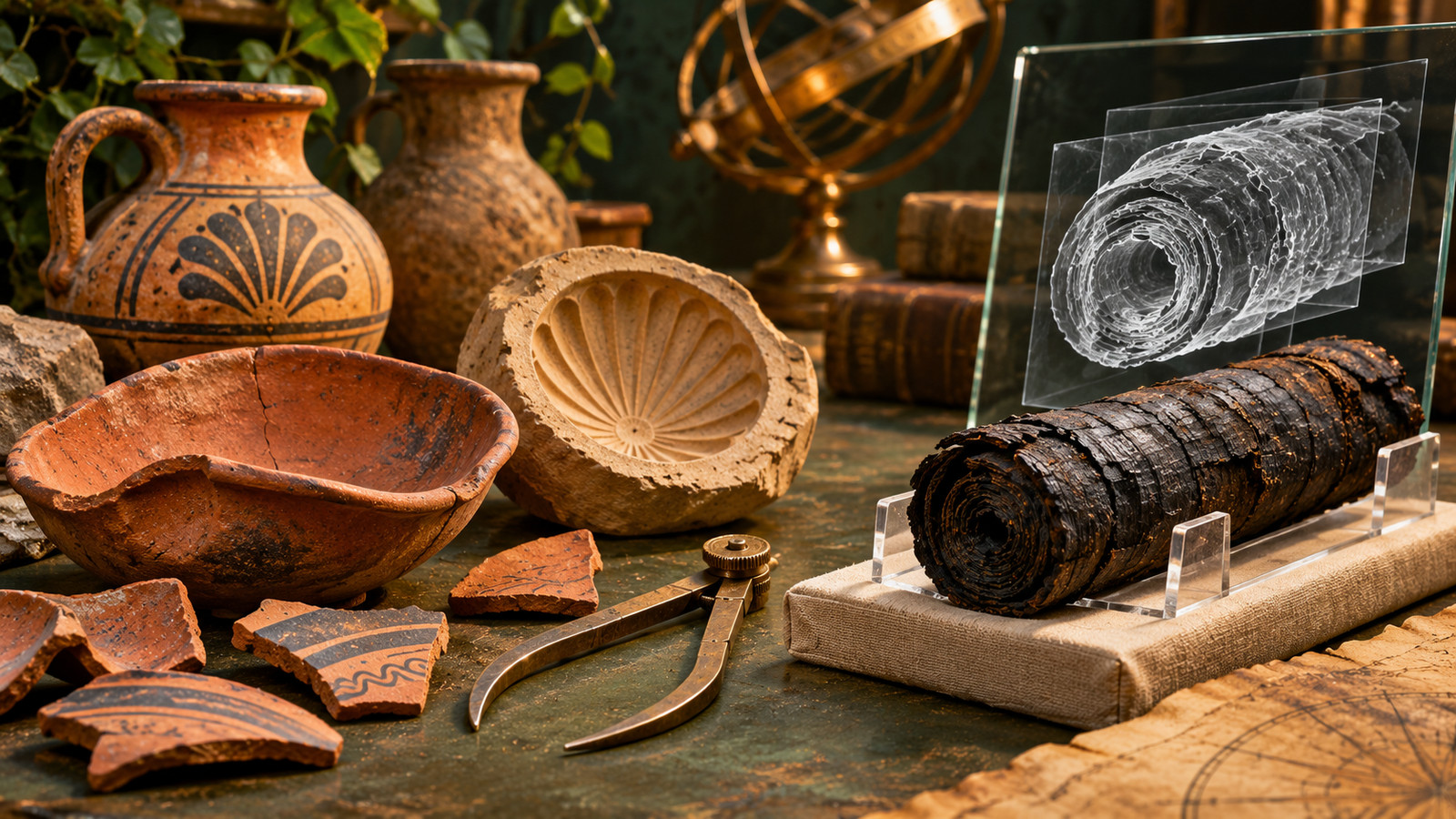
Two fresh deep dives and one field notebook for readers of Luke Halden’s Ancient World Gone Weird series.
An ancient object can look effortless once it reaches a museum display: the polished bowl, the legible inscription, the fragment arranged under a careful spotlight. But the most revealing evidence is sometimes what a craftsperson threw away—or what modern researchers dare not touch. This extra collection explores two kinds of historical detective work that deserve stories of their own. Neither is required to enjoy Ancient WTF?; both offer another way to ask how we know what we think we know.
DEEP DIVE 1 — The Ancient Reject Pile: How Failed Pots Reveal Successful Industries
The objects nobody meant to keep
A flawless ancient pot can tell us what skilled hands achieved. A badly warped pot can tell us what those hands were fighting. That is the peculiar value of manufacturing waste. When archaeologists uncover misshapen vessels, cracked moulds, slumped clay, or objects fused together in a firing, they may have found evidence from a workshop rather than an ordinary household rubbish heap.
The distinction changes the questions. A decorated bowl in a dining room invites us to think about taste, status, eating, and exchange. A distorted bowl among dozens of similar failures asks us about fuel, furnace temperatures, schedules, clay preparation, training, and quality control. It gives the historian a glimpse not of the finished product but of the circumstances of making it.
Archaeologists call some misfired or otherwise unusable products wasters. A waster is not simply a broken antique. It is an object that failed during manufacture or was rejected before normal use. Recognizing one depends on context and physical evidence. A vessel cracked after centuries underground is not automatically a kiln failure. A pot blackened in someone’s cooking fire is not automatically a failed firing. The marks, associated deposits, and condition of surrounding pieces matter.
When the firing goes wrong
Clay work involves several linked transformations. A potter selects and prepares clay, shapes it, dries it, may apply decoration or a surface treatment, and fires the vessel. Each stage can introduce a problem. Too much moisture in a poorly dried wall can cause damage in the kiln. Uneven heating may distort a vessel or leave an unstable surface. Objects placed too close together can stick or even fuse. The result is neither a mystery nor proof that ancient potters were careless. It is evidence that controlling a large, hot chamber was difficult.
A modern visitor can turn a dial on an electric kiln. An ancient craftsperson had to manage fuel, air movement, packing, and the behavior of a changing fire. The same workshop could produce hundreds of successful objects alongside a smaller collection of spectacular failures. Archaeologists cannot reconstruct a complete firing schedule from one cracked pot, but repeated patterns can suggest recurring problems or technical decisions.
One useful clue is a stacking scar: an area shaped by how vessels or kiln furniture touched during firing. Another is a surface that has changed differently on the inside and outside. A group of similar forms, found beside production debris and tools, may be more telling than any isolated defect. Context turns an accident into data.
Corinth: a neighborhood of imperfect evidence
At ancient Corinth in Greece, excavations conducted by the American School of Classical Studies at Athens identified an area known as the Potters’ Quarter. Investigators found moulds, misfired pieces, clay objects, and other material connecting the place with pottery and terracotta production. Much of the evidence belongs to the city’s Archaic period, although occupation and use changed over time.
This matters because finished pottery often travels. A successful vessel can be bought, given, reused, and finally deposited a long way from where it was made. Workshop rejects are less attractive cargo. A concentration of damaged wares and production equipment can therefore help anchor manufacturing to a particular place—provided the excavation record supports that interpretation.
Corinth also illustrates a caution. Archaeologists may recognize a production area without recovering every kiln that supplied it. Building remains can disappear, later construction can disturb earlier layers, and material can be dumped away from the place where it was made. The phrase “pottery workshop” is therefore an interpretation assembled from several kinds of evidence, not always a surviving room labeled with its ancient function.
The American School’s artifact collections retain test pieces, wasters, misfired vases, and figurine moulds from the Potters’ Quarter. They allow researchers to compare shape, clay, decoration, and defects across groups of objects rather than relying on one impressive display piece.
La Graufesenque: the paperwork joined the pottery
A different production story survives at La Graufesenque, near modern Millau in southern France. In the Roman period this area became a major center of fine red-gloss tableware usually called terra sigillata or samian ware. Excavations have documented workshops, kilns, discarded products, stamps, and inscriptions connected with the industry.
The remarkable addition is written evidence made in the workshop itself. Some inscribed pottery records list potters, types of vessels, and numbers. Scholars interpret many as records connected with kiln loads or firings. They are not universal business ledgers for every Roman workshop, and individual inscriptions can be fragmentary or difficult to classify. Still, the combination is extraordinary: production debris sits alongside traces of how production may have been organized and counted.
A stamp on a finished bowl cannot, by itself, tell you how many workers shaped or fired it. Nor does a name prove the named person personally made every stage of an object. A firing list may preserve a sequence of names and quantities without describing the complete labor hierarchy. But when the material record and inscriptions are studied together, an industry emerges in greater detail than the finished bowls alone can provide.
What a rubbish heap can—and cannot—prove
There are several traps in reading workshop waste. First, the waste may represent a short crisis rather than normal production. A single disastrous firing could create an unusually large dump. Second, not every pot found near a kiln was made there; people also brought in objects from elsewhere. Third, a large number of rejects does not automatically establish a high failure rate. Without knowing how much successful production left the workshop, there is no reliable denominator.
A further caution concerns the glamorous word innovation. A new shape, manufacturing shortcut, or surface treatment may be evidence of experimentation. It may also represent local tradition, market preference, or a change in available materials. Archaeologists need dates and comparisons to tell those possibilities apart. A new-looking object is not necessarily the first one ever made.
Despite these limits, a failed object changes our understanding of expertise. Technical skill was not a collection of flawless tricks handed down unchanged. It involved observation, practice, materials, shared tools, interrupted schedules, mistakes, repairs, and judgments about what could still be sold. Ancient craftspeople worked within systems that had to function day after day, not just once for posterity.
Next time a museum label describes a beautifully fired bowl, look for a photograph of the excavation, a broken example, or the production site. The imperfect companion may reveal the most human part of the technology: how hard it was to get the successful version right.
DEEP DIVE 2 — The Library That Could Not Be Opened: Reading Herculaneum’s Scrolls in 2026
Preserved by the same disaster that ruined them
In AD 79, the eruption of Mount Vesuvius buried Herculaneum and its surroundings. Among the objects that survived, in a cruelly altered form, were papyrus scrolls from the building known as the Villa of the Papyri. Heat carbonized the rolls. Their dark, fragile layers became difficult or dangerous to separate, leaving writing physically present but largely inaccessible.
This was a different problem from deciphering an unfamiliar language. Scholars could often identify the general writing tradition and the type of material. The immediate obstacle was more basic: how could anyone see ink trapped between tightly wound, damaged sheets without destroying the very thing they hoped to read?
Earlier attempts to open such scrolls physically had mixed results, sometimes producing fragments and damage. Those efforts are part of the history of the collection, but an unopened roll poses a special preservation challenge. A modern conservator cannot simply peel it apart to satisfy curiosity. The value of its potential contents has to be weighed against the risk of irretrievable loss.
A scan is not the same thing as a page
Modern high-resolution X-ray tomography provides a way to see inside a fragile object without physically opening it. The instrument collects measurements from many angles and uses them to produce a three-dimensional volume. Think of that volume as a dense stack of digital slices showing the internal structure of the scroll.
But a scroll is not a neat cylinder of perfectly separated pages. Layers have flattened, buckled, stuck together, torn, and shifted. A computer that receives thousands of images does not automatically know which crumpled surface once belonged to which part of a sheet. Before a sentence can be read, researchers must identify the papyrus surfaces in the volume and trace how they curve through space.
This stage is called segmentation. After tracing a surface, a program can attempt to flatten or virtually unwrap it into something resembling a page. The word virtual matters: the fragile original remains on its support. What opens is a model of its structure, not the scroll itself. Where sheets overlap or the data are ambiguous, researchers still face significant uncertainty.
Now the problem changes from geometry to visibility. A flattened patch of papyrus is not necessarily a readable one.
Ink that refuses to announce itself
Some ancient inks contain metallic ingredients that can provide helpful contrast in X-ray imaging. Carbon-based ink is more difficult: carbon ink and carbonized papyrus can look frustratingly similar in certain scans. The challenge is not simply increasing the brightness until letters pop out. The relevant differences can be subtle, and image-processing choices can introduce misleading patterns.
Researchers have developed methods using machine learning to detect ink-like signals and relate them to the underlying papyrus surface. One important approach trains a model with images of fragments where writing can already be verified, then tests whether the model can recognize comparable patterns inside unopened sections. Separating geometry from ink detection is crucial: a perfect unwrapping without detectable writing remains blank, and a supposed letter placed on the wrong surface is not a reliable reading.
This is where a careful reader should resist the neat headline “AI reads ancient scroll.” An algorithm can assist with tracing layers and locating potential writing. Experts in papyrology must still examine proposed letters, words, lines, and textual context. The process requires checks for image artifacts and for mistakes caused by damage, gaps, or overenthusiastic pattern recognition.
What changed in June 2026
On 25 June 2026, researchers involved in the Vesuvius Challenge announced a major advance. They reported the virtual unwrapping of the surviving portion of PHerc. 1667, revealing roughly 1.5 meters of text across about twenty columns. The results also described progress with other scrolls and new identification work involving writings by the Epicurean philosopher Philodemus. The European Synchrotron Radiation Facility and University of Kentucky described how high-resolution scans, computation, and scholarly review contributed to those discoveries.
The wording deserves care. “The surviving portion” is not the same as promising that every sheet of the original scroll still exists or that every missing passage can now be supplied. Nor should an announcement about one scroll be transformed into a claim that the entire Herculaneum library has been read. Each object presents its own geometry and preservation problems; a method that works well on one roll may require further refinement for another.
Still, the achievement is extraordinary. A text that could not be opened safely can become available for sustained study. Scholars are no longer limited to isolated snippets when the scan and interpretation support longer passages. That changes the kinds of historical questions they can ask about argument, authorship, reading culture, and intellectual life.
Why the ancient writing still needs human judgment
Consider what happens after a machine suggests a sequence of letters. A specialist must decide whether those marks belong to the papyrus rather than a scanning artifact; whether a character is damaged or simply unusual; how a line continues across a fold; and whether a proposed word fits its linguistic and philosophical setting. The most plausible reading is not always the correct one.
A scholarly edition should make room for uncertainty: missing letters, disputed readings, damaged sections, and alternatives. One passage may be highly secure while the next remains a puzzle. Even after a title or author’s name is identified, there are separate questions about composition, copying, ownership, and how the book reached that particular ancient library.
This also creates an ethical and practical question for museums and researchers. Scanning and digital reconstruction may reduce the need for destructive intervention, but scanning itself still requires handling, support, careful transport, and institutional decisions. “Non-invasive” does not mean cost-free or risk-free. The physical object remains irreplaceable, whatever the quality of its digital counterpart.
A new kind of evidence, not a time machine
The Herculaneum scrolls reveal something that a display of a finished ancient machine cannot: history sometimes survives while its meaning stays hidden. Better contemporary tools can bring an old source into view without changing what ancient people originally wrote. But technology alone cannot turn an uncertain interpretation into a fact.
This is the strongest connection to the spirit of Ancient WTF?. The world was not waiting for modern observers to grant its people intelligence. Their records, tools, and craft traditions already existed. Our understanding changes because evidence is recovered, measured, challenged, and read more carefully. A good discovery does not end the questions; it allows us to ask better ones.
COMPANION — The Ancient Technology Evidence Notebook
One reusable field guide for museum visits, research browsing, and surprising history claims.
When you encounter an astonishing claim about an old invention, use the questions below before deciding how confidently to repeat it. The notebook is intended as a practical reading aid, not an archaeological certification system.
Part A: Identify the evidence
- Name the object or text. Record its museum collection, inventory number, find location, or edition when available. “An ancient machine” is too vague to check.
- Separate observation from reconstruction. What is physically preserved? What has been drawn, modelled, restored, or supplied by a modern specialist?
- Ask how it was dated. Was it found in a secure archaeological layer, dated by associated material, studied through inscriptions, or assigned a broader stylistic date?
- Check the source type. Are you looking at an actual surviving artifact, an ancient writer’s description, a later copy, a modern replica, or a popular retelling?
- Look for context. Was the object excavated in a workshop, home, grave, shipwreck, temple, or secondary rubbish deposit? Could it have moved before burial?
- Record what is absent. Missing parts, uncertain materials, and lost documentation can matter more than a polished reconstruction.
Part B: Test a spectacular explanation
- Find the operating principle. Does the proposed mechanism rely on a demonstrated physical process? Can its moving parts, geometry, or materials be described?
- Distinguish possibility from proof. A working modern replica shows that a design can work under selected conditions; it does not prove that the ancient original was constructed or used exactly that way.
- Check for independent support. Do additional finds, contemporaneous accounts, repair traces, or other lines of evidence support the interpretation?
- Notice the uncertain words. “May,” “perhaps,” “reconstructed,” and “attributed to” can be signs of careful scholarship rather than weakness.
- Watch the date range. A device from a much later period should not be quietly moved into “ancient Egypt” or “classical Greece” to improve a headline.
- Ask who is missing. Technical histories often name rulers or famous writers but obscure makers, miners, transport workers, laborers, and maintainers.
Part C: One-page evidence card
Claim I encountered: ______________________________
Object / site / text: ______________________________
Date and how it was established: ______________________________
Directly surviving evidence: ______________________________
Modern reconstruction or interpretation: ______________________________
What another explanation could be: ______________________________
Best reliable source to consult: ______________________________
What remains unknown: ______________________________
My careful one-sentence description: ______________________________
Part D: Four helpful labels
Documented: a particular feature or fact is directly supported by surviving objects or contemporary evidence. Reconstructed: a modern proposal joins surviving evidence with stated assumptions. Plausible but unconfirmed: the idea is consistent with available information but lacks decisive support. Legend or unsupported claim: the attractive story lacks the evidence required to present it as fact. A single discovery may contain all four categories in different parts of its interpretation.
Sources and next steps
For ancient workshop archaeology, explore the American School of Classical Studies at Athens’ Corinth collections and its published study of the Potters’ Quarter. For Roman production records, see Oxford Academic’s discussion of La Graufesenque inscriptions.
For the Herculaneum scrolls, see the European Synchrotron Radiation Facility’s June 2026 report, the University of Kentucky research overview, and the Vesuvius Challenge’s explanations of virtual unwrapping.
For more of Luke Halden’s nonfiction, visit the author page or the Ancient World Gone Weird series page.
Research note: The June 2026 scroll results are reported as of 13 November 2026. Interpretations and transcriptions may be revised as researchers publish further work.

