Ancient Grunts, Guts & Graveyard Shifts
A complete companion to Ancient Grunts, Guts & Graveyard Shifts by Luke Halden, from Ancient World Gone Weird.
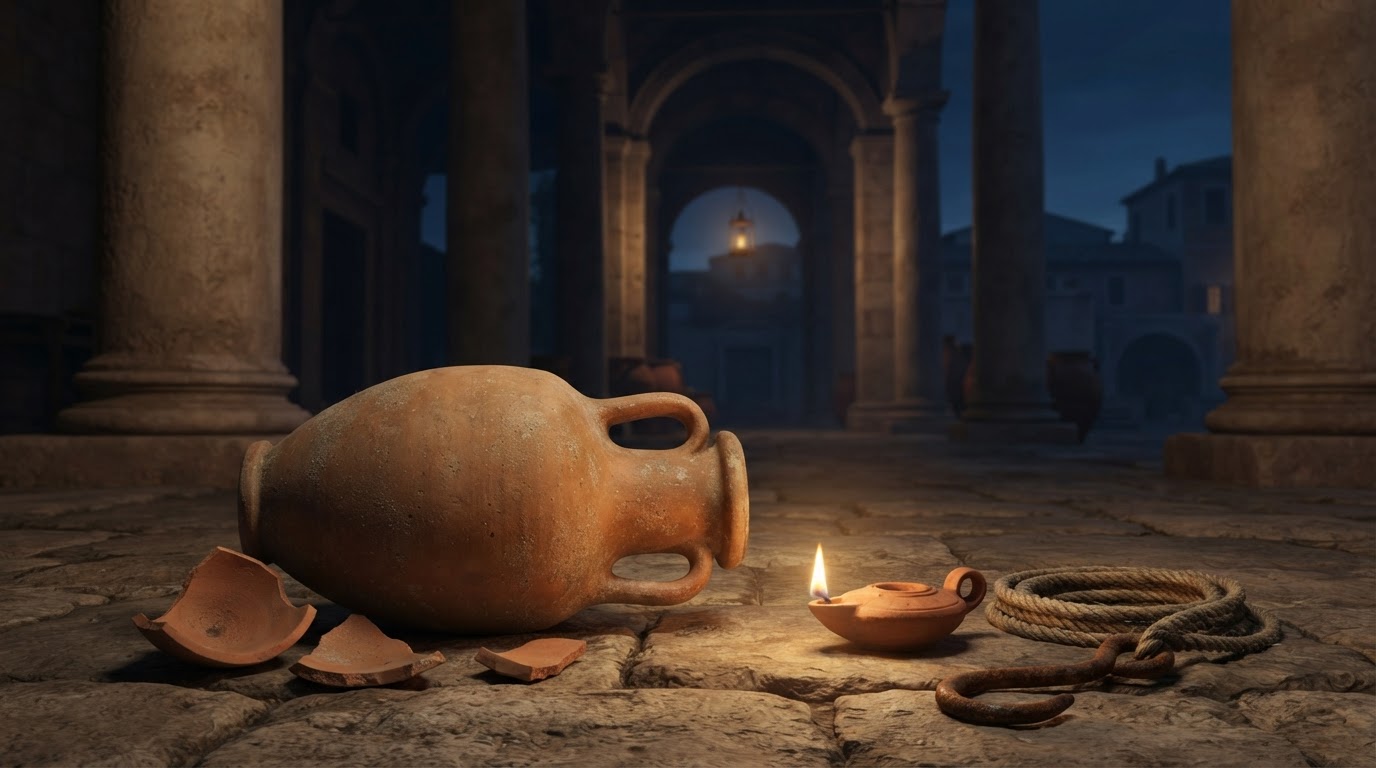
Two additional investigations and a hands-on historical evidence notebook for readers of Luke Halden’s Ancient World Gone Weird series.
Big empires required more than glamorous monuments and celebrated generals. They also required someone to stay awake when the city slept and someone to manufacture the jars that carried its food. These two investigations follow kinds of labor that the main book mentions only at the edges—or does not explore directly. The companion notebook at the end offers a way to test claims about ancient jobs for yourself.
Deep Dive One: Who Watched Rome While Everyone Else Slept?
A city with too many opportunities to catch fire
Imagine a Roman street after sunset. The cooking fire has been banked, but a lamp still burns in an upstairs room. At ground level, a workshop has stored combustible materials beside its tools. Somewhere a cart is rattling over paving stones. An open flame is useful until it finds something it should not. The scene is a reconstruction, not an eyewitness account of one particular night, yet its ingredients explain a practical problem: fire was an ordinary urban risk.
Rome’s crowded housing, shops, stores and continual need for light and heat made prevention an essential occupation. The famous disasters that reach our history books are only part of the story. What about the small blaze discovered before it became a neighborhood disaster? That kind of success seldom earns a monument. It looks like nothing happened—which is precisely the point of a night watch.
The organized Roman watch, the vigiles, gives us an unusual opportunity to examine the human infrastructure of safety. Their history is not a story about a single heroic firefighter. It is a story about repeated rounds, equipment, records, supervision, and sometimes very unpleasant decisions.
What Augustus organized—and what the name means
In AD 6, Augustus organized a corps of vigiles in the capital. According to the surviving evidence assembled by scholars, seven cohorts covered the city’s fourteen administrative regions, with each cohort responsible for two regions. Their commander was the praefectus vigilum, supported by officers and clerks. This was not a modern municipal fire service with identical training and equipment in every station, nor was it simply a group of soldiers sent to watch flames. The corps combined fire prevention and response with aspects of urban security.
The name comes from the Latin idea of keeping awake or watchful. Night patrols therefore mattered as much as dramatic rescues. They needed to notice trouble, raise an alarm, find water and coordinate people before a small fire became too dangerous. They also dealt with disturbances and some theft-related matters. Ancient legal material suggests an official concern with negligent householders, not merely fires already burning.
One legal passage preserved in the Digest describes the prefect of the watch as expected to patrol at night equipped for emergency action. It also discusses warning people to keep water available in upstairs accommodation. That is a striking detail. Prevention depended partly on residents and tenants—not just on the arrival of trained responders. It also demonstrates that a text about an official duty is not proof that every resident obeyed it.
The tools were ordinary; the coordination was not
What did a patrol do when a flame was spotted? Roman fire-fighting equipment included hooks, axes or pick-like tools, ladders, ropes and buckets. Descriptions of the watch also mention pumps and people who managed water supplies. Wet coverings could help smother smaller fires, while pulling down structures might sometimes be considered to prevent spread. Those actions could themselves cause dispute with property holders. Water had to come from somewhere; access, transport and manpower were part of the problem.
There was no radio to call another engine. Sound, runners, patrol contacts and prepared crews made the difference. An alarm might require people to leave guardrooms and cross a city that was less predictable after dark. The science of combustion had not changed, but everything about finding, moving and directing help differed from a contemporary city.
We should be cautious about turning general descriptions into a precise minute-by-minute procedure. The archaeological and textual record does not tell us how every patrol of every century handled a routine alarm. What can be said is that fire prevention required specialized roles, a chain of command, and physical labor: hauling water is rarely the part of emergency history that receives the most attention.
A guardroom in Trastevere left its traces
The Excubitorium of the Seventh Cohort in Rome’s Trastevere district adds a more intimate dimension. The surviving space is associated with a watch station, and its graffiti preserve evidence of the men who occupied it. The city’s tourism authority notes inscriptions referring to cohorts, ranks and sebaciarii, linked with sebum, the tallow used for torches during night patrols. A few scratched words can illuminate the daily realities of staying awake better than a grand statue can.
Think of what these marks do—and do not—tell us. They can attest to titles, identities and institutional presence. They do not reconstruct one man’s entire career, his opinion of his commander, or the exact frequency of the fires he encountered. Graffiti are an extraordinary source precisely because they are fragmentary and personal, not because they answer every question.
The physical room matters too. A watch needed a base for waiting, maintaining equipment, meeting colleagues and receiving instructions. A citywide service was still made of people occupying particular places, not an abstract box labeled ‘public safety’ on a chart.
Ostia: guarding the goods that kept Rome alive
An even clearer workplace survives at Ostia, the port city tied to Rome’s supply system. The Archaeological Park of Ostia describes barracks for the vigiles erected in the late first century AD, with surviving features reflecting later rebuilding in the Hadrianic period. The complex had a courtyard, rooms, wash facilities, a latrine and a shrine. Such features are reminders that even a force charged with emergencies had ordinary institutional routines.
The Ostian watch protected more than homes. Warehouses and their contents mattered because a blaze in a storage district could endanger livelihoods and supplies. Protecting grain, merchandise and infrastructure was a form of keeping the city provisioned. The watch therefore connects surprisingly well with dockworkers, porters and warehouse staff—even though those workers had very different duties.
The site also helps challenge the image of firefighting as a brief moment of spectacular bravery. Much of a watchman’s career probably involved being ready for a fire that did not start, staying in a designated area, and following duties assigned by superiors. The available evidence documents an organized force; it does not allow us to calculate the exact proportion of tedious nights to dangerous ones.
Who joined, and whose labor gets forgotten?
Early cohorts included freedmen, and recruitment patterns changed over time. A freed person was not simply a modern salaried employee with the same rights as every other citizen. Military-style organization and service conditions could create opportunity, obligation and hierarchy simultaneously. Senior officers, clerks, ordinary members and people doing support work did not experience the institution in the same way.
That matters whenever a modern retelling calls the vigiles ‘Rome’s firefighters’ and stops there. The label is helpful, but incomplete. They were part of a state system concerned with order and property, shaped by the legal inequalities of Roman society. Some people depended on their protection while lacking the status or influence of property owners. It would be misleading to assume that every neighborhood received the same attention simply because the city was divided into administrative regions.
The quiet achievement of an uneventful night
In hindsight, ancient Rome can look inevitable: an immense city supplied by roads, ports and aqueducts, operating around impressive monuments. Yet a night of safety had to be produced again and again. A watchman spotted a warning sign. Someone fetched water. A clerk kept track of personnel. A group stood ready in barracks near vulnerable buildings.
If the work succeeded, the record might remain silent. If it failed, a writer could devote pages to the disaster. That imbalance is familiar in the history of many occupations. The vigiles deserve attention not because they were identical to modern firefighters, but because they reveal how vigilance itself became a job—and how easily the routine labor behind security disappears from the story.
Further evidence: Archaeological Park of Ostia, Barracks of the Vigiles; Turismo Roma, Excubitorium of the Seventh Cohort; Ostia Antica research overview; Digest 1.15.3, duties of the watch. These sources document different places and periods and should not be treated as a single eyewitness account.
Deep Dive Two: The Potters Behind Rome’s Oil Jars
Before an amphora was cargo, somebody had to make it
A heavy clay vessel arrives at a Roman port. To a dockworker, it is something awkward to lift. To a merchant, it is merchandise and packaging. To a cook, it may hold the olive oil needed for tomorrow’s meals. But before anyone could transport, tax or consume the contents, a pottery workshop had to produce a reliable container in large numbers.
The main book introduces amphorae as part of Mediterranean transport. This bonus follows an earlier and a later stage: how the vessels were manufactured and marked, and what happened when huge quantities of oil containers were emptied. It is the history of a product’s entire working life, rather than another tour of ships and harbors.
A particularly revealing example is the Roman Dressel 20 amphora, a rounded, two-handled container strongly associated with olive oil from the province of Baetica in what is now southern Spain. Archaeologists recognize its distinctive shape, clay fabric and handle forms. Examples from this family occur over a broad period of the Roman Empire. The jar’s ordinary appearance hides an unusually rich administrative record.
A pottery yard was a manufacturing operation
Making transport vessels began with suitable clay, water and skilled preparation. Potters shaped components, joined parts, attached handles and worked vessels toward a consistent form. Containers then had to dry before firing. They needed kiln space, fuel, attention to heat and a way to sort successful products from broken or flawed ones. Drying, firing, moving and storing bulky ceramics were collective activities, not just a lone craftsperson spinning a wheel.
Research on the Baetican Dressel 20 industry suggests that production centers could contain several sections and work units. A unit might involve clay preparers, potters and assistants, with shared facilities such as kilns and warehouses. These are scholarly reconstructions built from surviving marks and workshop evidence—not a universal organization chart for all Roman potteries. Some centers were probably simpler than others.
That difference is important. A museum display often presents one beautiful intact vessel. An ancient producer needed a whole batch of vessels that could survive handling, firing, filling, storage and transport. A cracked amphora could represent lost labor, raw materials and kiln capacity. Quality control was not an abstract modern obsession; the physics of brittle clay made it practical.
The mark made before the fire
Many Dressel 20 handles carry stamps impressed while the clay was still soft. Their abbreviated names and signs are tempting to read as the autograph of a single individual. But research suggests a more complicated purpose. Some stamps identified people or units within a production organization, helping distinguish batches before firing and storage. The information might point to a manager, owner, production unit or other relationship, depending on context.
Scholars Emilia Mataix Ferrándiz and Juan Moros Díaz describe stamp patterns that can reveal how workshops coordinated production. One proposed model involves several manufacturing units whose sub-batches passed through shared kilns and onward to inspection and storage. This is a supported interpretation of particular evidence, not proof that every Roman amphora followed an identical factory diagram.
Other marks were scratched into soft clay before firing; archaeologists call these graffiti ante cocturam. Their timing matters. A mark made before firing belongs to the container’s manufacturing history. A scratch added much later may describe ownership, contents or use instead. Even when the letters are legible, their function can remain uncertain.
Consider what it means for labor history: the stamp may not give the potter a full biography, but it can expose an organization large enough to require tracking. Somebody needed to know which group had made which containers. That is a very different story from ‘Romans used clay jars.’
Then came the painted information
After firing, a vessel could receive painted inscriptions, known as tituli picti. These might record details about contents, weights, merchants, handlers, checks or dates. Their position and format varied, and not every amphora carried the same information. The collection Roman Inscriptions of Britain warns that paint is fragile; it survives unevenly and can disappear in unsuitable soil or careless cleaning.
Three different kinds of evidence must therefore be distinguished: a stamp impressed into wet clay, a scratch cut into the vessel, and an inscription painted on a fired surface. They can belong to different stages of the object’s journey. Conflating them makes the history sound simpler than the evidence allows.
Suppose archaeologists find a handle stamp but no painted label. They may learn something about production without knowing who shipped the filled jar. Find a painted merchant’s name and they may reconstruct a later business relationship. Find both together, and the possible questions multiply. But even a fully marked vessel does not automatically reveal whether the kiln workers were free, enslaved, paid by task or employed under another arrangement.
An oil jar’s second life: Rome’s mountain of broken pottery
The most dramatic testimony to this industry is not a pristine amphora. It is a hill made largely from broken ones. Monte Testaccio in Rome is an enormous accumulation of amphora fragments, especially olive-oil containers of the Dressel 20 family. Many arrived from Baetica; others came from North Africa. The concentrations and dates are evidence for sustained trade, but they are not a simple annual spreadsheet from which every missing shipment can be calculated.
Rome’s municipal heritage account describes an organized structure to the deposit rather than a random mound. The pieces were arranged in controlled layers and terraces, and lime was used among the fragments. This means that after oil had been consumed, there was still work to do: removing, breaking, moving and depositing bulky containers. The final stage of a supply chain had its own labor and logistics.
Why discard so many? Large oil jars could be difficult to clean and reuse for some purposes after holding fatty contents, while the city received them in huge quantities. That does not mean all amphorae everywhere were disposable or never reused. Containers had different materials, contents and afterlives. Monte Testaccio represents a distinctive place and waste stream.
A hillside of ceramic rubble can look like the opposite of a valuable archive. Yet its fragments contain painted information, stamps, shapes and geological traces. Collectively they help researchers study production centers, commercial networks and changes through time. A handle with an abbreviated mark may preserve a connection between a production group in Spain and a dump in Rome centuries after the people involved have vanished.
Three questions to ask of one fragment
First, when was this mark made? Before firing, after firing, or during a later reuse? Second, which part of the container’s life does it describe—manufacture, content, transport, ownership or disposal? Third, what cannot be recovered? The worker’s daily wages, family status and complete journey are usually beyond a single fragment’s reach.
That last question matters as much as the first two. Ancient industry left material evidence, not perfect employee files. When archaeologists move from a stamp to an account of organized production, they must compare many objects, places and marks. A single name can be suggestive; patterns make it informative.
A Roman amphora was a container, a product, a piece of paperwork and eventually a stubborn piece of rubbish. Following its entire career reveals two sets of laborers often separated in popular history: those who made the vessel, and those who dealt with it after its useful life ended. The jar rarely got a statue. It nevertheless carried an empire’s essentials.
Further evidence: University of Southampton’s Roman Amphorae resource, Dressel 20; Mataix Ferrándiz and Moros Díaz, Journal of Roman Archaeology (2025); Roman Inscriptions of Britain, painted labels; Roma Capitale, Monte Testaccio.
Companion: The Ancient Job Detective’s Field Notebook
The biggest problem in reconstructing an ancient occupation is not always finding a strange object. It is deciding how much that object can genuinely tell us. This notebook is an invitation to study labor history as a detective would: document the clue, test the explanation, and leave unanswered questions unanswered.
Ten questions to ask of an ancient workplace clue
- What survives? Is it a tool, inscription, structure, image, residue, human remains, or a later description?
- Where was it found? A fragment inside a workshop carries different context from the same fragment reused in a wall.
- When does it date from? Is the date established by the object, nearby finds, an inscription, or an interpretation?
- Who made or recorded it? A ruler, a clerk, an ordinary user, a later historian, or an unknown maker?
- What job does it actually demonstrate? Separate the physical evidence from your assumption about a worker’s duties.
- Who controlled the work? Do we know whether the person was free, enslaved, coerced, hired, apprenticed, or attached to a household?
- What does the object leave out? Wages, working hours, health, relationships and disputes can disappear even when a tool survives.
- Could there be another explanation? Storage, repair, ritual reuse and accidental deposition can imitate ordinary workshop patterns.
- What other evidence agrees? Compare archaeology, texts, inscriptions and neighboring sites instead of relying on one dramatic artifact.
- How certain is the claim? Mark it as documented, probable, possible, or unsupported—not simply ‘true’ or ‘false.’
A three-level confidence key
Direct evidence means that the object or inscription itself bears the relevant information, such as an identifiable mark on a particular vessel. Supported interpretation means that researchers infer a wider process by comparing multiple finds and contexts, such as a proposed workshop organization. Open question is a plausible idea for which the surviving material cannot decide among alternatives. Use these labels in your notes; they protect a good story from turning into an invented fact.
Your five-minute artifact worksheet
Object or record: ____________________________
Museum, site, inventory number or source link: ____________________________
Approximate date and place: ____________________________
What I can see or read directly: ____________________________
The worker or task this might concern: ____________________________
Another possible explanation: ____________________________
What evidence would change my mind: ____________________________
My confidence level: Direct / Supported / Open
A source trail for independent exploration
- Ostia’s fire-watch barracks: study how a workplace’s rooms reveal the organized routines behind a public service. Archaeological Park of Ostia.
- A Roman watch station in Rome: ask what names and rank marks in graffiti can establish, and what they cannot. Turismo Roma.
- Oil-jar shapes: compare how pottery forms and fabrics reveal a product’s likely origin and use. Southampton Roman Amphorae project.
- Marks before firing: compare the chronological evidence carried by incised letters or numerals. Roman Inscriptions of Britain, pre-firing graffiti.
- Painted commercial notes: see how much surviving ink can complicate the story of trade and handling. Roman Inscriptions of Britain, painted amphora labels.
- The broken-jar hill: consider what organized rubbish can tell us that a complete museum object cannot. Roma Capitale, Monte Testaccio.
The goal is not to turn every reader into a professional archaeologist. It is to make the next claim about the ancient world more interesting by asking, ‘How do we know?’
Explore more overlooked histories in Ancient World Gone Weird and discover the work of Luke Halden.

