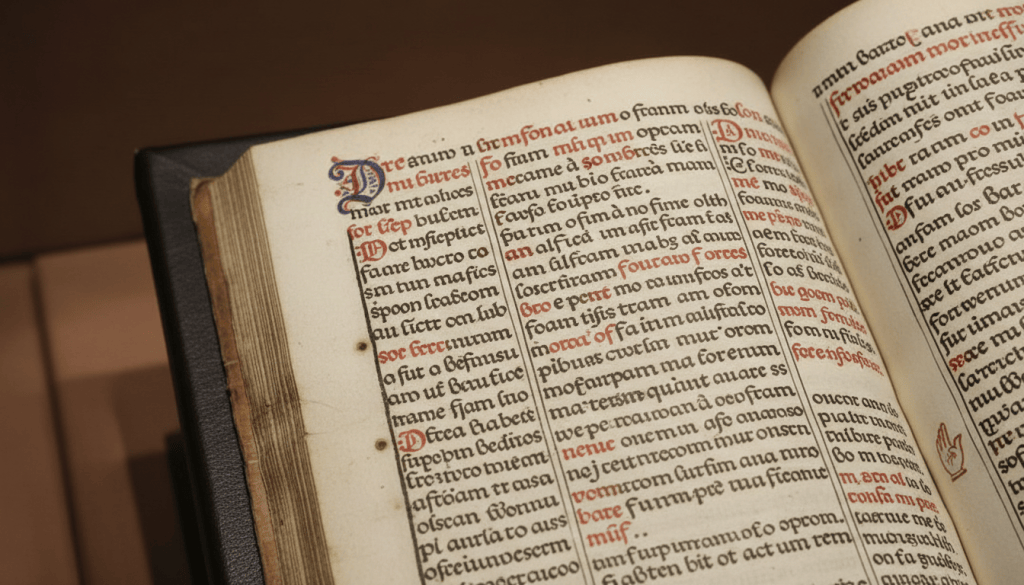
The most revealing words in a medieval book are not always part of its main text. Around the edges of parchment pages, readers and scribes left notes, corrections, tiny symbols and sometimes drawings. These additions are called marginalia. In a medieval manuscript, they may preserve evidence of teaching, interpretation, ownership and the way a text travelled. Yet an annotation is not a secret message simply waiting to be decoded. Understanding it requires attention to handwriting, date, page layout and the manuscript’s history.
What counts as medieval manuscript marginalia?
Marginalia is a broad term for writing or marks outside the main text block. Some notes were planned from the beginning; others were written decades or centuries later. A gloss might explain a difficult word, translate a phrase or offer commentary. An interlinear gloss sits between lines; a marginal gloss occupies surrounding space. Not every marginal mark was meant for later readers. Scribes also made corrections, production notes and reminders to themselves.
Surviving manuscripts show this variety. The Cambridge catalogue record for Pembroke College MS 56 describes a biblical manuscript with marginal and interlinear glosses. Those notes are part of how the book presented and explained its text, rather than incidental doodles.
Glosses made difficult texts usable
Medieval readers often encountered Latin works with specialised vocabulary, dense theological arguments or allusions that required explanation. A gloss could identify a source, clarify a grammar point or suggest how a passage should be understood. In some manuscript traditions, commentary was deliberately copied alongside the main work. In others, notes accumulated through use.
The distinction matters. If a gloss was copied with the text, it may reflect the book’s intended teaching apparatus. If it was added later, it may reveal how a particular reader or institution approached the work. Either can be historically important, but they answer different questions.
Pointing hands, symbols and visual notes
Among the most memorable marginal signs is the manicule, a small drawn pointing hand that directs attention to a passage. The British Library catalogue for Royal MS 6 B VIII specifically identifies pointing hands added during different periods, alongside later notes—an illustration of why marginal marks should not all be assigned to a manuscript’s original scribe. Readers also used marks resembling brackets, crosses, simple signs of emphasis or the word nota. These could help someone return to a useful quotation or a disputed claim. Their forms and meaning varied across times and communities, so a modern viewer should resist treating every symbol as a universal code.
Some medieval books feature elaborate beasts, comic scenes or seemingly unrelated figures in their margins. Such imagery may be decorative, playful, critical or connected to the text in a way that is now difficult to reconstruct. The British Library’s discussion of a fourteenth-century Book of Hours shows how vivid marginal images can survive even when other decorations have been removed.
A margin records layers of reading, not one moment
One manuscript can have several histories on the same page. Its principal text may have been copied in one century; a gloss added by a contemporary teacher; an ownership inscription entered later; and an early modern librarian’s shelfmark placed inside the cover. All are genuine features of the object, but not all are medieval and not all belong to the same person.
Scholars distinguish these layers through palaeography—the study of historical handwriting—alongside ink, layout, language, bindings and comparison with dated examples. The Cambridge University Library description of MS Kk.5.16, for example, identifies additions by different scribes and later owners. Its record shows why an annotation must be described in context rather than assigned to the manuscript’s original maker by default.
Can marginalia reveal who owned a manuscript?
Sometimes, but the evidence needs sorting. An inscription saying that a book belongs to an institution or person may provide a useful provenance clue. A recognisable coat of arms, pasted label or old shelfmark can also help, especially when independent catalogues confirm the association. But the words of a comment do not automatically identify its author. A visitor, student, copyist or borrower might have written in the same volume.
This is why provenance research combines handwriting with records about acquisition, donation and the movement of collections. Even an ownership note may describe one stage of a book’s life, not the entire chain. For a broader introduction to handwritten marks in books of different periods, see our article What Is Marginalia?.
What the margins can tell us about learning
Glosses, corrections and highlighting marks can reveal how a text was used in instruction or study. A reader who repeatedly explained vocabulary may have been learning an unfamiliar language; someone adding cross-references may have been comparing authorities. Yet these are interpretations, not automatic facts. Several people could have used a single classroom manuscript, and annotations copied from another exemplar may not express the local reader’s personal views.
The location of a note matters too. A short word squeezed above a line may serve a different purpose from a carefully spaced commentary column planned when the page was ruled. Looking at the whole opening—the position of headings, initials, glosses and changes of script—is more informative than isolating a picturesque mark.
What marginalia cannot safely prove
A dramatic note is tempting evidence, particularly in a story. In real research, it is essential to ask what alternative explanations exist. An apparent deletion could be normal correction. A gap at the edge might result from rebinding or trimming. A faded name might be impossible to read reliably. Even a striking symbol may have been copied as decoration rather than used as a private signal.
The safest approach is cumulative: compare hands, inspect physical layers, consult other copies and record uncertainty honestly. A single mark can open a question; the surrounding evidence determines whether it can answer one.
How digital imaging helps researchers read the margins
Today, high-resolution photography and specialised imaging can reveal details difficult to see in an ordinary reproduction. Conservators and imaging teams still have to consider the condition of the object, while scholars must distinguish an enhanced visual trace from proof of the writer’s identity or intention. The Bodleian Libraries describe discoveries of drypoint annotations scratched into parchment without ink. Such marks show that not every note is obvious under normal lighting.
If you’re studying a digitised page, begin with the library’s catalogue description. Note the shelfmark and folio number, then compare the full page with any close-up. Look for differences in handwriting, ink and spacing. Finally, check whether curators have already dated or identified the annotations. The most useful question is often not “What secret does this symbol hide?” but “When and why was it put here?”
Why manuscript notes belong in historical mysteries
Marginalia offers mystery writers an unusually fair clue system: readers can be shown a physical detail before its importance becomes clear. But the strongest fictional puzzles respect the same caution scholars use—one mark rarely establishes a conclusion alone. In Vivienne Hartmoor’s The Key in the Hartmoor Folio, Rose Vale examines evidence surrounding a disputed manuscript at the fictional Hartmoor Abbey. The novel draws its tension from conflicting accounts of what documents and books can prove, without requiring every annotation to be a cipher.
Readers interested in literary investigations can explore the Locked Library Mysteries series and Vivienne Hartmoor’s author page.
Related reading: For a practical introduction to inscriptions, notes, and handwritten clues, read What Is Marginalia?.

